Fried Food and Cooking Oil in Bangkok: Where the Fat Actually Comes From
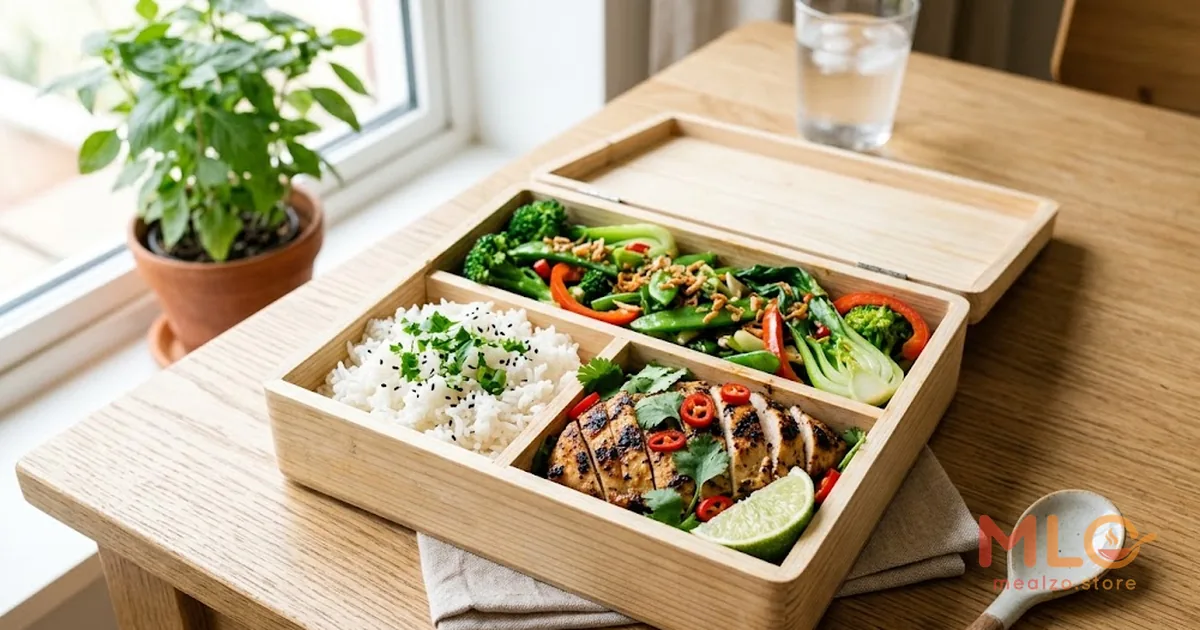
Mealzo Bangkok works in a city where a lot of everyday food passes through a wok, a fryer or a pan before it reaches the plate. That does not make the food a problem. It does mean that cooking fat is often harder to see than the other things people try to keep track of.
Salt announces itself. Sugar is usually obvious once you know where to look. Oil is different. It slips into sauce, coats noodles, soaks into rice and disappears inside a crisp coating. By the time you are eating, much of it no longer looks like oil at all.
Fat is also a normal part of cooking. It carries flavour, helps aromatics spread through a dish, changes texture and makes food satisfying. The useful question is not how to remove it from Bangkok food. The useful question is where it actually comes from, where it ends up and which parts of the meal you can realistically change.
If you eat at stalls, food courts and casual restaurants most days, there are a few places where your choices genuinely matter. There are also situations where the decision was made in the kitchen hours before you arrived.
1. Why fat is the hardest of the three to notice
This article follows two other everyday Bangkok problems: salt and sugary drinks. Salt can be hidden in sauces, but you still taste saltiness. Sugar can arrive in coffee, tea or sauce, but sweetness usually gives you a clue. Cooking fat is quieter.
A plate of rice with stir-fried meat can look almost dry from above while a layer of oil and sauce sits underneath. Noodles can absorb enough cooking fat to feel rich without leaving an obvious pool on the plate. Fried food can look crisp rather than oily even though the coating has taken up fat during cooking.
Fat is also the most energy-dense part of the plate. That does not make it something to fear or eliminate. It simply means that a generous pour in a wok can change the meal more than its appearance suggests.
This is why tracking Bangkok food by visual portion size alone can be misleading. Two dishes with similar amounts of meat, vegetables and rice can feel completely different after lunch because one was cooked with a light film of oil and the other carried a generous sauce through the rice.
For the earlier part of this trio, see where salt hides in everyday Thai food.
Key takeaway: Oil is difficult to judge because much of it stops looking like oil before the plate reaches you.
2. What the oil in a wok is actually doing
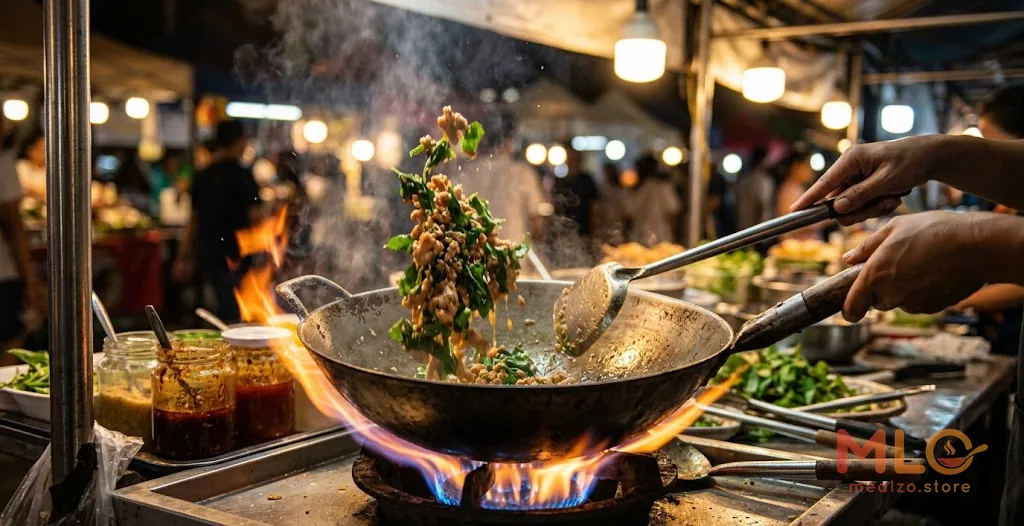
A Thai stir-fry is fast cooking. The wok gets hot, ingredients move quickly and the cook needs a medium that transfers heat across irregular pieces of meat, vegetables, garlic, chilli and herbs.
That medium is usually oil.
Oil carries heat from the metal into the food. It also picks up aromatic compounds from garlic, chilli, basil and other ingredients and distributes them through the dish. When you taste a spoonful of pad kra pao and the chilli, garlic and basil seem to coat everything, cooking fat is part of the reason.
A pour that looks generous from the customer side of the counter is therefore not automatically carelessness. It can be part of the technique required to cook a dish quickly over high heat.
The important part for the person eating is what happens after the frying stage. Oil mixes with seasoning, meat juices and sauce. Some stays on the ingredients. Some remains loose at the bottom of the wok. When the cook tips everything onto rice, that liquid follows.
This explains an observation familiar to anyone who eats stir-fries regularly: the last few spoonfuls can be the richest part of the plate. You are no longer eating mostly meat, vegetables and rice. You are eating the liquid that collected underneath them.
That is where a small behaviour change can matter. You do not need to scrape the plate clean simply because the sauce tastes good.
3. Where the oil ends up, and why rice is the sponge
Oil does not remain in one neat place.
Some coats the meat or vegetables. Some stays emulsified or mixed into the sauce. Some collects in a visible pool. The rest is absorbed by whatever is best at absorbing liquid.
Very often, that is the rice.
Rice under a saucy stir-fry behaves like a sponge. The first bites may be relatively plain. As you move downward, the grains have been sitting in sauce and cooking fat. By the end, the rice underneath the dish may carry more of the wok liquid than the food that was placed on top.
Noodles do something similar because sauce clings across a large surface area and works between strands.
This makes the serving arrangement surprisingly important. The same stir-fry eaten with rice beside it is not quite the same eating experience as the same stir-fry poured directly over the rice. With the rice beside the dish, you decide how much sauce crosses over. With the rice underneath, the transfer happens before you make a choice.
If you can request sauce separately, do it when the dish allows it. If not, simply eating the rice alongside the main dish instead of deliberately dragging every spoonful through the bottom of the plate gives you more control.
Draining also works better than simply making the entire portion smaller. Lifting solid food from a rich sauce leaves some of the cooking liquid behind. Eating half of everything, including half of the sauce-soaked rice, preserves roughly the same structure of the meal.
4. Deep frying is not one thing: coating, size and heat
Deep-fried food varies enormously because the food, coating and frying conditions all change how oil interacts with the surface.
A battered or floured coating has spaces that can hold cooking fat. The rougher and more porous the crust, the more places oil has to settle. That is why a thick, craggy piece of fried chicken behaves differently from a plain piece of meat placed directly into hot oil.
Size matters too. Small pieces have more surface relative to the amount of food inside. More exposed surface means more fried exterior.
Temperature matters in a practical way as well. When frying conditions are right, the outside cooks quickly and develops structure. When the oil is not hot enough for the food being cooked, the coating can spend longer absorbing oil before it firms up. That is one reason one batch of fried chicken can feel crisp and relatively clean while another feels heavy and greasy.
There is no single answer to "how oily is fried food?" The answer depends on what was fried and how it was fried.
| Cooking method | What happens to the fat | What to do at the table |
|---|---|---|
| Deep fried in batter | Fat can settle through a porous coating with a large fried surface | Eat it fresh, let loose oil drain and avoid soaking the crust in extra sauce |
| Deep fried plain | The exterior contacts the frying oil directly but has less absorbent coating | Drain before eating and pair it with non-fried sides |
| Stir fried | Oil coats ingredients and mixes into the sauce | Leave some of the oily sauce behind |
| Grilled | Fat may come from the food itself, marinade or brushing during cooking | Eat it as served and choose lighter sides if another part of the meal is rich |
| Steamed | Little cooking fat is needed for the cooking method itself | Pay attention to sauces and toppings added afterward |
| Boiled in a clear broth | The broth carries flavour without requiring a fried exterior | Choose garnishes deliberately rather than automatically adding fried toppings |
Key takeaway: The coating and surface area can matter as much as the fact that something was fried.
5. The oils and fats a Bangkok kitchen actually uses
Bangkok kitchens do not rely on one universal cooking oil.
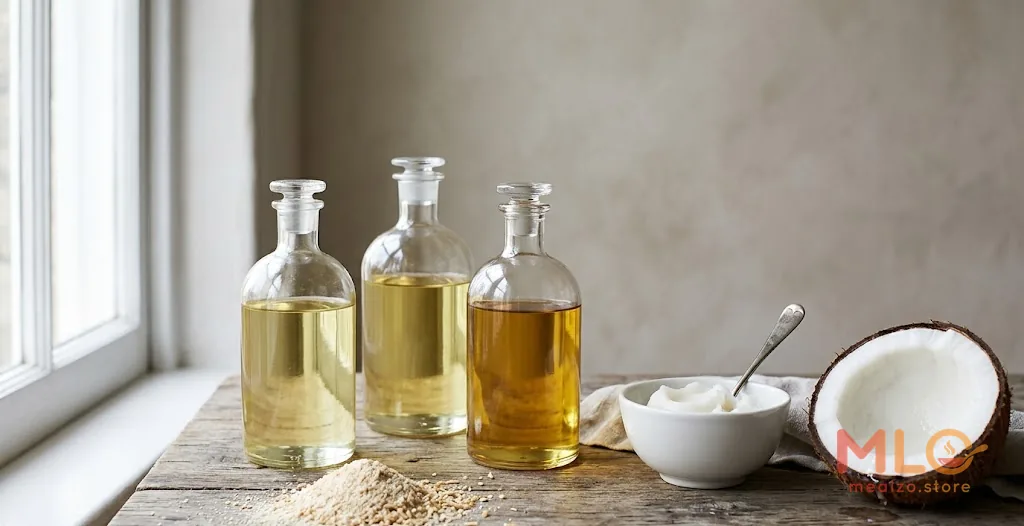
Palm oil and soybean oil are everyday workhorses. They are practical for busy kitchens and can be used across a broad range of dishes. Rice bran oil is also used. Coconut oil appears in some cooking, although coconut flavour in Thai food often comes from coconut milk rather than from frying everything in coconut oil.
Lard remains part of real kitchen practice as well. That matters especially to anyone avoiding pork. A dish does not need to contain a visible piece of pork for pork fat to have been used during preparation.
The practical lesson is not to build a moral ranking of cooking oils. For an ordinary lunch, the amount used and where it ends up can matter more to your experience of the meal than trying to identify the exact bottle used in the kitchen.
A moderate amount of one cooking fat can produce a less oily plate than a very generous amount of another. Technique, quantity and the rest of the dish still matter.
If avoiding pork is important to you, ask specifically whether lard or pork fat is used. Do not assume a vegetable dish automatically means vegetable oil was used.
6. Oil that has had a long day, and how to read it
A busy fryer is not filled with new oil for every order. It handles batches throughout the day. That is normal commercial cooking.
As frying oil goes through repeated batches, its appearance and behaviour change. It can become darker. The smell becomes stronger. You may see more foaming. Food coming from it can sometimes feel greasier because the surface takes up oil differently.
You do not need laboratory knowledge to make a practical decision. Use your senses.
Look at the fryer if it is visible. Notice whether the oil looks unusually dark or heavily foamed. When the food arrives, notice whether the coating is crisp and clean-tasting or whether it feels saturated and carries a strong old-oil flavour.
This is not a diagnosis of the food and it is not a claim that darker oil causes a particular illness. It is simply information about what you are about to eat.
If the fried food looks heavy before you order, choose something else from the stall. If it arrives and tastes oilier than you enjoy, you do not have to finish the coating just because you bought the portion.
7. Saturated and unsaturated, said plainly and once
Different fats contain different mixtures of fatty acids. For everyday eating, the useful distinction is that some cooking fats and ingredients are higher in saturated fat while others contain a larger proportion of unsaturated fat.
Coconut milk, lard and palm oil are examples of fats or fat-containing ingredients that are higher in saturated fat. Most dietary guidance suggests keeping saturated fat moderate rather than trying to eliminate it completely.
That is the distinction. It does not need to become a search for one perfect oil.
A creamy curry can still fit into an ordinary week. So can something cooked with lard or palm oil. What changes the meal is how much fat is present, how often similar dishes appear and what else is eaten around them.
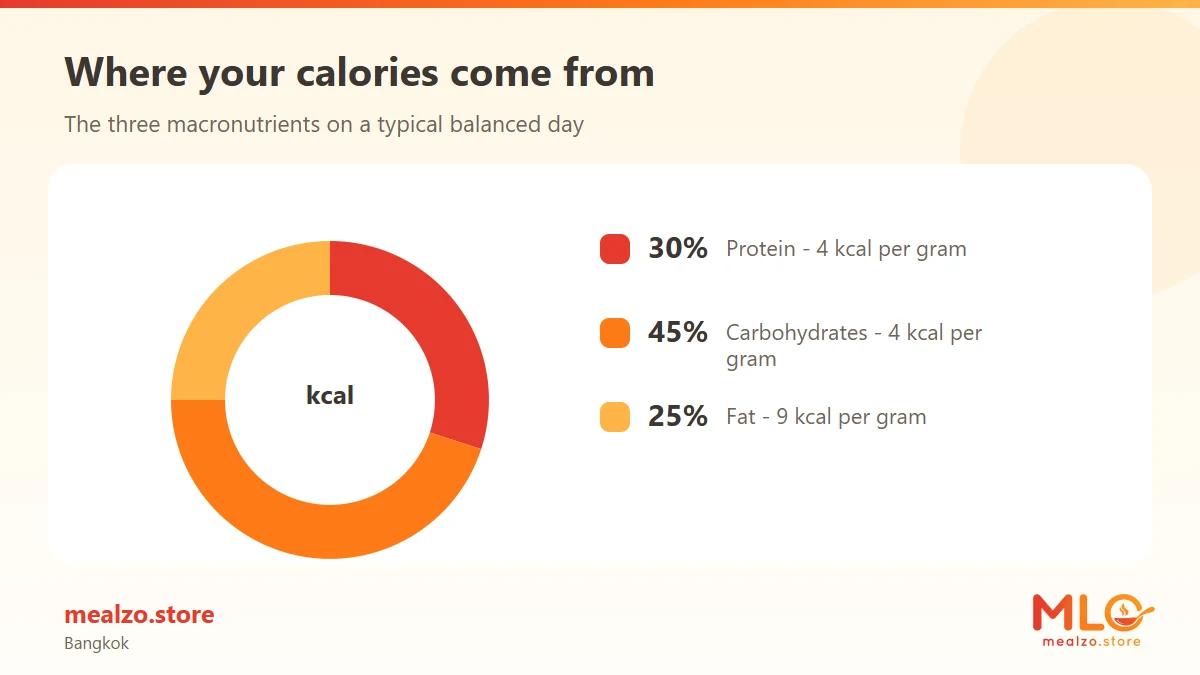
For a broader explanation of how dietary fat fits beside protein and carbohydrate, read the basic roles of protein, carbohydrate and fat.
If you have a medical reason to restrict fat, follow your own doctor's advice rather than using a general food article as a substitute.
8. Where fat hides when nothing was fried
The fryer gets attention because it is visible. Plenty of cooking fat enters Bangkok meals without anything being deep fried.
Look at a creamy curry. Coconut milk contributes much of its richness. A red curry may also show a visible oil layer floating at the top. That shine is part of the dish, not an accidental spill.
Then there are toppings and extras. Crispy pork adds both meat and rendered fat. Crispy shallots can turn a relatively simple dish into something richer. Peanuts contribute fat even though they do not look oily. Mayonnaise can appear in salads and sandwiches.
Drinks can carry fat too. Evaporated milk and condensed milk change more than sweetness in an iced drink.
And then there is the fried egg. In Bangkok, a rice dish can become a rice dish plus a fried egg almost by reflex. It tastes good, but it is still an additional fried component.
| Dish | Where the fat sits | Can the counter change it? | One adjustment that works |
|---|---|---|---|
| Pad kra pao with a fried egg | Stir-fry oil, sauce and the fried egg | Usually, if cooked to order | Ask for less oil or skip the fried egg |
| Kai tod | In and around the fried exterior | Usually not after frying | Choose a fresh piece and let excess oil drain |
| Moo krob | In the pork itself and the crisp exterior | Not meaningfully after cooking | Keep the portion deliberate and pair it with non-fried food |
| Pad thai | Across the noodles, egg and cooking sauce | Sometimes, when cooked to order | Ask for less oil and avoid collecting the oily remainder |
| Green curry with coconut milk | Throughout the coconut milk based curry | Usually limited | Take the solids you want without using every spoonful of curry over rice |
| Kluay tod | In the fried coating | Not after it is fried | Eat it fresh when you actually want it rather than as an automatic extra |
| Khao man gai | In the seasoned rice and chicken components | Usually limited once prepared | Keep extra sauces controlled and add clear soup rather than fried sides |
| Gai yang | In the chicken, skin and marinade rather than a fried coating | Limited after grilling | Pair it with rice, vegetables or clear soup instead of another fried dish |
| Tom yum nam sai | Mostly in added ingredients rather than the clear broth itself | Often little adjustment is needed | Keep fried toppings or rich sides separate |
9. Ordering at a stall, and what each request really achieves
At a made-to-order stall, you have more leverage than you may think, but each request has limits.
- Less oil: useful for a stir-fry being cooked for you. It asks the cook to reduce the amount going into the wok.
- No added oil: possible for some preparations, unrealistic for others. A dish built around wok frying may not cook or taste the same without it.
- Sauce on the side: useful when the sauce is added after cooking or served separately. It gives you control over how much reaches the rice.
- Skip the fried egg: simple and effective when the egg is an automatic add-on rather than the reason you ordered the dish.
- Choose another item: the only meaningful option when the food was deep fried earlier and is already sitting in a tray.
Nothing you say at the counter can pull oil back out of fried chicken that was cooked that morning.
Rice gives you another lever that costs nothing. When possible, keep the rice beside the saucy food rather than underneath it. Move food onto the rice as you eat instead of letting the entire serving soak from the beginning.
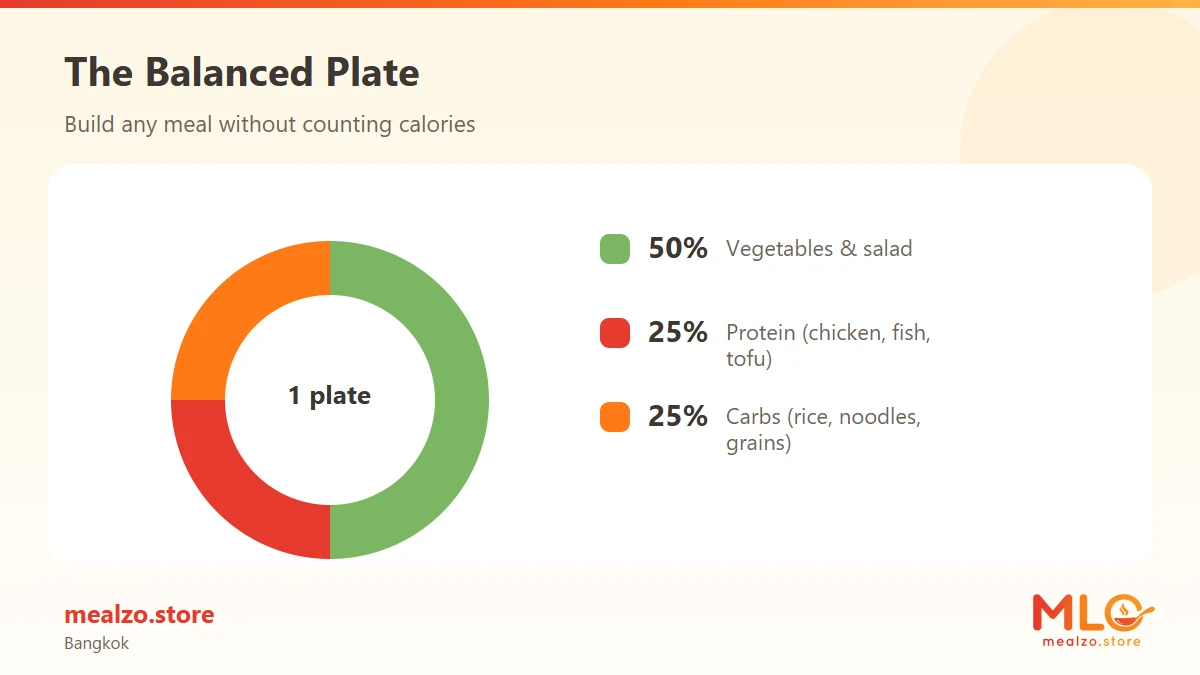
This also makes portioning easier. You can see the rice, the main dish and any vegetables as separate parts rather than one sauce-soaked mass. The same idea appears in practical ways to handle Thai dishes, sauces and portions and managing portions, sauces and snacks in Thai food.
Draining beats dipping. Lift meat or vegetables from the sauce, pause for a moment and let the excess fall back into the bowl. You still get the flavour carried by the sauce without turning the remaining rice into a reservoir for it.
Key takeaway: Keeping rice beside a saucy dish gives you control that disappears once the sauce has already soaked through it.
10. The food court, where the cooking is already done
Food courts change the problem because much of the food is already prepared.
At a made-to-order wok station, "less oil" can affect what happens next. At a curry counter with trays of finished food, the oil was chosen before you arrived. Asking the server to change the recipe is not realistic.
Your leverage moves from modifying the dish to choosing the counter and choosing what goes on the plate.
Before ordering, look at what is in front of you. Is there a pool of oil around the food? Does the sauce have a heavy slick on top? Is the rice already glossy from a sauce being ladled across it? Is most of what looks like garnish actually crispy fried pieces?
None of those observations means you cannot order the dish. They simply tell you what you are choosing.
If you want a fried item, take the fried item and make the rest of the plate simpler. If the curry is the part you want, choose it and skip the fried egg. If a tray looks much richer than you expected, another counter may have grilled chicken, clear soup or a cooked-to-order dish.
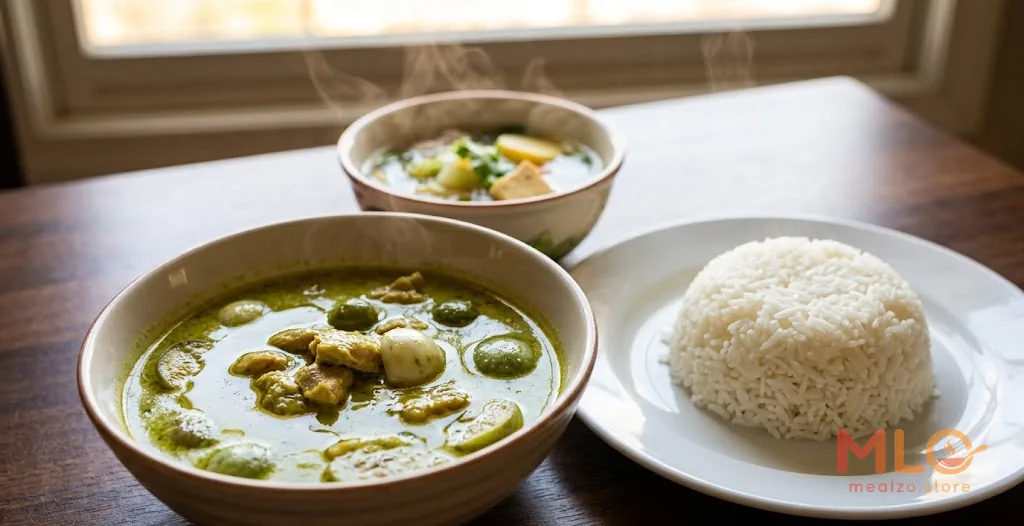
The food court advantage is variety. You may have less control over a particular tray, but you have more alternatives within a short walk.
11. Grilled, steamed and boiled dishes worth ordering on purpose
Non-fried food should not be treated as punishment for wanting fried food less often.
Gai yang is worth ordering because grilled chicken is good in its own right. Tom yum nam sai is a proper dish, not a reduced version of something better. Steamed fish, steamed eggs, clear soups, grilled meat and boiled dishes all have textures and flavours that stand on their own.
The useful approach is choice rather than prohibition.
One practical frame is one fried thing in a day when you genuinely want it. That is not a rule everyone needs to follow. It is simply a way to stop fried components from stacking without noticing.
A week can then contain fried chicken, crispy pork or fried banana because those were deliberate choices. On other meals, the cooking method happens to be grilled, steamed, boiled or stir-fried with a controlled amount of oil.
When you really want fried food, eat the version you actually want. Get it hot and fresh. Crisp food starts losing its best quality quickly. A coating that was excellent beside the fryer can become soft and oily after sitting in a box.
Then build the rest of the meal around it. Fried chicken does not require fried rice, a fried egg and another fried side. One good fried component can be enough.
Fat also contributes to fullness and satisfaction. A richer meal can feel substantial. The trade-off is that a heavy fried lunch in Bangkok's heat can also leave the afternoon feeling flat and slow. That is not a medical diagnosis. It is a familiar eating pattern worth noticing in your own day.
12. Why a delivered meal plan is rarely deep fried, and what that costs you
Deep frying has a basic delivery problem: crunch does not travel well.
A crisp coating begins changing after it leaves the fryer. Steam moves through it, condensation develops inside the container and reheating rarely recreates exactly what the first few minutes after frying provided.
That is why food designed to be delivered and reheated tends to lean more heavily on grilling, baking, steaming and stir-frying with a measured amount of cooking oil.
There is a trade-off. You lose some crunch.
A meal plan should not pretend otherwise. Deep-fried food eaten immediately can offer a texture that delivered food cannot reliably preserve. The reason to use other cooking methods is not that frying is forbidden. It is that those methods survive the journey and reheating process more predictably.
With a Mealzo Bangkok plan, the cooking fat is decided in the kitchen and portioned with the rest of the meal. The calorie level is selected up front across six levels from 1200 to 2500 kcal, which turns the amount of cooking oil into part of the meal setting rather than an unknown pour at the counter.
That does not mean the plan removes fat. It should not. Fat remains part of cooking and part of the meal. It also does not prevent anyone from adding oil, ordering a fried side or eating something else outside the plan.
Mealzo Bangkok uses one mixed cuisine, with Thai and international dishes in the same plan. Thai dishes therefore remain in the rotation rather than being separated into a different cuisine option.
There are 12 meal plans: Balanced, Weight Loss, High Protein, Vegetarian, Vegan, Keto, Low-Carb, Gluten Free, Easy-to-Digest, Pescatarian, No Fish & Seafood, and Dairy & Egg Free. Customers select three or five meals per day and packages of three, seven, fourteen or thirty days.
Meals are cooked fresh daily in Bang Na, Bangkok and delivered across Bangkok. Customers choose either the morning delivery window from 06:00 to 09:00 or the evening window from 17:00 to 20:00.
The website and mobile app operate in Thai, English, Polish, German, French, Russian, Simplified Chinese and Burmese. The app also includes a calorie calculator using the Mifflin-St Jeor formula. It provides an estimate, not medical advice.
For allergen handling, customers declare from nine allergen groups. Dishes containing a declared allergen are then not assigned to that customer. This describes the assignment mechanism and should not be read as a guarantee of an allergen-free meal.
You can see the available options under Mealzo Bangkok meal plans.
The practical difference is predictability. A street-food lunch leaves the amount of oil largely in the hands of the cook and the dish. A planned meal sets the cooking method, portion and calorie level before you start eating. Neither approach prevents you from enjoying fried food when you actually want it.
FAQ
Can I ask a Bangkok street-food cook to use less oil?
Yes, when the dish is cooked to order and reducing the oil still allows the cook to prepare it properly. Stir-fries are the obvious example. The request has much less value for food that was deep fried earlier or is already sitting in a prepared tray.
Is palm oil the main problem in fried Bangkok food?
It is more useful to look at quantity and cooking method than to treat one oil as the problem. Palm oil and soybean oil are common everyday cooking fats, while rice bran oil, coconut oil and lard also appear in Bangkok kitchens. A generous amount of any cooking fat changes a plate more than the name of the oil alone tells you.
What is the easiest way to reduce how much oily sauce I eat?
Keep rice beside the main dish rather than underneath it when possible. Lift food from the sauce and let it drain briefly before moving it to the rice. This leaves some of the cooking liquid in the serving dish instead of allowing the rice to absorb everything automatically.
Is grilled food always lower in fat than fried food?
The cooking method changes where the fat comes from, but the finished dish still depends on the ingredient, marinade, skin, sauce and toppings. Grilling avoids a deep-fried coating, but that does not make every grilled dish automatically light. Read the whole plate rather than relying on one cooking label.
Should I stop eating fried food if I eat out in Bangkok every day?
That is not the point. Fried food can remain something you choose because you want the texture and flavour. The practical change is to stop letting several fried components accumulate by default. When you want fried chicken, crispy pork or fried banana, eat it fresh and build the rest of the meal around that choice.
Mealzo Bangkok is a kitchen and meal delivery service operating exclusively in Bangkok, Thailand. We are not affiliated with similarly named services outside Thailand.
Find a Meal Plan That Fits
Compare Mealzo plans or use the calculator to explore meal options for your needs.