Rice in Bangkok: Jasmine, Sticky and Brown, and How Much Belongs on Your Plate
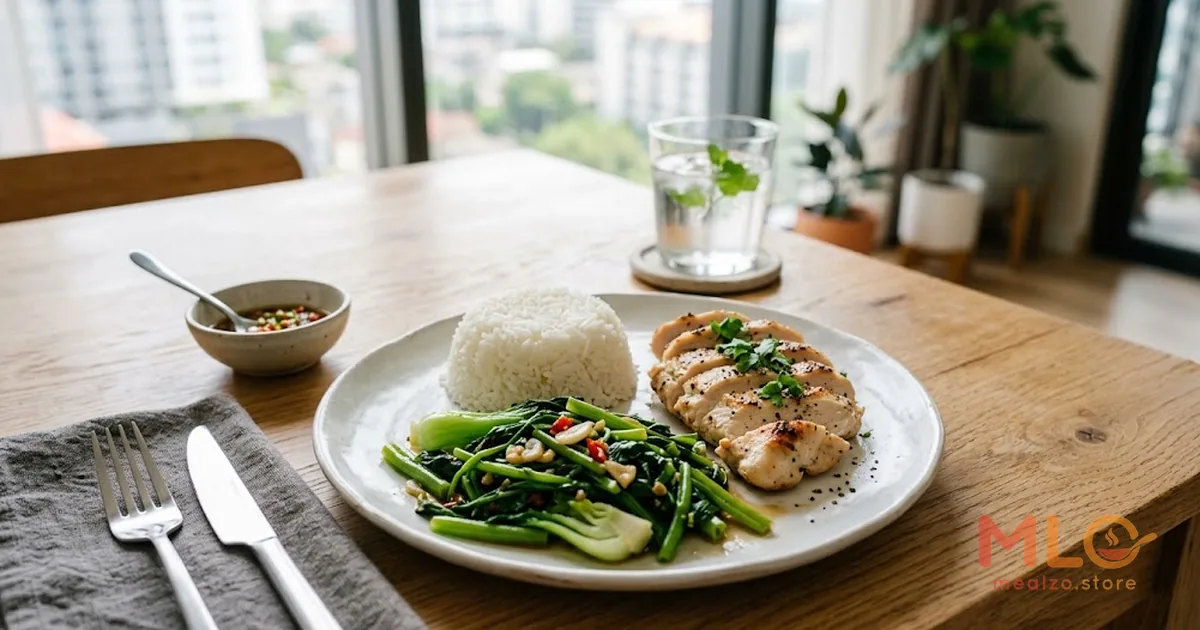
Rice appears so automatically in Bangkok meals that it is easy to stop seeing it as a portion at all. It arrives under curry, beside grilled meat, packed into a takeaway box, rolled into sticky balls, or stirred directly into a one-dish meal.
Mealzo Bangkok treats rice neither as a problem nor as something that can be ignored. For people who eat it most days, the useful question is simpler: how much rice fits the rest of this particular meal?
That matters because rice is often the largest and most adjustable carbohydrate source on the plate. Change the amount slightly and the whole meal changes. The difficulty is that the person eating often does not make that decision. Someone else scoops the rice first.
This guide is about practical rice portions Bangkok residents can use in food courts, office canteens, street stalls and at home, without weighing food or turning lunch into an accounting exercise.
1. Why rice is the most adjustable part of a Bangkok meal
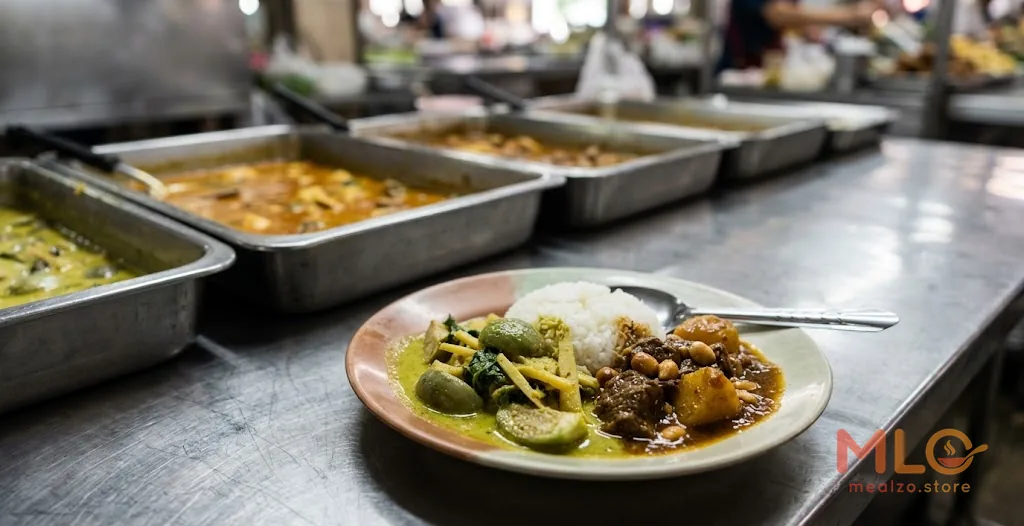
In many Bangkok meals, rice is the default rather than an extra decision. You order a curry, stir-fry or grilled dish, and rice simply appears with it. At a rice-and-curry stall, known as khao gaeng, the rice may be on the plate before you have finished choosing the toppings. At home or in some informal settings, another spoonful may appear because the plate looks empty.
That makes rice unusual. You may consciously choose chicken, fish, tofu, vegetables or curry, but the amount of rice can be determined by the person holding the scoop.
The problem is not rice itself. The problem is that an automatic serving can become disconnected from everything else on the plate.
A meal with a large serving of vegetables and a substantial protein portion can accommodate rice differently from a plate where the main dish is mostly sauce. A physically active afternoon may feel different from a quiet day at a desk. A person following a low-carb plan has different trade-offs from someone fuelling regular training.
The practical fix is therefore not "stop eating rice." It is to bring the rice portion back into the decision.
Key takeaway: Rice is useful to adjust because it is often the largest flexible part of the meal, not because it is something you need to remove.
One simple change is to notice the rice before eating. Is it filling half the container? Is it piled higher than the protein and vegetables combined? Was it scooped before you chose anything else? Once you see the serving as a choice, it becomes much easier to change.
2. The rice words worth knowing before you order
A few Thai food words make a surprisingly large difference because "rice" does not always mean the same thing.
Khao suay is steamed rice, usually the familiar fragrant jasmine rice served beside or underneath dishes.
Khao niao is sticky rice. It is commonly eaten with grilled meat, northeastern Thai dishes and som tam. It is usually handled in small pieces or balls rather than spread across a plate.
Khao kluk broadly refers to rice mixed with other ingredients or seasoning. Fried rice dishes also belong to a different practical category from plain steamed rice because the rice is cooked together with oil, sauce and other ingredients.
Khao tom is rice soup, with rice suspended in broth.
Jok is rice porridge, softer and more broken down, with rice carried through a larger volume of liquid.
Then there are dishes where rice is already built into the meal. A plate of curry poured over rice is not portioned in the same way as a bowl of curry served beside a separate bowl of rice. The food may sound identical when described casually, but the serving structure is different.
| Rice type or format | How it is usually served | What makes the portion easy to misjudge | Adjustment that helps most |
|---|---|---|---|
| Steamed jasmine rice | Scooped onto a plate or served in a separate bowl | The serving is often decided before the rest of the meal | Ask for a smaller scoop before it is served |
| Sticky rice | Served in a bag, basket or compact portion | It compresses and is eaten piece by piece | Set aside the amount you plan to eat before starting |
| Brown rice or riceberry | Served much like steamed white rice | The darker colour can create a false sense that quantity no longer matters | Portion it against the rest of the plate exactly as you would white rice |
| Fried rice | Rice cooked with oil, seasoning and other ingredients | The rice itself is already the main body of the dish | Adjust the overall meal rather than trying to remove rice after cooking |
| Rice in soup or jok | Rice dispersed through broth or porridge | Liquid makes the amount of rice harder to judge visually | Pay attention to how filling the whole bowl is rather than judging by surface area |
| Rice with curry ladled over it | Rice placed first, curry added on top | The base can be much larger than it looks once covered | Request less rice before the curry is added |
Knowing the format matters because some rice portions are adjustable at the serving counter and some are already locked into the dish.
3. Jasmine rice and sticky rice are easy to underestimate in different ways
Steamed jasmine rice is visually obvious. You can usually see the mound, compare it with the protein and vegetables, and decide whether the balance makes sense.
Sticky rice is different.
It is compact, dense in the hand and often eaten a small pinch at a time. That can make it feel as though you are eating less than you are. The rice does not spread across the plate, so the eye has fewer clues.
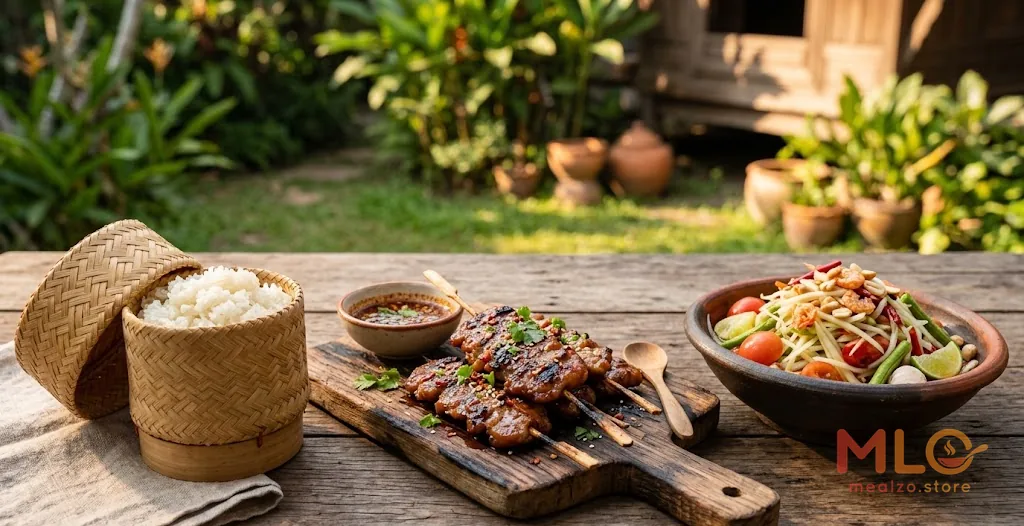
The classic combination worth watching is sticky rice with grilled pork and som tam. It is an excellent example of a meal where every component can be eaten casually and quickly. A piece of pork, a bite of som tam, another small ball of sticky rice, then another. The sticky rice package may not look large, but because it is compressed and eaten gradually, the total portion can disappear without ever looking like a large mound of rice.
This does not make sticky rice a worse choice. It simply makes visual portioning harder.
A practical method is to decide roughly how much of the sticky rice you intend to eat before beginning, rather than repeatedly reaching into the bag or basket until the meal is finished.
For jasmine rice, the adjustment is easier. Look at the plate. If rice is dominating everything else, reduce the mound before you start eating or ask for less at the counter.
For more context on combining familiar Thai dishes rather than treating each ingredient in isolation, see practical ways to balance Pad Thai, som tam and tom yum.
4. Brown rice, red rice and riceberry: what changes and what does not
Brown rice, red rice and riceberry are widely available in Bangkok, especially in health-oriented meal services, some office food options, supermarkets and restaurants that offer alternatives to standard jasmine rice.
They can bring more fibre, a firmer texture and a more substantial bite. They usually take longer to cook and taste noticeably different from soft white jasmine rice.
Those differences are real.
What does not change is equally important: they are still rice, and they can still be the biggest carbohydrate source on the plate.
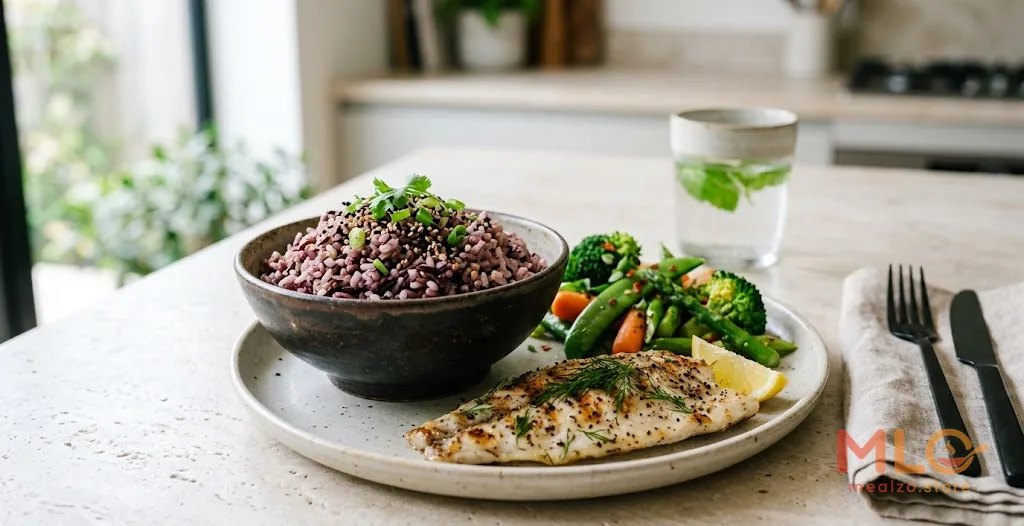
Switching from jasmine rice to brown rice does not remove the need to notice portion size. A very large serving of brown rice is still a very large serving of rice.
For everyday eating, the difference between a sensible portion and an oversized one often matters more than the difference between two types of rice.
That is useful because it removes unnecessary pressure. If you genuinely prefer jasmine rice, you do not need to force yourself to eat riceberry just because it looks more virtuous. If you enjoy brown or red rice, choose it for its texture, fibre and flavour, while still sizing it to the meal.
Key takeaway: Changing the type of rice can change texture, fibre and taste, but it does not make portion size irrelevant.
5. Rice beside the dish and rice under the dish are not the same decision
A bowl of curry with a separate bowl of rice gives you control. You can spoon some rice onto your plate, eat it with the curry, then stop when the balance feels right.
A plate of rice with curry already ladled over the top removes much of that control before you sit down.
The distinction is particularly important at khao gaeng stalls. Rice is often placed on the plate first, then one or more dishes are added over or beside it. If the initial scoop is large, every topping is effectively being built around that choice.
This is why ordering sequence matters.
At a stall where possible:
- Decide on the rice portion first.
- Ask for less rice before toppings are added.
- Choose a protein dish rather than relying only on sauce.
- Add a vegetable dish when available.
- Avoid treating leftover empty space as a reason to add more rice automatically.
At home, reverse the usual logic. Instead of filling the plate with rice and finding room for everything else, put the protein and vegetables on first. Then add enough rice to complete the meal.
That approach fits naturally with building a balanced tray at a Bangkok food court and getting more vegetables and fibre from Thai meals.
6. Fried rice and one-dish rice meals are less adjustable
Plain rice beside a dish is easy to reduce. Fried rice is not.
Once rice has been stir-fried with oil, sauce, egg, meat or vegetables, the rice is part of the recipe rather than a side serving. Asking for "less rice" after the dish has been cooked makes little practical sense because removing rice also removes the structure of the meal.
The same is true for many one-dish meals built directly on rice. If the cook has already portioned the rice and mixed or topped it as one complete dish, your adjustment options are limited.
This is where the useful question changes from "How much rice should I ask for?" to "How do I balance the rest of the day or meal around this dish?"
Possible adjustments include:
- Avoid automatically adding another rice-based side.
- Add vegetables if the meal contains very little.
- Choose a protein-rich accompaniment when the main dish is mostly rice.
- Eat slowly enough to notice whether the full portion is actually needed.
- Leave some if the serving is simply larger than you want.
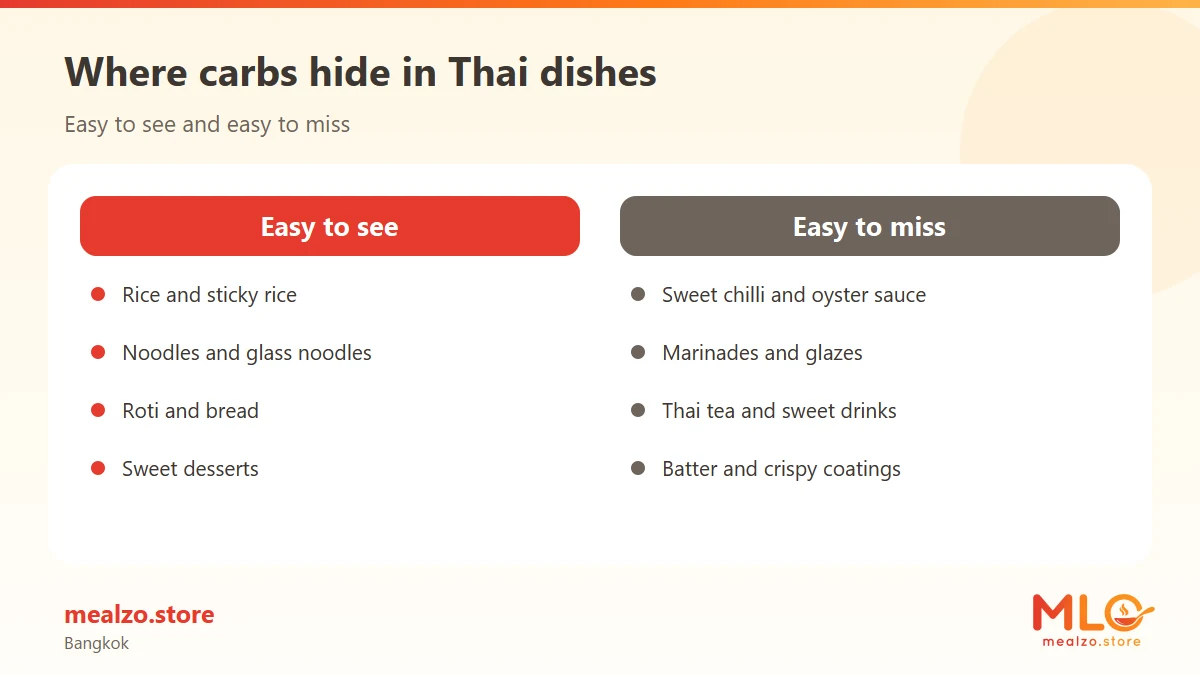
Fried rice also illustrates why focusing only on the visible mound can be misleading. The rice has already absorbed oil and seasoning before it reaches you. Sauces and other ingredients can add more carbohydrates elsewhere in the meal too, which is covered in hidden carbohydrates in Thai sauces, drinks and everyday dishes.
Key takeaway: Plain rice served on the side is highly adjustable. Rice that has already been fried, mixed or built into a one-dish meal is much less adjustable.
7. How to size rice without weighing anything
You do not need a kitchen scale at a food court.
A useful visual method is to compare the shape and space occupied by the rice with the protein and vegetables on the same plate.
Start by looking at three things:
- Is the rice mound noticeably larger than everything else?
- Is there enough protein that the meal is not mainly rice and sauce?
- Are vegetables actually present, or is rice filling the space where they could have been?
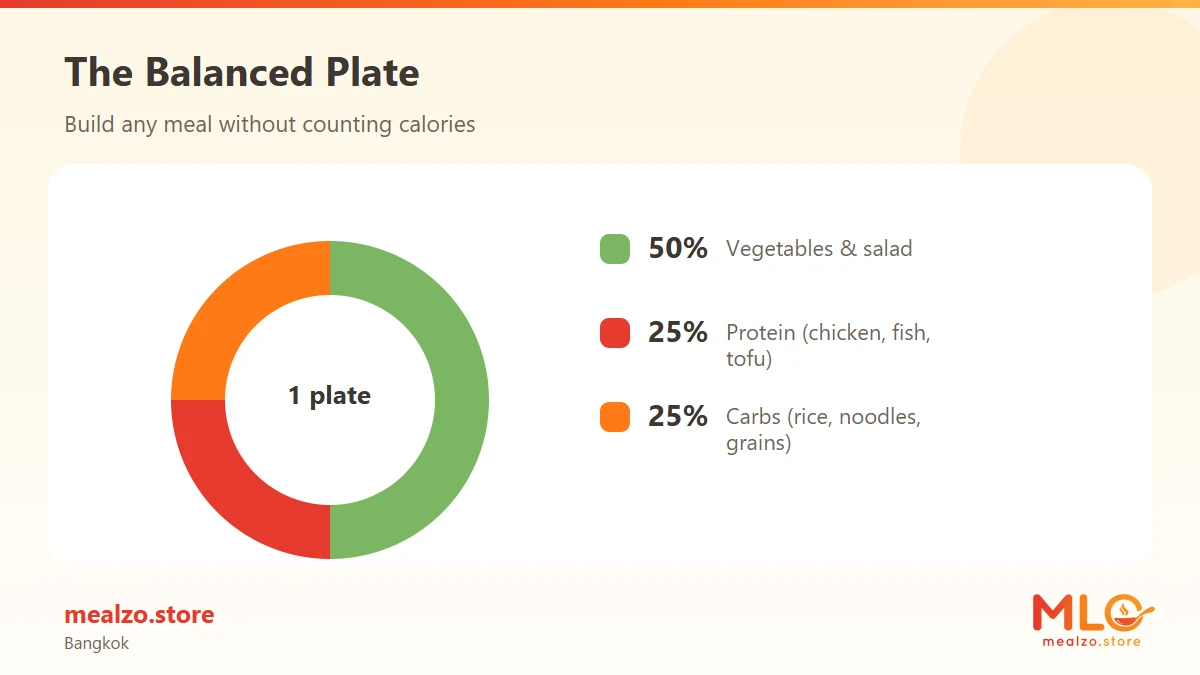
The goal is not to create mathematically equal sections. Thai meals do not always fit into neat compartments. Curries spread. Stir-fries contain mixed ingredients. Soup changes the visual volume completely.
What matters is proportion.
A plate where rice forms a supporting base for protein and vegetables feels very different from a plate where a thin spoonful of curry sits on top of a large rice mound.
The same principle works in takeaway boxes. Look at the depth as well as the surface. A compact box can hide a thick layer of rice under a relatively small topping.
At home, serve once rather than leaving the rice pot on the table as a silent invitation to refill. You can always take more, but making the second serving a conscious choice is useful.
8. Food courts, khao gaeng stalls and office canteens
Bangkok has several common lunch environments, and each creates a different portion problem.
| Situation | What tends to go wrong | Practical fix |
|---|---|---|
| Khao gaeng stall | Rice is scooped before you choose toppings | Ask for less rice first, then choose protein and vegetables |
| Food court | Large standard portions are served quickly | Make the rice request when ordering, not after receiving the plate |
| Office canteen | Habit makes the same serving appear every day | Vary the rice portion according to the meal rather than accepting the default |
| Street grilled pork with sticky rice | Compact sticky rice disappears bite by bite | Decide how much sticky rice you want before starting |
| Home dinner | The rice pot makes second servings effortless | Plate rice once, then pause before taking more |
| Late evening meal | Hunger and speed turn dinner into the largest rice serving of the day | Serve the meal fully before eating and slow the first few minutes down |
The office lunch is often the easiest place to improve consistency because the setting repeats. If the same vendor serves you most days, asking for a smaller rice portion quickly becomes normal.
Street lunch may require a faster decision. Make the rice request before the scoop lands.
Home dinner offers the most control but also the easiest access to seconds.
The late evening meal deserves special attention. After a long Bangkok workday, commute or training session, it is easy to arrive home very hungry, serve a large amount of rice and eat quickly. That may become the largest single rice portion of the day without ever being planned that way.
The fix is descriptive rather than moral: notice that the pattern exists, portion the whole dinner before sitting down, and make the second helping a separate decision.
9. How to ask for less rice in Thai
Asking for a different amount of rice in Thailand is normal. You are not insulting the cook or rejecting the food.
Useful phrases include:
- Khao noi noi: less rice, please.
- Ao khao nit diao: just a little rice.
- Mai ao khao: no rice.
- Khao perm: more rice.
- Kho khao perm noi: could I have a little more rice?
Exact pronunciation varies, and nobody expects a foreign resident to sound like a native speaker. The practical point is to make the request before the rice is plated whenever possible.
At a khao gaeng stall, say khao noi noi as the server reaches for the rice.
At an office canteen, the same request works.
At home, the equivalent is simply using a smaller serving spoon or stopping the first scoop earlier.
For people who regularly buy lunch rather than cook, this one piece of vocabulary can influence rice portions Bangkok-wide more reliably than remembering abstract nutrition rules.
10. Training days, low-carb plans and rest days
Rice can play different roles depending on what the rest of your day looks like.
Someone training regularly may deliberately prefer more rice with a meal because they want more carbohydrate around activity. Someone on a low-carb eating pattern may choose a smaller rice portion and build more of the meal from protein and vegetables. On a rest day, another person may simply prefer a lighter serving because their appetite is lower.
These are trade-offs, not universal rules.
Three practical ways to think about it:
- Training day: rice can be a convenient carbohydrate source, so reducing it automatically may not fit your goals.
- Low-carb plan: the simplest adjustment is often reducing or omitting the rice side while keeping the protein and vegetable components substantial.
- Rest day: use appetite and the rest of the meal rather than serving the same habitual rice mound automatically.
Anyone with diabetes, prediabetes or kidney disease should follow their own doctor rather than an article. Rice quantity and what it is eaten with genuinely matter for blood sugar management, but individual medication, health status and treatment plans cannot be replaced by general food writing.
11. Storing and reheating rice in a hot city
Rice safety in Bangkok is mainly a handling question.
Cooked rice should not spend long periods sitting at room temperature in a hot environment. If you are saving it for later, the practical approach is to cool and refrigerate it promptly, then reheat it properly when you are ready to eat.
This is not an argument against rice. It is simply the same kind of kitchen discipline that matters for many cooked foods in a warm climate.
Do not rely on smell alone to decide whether rice that has been sitting out for a long time is suitable to eat.
If you regularly prepare meals ahead, transport lunch to work or keep dinner for the next day, follow a consistent storage routine rather than improvising each time.
12. Where a portioned Mealzo Bangkok plan helps, and where it does not
A portioned meal plan removes one common source of inconsistency: the server's rice scoop.
At Mealzo Bangkok, the rice component is portioned in the kitchen and arrives already sized to the dish and the selected calorie level. The customer is not standing at a counter estimating how much rice has been added.
That does not make rice a free food. It does not stop someone adding another serving at dinner. It does not make brown rice automatically healthier than jasmine rice in every context, and it does not turn any particular rice into a shortcut for weight management.
It simply makes the original portion predictable.
Mealzo Bangkok operates from a kitchen in Bang Na, Bangkok. Meals are cooked fresh daily and delivered across Bangkok. Customers choose either the morning delivery window from 06:00 to 09:00 or the evening window from 17:00 to 20:00.
There are 12 meal plans: Balanced, Weight Loss, High Protein, Vegetarian, Vegan, Keto, Low-Carb, Gluten Free, Easy-to-Digest, Pescatarian, No Fish & Seafood, and Dairy & Egg Free. Each plan uses one mixed cuisine combining Thai and international dishes. There is no separate cuisine selection.
Customers can choose from six daily calorie levels from 1200 to 2500 kcal, with 3 or 5 meals per day and package lengths of 3, 7, 14 or 30 days. The calorie calculator in the app uses the Mifflin-St Jeor formula as an estimate, not medical advice.
For allergies, customers declare from nine allergen groups. Dishes containing a declared allergen are not assigned to that customer. This describes the assignment mechanism and is not a guarantee that a meal is allergen-free.
The website and mobile app are available in Thai, English, Polish, German, French, Russian, Simplified Chinese and Burmese. The Android app is available on Google Play, and the public contact address is [contact@mealzo.store](mailto:contact@mealzo.store).
If predictable portions would make weekday eating easier, see Mealzo Bangkok meal plans.
Key takeaway: A portioned meal plan controls the serving that arrives. What happens after that, including extra rice or second helpings, is still your decision.
FAQ
Is jasmine rice worse than brown rice?
No. They differ in texture, processing and fibre content, but describing white jasmine rice as inherently unhealthy would be misleading. For everyday meals, the size of the serving and what you eat with it often matter more practically than changing rice colour.
Is sticky rice more difficult to portion than steamed rice?
Often, yes, because it is compressed and eaten in small pieces rather than spread visibly across a plate. That makes it easier to underestimate, particularly with combinations such as grilled pork and som tam. Setting aside the amount you intend to eat before starting can help.
Should I stop eating rice at dinner?
There is no general reason everyone needs to remove rice from dinner. The more useful question is whether the evening serving has become automatically much larger than the rest of the day's portions because you are hungry, tired and eating quickly.
What should I say if I want less rice at a Bangkok food stall?
Say khao noi noi, meaning less rice, or ao khao nit diao, meaning just a little rice. It is a normal request and works best when you say it before the server has finished scooping.
Is fried rice the same as plain rice with a stir-fry?
Not practically. Plain rice served beside a stir-fry can be adjusted independently. In fried rice, the rice has already been cooked with oil, seasoning and other ingredients, so the portion is built into the dish.
Does switching to riceberry solve portion control?
No. Riceberry can provide a firmer texture and more fibre than standard white rice, but it is still rice. A large riceberry serving can still dominate the meal, so the same visual portioning principles apply.
Mealzo Bangkok is a kitchen and meal delivery service operating exclusively in Bangkok, Thailand. We are not affiliated with similarly named services outside Thailand.
Find a Meal Plan That Fits
Compare Mealzo plans or use the calculator to explore meal options for your needs.