Eating Well in Bangkok's Rainy Season: Food Safety, Appetite and Getting Meals Delivered
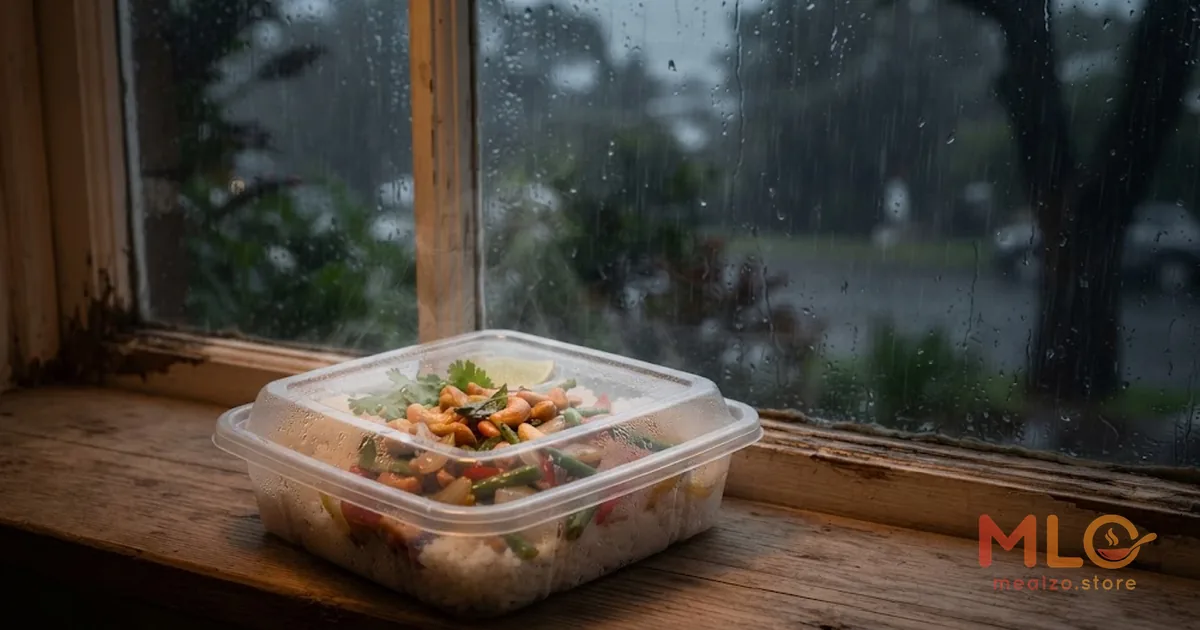
Bangkok’s rainy season is not one long stretch of gentle rain. It is often a matter of timing: a dry morning, a sudden black sky, then a downpour strong enough to turn a normal trip across Sukhumvit or Sathorn into a much longer journey. Thailand’s Meteorological Department describes the main rainy season as running roughly from mid-May to mid-October, with rainfall in upper Thailand particularly active around August and September. Thailand Meteorological Department: Thailand's rainy season
For anyone living in Bangkok, the practical effect is simple. Rain changes when you leave home, when you shop, and sometimes whether you bother going out for food at all.
A flooded soi, slow traffic around Asok, a packed BTS platform, or a storm arriving just before dinner can be enough to turn a planned meal into whatever happens to be available downstairs.
That is where a little planning becomes useful. Not because rainy-season eating requires a special diet, but because it helps keep food, hydration and meal timing from becoming another daily problem.
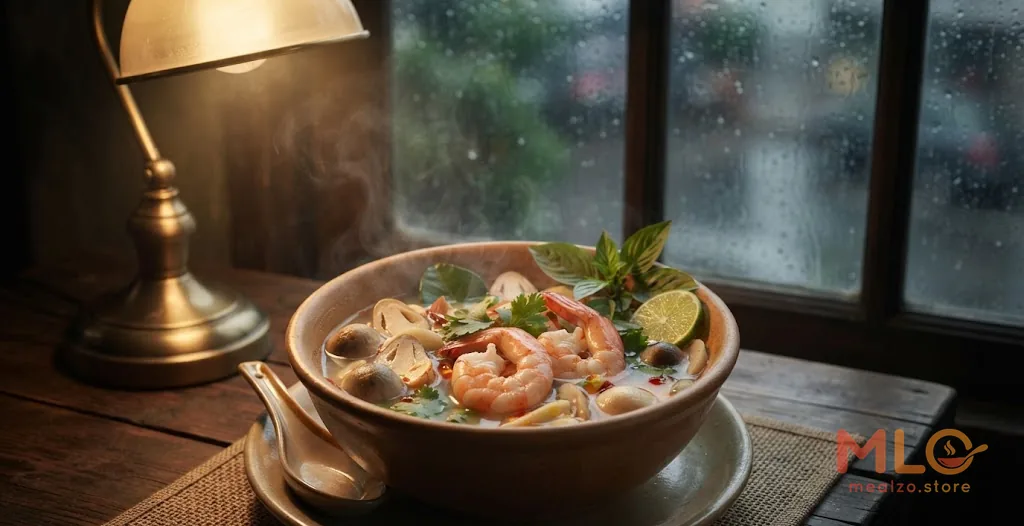
1. What the rainy season actually does to eating in Bangkok
The biggest change during monsoon season Bangkok residents experience is not necessarily what they eat. It is how they make decisions about food.
On a clear day, walking to a restaurant in Thonglor, stopping at a supermarket, or picking something up near the MRT is easy enough. When the rain starts, the calculation changes.
You may already be at work when the sky opens. You may be in a condo in Bang Na watching water collect outside the entrance. You may live close to BTS but still have to cross a flooded stretch of pavement to get there. Or you may simply decide that putting on shoes and dealing with traffic for dinner is not worth it.
The result is predictable: convenience wins.
The meal that was planned for 19:00 becomes a delivery order at 20:30. The balanced dinner becomes noodles, fried food, dessert or a sweet drink because that is what is easiest to obtain without going outside.
There is nothing inherently wrong with any of those foods. The problem is repetition. A few disrupted evenings can easily become a disrupted routine for weeks.
Bangkok's rainy season also creates a strange split between morning and afternoon. A morning can be perfectly manageable while the afternoon becomes difficult. That matters for anyone using food delivery because the weather can interfere with the physical act of receiving, storing and eating food.
The practical response is not to fight the weather. It is to build a food routine that assumes the weather will sometimes win.
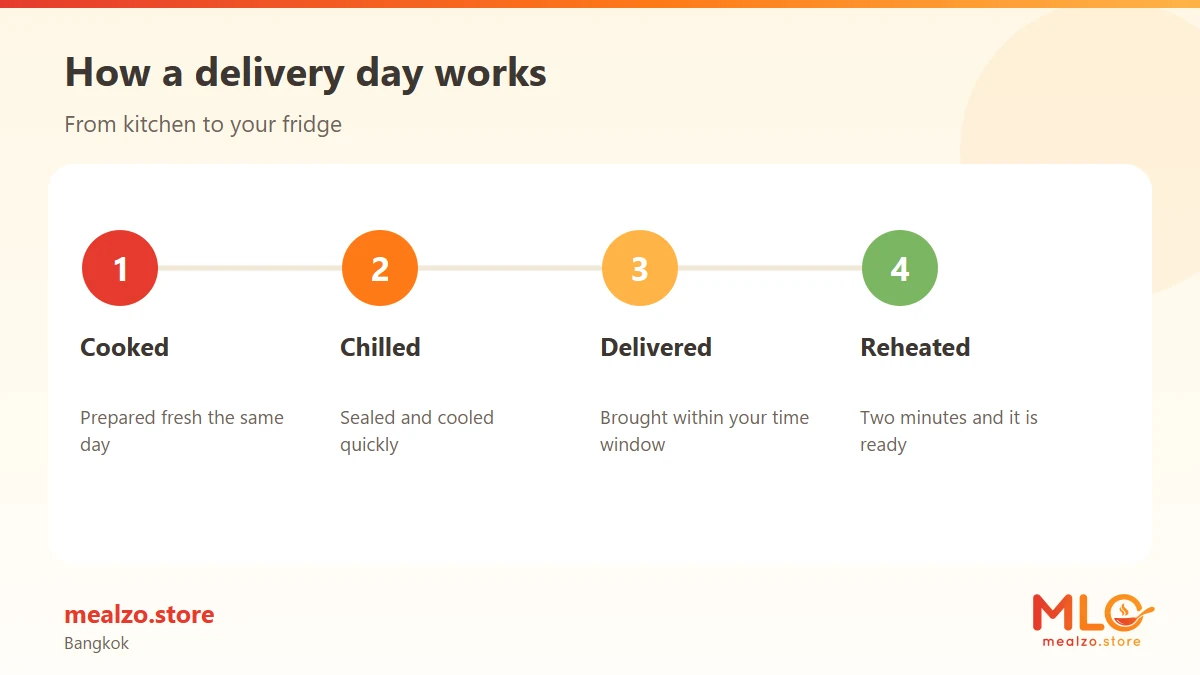
2. Heat, humidity and the way appetite changes
Humidity can make eating feel different even when you are not consciously thinking about the weather.
When the air feels heavy, a large hot meal may be less appealing than something cold, light or easy to eat. On another day, especially after being caught in heavy rain, a hot soup, curry or rice dish can suddenly sound much better.
That variation is normal. Appetite does not have to look identical every day.
What is easy to underestimate is drinking. In humid weather, people often associate dehydration with obvious sweating. Bangkok does not always give you that clear signal. You can spend much of the day indoors, move between an air-conditioned condo, BTS, office and car, and still spend hours in hot, humid conditions when you are outside.
Cold sweet drinks are particularly tempting because they are immediately refreshing. They can also become an automatic part of the rainy-day routine: iced coffee in the morning, sweet tea in the afternoon, another drink with dinner.
The useful distinction is between drinking because you are thirsty and drinking because a particular drink has become part of the weather ritual.
For everyday eating, water should remain easy to access. Keeping a bottle beside your desk, in your bag or near the kitchen is more practical than relying on thirst to remind you.
There is no need to turn this into a complicated hydration programme. The goal is simply not to let weather-related appetite changes turn into a day where food and fluids are both treated as afterthoughts.
3. Why food safety matters more when it is hot and humid
Rain itself does not make a meal unsafe. The bigger issue is temperature.
Warm, humid conditions provide better conditions for microorganisms to multiply, and cooked or perishable food becomes more vulnerable when it spends too long outside safe refrigeration. The WHO specifically advises keeping food at safe temperatures and notes that microorganisms can multiply quickly when food is stored at room temperature. It recommends prompt refrigeration of cooked and perishable food, preferably below 5°C. WHO: Public health advice on food safety during summer
That makes a meal sitting in a refrigerated kitchen very different from the same meal sitting in a warm condo lobby.
A common mistake is thinking that because the food was freshly prepared, it can safely wait for several hours. Fresh preparation is useful, but it does not remove the need for proper temperature control after cooking.
The practical rainy-season rule is straightforward:
If a meal is perishable and meant to be chilled, get it into a properly cold refrigerator as quickly as reasonably possible.
Do not judge safety only by smell or appearance. Food can be unsafe without looking obviously spoiled. WHO guidance also specifically warns against relying on smell, taste or appearance as a complete safety test. WHO EMRO: Food safety guidance in hot weather
This is especially relevant to food delivery in Bangkok because a customer may not be home when the delivery arrives.
If you know you will be away, the best solution is to arrange for someone or a suitable reception point to receive the food and put it somewhere appropriately chilled. A meal left for hours in a hot lobby should not be treated as though it has been refrigerated simply because the building itself is air-conditioned.
4. What to do if you were not home to receive the food
This is one of the less glamorous parts of meal planning, but it matters.
A condo reception desk is convenient, but reception is not automatically refrigeration. An office security desk is not a refrigerator either. Neither is a sheltered corner away from direct sunlight.
If you are using a meal delivery service, think about where the food actually goes between delivery and your refrigerator.
A sensible setup is:
- Know the expected delivery window.
- Make sure someone can receive the food if you will be away.
- Tell the relevant person that chilled food needs to be stored appropriately.
- Put meals into your refrigerator promptly after receiving them.
- If food has been left unrefrigerated for too long, do not try to rescue it simply because it still looks normal.
- If flooding or a power problem has affected refrigeration, be more cautious about perishable food.
WHO's guidance is particularly clear on the importance of temperature control and prompt refrigeration. WHO: Five Keys to Safer Food
For a Bangkok condo, this means the delivery arrangement is part of food safety. The address alone is not enough. Someone has to be able to receive the food and handle it correctly.
5. Some dishes tolerate a delay better than others
Not every meal behaves the same way after delivery.
A substantial cooked dish that is intended to be reheated is generally easier to manage during an unpredictable day than a delicate salad that depends heavily on freshness and texture.
That does not mean one category is automatically "safe" and another is automatically "unsafe." Time and temperature still matter. It simply means some foods are more forgiving from a practical eating-quality perspective when your schedule changes.
| Dish type | What tolerates a delay | What does not | What to do |
|---|---|---|---|
| Soups and stews | Usually maintain their eating quality well when properly chilled | Extended time at room temperature | Refrigerate promptly; reheat thoroughly |
| Curries and cooked rice dishes | Often practical for planned reheating | Long unrefrigerated storage | Chill promptly and follow storage instructions |
| Cooked meat or poultry | Can work well as a planned meal | Warm storage for an extended period | Refrigerate promptly; reheat appropriately |
| Cooked vegetables | Generally manageable when chilled | Prolonged warm storage | Refrigerate promptly |
| Leafy salads | Texture can deteriorate with time and moisture | Warm conditions and long delays | Keep properly chilled and eat promptly |
| Cut fruit | Can lose quality and freshness | Extended exposure to heat | Keep refrigerated |
| Dairy-containing dishes | Need careful temperature control | Warm storage | Refrigerate promptly |
| Seafood dishes | Particularly worth treating as perishable | Long periods outside refrigeration | Keep chilled and avoid unnecessary delays |
The point is not to create a list of "good" and "bad" rainy-season foods. It is to recognise that food delivery is a physical process. The meal has to travel, arrive, be received and then be stored.
6. Planning around the weather instead of against it
The most useful rainy-season routine is one that assumes some days will go wrong.
If you plan every meal around a perfect timetable, one flooded road or unexpected meeting can knock the entire day off course.
A better approach is to establish a baseline.
For example, keep at least one planned meal available in the refrigerator so that an unexpected storm does not immediately create a food decision. If you are using a multi-day meal plan, the food is already there. You do not need to decide what to order while watching rainwater rise outside.
This is where a structured plan can be more useful than repeatedly making individual decisions.
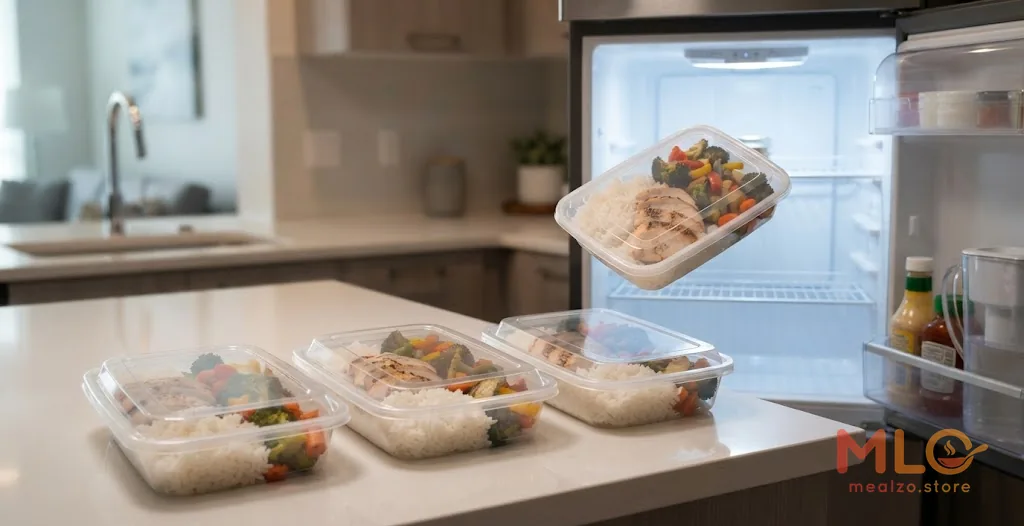
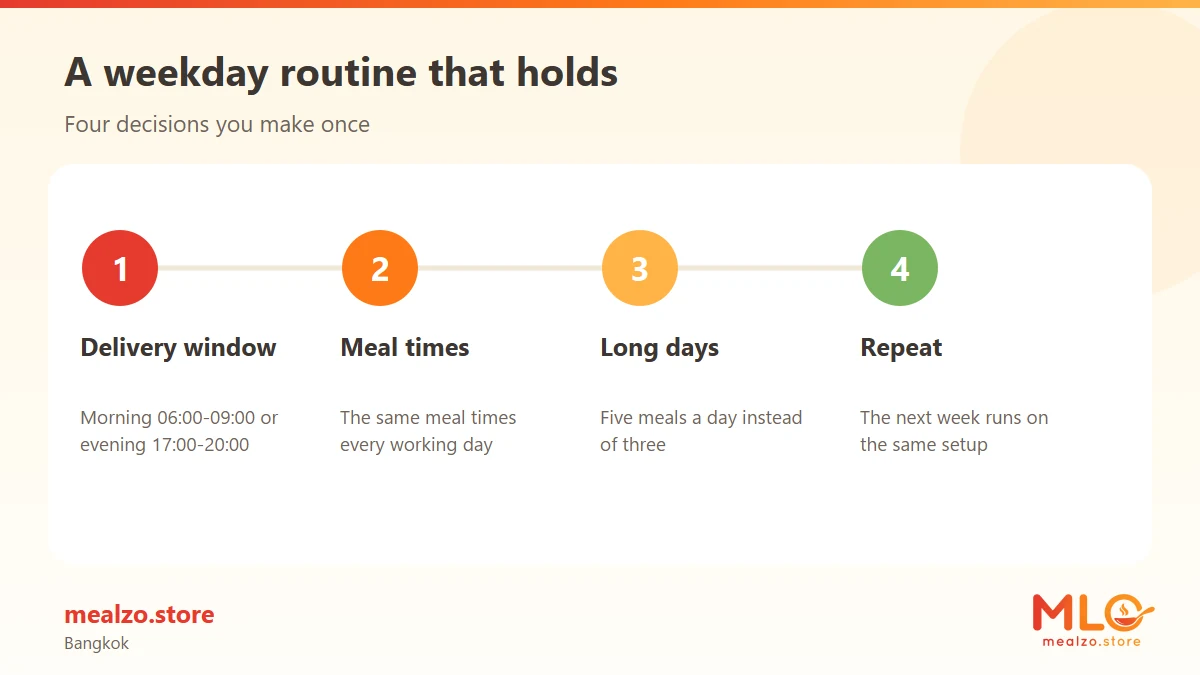
Mealzo Bangkok prepares meals in its kitchen in Bang Na and delivers across Bangkok. Customers select one of two delivery windows: morning, 06:00-09:00, or evening, 17:00-20:00.
The morning window can be particularly practical for people whose afternoons regularly become unpredictable. Food arrives before the period when a sudden storm may make movement across Bangkok more difficult.
The evening window suits a different routine. Someone working through the day may prefer to receive the following meals later, but the trade-off is that the delivery itself happens during a part of the day when traffic and weather can be less predictable.
7. Morning or evening delivery during storm season?
There is no universally better window. The right choice depends on when you are actually able to receive and store the food.
| Delivery window | Potential advantage in rainy season | Main trade-off | Works well for |
|---|---|---|---|
| 06:00-09:00 | Arrives before many afternoon and evening storms; meals are available earlier in the day | You need to be awake and able to receive the delivery early | Early starters, home workers, people who prefer having the day's meals ready |
| 17:00-20:00 | Convenient for people who are home after work | Storms, traffic and delays can be more disruptive later in the day | People who reliably return home during the evening window |
The important part is not guessing which window is "best." It is choosing the window you can reliably manage.
If your condo reception can accept deliveries and you have a reliable way to get meals chilled promptly, that can make either window easier.
If you live around Sukhumvit and your evening commute regularly becomes unpredictable when heavy rain hits, the morning window may remove one more variable from the day.
If you work from home in Bang Na and can reliably receive food in the evening, the later window may fit better.
Meal planning works best when it reflects your actual routine rather than an imaginary perfect schedule.
8. What a structured meal plan changes, and what it does not
A scheduled meal plan removes one specific problem: deciding what to eat every day.
It does not remove Bangkok traffic. It does not stop rain. It does not make a condo reception desk refrigerated. It does not guarantee that you will feel hungry at exactly the planned time.
That distinction matters.
Mealzo Bangkok offers 12 meal plans: Balanced, Weight Loss, High Protein, Vegetarian, Vegan, Keto, Low-Carb, Gluten Free, Easy-to-Digest, Pescatarian, No Fish & Seafood, and Dairy & Egg Free.
There is one mixed cuisine approach, combining Thai and international dishes. Customers are not choosing between separate cuisine programmes.
There are also six calorie levels from 1200 to 2500 kcal, with options for three or five meals per day. Packages are available for 3, 7, 14 or 30 days.
The value during rainy season is mostly logistical. You already have a defined food structure instead of starting from zero every afternoon.
But there are limits.
A meal plan does not make sense if you cannot reliably receive and store the food. It is also not a substitute for paying attention to whether you are actually hungry, whether your schedule has changed, or whether the meals fit your needs.
For some people, ordering individually will remain more flexible. That is a perfectly reasonable choice.
The question is whether removing daily food decisions is useful enough to justify committing to a plan.
Meal Plan Delivery in Bangkok Traffic
9. Keeping the routine when the weather keeps changing
A workable rainy-season routine does not need to be complicated.
Think about the parts of the day that are most vulnerable to disruption. If lunch is normally purchased near the office but the route becomes difficult in heavy rain, that is a weak point. If dinner depends on stopping at a supermarket after work, another weak point appears.
The aim is to identify those points before they become a problem.
A simple baseline might look like this:
- Have the day's meals planned before the weather becomes a factor.
- Keep the refrigerator organised so new meals can be stored quickly.
- Choose a delivery window you can reliably receive.
- Have a fallback meal available for a delayed day.
- Keep water accessible rather than relying entirely on sweet drinks.
- Avoid treating every rainy afternoon as an excuse to abandon the normal eating routine.
- Check your schedule before choosing a delivery window.
For people living in condos, storage and access deserve particular attention. A delivery can be perfectly organised from the kitchen and still become inconvenient if the customer is travelling across Bangkok, the building has restricted access, or no one is available to receive it.
Meal Delivery to Bangkok Condos and Offices: Access, Storage and Scheduling
10. Food safety is also about the last metre
Meal delivery is often discussed as though the process ends when the food reaches the building.
It does not.
The final part happens at the customer's address: the lobby, reception area, security desk, elevator, corridor and finally the refrigerator.
That last metre is especially important in Bangkok's climate.
If a customer knows they will not be home, the delivery arrangement should be decided beforehand. The goal is not simply to make sure the package reaches the correct building. The goal is to make sure perishable food is handled appropriately once it arrives.
This is also why a predictable delivery schedule can be useful. A customer who knows that food arrives between 06:00 and 09:00 can organise their morning around it. Someone choosing 17:00-20:00 can make sure they or an authorised recipient will be available.
Mealzo Bangkok provides delivery across Bangkok from its Bang Na kitchen, but the customer's part of the process still matters.
For more detail on the preparation and delivery process, see how the Bang Na kitchen prepares and delivers meal plans.
11. Allergens, dietary plans and realistic expectations
Rainy-season eating does not change the need to communicate dietary requirements clearly.
Mealzo Bangkok allows customers to declare allergens from nine groups. Dishes containing a declared allergen are not assigned to that customer. This is a mechanism for excluding declared allergens from assigned dishes, not a guarantee of an allergen-free environment.
That distinction should be understood before ordering.
The same principle applies to dietary plans. A selected plan gives the kitchen a framework for assigning meals, but it should not be treated as medical treatment or as a replacement for professional dietary advice.
The available plans cover a broad range of ordinary dietary preferences and restrictions, including Vegetarian, Vegan, Keto, Low-Carb, Gluten Free, Pescatarian, No Fish & Seafood and Dairy & Egg Free.
Meal plans are available in Thai, English, Polish, German, French, Russian, Simplified Chinese and Burmese.
People who are pregnant, breastfeeding, immunocompromised, elderly or managing a medical condition should be more careful with food-safety margins and follow their doctor's guidance.
For someone simply trying to keep a consistent eating routine through Bangkok's wet season, however, the principle is much simpler: know what is arriving, know when it arrives, store it properly and make sure the plan fits your actual life.
12. What people are really looking for when eating through Bangkok's rain
Searches and local food coverage around Bangkok's rainy season tend to circle around practical questions rather than a special "monsoon diet": where to eat without getting soaked, what foods work in wet weather, covered markets, hot bowls, comfort food, and how to deal with sudden rain while going out to eat. Recent Bangkok food coverage, for example, focuses on covered markets and dishes that are practical in heavy rain rather than suggesting that residents need a completely different diet. cite
That makes sense.
Most people living in Bangkok do not need a rainy-season menu. They need fewer points of failure.
Sometimes that means choosing a covered food court rather than a street stall. Sometimes it means eating at home instead of crossing a flooded soi. Sometimes it means having a meal already waiting in the refrigerator.
The useful question is not "What should I eat because it is raining?"
It is "How can I make eating properly less dependent on whether the weather behaves today?"
That is the more durable approach to Bangkok rainy season food.
A meal plan can help with that because it moves part of the decision-making earlier. You choose the package, calorie level, meal frequency and delivery window in advance. Then the weather can change without forcing you to rethink dinner.
Mealzo Bangkok offers packages of 3, 7, 14 or 30 days. Current package prices range from 1,100-2,600 THB for three days, 2,360-5,590 THB for seven days, 4,380-10,400 THB for fourteen days, and 8,770-20,810 THB for thirty days.
see the available Bangkok meal plans and packages
The trade-off is commitment. You are deciding in advance, and someone needs to receive the food during the selected delivery window. For some Bangkok residents, that is precisely the point. For others, daily flexibility will be more valuable.
Neither approach is automatically better.
The rainy season simply makes the cost of an unreliable food routine more obvious.
Key takeaways
Key takeaway: In Bangkok's rainy season, the biggest eating problem is often disruption rather than a lack of food choices.
Key takeaway: Perishable meals should be moved into proper refrigeration promptly; a warm condo lobby is not equivalent to a refrigerator.
Key takeaway: Choose a delivery window based on when you can reliably receive and store the meals, not simply on which time looks convenient on paper.
Key takeaway: A meal plan can reduce daily food decisions, but it cannot replace proper storage, receiving arrangements or attention to your own routine.
FAQ
When is Bangkok's rainy season?
Thailand's rainy season generally runs from around mid-May to mid-October, influenced by the southwest monsoon. Rainfall patterns vary from year to year, but August and September are typically important wet-season months for upper Thailand. Thailand Meteorological Department seasonal information
Is food delivery safe during Bangkok's rainy season?
Delivery itself does not make food unsafe. The important issue is how perishable food is handled before and after delivery. Hot and humid conditions can allow microorganisms to multiply more quickly, so chilled food should be refrigerated promptly and should not be left at room temperature for extended periods.
What should I do if I am not home when my meal delivery arrives?
Arrange for someone or an appropriate reception point to receive the meals and ensure they are stored properly. A condo reception desk should not automatically be assumed to provide refrigeration. If perishable food has been left unrefrigerated for too long, do not rely on smell or appearance alone to decide whether it is safe.
Is the morning or evening delivery window better during rainy season?
It depends on your routine. The 06:00-09:00 window gets meals to you before many afternoon and evening weather disruptions, while the 17:00-20:00 window can be more convenient if you are home after work. The better choice is the one you can reliably receive and store.
Does a meal plan mean I have to eat exactly at the scheduled time?
No. A meal plan provides structure, but your actual eating schedule can vary. The important practical point is to store perishable meals correctly and avoid leaving them unrefrigerated for long periods.
Does Mealzo Bangkok offer different cuisines to choose from?
No. Mealzo Bangkok uses one mixed cuisine approach combining Thai and international dishes. Customers choose from the available meal plans, calorie levels, meal frequency and package lengths rather than selecting between separate cuisine programmes.
Sources
The food-safety and hydration guidance draws on public health authorities; follow your doctor for individual medical questions.
- WHO : Public health advice on food safety during summer
- WHO : Five Keys to Safer Food
- WHO EMRO: Food safety
- Thai Meteorological Department
Mealzo Bangkok is a kitchen and meal delivery service operating exclusively in Bangkok, Thailand. We are not affiliated with similarly named services outside Thailand.
Find a Meal Plan That Fits
Compare Mealzo plans or use the calculator to explore meal options for your needs.