Meal Plan Delivery in Bangkok Traffic: How Mealzo Bangkok Gets Food to You on Time
Bangkok traffic can turn a short journey into a long one. A delivery that looks simple on a map may involve a congested main road, a narrow soi, a flooded side street or a condo reception desk that does not allow couriers upstairs.
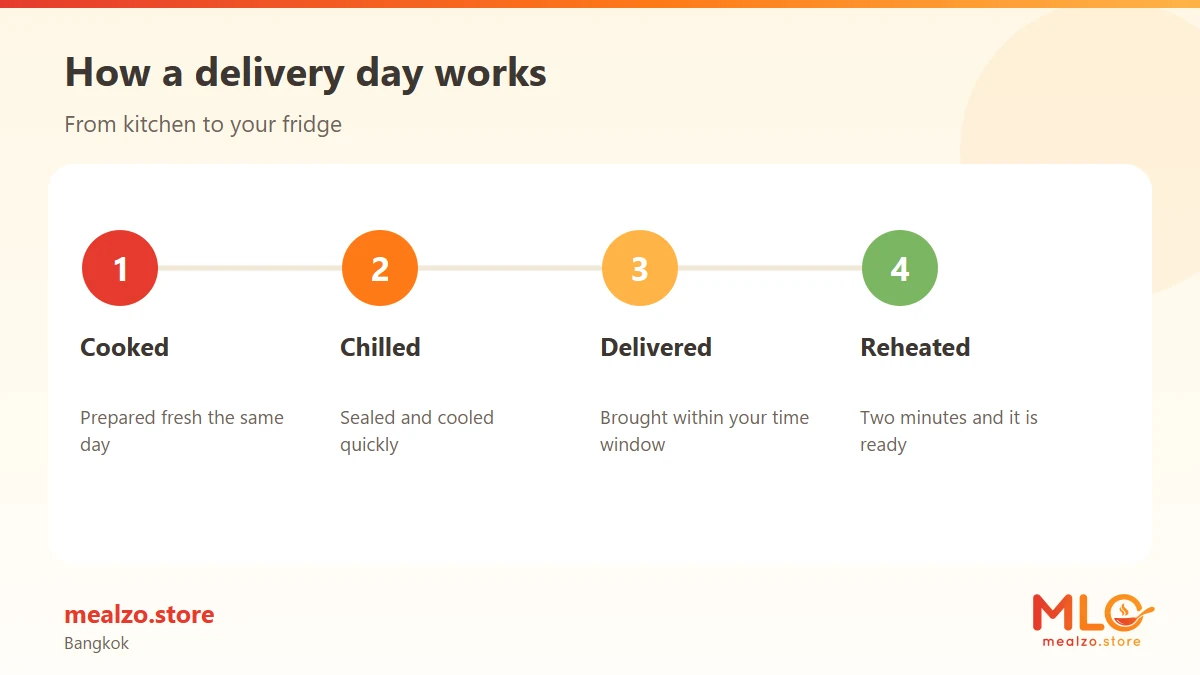
That matters when you are receiving several meals at once. Meal-plan delivery is not simply a restaurant order sent out whenever you click a button. The meals are prepared in the Bang Na kitchen and delivered according to planned routes, with a fixed delivery window selected by the customer.
Mealzo Bangkok operates from a kitchen in Bang Na and delivers meals prepared in its Bang Na kitchen across Bangkok. The practical question is not whether traffic exists. It does. The question is how to make the delivery work with the way Bangkok actually functions.
1. Why meal-plan delivery works differently from on-demand delivery
With an on-demand restaurant order, the delivery process normally begins after an individual customer places an order. The restaurant prepares that particular order, and the courier is dispatched for that delivery.
A fixed daily meal plan works differently. The meals are part of a larger delivery schedule, so routes are planned the night before rather than being dispatched separately for each individual order.
That distinction is important in Bangkok. The delivery route can be organized around the addresses scheduled for the next day instead of treating every meal box as an isolated trip.
The kitchen in Bang Na prepares meals, and deliveries are made across Bangkok. The customer chooses one of two available windows:
- Morning: 06:00-09:00
- Evening: 17:00-20:00
The purpose of a fixed window is predictability at the planning level, not a promise that traffic will behave perfectly. Bangkok roads do not offer that kind of certainty.
Key takeaway: Mealzo Bangkok plans meal-plan routes the night before, rather than dispatching every customer order separately when it is placed.
This is one reason meal delivery Bangkok traffic should be understood as a routing problem rather than simply a question of distance. Two addresses only a few kilometres apart can be very different deliveries if one is on a major road and the other is deep inside a narrow soi.
For more background on how the service works, see how Mealzo Bangkok meal plans work.
2. How the route is built before the delivery day
The route planning process starts with the addresses and delivery requirements known for the next day. That gives the delivery operation an opportunity to account for the structure of Bangkok rather than reacting to orders one by one.
A Bangkok address is rarely just a street name and building number. A useful delivery address may need a condo name, soi number, building or tower, lobby instructions and a clear handover point.
This is particularly relevant in areas such as Sukhumvit, Asok and Thonglor, where a main-road address can lead into a network of smaller sois. The route may look straightforward on a map while being less straightforward on the ground.
The same applies to Sathorn and Bang Na. A destination can be close to a major road but still require a final approach through local streets.
If you want to understand what happens between preparation and delivery in more detail, how the Bang Na kitchen prepares and delivers meal plans explains the wider process.
The night-before planning approach also explains why customers should avoid treating the delivery window as an appointment for a specific minute. A window gives a practical period for receiving the food while allowing the route to operate through changing road conditions.
3. Morning or evening: which delivery window makes sense?
The morning window runs from 06:00 to 09:00. The evening window runs from 17:00 to 20:00. The customer chooses one.
These windows solve different practical problems.
The morning option is useful when someone can receive the meal box before the main working day gets underway. It can work particularly well for people who are at home in the morning or have a reliable reception arrangement at their condo.
The evening option is aimed at customers who prefer to receive the next delivery later in the day, for example after returning from work.
Neither window is automatically better. The right choice depends on where the food will be received and who can actually take responsibility for it.
| Situation | Morning 06:00-09:00 | Evening 17:00-20:00 |
|---|---|---|
| Customer working from home | Often convenient | Also possible |
| Condo with reliable reception | Practical if reception accepts delivery | Practical if reception accepts delivery |
| Office delivery | Can work if staff are present early | Can work if the office remains staffed |
| Customer away all morning | Usually unsuitable | Potentially more suitable |
| Customer away during evening | Potentially more suitable | Usually unsuitable |
| Main concern is avoiding the workday | Strong option | Less suitable |
Key takeaway: The fixed delivery window works best when you choose it around a reliable receiving point, not simply around the time you would like to eat.
The meal does not have to be eaten immediately after delivery, but the receiving arrangements still matter.
4. Bangkok districts are only part of the delivery equation
Sukhumvit, Sathorn, Asok, Thonglor and Bang Na all have different traffic patterns and building layouts. Yet a district name alone does not tell a courier exactly where a meal box should go.
A high-rise in Asok may have a clearly defined reception desk. A small office in Sathorn may have a lobby with security but no dedicated parcel area. A residential address in Thonglor may require navigation through a narrow soi. A destination in Bang Na may be easier to reach by road but still have its own building-access rules.
BTS and MRT stations can also create a false impression of how simple an address is. Public transport may make a neighbourhood easy for a person to reach while doing little to simplify the final road approach for a delivery.
The practical lesson is straightforward: give the delivery instructions the information that a person on the road actually needs.
| District or building situation | Recommended handover method |
|---|---|
| High-rise condo in Asok | Condo reception desk with customer name and unit details |
| Sukhumvit condo on a narrow soi | Reception handover plus exact soi and building information |
| Thonglor residential building | Reception or security desk with clear entrance instructions |
| Sathorn office tower | Office lobby or reception desk with company and recipient name |
| Bang Na residence | Clear entrance details, building name and soi information |
| Small office without reception | Named person and defined ground-floor meeting point |
This is why the Bangkok condo and office delivery checklist is useful before starting a plan. Access arrangements can be just as important as the address itself.
5. Condo reception desks can make or break the final handover
Bangkok condominiums do not all handle deliveries in the same way. Some allow couriers to reach the lobby only. Others have specific reception or security procedures. Some buildings may refuse to let a courier proceed beyond reception.
That is not necessarily a problem if the customer knows about it in advance.
The simplest arrangement is a clearly identified handover point. If the courier leaves the meal box with reception, the customer should know that this is where the delivery ends.
Before the first delivery, check with the condo:
- Whether food deliveries can be left at reception.
- Whether reception accepts chilled meal boxes.
- Whether the recipient's name and unit number are required.
- Whether security requires the courier to call the resident.
- Whether there is a designated food-delivery area.
- How long reception normally holds delivered items.
Do not assume that a courier can come to your door simply because another delivery service has done so in the past.
The same principle applies to office lobbies. An office tower may have security procedures, restricted lift access or a reception desk that closes at a particular time. If the chosen delivery window does not match the building's access policy, the problem is not solved by having a correct street address.
6. Rain, rush hour and the reality of Bangkok roads
Bangkok traffic changes during the day, and the rainy season, roughly May to October, can add another layer of uncertainty.
Heavy rain can slow traffic, create standing water and make some sois difficult to navigate. Flooded sois are particularly troublesome because the last part of the route may become much slower than the main road.
Morning and evening rush hour create a different problem. A route through a busy part of the city can be affected by congestion even when there is no unusual incident.
This is why a fixed delivery window should not be interpreted as a guaranteed minute-by-minute arrival time. The useful thing about the window is that it gives the route room to operate under ordinary Bangkok conditions.
Key takeaway: During heavy rain or rush hour, the final soi and building entrance can matter as much as the main road when it comes to delivery logistics.
Customers can reduce avoidable problems by keeping the destination information current. If a building changes its entrance, reception procedure or delivery policy, the delivery instructions should be updated rather than relying on an old note.
7. What should you put in your delivery instructions?
A good delivery note is short but specific. The goal is to remove decisions that would otherwise have to be made at the end of the route.
For a condo, useful information may include the building name, soi, tower, reception location and the customer's name. For an office, it may be the company name, floor, lobby and the person responsible for receiving the box.
Avoid instructions that make sense only to someone who already knows the building.
A useful delivery note might contain:
- Condo or building name.
- Soi number and street name where applicable.
- Tower or building section.
- Reception or security desk location.
- Customer or recipient name.
- Office or company name if relevant.
- A clear statement that the box should be handed to reception, security or a named person.
- Any entrance detail that differs from the address shown on a map.
Unclear soi numbering is a common Bangkok problem. If your address uses a local landmark or an informal description, include the formal address as well.
If the building has two entrances, say which one should be used. If reception is inside a particular lobby, describe that rather than simply writing "front desk."
The best delivery note is not the longest one. It is the one that answers the obvious questions before they arise.
8. What happens if the meal arrives before you are ready to eat?
A meal-plan delivery is a delivery of several meals, not necessarily something you eat immediately at the door.
That makes storage important.
At home, the simplest arrangement is to move the meals into appropriate chilled storage as soon as practical after receiving the box.
An office delivery requires more planning. If you intend to receive the meal plan at work, check whether you have access to a refrigerator before choosing the office as the delivery location.
Do not assume that an air-conditioned office lobby is an adequate substitute for refrigeration. Air conditioning does not make a lobby into a refrigerator.
Likewise, do not leave a chilled meal box sitting indefinitely at a reception desk simply because someone has accepted it. The realistic tolerance of a chilled box in a lobby depends on the actual temperature, exposure and time. There is no responsible universal number of hours that applies to every reception area.
For an office, arrange one of these systems in advance:
- A refrigerator where the meals can be stored.
- A clearly designated person who receives the box and transfers it to chilled storage.
- A reception procedure that gets the meals into suitable storage promptly.
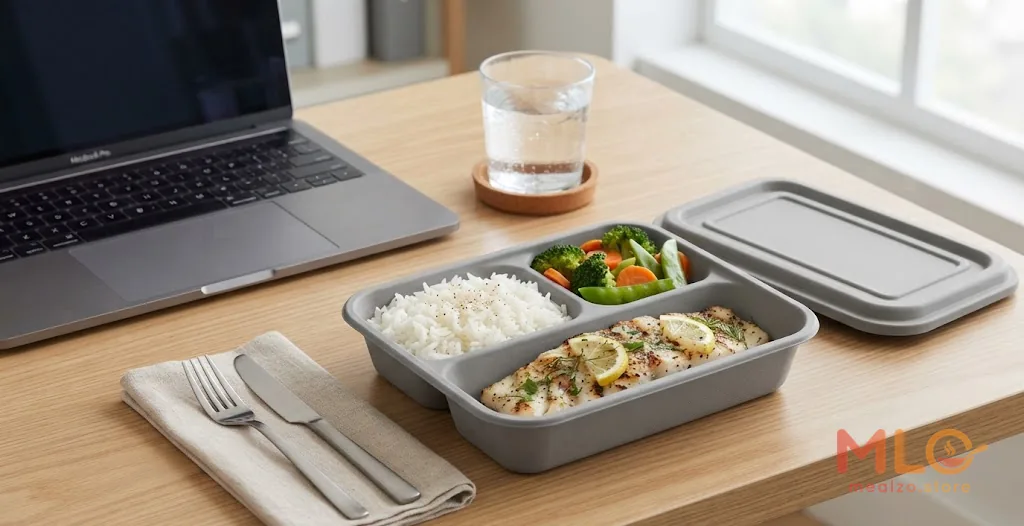
The delivery window solves the question of when the box arrives. It does not solve the question of where the food stays afterward.
9. What to do when the delivery does not go as planned
Even a carefully planned route can encounter a practical obstacle.
A soi may be flooded. Traffic may be unusually heavy. A building may suddenly change its access policy. Reception may refuse to accept food. A customer may discover that the address on the order does not match the entrance used by the building.
The first step is to distinguish between a route problem and an access problem.
If the road is blocked or traffic is unusually slow, that is a transport issue. If the courier reaches the building but cannot identify the correct entrance or handover point, the address instructions are the more likely problem.
If reception will not accept the delivery, a defined alternative handover point needs to be established rather than leaving the courier to guess.
For future deliveries, update the instructions with the information that was missing. For example, replace "deliver to Tower B" with the actual lobby name and reception location.
The system works better when delivery information reflects the real building rather than just the postal address.
10. Choosing between 3, 7, 14 and 30 days
Delivery logistics are also connected to how long you intend to follow the plan.
Mealzo Bangkok offers packages of 3, 7, 14 or 30 days. The right length depends on how much commitment and routine you want, but the delivery question is worth considering before selecting one.
If you are still testing whether a fixed meal schedule fits your working day, a shorter package lets you experience the practical routine without committing to a longer period.
Longer packages make more sense when you already know that the chosen delivery window, receiving point and storage arrangement fit your routine.
You can read how to choose between 3-day, 7-day, 14-day and 30-day plans for a separate look at subscription length.
The plans themselves cover 12 options: Balanced, Weight Loss, High Protein, Vegetarian, Vegan, Keto, Low-Carb, Gluten Free, Easy-to-Digest, Pescatarian, No Fish & Seafood, and Dairy & Egg Free.
Every plan uses one mixed cuisine, with Thai and international dishes together in the same plan. There is no separate choice between Thai cuisine and international cuisine.
Customers can also select from six daily calorie levels ranging from 1200 to 2500 kcal, as well as 3 or 5 meals per day. If you are ready to review the available options, view the available meal plans and packages provides the commercial plan selection.
A calorie calculator in the app uses the Mifflin-St Jeor formula to provide an estimate. It is not medical advice.
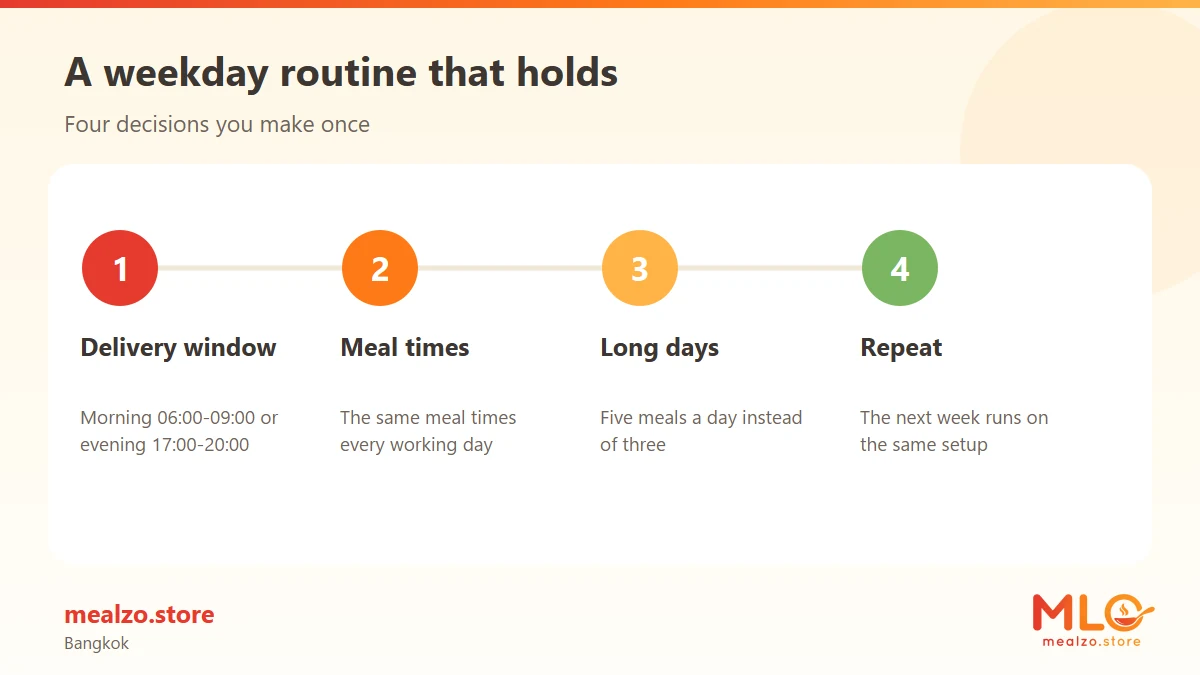
11. The fixed-window trade-off: convenience requires a receiving point
The biggest logistical trade-off is simple.
A fixed morning window of 06:00-09:00 can be convenient, but someone or somewhere needs to receive the food. If you leave home at 06:30 and your condo does not accept deliveries at reception, that window may not suit you.
The evening window of 17:00-20:00 solves that problem for some people, but creates another for anyone who is regularly away during those hours.
There is no delivery schedule that removes this basic reality. A meal plan is designed to reduce the need to decide what to eat every day, but the food still has to reach a real person or a suitable receiving point.
For many customers, that means setting up the system once: choose the window, confirm the condo or office procedure, provide accurate soi and building information, and establish chilled storage.
After that, the daily routine becomes much simpler.
Mealzo Bangkok also supports its website and mobile app in eight languages: Thai, English, Polish, German, French, Russian, Simplified Chinese and Burmese. Payment is exclusively online through PromptPay via Thai QR, processed by a payment provider. The courier does not collect cash.
FAQ
Can I choose a specific delivery minute within the window?
No specific minute should be assumed. Mealzo Bangkok provides two delivery windows, 06:00-09:00 and 17:00-20:00, and the customer selects one. Traffic, access and route conditions can affect the precise arrival time within that window.
What if my condo does not allow couriers upstairs?
Arrange a handover at the condo reception or another approved location. Check the building's policy before starting the plan and put the relevant instructions in the delivery note.
Can I receive my meals at the office?
Yes, provided the office can receive the delivery during the selected window and you have a suitable place to store the meals. A refrigerator or another appropriate chilled-storage arrangement should be available rather than relying on an air-conditioned lobby.
How long can a meal box stay at a lobby?
There is no single safe time that applies to every lobby. Temperature, exposure and the actual conditions matter. Treat reception as a handover point, not as long-term food storage, and arrange prompt transfer to suitable chilled storage.
Does Mealzo Bangkok offer separate Thai and international meal plans?
No. Every plan uses one mixed cuisine, combining Thai and international dishes within the same plan. The available choice is between different meal-plan types, not separate cuisine categories.
How are declared allergens handled?
Customers declare allergens from nine allergen groups. Dishes containing a declared allergen are not assigned to that customer. This describes the assignment mechanism and should not be interpreted as a guarantee that meals are allergen-free.
Mealzo Bangkok is a kitchen and meal delivery service operating exclusively in Bangkok, Thailand. We are not affiliated with similarly named services outside Thailand.
Find a Meal Plan That Fits
Compare Mealzo plans or use the calculator to explore meal options for your needs.