3-Day, 7-Day, 14-Day or 30-Day Diet Plans: How to Choose Your Subscription Length
Choosing a meal plan is not only about calories or whether you prefer Balanced, High Protein or Vegetarian food. There is another decision that affects how comfortably the service fits into your week: how long you want to commit to it.
A short package gives you room to test the routine. A longer package reduces how often you need to make the same food decision again. Neither is automatically better. The useful question is whether the package matches the part of your life you are actually trying to organise.
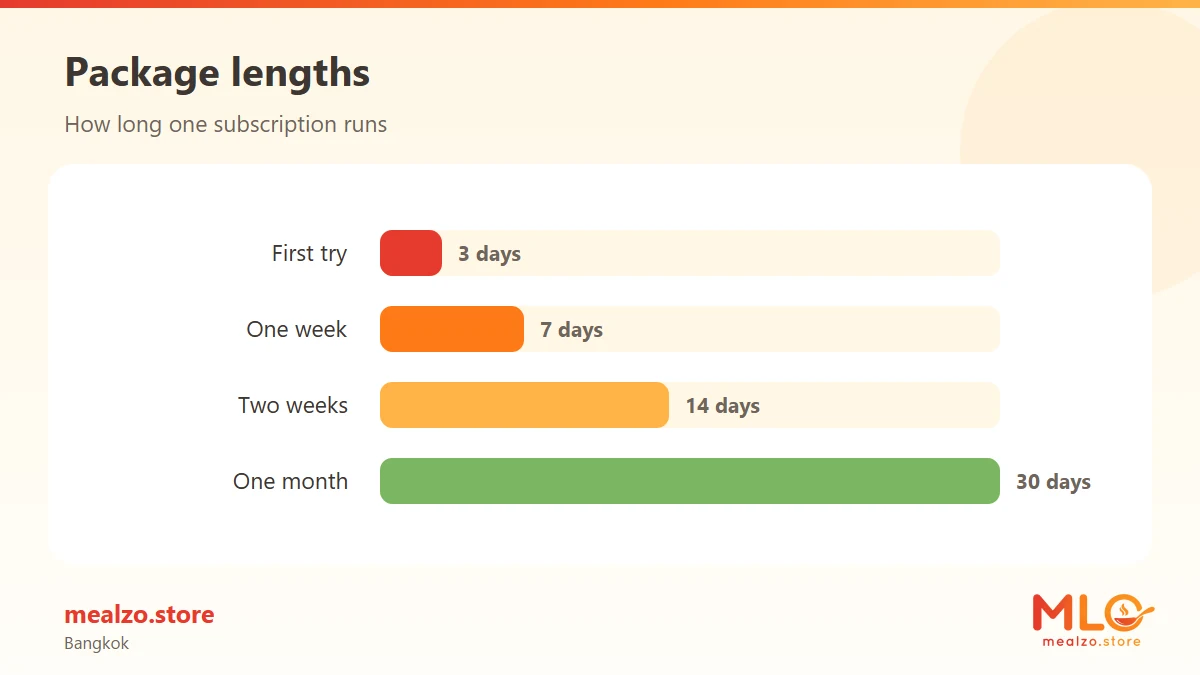
For Mealzo, the available durations are 3, 7, 14 and 30 days. Your ideal diet meal plan subscription length depends on your schedule, eating habits, social plans and how certain you already are about the diet, calorie level and number of meals you want.
1. Start with the problem you want the subscription to solve
Before comparing 3 days with 30 days, decide what you want the meal plan to take off your plate, figuratively as well as literally.
Some people are mainly trying to simplify weekday food decisions. Others want a structured way to cover more of their daily meals. Someone else may simply want to find out whether prepared meal delivery works with their Bangkok routine before committing for longer.
Those are different jobs, so they point toward different package lengths.
Ask yourself:
- Am I testing meal delivery for the first time?
- Do I want coverage for a particularly busy period?
- Is my weekly schedule predictable or does it change constantly?
- Do I regularly eat out with friends, colleagues or family?
- Have I already decided which diet and calorie level I want?
- Do I know whether 3 or 5 meals a day fits my routine?
If several of those questions are still unresolved, a shorter package can be useful. If your answers are already clear, repeatedly buying very short packages may simply mean making the same decision more often.
Key takeaway: Choose the subscription length around the period of your life you want to organise, not around the idea that a longer plan must be more serious.
2. What actually changes between 3, 7, 14 and 30 days?
The basic distinction is straightforward: duration changes how long the package covers. It does not tell you which diet, calorie level or meal frequency is appropriate.
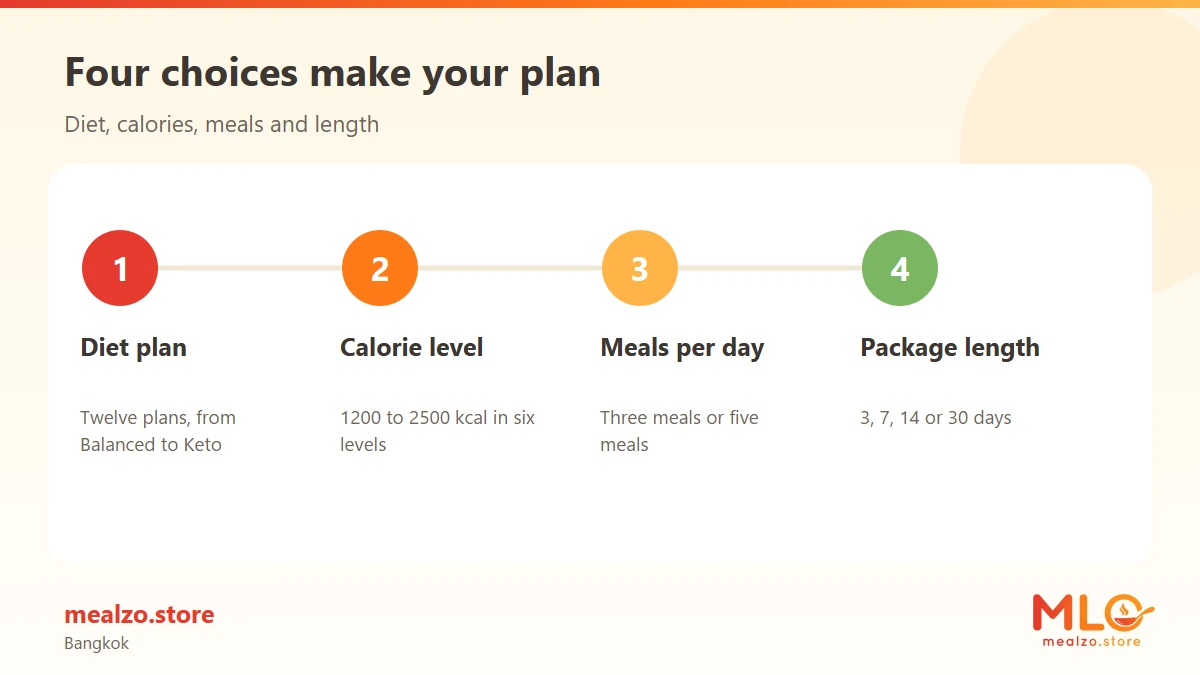
Mealzo offers 12 meal plans, six calorie levels, 3 or 5 meals per day, and four package durations. Duration is therefore only one part of the configuration. If you are still deciding between those elements, the broader guide to choosing your Mealzo plan explains how diet, calories, meals and duration fit together.
| Package | Best viewed as | Main advantage | Main trade-off |
|---|---|---|---|
| 3 days | Short trial period | Low commitment while you test the routine | May be too brief to represent a normal week |
| 7 days | One-week structure | Easy to compare against your usual weekly schedule | One unusual week can distort your impression |
| 14 days | Two-week routine | More time to experience normal variations in your schedule | Requires more confidence in your choices |
| 30 days | Longer-term food structure | Fewer repeated decisions about renewing the routine | Less suitable if your upcoming month is unpredictable |
This table is not a ranking. A three-day package can be the sensible choice for an uncertain schedule, while a 30-day package may suit someone whose routine is already settled.
3. A 3-day plan works best as a focused test
Three days is the shortest Mealzo package and therefore the easiest way to answer practical questions without turning them into a month-long commitment.
You can observe whether prepared meals work around your commute, office hours and evenings. You can also find out whether your chosen number of meals matches your appetite pattern and daily schedule.
Three days is particularly reasonable when several variables are new at once. Perhaps you have never used meal-plan delivery, you are trying a different style of food, or you are unsure whether 3 or 5 meals fits your day.
It has limitations. Three days may fall entirely inside an unusually quiet work period or, conversely, three chaotic days. That gives you information, but not necessarily a complete picture of your normal routine.
The short package also makes sense when you know your availability will change soon. There is little benefit in choosing a longer duration simply because longer sounds more committed.
4. A 7-day plan lets you test a complete week
Seven days is easier to judge against real life because many people's routines change between workdays and weekends.
A full week lets you notice whether meal delivery remains useful when your calendar changes. Office lunches, evenings at home and weekend plans may place very different demands on a subscription.
This matters particularly in Bangkok, where eating is often social as well as practical. A plan that fits Monday perfectly may feel different on Saturday when you want to go out for Thai food.
If cooking is the main alternative you are comparing, look beyond the food itself. Shopping, preparation, washing up and deciding what to cook all contribute to the workload. The comparison of meal subscriptions and home cooking looks at those practical differences in more detail.
Key takeaway: Seven days is long enough to expose the difference between your ideal routine and the week you actually live.
5. A 14-day plan gives your routine more than one chance
Two weeks can be useful when you already understand the basic idea of meal delivery but do not want to judge it from a single week.
A week can be unusually busy, unusually quiet or filled with social events. Fourteen days gives you a second cycle in which to see whether the routine still makes sense.
That does not mean two weeks prove whether a particular diet is "working" in a medical or health sense. A meal subscription is a food-planning tool, not a clinical test. What you can assess is much more practical: convenience, food preferences, meal timing and whether the package integrates into your normal day.
A 14-day commitment usually makes more sense when you have already narrowed down:
- the meal plan you want,
- your approximate calorie level,
- whether you prefer 3 or 5 meals,
- how often outside meals interrupt your schedule.
If those choices are still changing every few days, beginning shorter may provide more flexibility.
6. A 30-day plan is for an established routine
A 30-day package shifts the emphasis from testing the service to building food delivery into your calendar for a longer period.
That can suit someone whose month is fairly predictable and who is comfortable with their chosen configuration. Instead of reconsidering the package after a few days or every week, the food plan becomes one less recurring decision.
The trade-off is obvious: your future schedule matters more. A month containing travel, frequent dinners out or irregular working periods may not resemble an ordinary month at all.
Before choosing 30 days, look at your calendar rather than your motivation. Motivation can be high on the day you order. Your calendar is more likely to reveal whether the plan has somewhere realistic to fit.
7. Choose meals per day before choosing a long package
Duration and meal frequency interact. Mealzo offers either 3 or 5 meals per day, and that difference can change how much of your normal eating routine the subscription occupies.
Three meals may fit someone who wants the main eating occasions covered without structuring smaller meals around them. Five meals creates more eating occasions within the plan and therefore needs to fit more points in your daily schedule.
Neither format is inherently better. The question is logistical.
| Question | 3 meals may fit better when… | 5 meals may fit better when… |
|---|---|---|
| Daily schedule | You prefer fewer defined eating occasions | You prefer food divided across more occasions |
| Workday flexibility | Breaks are limited | You can accommodate additional meal times |
| Outside food | You want more room around the plan | You want the package to cover more of the day's eating occasions |
| First subscription | You already eat around three main meals | A five-meal structure already suits your routine |
If you are uncertain, the 3-meal versus 5-meal delivery comparison focuses specifically on that decision.
A longer subscription is easier to live with when the number of daily meals already feels natural. Duration cannot compensate for a meal frequency that conflicts with your day.
8. Do not use package length to solve a calorie question
Mealzo offers 1200, 1500, 1800, 2000, 2200 and 2500 kcal per day. These are separate choices from package duration.
The app includes a calorie calculator using the Mifflin-St Jeor formula. Its result is an estimate, not medical advice. It can provide a starting point for choosing among the available calorie levels, but the fact that a package lasts 30 days does not make one calorie level more appropriate than another.
| Decision | Available Mealzo options | What the decision changes |
|---|---|---|
| Diet | 12 meal plans | Style and dietary framework |
| Calories | 1200-2500 kcal | Planned daily energy level |
| Meals | 3 or 5 | Number of eating occasions |
| Duration | 3, 7, 14 or 30 days | Length of the package |
Treat these as four separate decisions. Combining them deliberately is easier than trying to use one setting to correct uncertainty about another.
Key takeaway: Package duration determines how long your plan runs; it does not determine which calorie level is appropriate for you.
9. Your cuisine preferences matter more on longer subscriptions
Food can be nutritionally organised and still become a poor fit if you simply do not want to eat it repeatedly.
That becomes more relevant as package length increases. Three days requires relatively little confidence in your food preferences. Thirty days deserves more thought about the kind of meals you actually enjoy as part of normal life.
Meal plans also need to coexist with Bangkok rather than pretend the city is not there. You may still want restaurant meals, street food or dinner with friends. A subscription that leaves realistic space for those occasions is often easier to follow than one designed around an imaginary month with no interruptions.
If cuisine style is part of your hesitation, compare Thai, international and mixed cuisine preferences before choosing the longest package.
10. Check delivery timing against the days you are committing to
Mealzo delivers across Bangkok in two windows: 06:00-09:00 and 17:00-20:00.
Those windows should be considered before duration, especially if your home or office schedule changes during the week. A delivery window that works comfortably on one type of day may require more planning on another.
Before selecting a package, check:
- where you are normally located during the relevant period,
- whether morning 06:00-09:00 or evening 17:00-20:00 fits better,
- whether your work pattern changes across the week,
- whether you have travel or extended time away planned,
- whether your social calendar makes some periods less predictable.
This is another reason not to choose 30 days solely because you want to "commit." A subscription should fit your logistics rather than compete with them.
11. Dietary restrictions deserve a separate check
If you have dietary restrictions, do not assume that choosing a particular subscription length changes how allergen handling works.
Mealzo allows customers to declare allergens from nine allergen groups. Dishes containing a declared allergen are then not assigned to that customer. This describes the assignment mechanism only; it is not a guarantee that meals are allergen-free.
The same principle applies to the 12 meal-plan categories. Balanced, Weight Loss, High Protein, Vegetarian, Vegan, Keto, Low-Carb, Gluten Free, Easy-to-Digest, Pescatarian, No Fish & Seafood, and Dairy & Egg Free describe plan choices. Duration is independent of them.
For someone still evaluating whether a particular plan matches their food requirements, a shorter subscription can make practical sense. But serious allergy decisions should never be reduced to "try it for three days and see."
12. A simple way to choose your diet meal plan subscription length
If you are still undecided, use uncertainty as the deciding variable.
Choose 3 days when you mainly want to test how meal delivery fits into your day.
Choose 7 days when you want to see the service across a complete week, including the difference between weekdays and weekends.
Choose 14 days when your basic choices are settled and you want to judge the routine across more than one week.
Choose 30 days when your schedule is predictable enough that you are comfortable building the plan into a larger part of the month.
There are exceptions. Someone with a three-day work project may know exactly what they need and choose the shortest package despite being an experienced meal-plan customer. Someone completely new to delivery may still have a highly predictable month and prefer 30 days. The framework is useful because it exposes the trade-offs, not because every person must move from 3 to 7 to 14 to 30 days in sequence.
Once you have decided how long you want the plan to run, you can compare Mealzo package options and prices alongside your preferred diet, calorie level and number of meals.
FAQ
Is a longer Mealzo package automatically better?
No. A longer package simply covers more days. It can be convenient when your routine and preferences are already clear, but a shorter package provides more flexibility when you are testing meal delivery or approaching a period with an uncertain schedule.
Should a first-time customer always choose 3 days?
Not necessarily. Three days is useful for a low-commitment test, but someone with a predictable routine may reasonably choose 7, 14 or 30 days. The better question is how confident you are about your diet, calorie level, meals per day and upcoming schedule.
Can I choose 3 or 5 meals regardless of package length?
Mealzo offers 3 or 5 meals per day and packages of 3, 7, 14 or 30 days. Meal frequency and package duration are separate parts of the plan configuration, so consider both when deciding how much of your daily eating routine you want structured.
Which subscription length is best for weight loss?
There is no package length that can guarantee a weight-loss outcome. Duration tells you how long the meal package covers. Calorie choice, food intake outside the plan and individual energy needs are separate considerations. Mealzo's Mifflin-St Jeor calculator provides an estimate rather than medical advice.
What if I eat out regularly in Bangkok?
Include those meals when choosing your subscription rather than pretending they will disappear. If restaurant meals, work dinners or weekends out are a normal part of your life, choose a duration and meal frequency that can coexist with them.
What delivery times should I consider before choosing a package?
Mealzo's Bangkok delivery windows are 06:00-09:00 and 17:00-20:00. Check which window fits your home or work routine across the entire period you are considering, particularly before choosing a 14- or 30-day package.
Find a Meal Plan That Fits
Compare Mealzo plans or use the calculator to explore meal options for your needs.