How to Choose Your MEALZO Plan: Diet, Calories, Meals and Duration
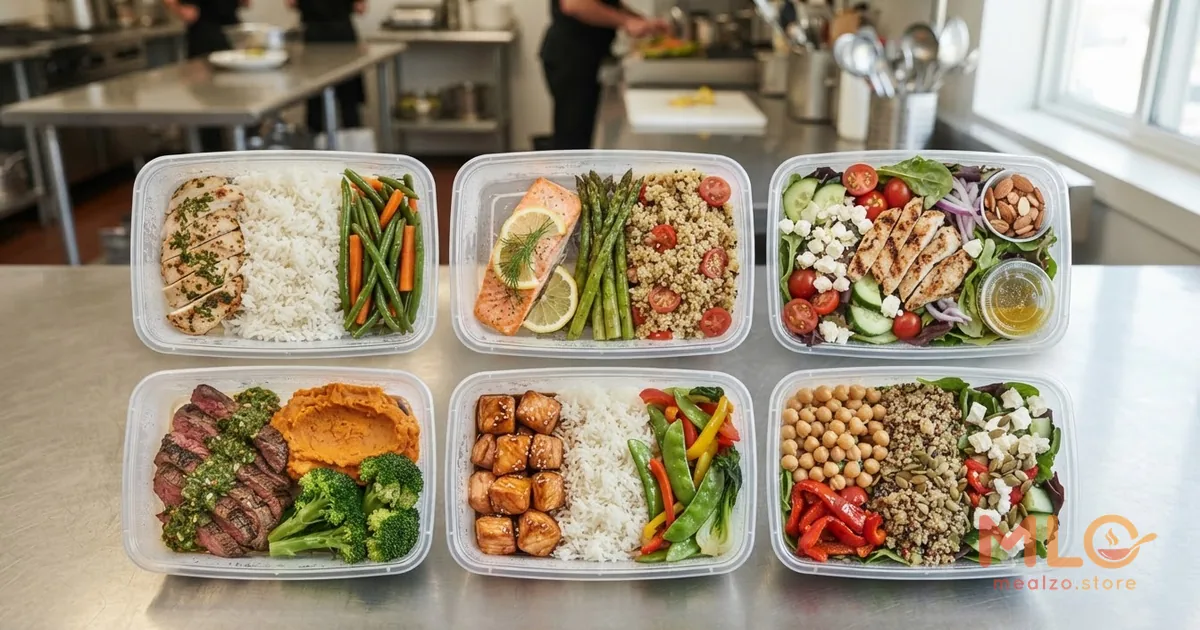
Choosing a meal plan sounds simple until several decisions arrive at once. Balanced or High Protein? 1500 or 2000 kcal? Three meals or five? A short three-day package or a full month? Each choice changes how the plan fits into your normal week, so it helps to separate the decisions instead of trying to solve everything at once.
The practical question is not which option looks strictest or most impressive. It is which combination you can realistically use while working, commuting, eating socially and dealing with the ordinary unpredictability of life in Bangkok.
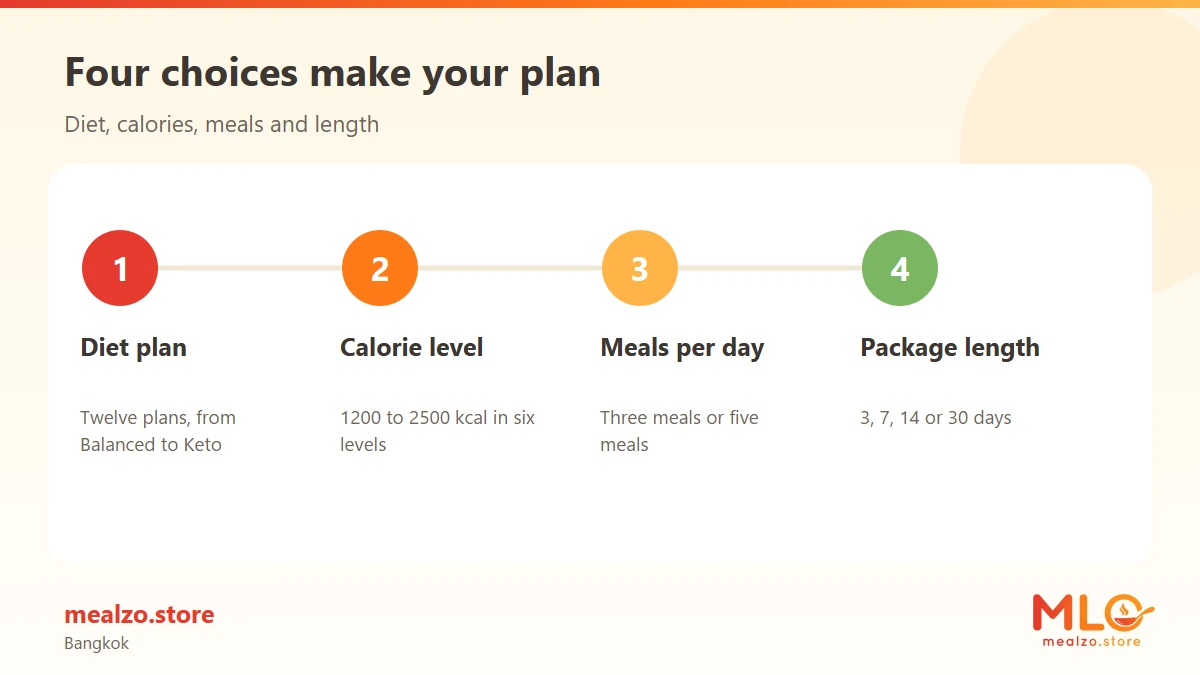
MEALZO gives you four main variables to choose from: the diet plan, daily calorie level, number of meals per day and package duration. Every plan uses one mixed menu with Thai and international dishes, while allergen declarations are handled separately.
This guide explains how to choose a MEALZO plan one decision at a time, including where the available options differ and when a seemingly obvious choice may not be the most practical one.

1. Start With the Part of Your Diet You Actually Want to Change
MEALZO offers 12 meal plans: Balanced, Weight Loss, High Protein, Vegetarian, Vegan, Keto, Low-Carb, Gluten Free, Easy-to-Digest, Pescatarian, No Fish & Seafood, and Dairy & Egg Free.
That is a broad list, but you do not need to compare all 12 equally. Start by asking what you need the plan to control.
For some people, the answer is mainly preference. They may want Vegetarian, Vegan or Pescatarian meals because that is how they normally eat. For others, the defining requirement is what they do not want included, which makes No Fish & Seafood or Dairy & Egg Free more relevant.
Plans such as Balanced, High Protein, Keto and Low-Carb describe a broader eating pattern rather than a single excluded ingredient. Weight Loss is a separate plan option, but choosing it does not remove the need to choose an appropriate calorie level. The plan name and the calorie setting are two different decisions.
| Plan | Useful starting point if you want to... |
|---|---|
| Balanced | Keep the choice relatively general rather than selecting a more specific plan type |
| Weight Loss | Choose the dedicated Weight Loss menu category while setting calories separately |
| High Protein | Select the High Protein menu category |
| Vegetarian | Avoid meat and fish within a vegetarian plan |
| Vegan | Choose the vegan plan category |
| Keto | Follow the Keto menu category |
| Low-Carb | Choose a lower-carbohydrate plan rather than Keto |
| Gluten Free | Select the Gluten Free plan category |
| Easy-to-Digest | Choose the Easy-to-Digest menu category |
| Pescatarian | Choose a pescatarian eating pattern |
| No Fish & Seafood | Exclude fish and seafood through the dedicated plan |
| Dairy & Egg Free | Exclude dairy and egg through the dedicated plan |
The table is a way to narrow the menu, not a set of health claims. A plan name describes the option you are selecting; it does not tell you how your body will respond to it.
Key takeaway: Choose the diet plan according to the eating pattern or food restriction you actually need, then treat calories as a separate decision.
2. Do Not Use the Plan Name as a Shortcut for Calories
One of the easiest mistakes when choosing a prepared meal plan is assuming that the diet label automatically answers the calorie question.
It does not.
MEALZO offers six daily calorie levels: 1200, 1500, 1800, 2000, 2200 and 2500 kcal. These calorie options sit alongside the diet plan choice. Someone choosing Balanced still needs to select a calorie level. The same is true for High Protein, Vegan, Keto, Weight Loss and the other plans.
This separation matters because two people can choose the same meal-plan category while needing very different amounts of food during the day. Their work routines, body sizes and normal eating patterns may differ considerably.
MEALZO includes a calorie calculator in the app using the Mifflin-St Jeor formula. It provides an estimate rather than medical advice. That distinction is useful: a calculator can give you a rational starting point, but it cannot know every detail of your daily life.
For a more detailed look at this decision, compare the six available calorie levels before selecting your package.
What the six calorie levels actually change
The available choices are straightforward:
| Daily level | What it represents in the MEALZO selector |
|---|---|
| 1200 kcal | Lowest available daily calorie level |
| 1500 kcal | Second available level |
| 1800 kcal | Mid-range option below 2000 kcal |
| 2000 kcal | One of the central higher-volume options |
| 2200 kcal | Higher daily level |
| 2500 kcal | Highest available daily calorie level |
There is no universal "best" number in that table. Choosing the lowest number simply because it is the lowest is not a sound selection method. Equally, selecting more food automatically because you worry about being hungry can miss the point of planning your intake in the first place.
Use the calculator estimate, compare it with the amount of food you normally eat, and consider whether the MEALZO meals will represent your entire day's planned food or only the structured part of it.
3. Decide Whether You Want Three Meals or Five
After diet type and calories, meal frequency is the next practical choice. MEALZO offers either three or five meals per day.
This decision is less about nutritional ideology and more about how you actually move through the day.
Three meals can suit someone whose schedule naturally revolves around breakfast, lunch and dinner or another three clear eating periods. Five meals divide the day's plan into more eating occasions, which may fit people who prefer to eat more frequently.
Neither format is inherently more disciplined. A five-meal plan can become inconvenient if you spend large parts of the day away from somewhere you can comfortably eat. A three-meal plan can feel poorly matched if your normal day is built around several smaller eating periods.
Ask yourself:
- How many times do you realistically stop to eat on a normal workday?
- Do you regularly eat outside the plan with colleagues, friends or family?
- Are you usually at home, at an office, travelling between meetings or moving around Bangkok?
- Would five planned meals simplify your day, or create five separate occasions you have to organise?
- Would three meals leave enough flexibility for the rest of your normal routine?
If this choice is the main source of uncertainty, compare the 3-meal and 5-meal formats in detail.
Key takeaway: The useful meal frequency is the one that matches your actual eating opportunities, not the one that looks more structured on paper.
4. Match the Package Length to How Certain You Are
MEALZO packages are available for 3, 7, 14 or 30 days.
The longer option is not automatically the sensible choice. Duration should reflect how confident you are about the combination of plan, calories and meal frequency you have selected.
A three-day package can make sense when you are still testing whether the basic format fits your schedule. Seven days gives you a longer view across a typical week. Fourteen days increases continuity, while a 30-day package is the longest available option for someone who already knows what structure they want.
| Duration | Consider it when... | Main trade-off |
|---|---|---|
| 3 days | You want a short introduction to the format | Limited time to judge how it fits different kinds of days |
| 7 days | You want to see how the plan works through a full week | Still relatively short compared with longer routines |
| 14 days | You want more continuity before committing to a month | Less flexible than starting with a short package |
| 30 days | You already have a clear plan, calorie and meal-frequency choice | Requires greater confidence in the setup you selected |
A short package is not only for beginners. It can also be useful during a temporary period when your normal routine has changed. Conversely, if your days are stable and you already know which configuration works for you, repeatedly choosing the shortest duration may simply create unnecessary decision-making.
The dedicated guide to choosing between 3, 7, 14 and 30 days goes deeper into the trade-offs.
5. Treat Bangkok Delivery as Part of the Plan, Not an Afterthought
Meal planning fails surprisingly easily when the food schedule and the delivery schedule do not fit the same life.
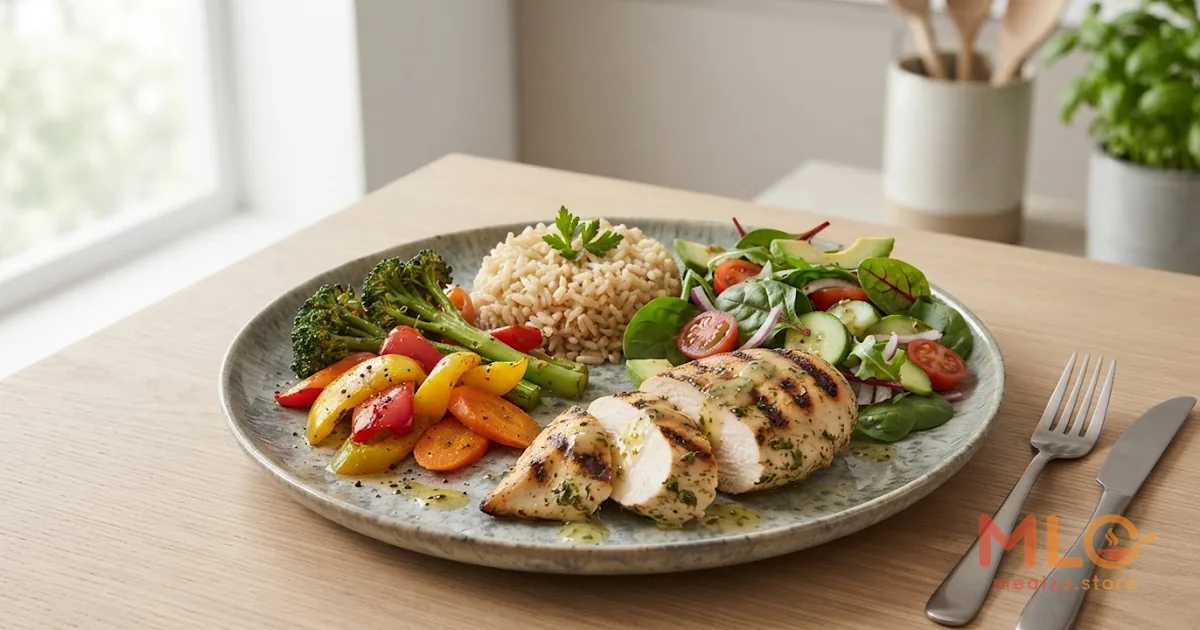
MEALZO delivers across Bangkok with two delivery windows: morning 06:00-09:00 or evening 17:00-20:00.
Those windows should be considered while you are choosing the package, especially if your days start early, finish late or vary substantially.
A morning window may fit one household perfectly and be inconvenient for another. The same is true of evening delivery. The question is simply which period works more reliably with where you are likely to be.
Think about the practical details before choosing:
- Are you normally available at the delivery location during 06:00-09:00?
- Is 17:00-20:00 more predictable for your routine?
- Does your work pattern change significantly between weekdays and other days?
- Will you regularly be away from the delivery location?
- Are you choosing five meals even though your schedule makes carrying or organising several eating occasions awkward?
These are mundane questions, which is precisely why they matter. A theoretically suitable meal plan becomes less useful if the logistics constantly fight your schedule.
6. Understand the Mixed Cuisine Menu
MEALZO does not offer separate Thai, International or Mixed cuisine choices. Every plan uses one mixed menu that combines Thai and international dishes.
Cuisine therefore is not a setting you need to choose when building a package.
Focus instead on the plan, calorie level, number of meals and package duration.
The mixed menu applies across Mealzo plans, so you can make the other package choices without selecting a separate cuisine style.
You can read how the mixed cuisine menu works.
Key takeaway: Cuisine is fixed as one mixed menu combining Thai and international dishes, so it is not an extra package choice.
7. Keep Allergen Declarations Separate From Diet-Plan Labels
Diet-plan categories and allergen handling solve different problems.
MEALZO allows customers to declare allergens from nine allergen groups. When an allergen is declared, dishes containing that declared allergen are not assigned to that customer.
That describes the assignment mechanism. It should not be turned into a broader guarantee that a meal is allergen-free.
This distinction matters when comparing, for example, a Gluten Free plan or a Dairy & Egg Free plan with an allergen declaration. The plan describes the meal-plan category you selected. The allergen system separately affects which dishes can be assigned based on your declarations.
If avoiding a particular allergen matters to you, use the declaration system rather than assuming the name of another dietary plan covers your specific situation.
Similarly, do not choose a restrictive-sounding plan just because it appears to exclude more foods. Choose the plan you actually want, then declare the relevant allergen groups separately.
A simple way to think about the two systems
- Diet plan: determines the plan category you are ordering.
- Allergen declaration: tells the assignment system not to assign dishes containing your declared allergen.
- Calorie level: determines your selected daily calorie level.
- Meal frequency: determines whether your daily plan contains three or five meals.
- Duration: determines whether your package runs for 3, 7, 14 or 30 days.
These settings work together, but they should not be mentally collapsed into one choice.
8. Build the Plan Around Normal Life, Including Meals You Will Eat Elsewhere
A meal-delivery plan does not make restaurants, family meals, work lunches or social plans disappear.
That is particularly relevant in Bangkok, where your eating schedule may change from one day to the next. You might have a structured weekday and a much less predictable evening. You may eat most meals at home but still have lunch meetings. Or you might use delivered food mainly to reduce decisions during working hours.
You do not have to pretend those meals outside the plan will stop happening.
Instead, decide how much of your day you actually want MEALZO to structure. Three meals may be enough if you deliberately want some eating occasions outside the package. Five can make more sense when you want more of the day's food organised in advance.
This is also where calorie selection needs context. A chosen calorie level describes the MEALZO plan for the day. Your real daily intake can differ if you add food or drinks outside it. That is not a moral failure; it is simply part of understanding what the plan represents.
The more accurately you acknowledge your normal routine before ordering, the less likely you are to choose a configuration based on an imaginary version of your week.
9. Use a Simple Order of Decisions
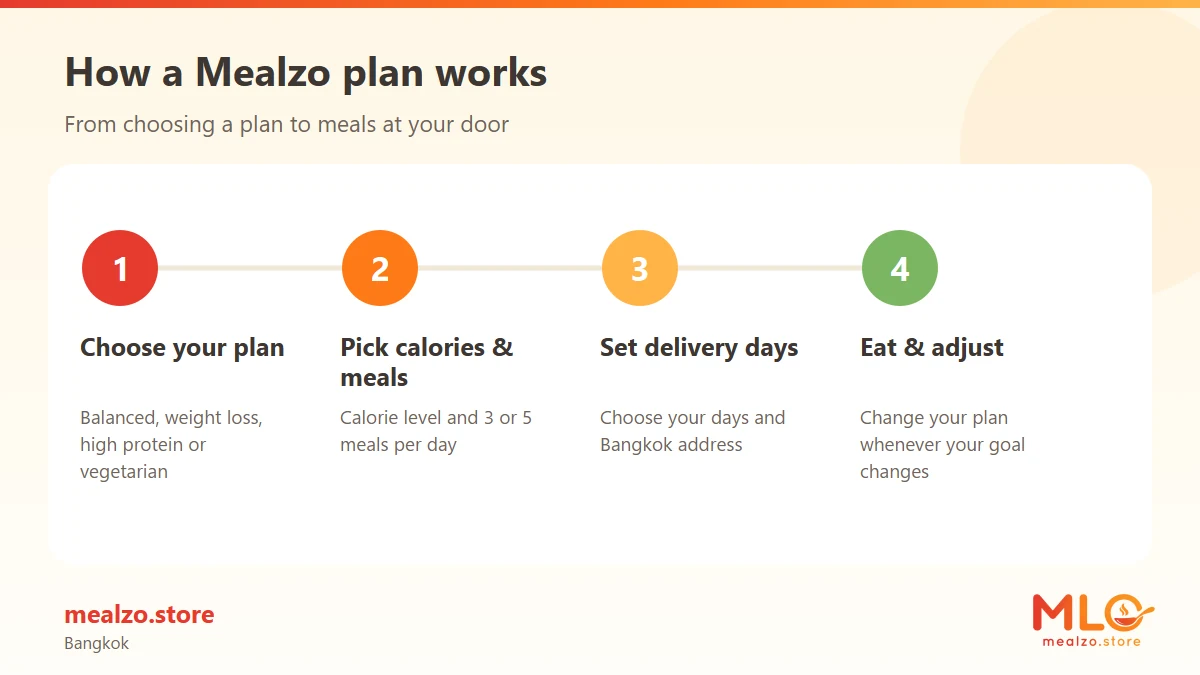
If the number of combinations feels excessive, make the choices in a fixed sequence.
First choose the dietary plan. Then select calories. Next decide between three and five meals. After that, choose the package length. Finally, check your delivery window and allergen declarations.
In practical terms:
- Pick the plan category that matches how you want to eat.
- Use the calorie calculator as an estimate and choose from 1200, 1500, 1800, 2000, 2200 or 2500 kcal.
- Decide whether three or five daily meals fit your schedule.
- Choose 3, 7, 14 or 30 days according to how certain you are about the setup.
- Note that every plan uses one mixed menu with Thai and international dishes.
- Declare any relevant allergens through the allergen system.
- Choose the delivery window that fits your day: 06:00-09:00 or 17:00-20:00.
This order is useful because each decision answers a different question. You avoid using calorie level as a substitute for choosing a diet, or using a diet label as a substitute for declaring an allergen.
10. Check the Whole Combination Before You Order
Before placing an order, look at the configuration as one package rather than treating each setting as unrelated.
Suppose you like the idea of a particular diet plan but dislike eating five times per day. That is a sign to reconsider the meal count, not necessarily the diet itself. If 30 days feels like too much commitment but everything else looks right, shorten the duration rather than rebuilding the whole plan.
Likewise, if you are comfortable with Balanced but unsure about calories, solve the calorie question specifically. You do not need to switch to a more restrictive plan just to make the choice feel more deliberate.
A final check can be very short:
- Is this the diet category I actually want?
- Does the selected calorie level make sense as an estimate for my situation?
- Will I realistically eat three or five planned meals?
- Am I comfortable using this setup for the full package duration?
- Am I comfortable with the mixed menu of Thai and international dishes over that period?
- Have I made the relevant allergen declarations?
- Does the chosen Bangkok delivery window fit where I will normally be?
If all seven answers are clear, you have done most of the useful thinking already.
Key takeaway: When one part of a MEALZO configuration feels wrong, adjust that variable first instead of replacing the entire plan.
You can then view the available MEALZO plans and build the combination that fits your normal routine.
FAQ
How do I choose a MEALZO plan if I am not sure which diet type I need?
Start with the least complicated description of how you actually want to eat. MEALZO offers 12 categories, ranging from Balanced to more specific options such as Vegan, Keto, Gluten Free, Pescatarian, No Fish & Seafood and Dairy & Egg Free. If you do not have a clear reason to choose a specialised category, compare the plan names by what they change rather than assuming a more restrictive option is automatically better.
Which MEALZO calorie level should I choose?
MEALZO offers 1200, 1500, 1800, 2000, 2200 and 2500 kcal per day. The app includes a calorie calculator based on the Mifflin-St Jeor formula, which provides an estimate rather than medical advice. Use that estimate as a starting point and consider how the delivered plan fits with anything else you normally eat during the day.
Is a 3-meal or 5-meal plan better?
Neither is universally better. Three meals may fit people with three clear eating periods, while five meals may suit people who prefer more frequent planned eating occasions. The more useful choice is the one that fits your daily schedule without creating meals you regularly cannot or do not want to eat.
Should I start with a 3-day plan or choose 30 days immediately?
That depends on how certain you are about your configuration. Three days provides a short introduction, while 7 and 14 days give you more time with the setup. A 30-day package makes more sense when you are already comfortable with the diet type, calories, meal frequency and the mixed menu format.
How does MEALZO handle declared allergens?
Customers can declare allergens from nine allergen groups. Dishes containing a declared allergen are then not assigned to that customer. This describes the dish-assignment process and should not be interpreted as a guarantee that any meal is allergen-free.
Can I choose a separate cuisine style?
No. Every MEALZO plan uses one mixed menu that combines Thai and international dishes. Cuisine is not selected separately from the diet plan.
Find a Meal Plan That Fits
Compare Mealzo plans or use the calculator to explore meal options for your needs.