1200-2500 Calorie Meal Plans: How to Choose the Right Calorie Level

Choosing a calorie level sounds simple until you have to live with the choice. A lower number may look efficient on a calculator, but meals still have to carry you through meetings, commuting, exercise, social plans and an ordinary Bangkok day.
Meal plan calorie levels are best treated as practical starting points rather than labels such as “good,” “bad,” “strict” or “healthy.” The right level depends partly on how much energy your body uses and partly on whether the amount of food is realistic enough to follow consistently.
MEALZO offers six daily calorie levels: 1200, 1500, 1800, 2000, 2200 and 2500 kcal. The useful question is not simply which number is lowest. It is which level makes sense for your estimated needs, activity and reason for ordering a meal plan.
This guide explains what those numbers mean, where calorie calculators help, why activity matters and what to review once you have started eating at a chosen level.
1. What meal plan calorie levels actually mean
A daily calorie level describes the approximate amount of food energy planned across the day. If a package is set at 1800 kcal, for example, the meals for that day are structured around that calorie level rather than around an arbitrary idea of small, medium or large portions.
Calories themselves are simply units of energy. Your body uses energy continuously: for basic physiological functions, digestion, movement, exercise and everything else involved in getting through the day.
That means the same calorie level can feel quite different to two people. Someone with a desk-based routine may have different needs from a person who walks extensively, trains several times a week or works a physically demanding job.
It is therefore more useful to think of the six MEALZO levels as points on a scale:
| Daily level | Practical way to view it | What deserves attention |
|---|---|---|
| 1200 kcal | Lowest available MEALZO level | Whether the amount is genuinely appropriate and sustainable for you |
| 1500 kcal | Lower-calorie option | Hunger, activity and how much food you eat outside the plan |
| 1800 kcal | Moderate option | Whether it matches your estimated daily needs and routine |
| 2000 kcal | Mid-range option | Activity level, body size and overall intake |
| 2200 kcal | Higher-energy option | Training, movement and appetite |
| 2500 kcal | Highest available MEALZO level | Whether your lifestyle genuinely requires a higher intake |
The table is not a prescription. A person's calorie requirements cannot be determined from a meal-plan name alone.
Key takeaway: Choose a calorie level in relation to your estimated energy needs, not because a particular number sounds more disciplined.
2. Start with an estimate, not a guess
The easiest place to begin is a calorie-needs estimate. MEALZO includes a calorie calculator in the app using the Mifflin-St Jeor formula.
The formula estimates basal energy requirements using personal inputs and then helps place those requirements in the context of daily energy needs. It is useful because it gives you a more rational starting point than simply choosing the lowest calorie package.
It is still an estimate. Real life includes variables that a formula cannot measure perfectly, including differences in everyday movement, training volume and how accurately people describe their activity.
For a practical starting point, use the MEALZO calorie calculator and treat the result as guidance rather than an exact daily requirement.
If you want to understand how movement changes calorie requirements before selecting a plan, the guide to daily calorie needs by activity level explains the difference between sedentary, moderately active and more active routines.
Useful inputs to consider include:
- your age, height and body weight;
- your normal activity rather than your most active day of the month;
- whether you train regularly;
- how much walking and standing you actually do;
- whether the meal plan will represent your full intake or only part of it.
That last point matters more than it first appears. A 1800 kcal meal plan does not mean your daily intake is necessarily 1800 kcal if you also have drinks, snacks, restaurant meals or food at home.
3. Understand the relationship between calories and body weight
Body weight is influenced by energy balance over time. In simple terms, your body takes in energy through food and drink and expends energy through basic bodily functions, digestion and activity.
When energy intake stays below energy expenditure over time, the body must obtain some of the missing energy from stored tissue. When intake consistently exceeds expenditure, the excess energy can contribute to increasing stored body mass.
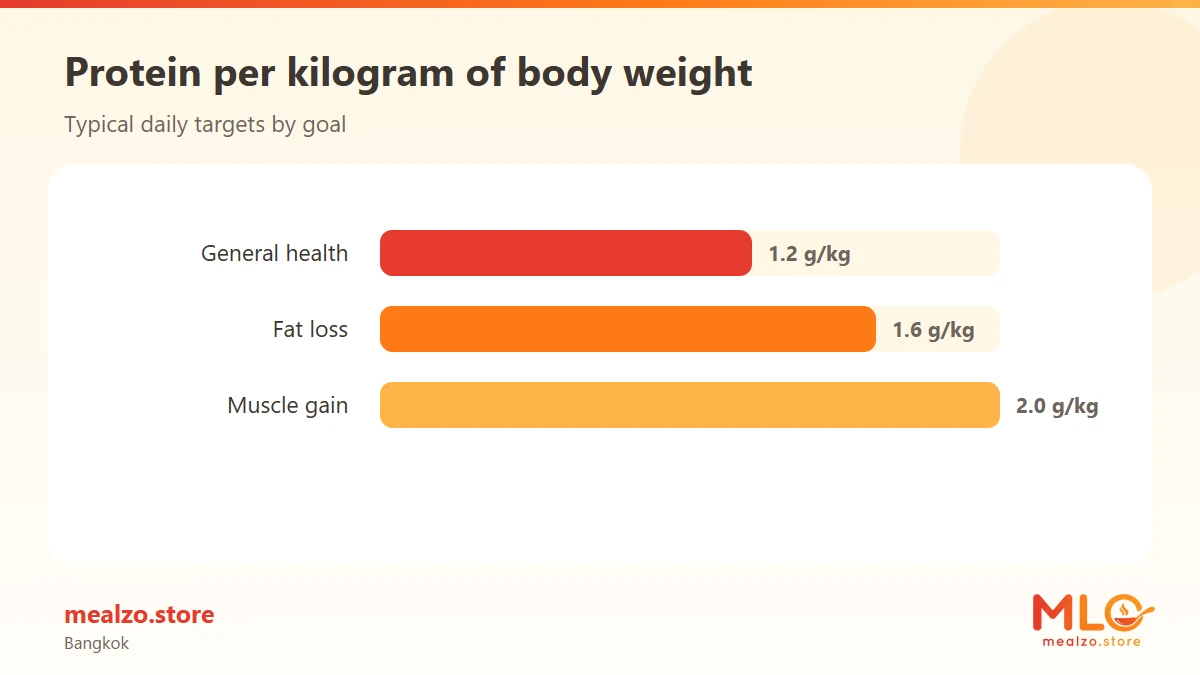
That is the underlying mechanism behind a calorie deficit. It does not mean that the lowest possible intake is automatically the best approach.
A very aggressive gap between intake and expenditure can make a plan difficult to maintain. Hunger may become distracting, training may become harder to support, and people may compensate by eating substantially more outside the planned meals.
For a fuller explanation of the mechanism, see how a calorie deficit works. The important point when choosing between 1200 and 2500 kcal is that the target should make sense relative to your own estimated expenditure.
If your goal relates specifically to reducing body weight, the complete guide to weight loss meal plans in Bangkok gives broader context around meal structure, consistency and choosing a plan that fits daily life.
4. How to think about 1200 and 1500 kcal plans
The two lowest MEALZO levels are 1200 and 1500 kcal per day. They should not automatically be treated as default options for anyone trying to eat less.
A lower calorie allocation means there is less total food energy available across the day. That makes meal composition particularly important, but it also means the gap between planned intake and someone's actual energy needs can become large if that person is active or naturally has higher requirements.
Before choosing one of these levels, ask practical questions:
- Did a calculator estimate place your needs reasonably close to this range?
- Will you be eating additional food outside the plan?
- Do you have a mostly sedentary routine or a demanding one?
- Are you repeatedly hungry when trying similar intakes?
- Does choosing the lower number lead to unplanned eating later?
The last question is worth taking seriously. A theoretical plan that looks precise on paper may be less useful than a slightly higher level that fits normal life more comfortably.
There are also circumstances in which generic calorie planning deserves professional input rather than self-selection. People with medical conditions, specific clinical nutrition requirements, pregnancy-related needs or a history that makes restrictive eating inappropriate should not rely on a standard online calorie guide as personalized medical advice.
5. Why 1800 and 2000 kcal often need context, not assumptions
The middle of a calorie range can appear automatically “balanced,” but 1800 or 2000 kcal is not universally moderate. For one person it may be below daily expenditure; for another it may be close to maintenance; for someone else it could exceed typical needs.
This is where activity level changes the picture.
Imagine two people with broadly similar body size. One works from home and moves relatively little during the day. The other walks between locations, spends substantial time on their feet and trains in the evening. Their energy expenditure can differ enough that the same meal plan produces a very different experience.
Bangkok routines also vary considerably. Some people move mainly between a condominium, car and office. Others walk to public transport, change trains, climb stairs and accumulate substantial daily movement without considering it formal exercise.
This is why activity should be assessed from your normal week, not from whether you identify as someone who “works out.”
Key takeaway: A calorie number has meaning only in relation to the person eating it and the amount of energy that person typically uses.

6. When 2200 or 2500 kcal may make more sense
Higher meal plan calorie levels can be appropriate when energy requirements are higher. That may apply to larger individuals, people with high levels of daily movement or those whose training adds meaningful energy expenditure.
The mistake is assuming that a higher-calorie meal plan contradicts an intention to manage body weight. If someone's actual daily expenditure is relatively high, a plan at 2200 or 2500 kcal can still sit below that expenditure.
Conversely, choosing 2500 kcal because you exercise occasionally does not automatically make it suitable. Exercise is only one part of total energy expenditure.
A useful comparison is:
| Situation | What to consider before choosing |
|---|---|
| Mostly seated day, little structured exercise | A higher plan may exceed requirements for some people |
| Regular walking plus occasional training | Estimate total needs rather than counting workouts alone |
| Frequent structured training | Consider whether lower levels leave enough energy for the rest of the day |
| Physically active occupation | Everyday movement may contribute substantially to expenditure |
| Plan is only part of daily food intake | Include food and drinks consumed outside the package |
| Plan covers most daily eating | The selected calorie level becomes more important to overall intake |
If you regularly train, pay attention not only to calories but also to how the overall plan fits the demands of your routine. A lower figure is not inherently more effective if it results in a pattern you cannot realistically maintain.
7. Calorie level is only one part of choosing a MEALZO plan
MEALZO has six calorie levels, but calorie intake is only one variable in the package.
There are 12 meal plans: Balanced, Weight Loss, High Protein, Vegetarian, Vegan, Keto, Low-Carb, Gluten Free, Easy-to-Digest, Pescatarian, No Fish & Seafood, and Dairy & Egg Free.
You can also select either 3 or 5 meals per day and package lengths of 3, 7, 14 or 30 days.
This creates several separate decisions:
- which type of meal plan fits the way you want to eat;
- which calorie level is appropriate;
- whether you prefer 3 or 5 meals;
- how long you want the package to run;
- which spice level you want.
MEALZO provides six spice settings: not spicy, mild, medium, standard, hot and Thai-spicy. You choose one for the package and can change it later.
The broader guide to choosing your MEALZO plan explains how diet type, calories, meal frequency and package duration fit together.
A person can therefore select the same calorie level in different plan formats depending on dietary preferences. Calories describe total energy; they do not by themselves describe what types of food make up the diet.
8. Three meals or five meals does not change what the daily calorie target means
Meal frequency is easy to confuse with daily calorie intake. They are related operationally, but they are not the same thing.
If two packages use the same daily calorie level, choosing 3 meals rather than 5 does not mean you have selected a different daily calorie target. It changes how the day's food is distributed.
Some people prefer fewer, more substantial eating occasions. Others like having food spread across more points during the day. Work schedules can make one option considerably more practical than the other.
For someone spending long periods in meetings, three meals may be simpler. Someone with a long day who dislikes large gaps between meals may prefer five.
Neither pattern is inherently superior for everyone. The better question is which structure reduces friction in your actual routine.
Key takeaway: Choose meal frequency for practicality and appetite pattern; choose calorie level for total daily energy needs.
9. Check what you eat outside the meal plan
A calorie-controlled meal plan can organize a large part of your food intake, but it cannot account for everything you decide to consume outside it.
Coffee additions, alcoholic drinks, snacks, desserts, convenience-store purchases and restaurant meals all contribute energy. That does not mean they must be prohibited. It simply means they belong in the overall picture.
This becomes especially relevant when someone selects a very low meal-plan level but regularly adds substantial food later in the day. The number printed on the plan may then have little resemblance to total intake.
A useful review looks like this:
| Check | Why it matters |
|---|---|
| Drinks with calories | Easy to overlook because they are not part of a plated meal |
| Snacks between meals | Can materially change total intake |
| Restaurant meals | Portions and ingredients may differ from your usual plan |
| Weekend eating | A weekday routine may not describe the whole week |
| Training-day extras | Added food may be reasonable but still counts toward total intake |
| Hunger-driven eating | May indicate that the selected level is not practical for your routine |
The aim is not to create perfect accounting. It is to avoid making decisions based on only one part of your eating pattern.
10. Review the plan after you start using it
The first calorie choice does not have to be treated as permanent. A calculator produces an estimate, and your experience after using the plan provides additional information.
Give attention to patterns rather than reacting to a single unusual day.
Questions worth reviewing include:
- Is hunger manageable between meals?
- Are you repeatedly adding substantial food because the planned amount feels too low?
- Has your activity changed?
- Are you leaving food regularly because the selected level is more than you want?
- Does the meal frequency work with your job and commuting schedule?
- Is the plan practical on both quieter days and busier ones?
If the answers consistently point in one direction, reconsidering the calorie level may make more sense than forcing yourself to adhere to the original choice simply because it came from a calculator.
This also applies when circumstances change. A period with little exercise may not require the same approach as a month of regular training. A new job can alter daily walking. Travel, schedule changes and eating outside the home can all affect how useful a particular plan feels.
MEALZO delivers across Bangkok in two delivery windows: morning from 06:00-09:00 and evening from 17:00-20:00. Delivery timing does not change calorie needs, but it can affect how conveniently the plan fits your routine.
The package can also be set for 3, 7, 14 or 30 days. If you are uncertain about meal structure or calorie level, the practical advantage of thinking carefully before committing to a longer period is simply that your real routine often teaches you things a calculator cannot.

11. Dietary restrictions and allergens are a separate decision
Calorie selection should not be confused with allergen handling or dietary-plan selection.
MEALZO allows customers to declare allergens from nine allergen groups. Dishes containing a declared allergen are then not assigned to that customer.
That describes the assignment mechanism; it should not be interpreted as a guarantee that a meal is completely free from an allergen.
Similarly, plan labels such as Gluten Free, Vegetarian, Vegan, Pescatarian or Dairy & Egg Free describe different dietary configurations. They do not determine which calorie level is appropriate for a particular person.
Someone selecting a Vegetarian plan may need 1500 kcal, 2000 kcal or 2500 kcal depending on their own energy requirements. The same principle applies to High Protein, Low-Carb, Keto and the other available plans.
Key takeaway: Diet type, allergen declarations and calorie level solve different planning problems and should be selected separately.
12. A practical way to choose your starting calorie level
If the six choices still feel abstract, reduce the decision to a short process.
First, estimate your daily calorie needs using the calculator. Avoid deliberately understating your activity simply to produce a lower result.
Second, compare that estimate with the available MEALZO levels: 1200, 1500, 1800, 2000, 2200 and 2500 kcal.
Third, decide what role the meal plan will play in your day. If you expect it to provide most of your food, the selected level should reflect that. If you routinely eat outside the plan as well, account for that rather than pretending the extra food does not exist.
Fourth, choose between 3 and 5 meals according to your schedule and preferred eating pattern.
Finally, review the choice once you have lived with it. If the plan repeatedly leaves you needing substantial additional food, or if you regularly cannot finish what is provided, the original level may need reconsideration.
A calorie target is useful because it gives structure. It becomes less useful when treated as a rule that must never be adjusted despite clear evidence from your everyday routine.
FAQ
Is 1200 kcal the best MEALZO level for weight loss?
Not necessarily. Weight change depends on energy intake in relation to energy expenditure, so the lowest available plan is not automatically the most appropriate choice. Your estimated calorie needs, activity and food consumed outside the plan all matter.
Should I choose 1800 or 2000 kcal?
Start by estimating your daily needs rather than choosing between the two based on the numbers alone. If your estimated expenditure sits near that range, consider your activity, hunger, additional snacks or meals and how much of your daily food the MEALZO package will provide.
Do I need more calories if I exercise?
Exercise increases energy expenditure, but the effect depends on the type, duration and frequency of activity as well as the rest of your daily movement. Use your normal activity pattern when estimating calorie needs rather than automatically moving to a higher plan because you train occasionally.
Is five meals better than three for controlling calories?
Not inherently. With the same daily calorie level, three and five meals are different ways of distributing food across the day. Choose the option that works better with your appetite, working hours and normal routine.
Can I change my calorie level if my needs change?
Your calorie requirements can change as activity, body weight, training and routine change. Reassessing your chosen level is therefore reasonable rather than assuming that one estimate must remain appropriate indefinitely.
Does choosing a specific Mealzo diet determine how many calories I need?
No. The diet plan and calorie level are separate choices. Balanced, High Protein, Vegetarian, Vegan, Keto and the other MEALZO plans can be considered independently from whether 1200, 1500, 1800, 2000, 2200 or 2500 kcal is suitable for your estimated energy needs.
Find a Meal Plan That Fits
Compare Mealzo plans or use the calculator to explore meal options for your needs.