Daily Calorie Needs by Activity Level: Sedentary to Highly Active

Daily calorie needs are not fixed. Two people of similar size can eat very different amounts and still maintain a stable body weight because their days demand different amounts of energy.
That difference is often described through activity level: sedentary, lightly active, moderately active, very active, or highly active. The labels are useful, but they are also rough. A desk job with an evening gym session is not automatically the same as a job that keeps you walking for eight hours.
Bangkok makes this especially easy to misjudge. You might spend most of the working day at a computer, walk through a BTS station, climb a few flights of stairs, train after work, then spend the evening sitting again. Another person may work on their feet all day without ever doing a formal workout.
Understanding calorie needs by activity level is therefore less about finding one perfect number and more about choosing a sensible starting point, observing what your normal routine actually looks like, and adjusting from there.
1. What Daily Calorie Needs Actually Mean
Your body uses energy even when you are doing nothing visibly active. Breathing, circulating blood, maintaining body temperature and supporting normal cellular processes all require calories.
The energy you use across a full day can be thought of as several parts:
- energy required for basic bodily functions
- energy used while digesting and processing food
- energy spent during deliberate exercise
- energy used through everyday movement such as walking, standing, carrying bags and climbing stairs
Together, these make up your approximate total daily energy expenditure.
This is why simply asking, "How many calories does a person need?" is not enough. Age, body size and other individual factors matter, but so does the difference between sitting through most of the day and spending hours moving.
A calculator can provide a structured starting estimate. Mealzo's app uses the Mifflin-St Jeor formula as part of its calorie calculator, but the result should still be treated as an estimate rather than medical advice. You can start with the Mealzo calorie calculator and then consider whether the selected activity category resembles your real week.
Key takeaway: Your calorie target is an estimate of daily energy use, not a permanently correct number.
2. Why Activity Level Changes Calorie Requirements
Movement requires energy. That sounds obvious, but the important detail is that "activity" includes much more than exercise.
Someone who works at a desk and trains for 45 minutes may still spend most of the day relatively inactive. A shop employee, chef, teacher or hospitality worker might accumulate far more movement through ordinary work even without visiting a gym.
The effect also varies from day to day. A weekday spent commuting, walking between meetings and training may require more energy than a quiet Sunday at home.
That is why activity classifications work best as summaries of a typical routine rather than descriptions of one unusually busy day.
| Activity level | What the day may look like | Main source of movement |
|---|---|---|
| Sedentary | Mostly sitting with limited walking | Basic daily tasks |
| Lightly active | Some walking and occasional exercise | Daily movement plus light training |
| Moderately active | Regular exercise or a generally mobile routine | Exercise and everyday activity |
| Very active | Frequent training or physically demanding work | High movement throughout the day |
| Highly active | Heavy training combined with substantial daily movement | Training plus sustained physical activity |
These categories overlap. There is no sharp line where "lightly active" becomes "moderately active."
3. Sedentary: When Most of the Day Is Spent Sitting
A sedentary routine usually means that sitting occupies most of the working and leisure day.
Typical examples include:
- office or remote work at a computer
- commuting mainly by car, taxi or public transport
- limited walking outside necessary errands
- little or no structured exercise
This does not mean the person never moves. It means movement contributes relatively little to total daily energy expenditure.
One common mistake is assuming that a short gym session automatically makes an otherwise sedentary day "very active." It may increase energy use, but the remaining 23 hours still matter.
If your routine fits this pattern, starting with a conservative activity estimate is usually more sensible than choosing a higher category because you occasionally train hard.
For people comparing specific Mealzo calorie options, this guide to choosing between 1200 and 2500 calorie meal plans explains how calorie levels can be considered without treating one level as universally correct.
4. Lightly Active: More Movement, but Still Plenty of Sitting
Light activity often describes people whose days include meaningful movement without sustained physical work or frequent demanding training.
You might walk to and from public transport, move around an office, do errands on foot and exercise a few times during the week. You are not inactive, but movement is not the dominant feature of your day.
In Bangkok, this can include someone who uses BTS or MRT regularly and walks between stations, offices, malls and home. Those short walking periods add up differently from travelling door to door by car.
At the same time, it is easy to overestimate their effect. Walking around a shopping centre on Saturday does not necessarily change a mostly seated week into a highly active one.
The best classification is the one that reflects your repeated routine.
Key takeaway: Classify your activity from an ordinary week, not your busiest workout or most active day.
5. Moderately Active: Regular Training Meets Everyday Movement
Moderate activity is often where classification becomes less obvious.
A person could reach this level through regular structured exercise, through a job that involves substantial walking, or through a combination of both. The exact pattern matters less than the fact that movement consistently represents a meaningful part of the week.
For example, a person might:
- train several times during the week
- walk regularly as part of commuting
- spend portions of the working day standing or moving
- have active weekends rather than spending them almost entirely seated
This category should still be approached as an estimate. Exercise intensity differs widely. An easy session and a demanding training session cannot be treated as interchangeable simply because both last an hour.
It is also possible for someone's activity level to change temporarily. A busy work period may reduce training. A holiday may increase daily walking. Someone recovering from an injury may be less active than usual.
Rather than constantly changing your calorie plan after every unusual day, it is usually more practical to consider your broader pattern.

6. Very Active and Highly Active: Where Underestimating Movement Becomes Easier
Very active and highly active routines involve substantial energy expenditure from training, work or both.
This may include people who train hard and frequently, workers whose jobs involve hours of physical movement, or people combining demanding exercise with an active occupation.
The distinction between very active and highly active is not especially useful if it creates false precision. What matters is recognising that a person who moves for much of the day has different energy requirements from someone who trains briefly but otherwise remains seated.
| Routine | Exercise | Daily movement | Likely classification |
|---|---|---|---|
| Desk work, almost no exercise | Minimal | Low | Sedentary |
| Desk work, some walking and occasional training | Light | Low to moderate | Lightly active |
| Regular training and regular walking | Consistent | Moderate | Moderately active |
| Frequent demanding exercise or physical work | High | High | Very active |
| Demanding training combined with physical work | Very high | Very high | Highly active |
People at the higher end may also notice that food volume becomes a practical consideration. Meeting higher energy needs with very small portions can be difficult, while simply adding highly processed snack foods can leave meals poorly balanced.
Meal structure therefore becomes increasingly useful as activity rises.
7. Maintenance, Calorie Deficits and Surpluses Are Different Questions
Activity level helps estimate how much energy you use. It does not determine what your goal should be.
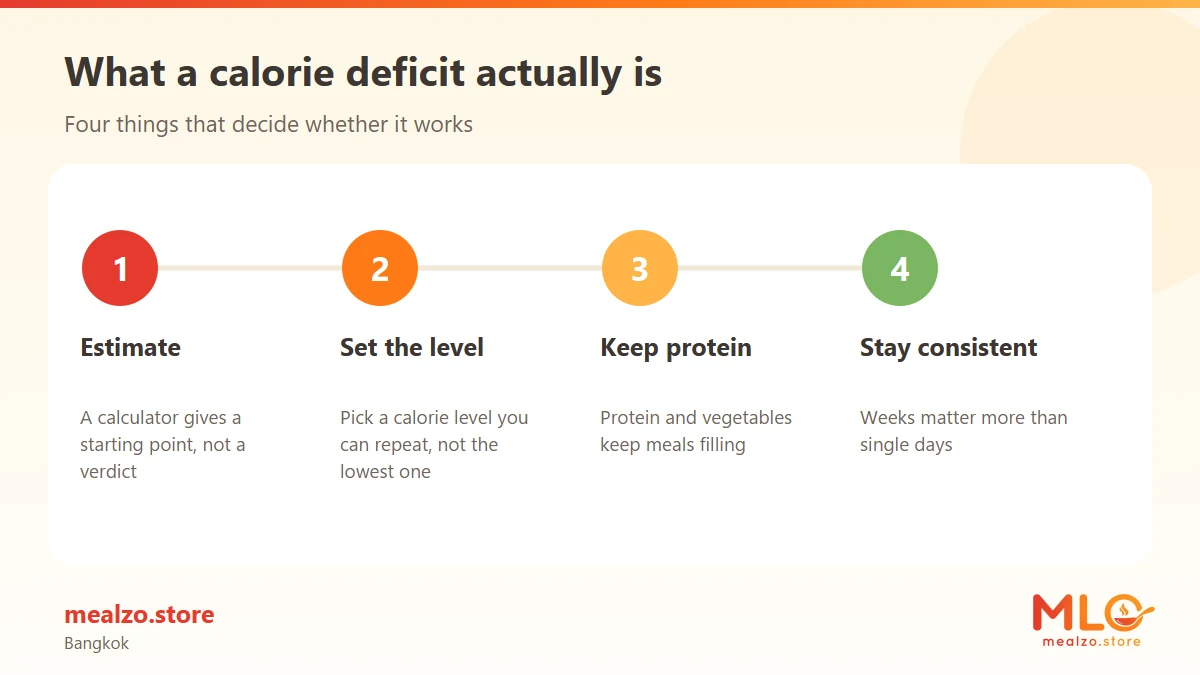
A maintenance intake aims to roughly match energy expenditure. A calorie deficit means energy intake is below expenditure over time. A surplus means intake exceeds expenditure.
The important point is that a deficit is relative to your own energy use. A calorie amount that represents a deficit for one person could be close to maintenance for another.
If fat loss is the goal, the explanation of how a calorie deficit works provides more detail on the underlying energy-balance mechanism.
This is also why simply copying another person's calorie target is unreliable. Their body size, daily movement, work demands and training schedule may be quite different from yours.
Someone who is highly active can often eat more while still being in a deficit than a sedentary person who uses less energy overall.
Key takeaway: A calorie deficit is defined relative to energy expenditure, not by a universal calorie number.
8. Activity Level Does Not Tell You How to Build a Meal
Calories describe energy. They do not describe the entire nutritional composition of a meal.
Two meals can contain similar amounts of energy while differing substantially in protein, carbohydrate, fat, vegetables and overall food volume.
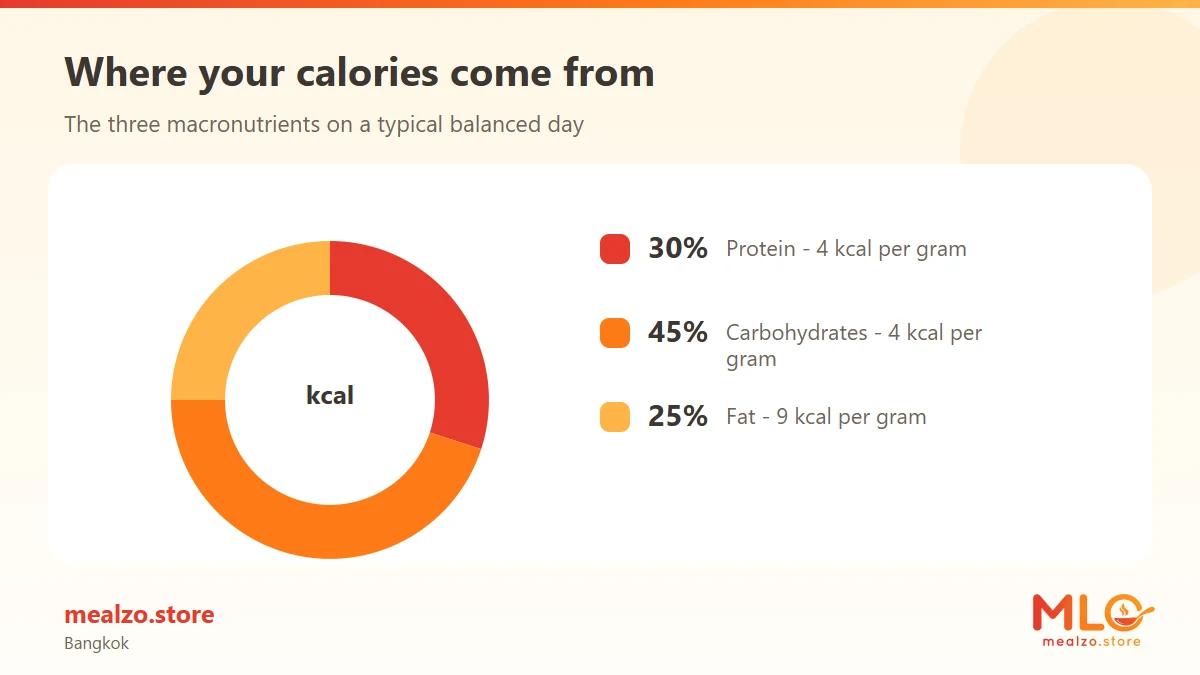
For active people, carbohydrate may be useful around demanding training because it is a readily available source of energy. Protein contributes amino acids used in normal tissue maintenance and repair. Dietary fat is energy-dense and also contributes to the structure and function of meals.
There is no single macronutrient ratio that automatically suits everyone. Training style, food preferences, total intake and the rest of the diet all affect what makes sense.
Someone who prefers meals centred more heavily on protein can read the guide to high-protein meal delivery in Bangkok. That does not mean a High Protein plan is necessary for every active person; it is simply one way of structuring meals.
Mealzo has 12 plans: Balanced, Weight Loss, High Protein, Vegetarian, Vegan, Keto, Low-Carb, Gluten Free, Easy-to-Digest, Pescatarian, No Fish & Seafood, and Dairy & Egg Free.
9. How Meal Frequency Fits Into the Picture
Eating more frequently does not automatically mean you require more calories. Meal frequency is mainly a way of distributing your daily intake.
Some people prefer three larger meals. Others find five smaller meals easier to fit around work, commuting or training.
Mealzo offers both 3-meal and 5-meal daily formats. The practical choice may depend on factors such as:
- how long your workday is
- whether you train before or after work
- whether large meals make you feel too full during the day
- whether you prefer fewer eating occasions
- how you normally manage hunger between meals
A highly active person does not automatically need five meals, just as a sedentary person does not automatically need three. Total intake and meal composition remain the more important variables.
Mealzo packages are available for 3, 7, 14 or 30 days, which allows the meal structure to be selected independently of the calorie level.
10. Choosing a Calorie Level Without Pretending the Estimate Is Exact
Mealzo offers six daily calorie levels: 1200, 1500, 1800, 2000, 2200 and 2500 kcal.
These are practical fixed levels rather than individually calculated calorie prescriptions. Your estimated requirement might not land exactly on one of them.
In that situation, it is more realistic to choose the closest sensible level and observe whether it fits your actual routine, rather than pretending that a calculator result is precise to the last calorie.
| Situation | Practical approach |
|---|---|
| Estimated need falls close to a Mealzo level | Start with the closest appropriate option |
| Estimate falls between two levels | Consider activity, appetite and overall goal |
| Training varies significantly across the week | Think in terms of your average routine |
| Activity recently changed | Reassess rather than relying on an old estimate |
| Calculator result feels inconsistent with real life | Treat it as a starting estimate, not a verdict |
For a broader discussion of using prepared meals while trying to reduce energy intake, see the complete guide to weight loss meal plans in Bangkok.

11. Practical Factors That Matter in Bangkok
A theoretical calorie target only helps if it works within your actual day.
Bangkok routines can be irregular. Commuting time, office schedules, heat, evening training and long working hours may all influence when eating feels practical.
Mealzo delivers across Bangkok in two delivery windows: morning from 06:00-09:00 or evening from 17:00-20:00. The kitchen is in Bang Na.
Customers also choose one of six spice levels for the package: not spicy, mild, medium, standard, hot or Thai-spicy. The selected level can later be changed.
Food restrictions require separate consideration from calorie needs. Mealzo allows customers to declare allergens from nine allergen groups. Dishes containing a declared allergen are then not assigned to that customer. This is a meal-assignment mechanism; it should not be interpreted as a guarantee that a meal is allergen-free.
The practical value of a structured meal plan is not that it removes every decision. It reduces some of the daily planning while still leaving you responsible for choosing a calorie level and meal style that make sense for your circumstances.
12. Reassess When Your Routine Changes
Your activity level is not a permanent identity.
A new job can turn a previously active routine into a sedentary one. Starting regular training can move it in the other direction. Travel, injury, changes in commuting and seasonal work patterns can all shift daily energy expenditure.
That means a calorie target chosen months ago may no longer reflect the way you live now.
Instead of reacting to every individual day, reassess when the overall pattern changes. Consider your work, commuting, exercise and ordinary movement together.
A calculator can help you establish another starting estimate, but observation still matters. If your actual routine consistently differs from the category you originally selected, change the assumption rather than forcing reality to fit the calculator.
Key takeaway: Recalculate when your normal routine changes substantially, not every time you have one unusually active or inactive day.
FAQ
How do I know whether I am sedentary or lightly active?
Look at your normal week as a whole. If most of your day is seated and walking or exercise is limited, sedentary may be the better description. If regular walking and some exercise are built into your routine, lightly active may fit better.
Does going to the gym make me moderately active?
Not automatically. Training contributes to energy expenditure, but so does everything outside the gym. Someone who trains briefly and sits for the rest of the day may use less energy than someone who walks and stands for hours at work.
Should I eat more calories on workout days?
It depends on how much your activity varies and how you prefer to structure your intake. Some people keep calories relatively consistent across the week, while others adjust food around demanding training days. Your average energy balance still matters.
Which Mealzo calorie level should I choose?
Mealzo offers 1200, 1500, 1800, 2000, 2200 and 2500 kcal per day. Use the calculator estimate as a starting point, then choose the level that most reasonably matches your activity, goals and routine. The calculator is an estimate rather than medical advice.
Is a lower calorie plan always better for weight loss?
No. Weight loss depends on creating an energy deficit relative to your own expenditure. A lower number is not automatically more appropriate, and activity level changes how much energy a person uses.
Can my calorie needs change even if my body weight stays similar?
Yes. A change in work, commuting, training or everyday movement can alter daily energy expenditure even when body weight has not changed substantially. That is one reason activity assumptions should occasionally be reviewed.
People who are pregnant, breastfeeding, under medical treatment, managing an eating disorder or dealing with another condition affecting nutrition should not rely on a general calorie article to set an intake target. Individual professional advice is more appropriate.
Find a Meal Plan That Fits
Compare Mealzo plans or use the calculator to explore meal options for your needs.