Calorie Deficit Explained: How Weight Loss Works

A calorie deficit sounds technical, but the basic idea is straightforward. Your body uses energy every day. Food and drinks provide energy. When, over time, you take in less energy than your body uses, the difference has to come from stored energy.
That does not mean successful eating has to look like endless salads, tiny portions or refusing dinner with friends. For someone living in Bangkok, the harder question is usually practical: how do you create a sensible deficit while still eating normal meals, working long days, ordering food and occasionally going out?
It also helps to separate the mechanism from the marketing around it. A calorie deficit explains why body weight can decrease over time, but it does not tell you which foods you must eat, how often you should eat or which diet label is best.
This guide gives the calorie deficit explained in practical terms, including what affects energy needs, how meal composition matters, why calorie targets are estimates and how to choose a routine that can fit ordinary life.
1. What a calorie deficit actually means
Calories are a measure of energy. Your body continuously uses energy for basic functions and daily activity, even before deliberate exercise enters the picture.
If the energy you consume roughly matches the energy you use, body weight tends to remain relatively stable over time. If intake consistently exceeds expenditure, excess energy can be stored. If intake remains below expenditure, the body has to make up the difference from energy already stored in the body.
That difference is the calorie deficit.
A simplified version looks like this:
| Energy balance | What it means |
|---|---|
| Intake roughly matches expenditure | Body weight may remain relatively stable over time |
| Intake is lower than expenditure | The body must draw on stored energy |
| Intake is higher than expenditure | Surplus energy can be stored |
The word consistently matters. A single low-calorie lunch does not create a meaningful long-term pattern, just as one large dinner does not define an entire diet.
Daily intake can vary substantially. What matters more is the overall relationship between energy intake and expenditure across time.
Key takeaway: A calorie deficit is an energy gap, not a specific diet, food list or meal schedule.
2. Where your daily calorie needs come from
People often talk about calories burned through exercise, but deliberate workouts are only one part of daily energy expenditure.
Your body uses energy for several broad purposes:
- maintaining basic physiological functions
- digesting and processing food
- ordinary movement such as walking, standing and household activity
- structured exercise or sport
This is why two people of similar size may not have identical calorie requirements. One may spend most of the working day seated, while another walks between meetings, uses public transport and trains several times per week.
Age, body size, sex and activity patterns also influence estimated energy needs.
Mealzo's calorie calculator uses the Mifflin-St Jeor formula to estimate calorie requirements. It is useful as a starting point, but it remains an estimate rather than a medical assessment. You can use the Mealzo calorie calculator to get an initial reference point.
For a closer look at how movement changes estimated requirements, see daily calorie needs by activity level.
3. Why calorie targets are estimates, not exact numbers
A calculated calorie requirement can look unusually precise. A calculator might produce a specific number, which can create the impression that your body operates like a perfectly calibrated machine.
It does not.
Formulas estimate energy requirements from variables such as age, height, weight and sex. An activity category then tries to represent how much you move. Real life is less tidy.
Consider two office workers in Bangkok. Both might select "lightly active." One walks to the BTS, stands frequently during the day and goes out most evenings. The other drives, sits for long periods and spends evenings at home. The same activity label cannot capture every difference.
Food tracking has its own uncertainty too. Portions vary. Restaurant recipes differ. Sauces, cooking oils and drinks can contribute calories without being obvious from the plate.
That does not make calorie estimates useless. It means they should be treated as working estimates rather than laboratory measurements.
Key takeaway: A calorie target is a practical starting point that may need adjustment, not a perfectly known daily requirement.
4. How large should a calorie deficit be?
There is no single deficit that suits everyone.
A larger gap between intake and expenditure creates a larger theoretical energy shortfall, but that does not automatically make it a better choice. Lower intake can make meals harder to structure, reduce flexibility for social eating and leave less room for foods you enjoy.
A more moderate approach may be easier to integrate into a normal schedule.
The practical question is therefore not simply, "How low can I go?" It is, "What intake can I realistically maintain while still eating adequately and functioning normally?"
Mealzo offers six daily calorie levels:
| Daily level | Practical context |
|---|---|
| 1200 kcal | A low intake level that may not suit many adults |
| 1500 kcal | Lower-calorie option with limited room for extras |
| 1800 kcal | Moderate intake for some people depending on their needs |
| 2000 kcal | May suit people whose estimated requirements are higher |
| 2200 kcal | More room for larger meals or higher energy needs |
| 2500 kcal | Higher intake option for people with greater estimated requirements |
These levels are options, not universal recommendations. The appropriate level depends on estimated requirements and personal circumstances.
For a more detailed comparison, read how to choose between 1200 and 2500 calorie meal plans.
People who are pregnant, breastfeeding, under medical treatment, managing an eating disorder or dealing with another condition affecting nutrition should not rely on a general calorie article to set an intake target. Individual professional advice is more appropriate.
5. Food quality still matters in a calorie deficit
If energy balance determines whether a deficit exists, does food choice matter?
Yes, but for a different reason.
Two meals can contain similar calories while feeling very different to eat. A meal containing a meaningful portion of protein, vegetables and a carbohydrate source provides a different volume and eating experience from the same energy intake consumed mainly through pastries, sweet drinks or snack foods.
That does not make particular foods "good" or "bad." It means meal composition affects how practical a calorie target feels.
Foods that can help build substantial meals include:
- protein sources such as chicken, fish, eggs, tofu or legumes
- vegetables and fruit
- rice, potatoes, noodles, oats and other carbohydrate sources in portions that fit the meal
- fats used deliberately rather than added without consideration
Bangkok makes this both easier and harder. Good food is everywhere, but many meals are prepared outside the home, where the amount of oil, sugar, sauce or coconut milk is not always obvious.
You do not need perfect information to make reasonable choices. Consistency matters more than pretending every restaurant meal can be calculated exactly.

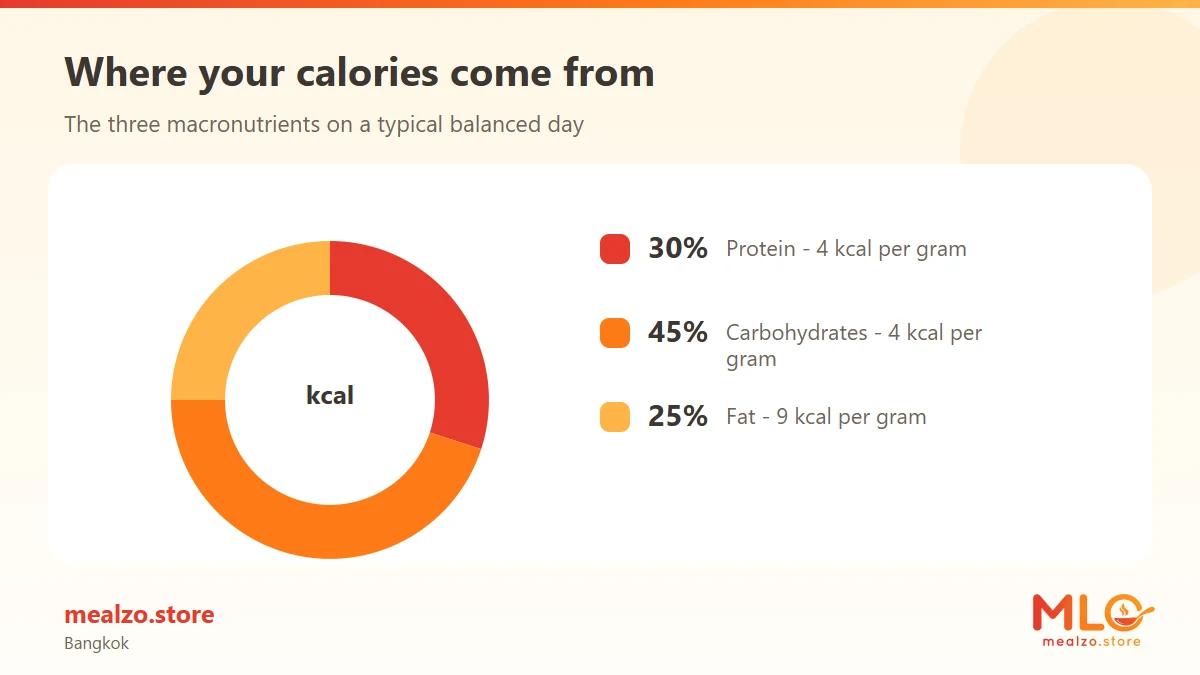
6. Protein, carbohydrates and fats all contribute calories
Calories describe energy, while macronutrients describe where much of that food energy comes from.
Protein, carbohydrate and fat all contribute to total calorie intake. Alcohol also supplies energy, although it is not treated as one of the three main macronutrients.
A calorie deficit therefore does not require removing carbohydrates or avoiding fat completely.
Protein
Protein-containing foods can form the centre of a meal and help make calorie-controlled eating feel more substantial. Mealzo includes plans such as Balanced, Weight Loss, High Protein, Vegetarian, Vegan and Pescatarian, which approach meal composition differently.
Carbohydrates
Rice, noodles, bread, fruit and other carbohydrate foods can fit within a deficit. Portion size and the rest of the meal determine how they contribute to total intake.
For many people in Bangkok, eliminating rice completely would make eating less convenient and less enjoyable without being necessary for the underlying energy-balance mechanism.
Fat
Fat is energy-dense, which means modest quantities can contribute a meaningful amount of energy. Cooking oil, fried foods, creamy sauces, nuts and rich dressings are therefore worth noticing when total intake matters.
That does not mean avoiding them. It means portion awareness can have a larger effect than people expect.
Key takeaway: A calorie deficit can contain protein, carbohydrates and fats; the overall energy intake is what determines whether a deficit exists.
7. Bangkok eating: where calories become easy to overlook
Calorie control is simple on paper and less simple when dinner comes from a food court, delivery app or street-side kitchen.
Restaurant meals often contain ingredients you cannot see clearly. Oil may be used generously. Sweetened sauces can add energy. Drinks can contribute calories without making a meal feel more filling.
Some practical checks are more useful than trying to calculate every gram:
| Situation | What to check |
|---|---|
| Stir-fried meal | Oil-heavy sauces and oversized rice portions |
| Curry | Coconut milk, added fat and portion size |
| Noodle dish | Noodle quantity, oil and toppings |
| Café meal | Dressings, cheese, sauces and sweet drinks |
| Delivery order | Multiple sides, snacks or drinks added automatically |
| Social dinner | Shared dishes that make portions difficult to judge |
None of these foods has to disappear.
A person might eat a lighter breakfast and lunch before a restaurant dinner. Someone else might keep their usual meals but skip a sweetened drink. Another may prefer prepared meals on working days and more flexibility on weekends.
Different methods can produce a similar overall energy balance.
8. Meal frequency does not create the deficit by itself
Three meals per day can work. Five meals per day can work. So can other patterns.
Meal frequency mainly changes how your daily intake is distributed.
Someone who dislikes large gaps between meals may prefer smaller meals spread throughout the day. Another person may find frequent eating annoying and would rather have three larger meals.
Mealzo offers both 3-meal and 5-meal daily formats. The important distinction is not that one format automatically produces better weight outcomes. It is whether the total intake and meal pattern fit the person's routine.
For a fuller explanation of this issue, see whether meal frequency affects weight loss.
A useful question is:
Which pattern makes it easiest for you to eat an appropriate total amount without constantly negotiating with yourself about food?
That answer may be different from what works for a colleague, partner or fitness influencer.
9. Why aggressive restriction often makes normal life harder
A calorie deficit can be taken too far.
When people become highly focused on reducing calories, they may begin cutting anything that seems optional: rice, sauces, breakfast, snacks, dinners out. The resulting diet can become increasingly difficult to fit around work and social life.
That trade-off matters.
Bangkok is a city where eating is often social. Meetings happen over coffee. Colleagues order lunch together. Families share dishes. Friends meet for dinner. A calorie strategy that only works when you control every ingredient may be difficult to maintain outside your kitchen.
Instead of treating any deviation as failure, it is more useful to build some flexibility into the plan.
Possible approaches include:
- using more structured meals on busy weekdays
- choosing water or an unsweetened drink more often
- keeping portions moderate when eating several shared dishes
- deciding which extras you actually enjoy rather than eating all of them automatically
- returning to your normal pattern after a larger meal instead of compensating with extreme restriction
The goal is not to make every day identical.
Key takeaway: A workable calorie deficit has to coexist with ordinary meals, work schedules and social eating rather than requiring perfect control.
10. Using prepared meal plans without pretending they solve everything
Prepared meals can reduce one specific source of friction: repeatedly deciding what to cook, portion and order.
Mealzo offers 12 plan types: Balanced, Weight Loss, High Protein, Vegetarian, Vegan, Keto, Low-Carb, Gluten Free, Easy-to-Digest, Pescatarian, No Fish & Seafood, and Dairy & Egg Free.
Customers can choose among 1200, 1500, 1800, 2000, 2200 and 2500 kcal per day, with either 3 or 5 meals. Packages are available for 3, 7, 14 or 30 days.
That structure may make intake easier to plan, but it does not remove the rest of your diet from the equation. Additional drinks, snacks, restaurant meals and alcohol still contribute energy.
If you are comparing structured options specifically for reducing calorie intake, the complete guide to weight loss meal plans in Bangkok covers that decision in more detail.
Mealzo delivers across Bangkok in two windows: 06:00-09:00 in the morning or 17:00-20:00 in the evening. Whether prepared meals make sense depends partly on whether those windows and the package structure suit your schedule.

11. Allergies, preferences and calorie targets are separate decisions
A calorie target tells you how much energy is planned for the day. It does not tell you whether a meal is suitable for an allergy or dietary preference.
Those are separate filters.
Mealzo allows customers to declare allergens from nine allergen groups. Dishes containing a declared allergen are then not assigned to that customer. This describes the assignment mechanism; it should not be interpreted as a guarantee that a meal is allergen-free.
Diet-plan choice is also separate from calorie level.
Someone might choose Vegetarian at 1800 kcal, High Protein at 2200 kcal or Balanced at another available level. The plan describes the dietary framework, while the calorie level describes planned daily energy intake.
Keeping these decisions separate makes the system easier to understand:
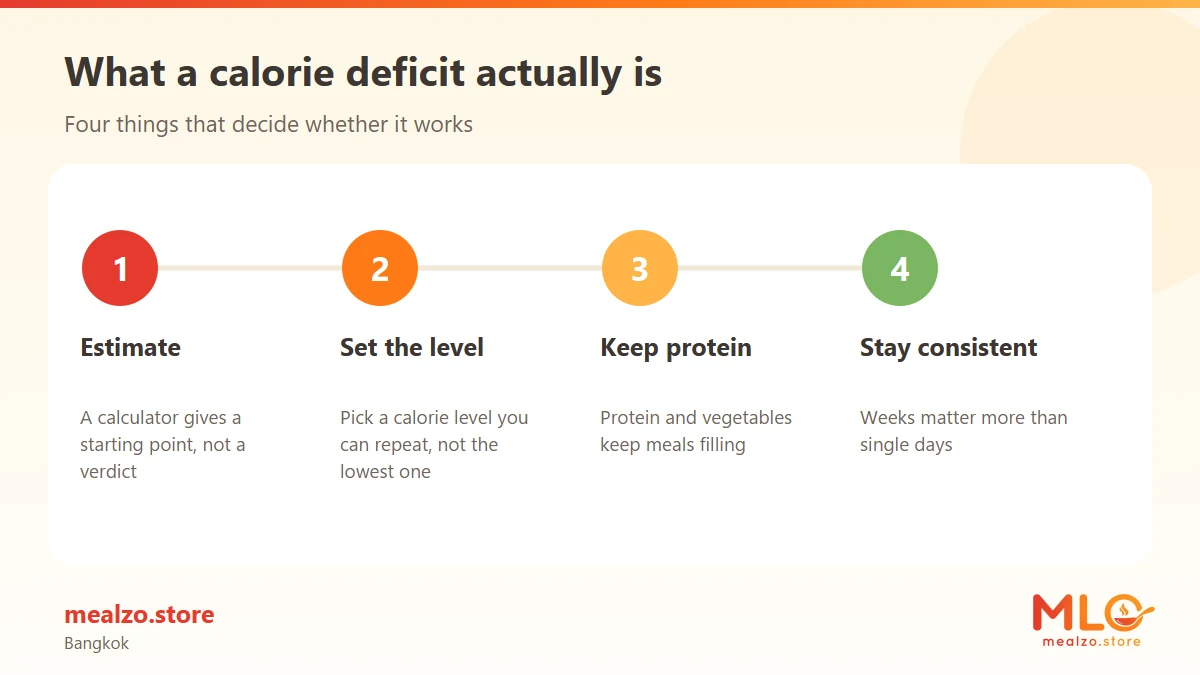
- estimate your calorie requirements
- decide whether a deficit is appropriate
- choose a calorie level
- choose a dietary style
- choose 3 or 5 meals
- select a package length that suits your schedule
12. What to monitor once you choose a calorie level
You do not need to obsess over every daily fluctuation.
Body weight can move for reasons unrelated to changes in body fat, including differences in food volume and water balance. A single measurement therefore gives limited information.
The more useful question is whether the overall plan still makes sense after you have lived with it for a while.
Pay attention to practical signals as well:
- Is the meal pattern manageable during workdays?
- Are you constantly adding snacks because the plan feels too restrictive?
- Can you still eat socially without feeling that the entire day is ruined?
- Does the calorie level match your actual activity better than your imagined activity?
- Are you choosing a diet style because it suits you, or because you think the label itself causes a deficit?
If a target repeatedly forces you into a cycle of restriction and uncontrolled eating, the problem may be the target rather than a lack of discipline.
Calorie calculations are tools. They are not verdicts.
FAQ
What is a calorie deficit in simple terms?
A calorie deficit occurs when your body uses more energy than you consume over time. The difference has to be supplied from stored energy. It is the underlying energy-balance mechanism involved when body mass decreases, rather than a specific diet such as low-carb, keto or intermittent fasting.
Do I have to count calories to be in a calorie deficit?
No. A deficit can exist without formal calorie tracking. Smaller portions, different food choices, fewer energy-containing drinks or a structured meal plan can all reduce intake. Tracking can make the relationship easier to see, but it is not the mechanism itself.
Can I eat rice and still be in a calorie deficit?
Yes. Rice contributes calories like other carbohydrate foods, but eating rice does not prevent a deficit. The amount eaten and total daily energy intake matter. For people who normally eat rice, keeping a sensible portion may be more practical than removing it completely.
Is 1200 kcal the best level for faster weight loss?
There is no universal "best" calorie level. A lower intake creates a larger deficit only relative to the individual's energy needs, and very low intake may be unsuitable or difficult to maintain. A calculator can provide an estimate, but individual circumstances still matter.
Is three meals or five meals better for a calorie deficit?
Neither format automatically creates a better deficit. Three meals may suit people who prefer larger portions and fewer eating occasions, while five meals may suit people who prefer smaller portions spread through the day. Total intake remains the central factor.
Can a prepared meal plan guarantee that I stay in a calorie deficit?
No. A prepared plan can provide a defined daily calorie level, but anything consumed in addition to those meals also contributes energy. Actual energy requirements are estimates as well, so a meal plan should be viewed as a structured tool rather than a guaranteed outcome.
Find a Meal Plan That Fits
Compare Mealzo plans or use the calculator to explore meal options for your needs.