Why Consistency Matters More Than a Perfect Weight Loss Diet

A perfect diet looks impressive on paper. Every meal is measured, every ingredient fits the plan, and nothing unexpected gets in the way. Real life in Bangkok rarely works like that.
Work runs late. Friends suggest dinner. Traffic changes the evening. Some days you want Thai food with enough spice to taste like Thai food, while on others you simply want something easy. A plan that only works under ideal conditions can become difficult to maintain very quickly.
That is why diet consistency for weight loss often matters more in practice than designing the theoretically perfect menu. Consistency does not mean eating exactly the same foods every day or never having an unplanned meal. It means having a way of eating that you can return to repeatedly without needing constant willpower or complicated decisions.
The useful question is therefore not only, "Is this diet good?" It is also, "Can I realistically keep eating this way while living my normal life?"

1. What does diet consistency for weight loss actually mean?
Diet consistency for weight loss means following a broadly suitable eating pattern often enough that individual imperfect meals do not constantly derail the overall structure.
Consistency is not the same as strictness. A strict diet may prescribe exact foods, exact times and exact portions. A consistent diet can allow some variation while keeping the main framework stable.
That framework might include:
- a suitable daily calorie target rather than random intake from day to day
- regular meals that reduce last-minute food decisions
- enough flexibility for work, social meals and changing schedules
- portions that are realistic enough to repeat
- a clear way to return to the plan after eating differently than expected
This distinction matters because people often treat one off-plan meal as evidence that the entire plan has failed. In reality, a single meal is simply one meal. The more useful measure is what your eating pattern looks like across repeated days.
Key takeaway: Consistency is the ability to follow a workable eating pattern repeatedly, not the ability to eat perfectly at every meal.
2. Why can a less-than-perfect diet work better in real life?
A less-than-perfect diet can be more practical because a plan only influences your eating when you can actually follow it.
Imagine two approaches. The first is nutritionally meticulous but requires extensive preparation, precise timing and foods that do not fit your routine. The second is simpler, allows ordinary meals and leaves room for occasional changes.
On paper, the first plan may look more controlled. In practice, the second may be easier to repeat.
| Approach | What it looks like in practice |
|---|---|
| Very strict plan | Precise foods, portions and timing with little room for changes |
| Flexible structured plan | Defined calorie and meal structure with some room for normal life |
| Unstructured eating | Decisions are made meal by meal without a consistent framework |
The point is not that structure is bad. Structure is useful. The problem begins when the structure demands more time, attention or restriction than someone can realistically maintain.
For a broader look at building meals around a sustainable calorie-controlled approach, see our complete guide to weight loss meal plans in Bangkok.
3. How does consistency affect calorie intake over time?
Consistency affects calorie intake by reducing large swings between carefully controlled days and completely unstructured ones.
Body weight is influenced by energy balance over time, so a single unusually light or heavy meal does not tell you much about the overall pattern. What matters more is whether your usual intake stays reasonably aligned with the target you have chosen.
This is one reason extreme restriction can be difficult. If a plan feels too demanding, it may be followed closely for a short period and then abandoned. A more moderate approach may create fewer dramatic fluctuations.
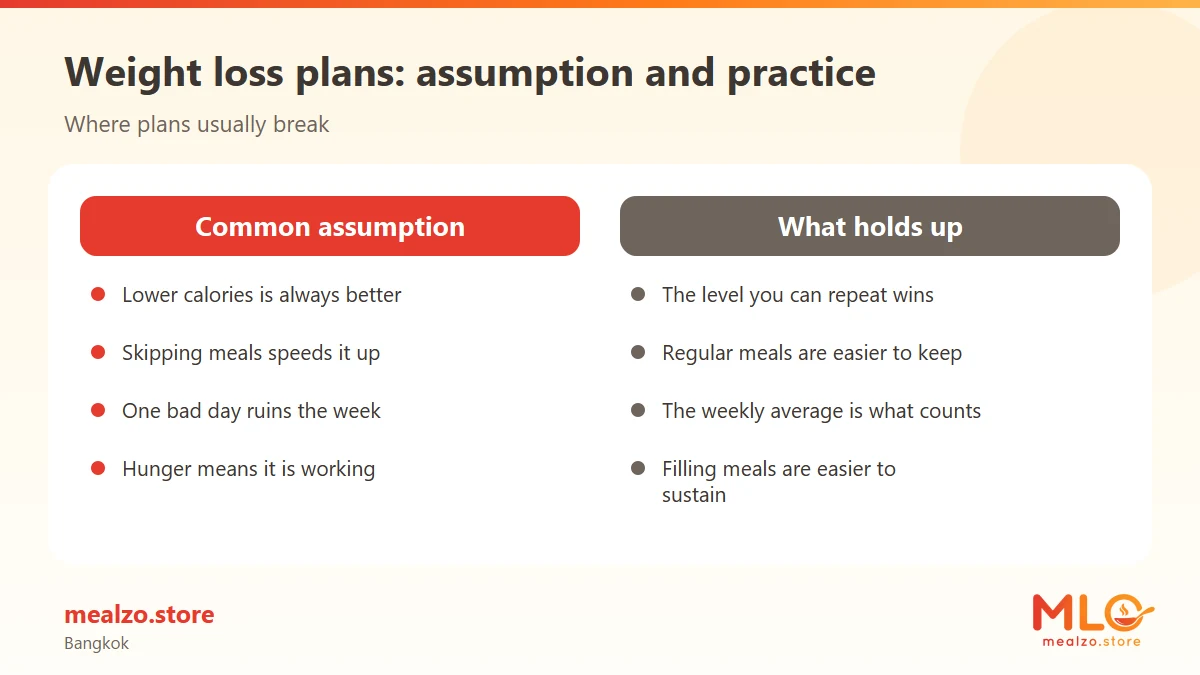
Consider a simple seven-day pattern. Someone might eat according to plan from Monday to Thursday, eat more freely on Friday and Saturday, then try to compensate with a very restrictive Sunday. The issue is not that any one of those days is automatically "bad." The issue is that the week lacks a stable structure.
A more consistent week might include planned meals most days, one or two social meals, and a normal return to the usual eating pattern afterward. The plain-text principle shown in the infographic is simple: the pattern across the week matters more than judging one meal in isolation.
4. Why does an all-or-nothing mindset make dieting harder?
An all-or-nothing mindset makes dieting harder because it turns small deviations into reasons to abandon the plan completely.
People often describe food choices in absolute terms: perfect or ruined, clean or bad, on-plan or off-plan. That language creates a false choice. If lunch did not match the plan, dinner does not need to become a free-for-all.
A more useful response is much less dramatic:
- acknowledge that the meal was different from the plan
- avoid trying to "undo" it with extreme restriction
- make the next meal normally
- continue with the usual schedule
This approach removes unnecessary negotiation. You do not need a fresh start next Monday. You simply need the next meal.
That same idea applies to meal composition. Balanced meals do not need to look identical every day; what matters is having a workable combination of foods within the broader pattern. Our article on practical reasons balanced meals can be easier to maintain explains that structure in more detail.
Key takeaway: One unplanned meal does not require a compensatory diet; returning to your normal structure at the next meal is usually the simpler approach.
5. How can routine reduce daily food decisions?
Routine can reduce daily food decisions by deciding the basic structure of your eating before hunger, convenience and time pressure begin competing for attention.
This is particularly relevant in Bangkok, where food is available almost everywhere. That is convenient, but convenience also means there are many decisions to make.
What should you eat? Where should you order from? How large should the portion be? Is there enough protein? Should you add rice? Is there time to cook?
None of these decisions is difficult by itself. Repeating them several times every day can become tiring.
A routine removes some of that decision load. You might already know how many meals you plan to eat, roughly when you will eat them, and what calorie level you are following. That still leaves room for normal choices, but the basic framework has already been decided.
Mealzo, for example, offers plans with 3 or 5 meals per day and packages of 3, 7, 14 or 30 days. The point of that kind of structure is not to claim that one meal frequency is universally better. It simply gives people different ways to fit planned eating around their schedules.

6. Does eating at the same times every day matter?
Eating at exactly the same times every day is not necessary for everyone, but a reasonably predictable meal pattern can make a plan easier to follow.
Some people prefer three larger meals. Others find five smaller meals easier to fit around work or hunger patterns. Neither format should automatically be treated as the correct one for weight loss.
The useful question is whether the frequency helps you keep the overall plan manageable.
| Meal pattern | May suit someone who prefers |
|---|---|
| 3 meals per day | Fewer eating occasions and larger individual meals |
| 5 meals per day | Smaller portions spread through the day |
| Variable daily pattern | Maximum flexibility, but potentially more daily decision-making |
Meal timing can also change because of shifts, meetings, commuting or social plans. A realistic plan should survive those changes rather than treating them as failures.
If you are deciding between different schedules, our guide to meal frequency and weight loss in everyday routines covers the trade-offs in more detail.
7. Why is a realistic calorie target easier to maintain?
A realistic calorie target is easier to maintain because it can reduce the gap between what the plan asks you to eat and what you can comfortably sustain in daily life.
Calorie needs differ between people. They are influenced by factors such as body size, age, sex and activity, so copying another person's intake is not a reliable way to choose your own.
Mealzo provides six daily calorie levels: 1200, 1500, 1800, 2000, 2200 and 2500 kcal. The app also includes a calorie calculator based on the Mifflin-St Jeor equation. That calculation is an estimate, not medical advice, and it does not replace individual professional assessment where that is needed.
A very low target is not automatically a better target. If the intake feels so restrictive that you regularly abandon it, the theoretical plan may be poorly matched to your actual routine.
At the same time, "sustainable" should not become an excuse to ignore the target completely. Flexibility works best when there is still a clear structure underneath it.
8. How does flexibility make consistency easier?
Flexibility makes consistency easier by allowing the plan to adapt to ordinary preferences and schedule changes without losing its basic structure.
Flexibility can mean different things. It may involve choosing three meals rather than five, changing spice preferences, or selecting a meal plan that better fits the foods you normally want to eat.
Mealzo offers 12 plan types:
- Balanced
- Weight Loss
- High Protein
- Vegetarian
- Vegan
- Keto
- Low-Carb
- Gluten Free
- Easy-to-Digest
- Pescatarian
- No Fish & Seafood
- Dairy & Egg Free
There are also six package spice levels: not spicy, mild, medium, standard, hot and Thai-spicy. The selected spice level can be changed later.
That matters because food still has to be something you are willing to eat. A technically appropriate menu that repeatedly clashes with your preferences creates unnecessary friction.
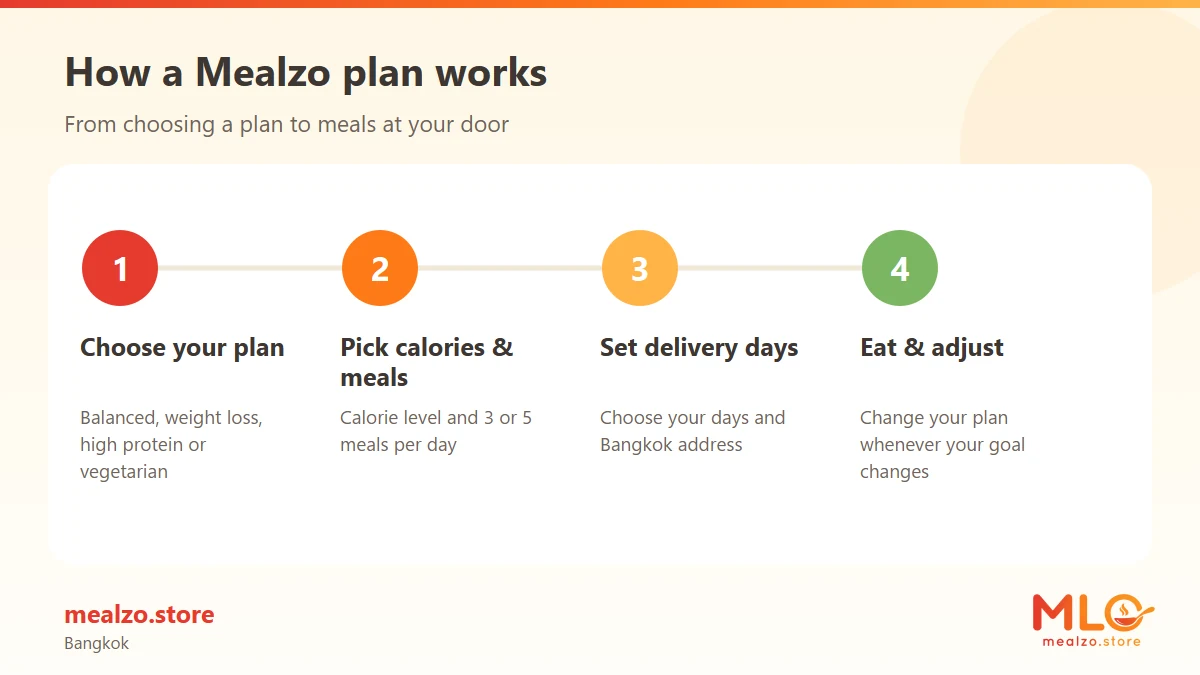
The mechanism shown in the infographic is straightforward: choose a structure that fits your needs, repeat it on ordinary days, adjust when real life requires it, and return to the same structure afterward. Consistency comes from making the plan repeatable rather than making every day identical.
Key takeaway: Flexibility supports consistency when it changes the details of the plan without removing the overall structure.
9. What should you do when social meals do not fit the plan?
When a social meal does not fit the plan, treat it as part of normal life and return to your usual eating pattern afterward.
Bangkok is not an easy city in which to pretend restaurant meals, family dinners and evenings with friends do not exist. A diet that requires avoiding all of them may not fit the life you actually want to live.
That does not mean every social meal needs to become unlimited eating. You can still make ordinary choices.
For example:
- eat normally earlier in the day rather than deliberately starving before dinner
- choose foods you genuinely want instead of ordering everything because it is a "cheat meal"
- stop when the meal is finished rather than turning one dinner into an entire weekend
- resume your regular meals at the next planned eating occasion
The phrase "cheat meal" itself can be unhelpful because it suggests you have broken a rule. A restaurant dinner is not automatically a failure. It is simply a meal that may be less controlled than your usual one.
10. How can meal delivery support consistency?
Meal delivery can support consistency by removing some of the shopping, preparation and portion-planning decisions that make structured eating harder to repeat.
It does not eliminate every decision, and it does not make a diet automatically suitable. You still need to choose a plan, calorie level, meal frequency and package length that make sense for you.
Mealzo delivers meal plans across Bangkok from its kitchen in Bang Na. Delivery is available in two windows: morning from 06:00-09:00 or evening from 17:00-20:00.
For someone whose main problem is repeatedly finding, cooking or portioning food during busy days, having meals prepared in advance can make the routine simpler. For someone who enjoys cooking and already has a reliable routine, delivery may be less important.
Food restrictions also need careful handling. Mealzo customers can declare allergens from nine groups, and dishes containing a declared allergen are not assigned. This describes the assignment mechanism only; it should not be interpreted as a guarantee that a meal is allergen-free.
If the practical side of maintaining a routine is your main concern, see our guide to staying consistent with a meal plan during normal life.
11. When is consistency not enough?
Consistency is not enough when the underlying diet is poorly matched to your needs, unnecessarily restrictive or inappropriate for your circumstances.
Repeating a plan does not make that plan automatically sensible. Consistency is valuable only when the basic structure is reasonable.
There are several situations where the plan itself deserves another look:
- the calorie level feels consistently unsuitable
- the food pattern conflicts with dietary restrictions
- the plan removes major food groups without a clear reason
- you regularly feel unable to follow it despite repeated adjustments
- you have circumstances that require individual medical or nutritional guidance
This is where the idea of "just be consistent" can become too simplistic. Consistency should reduce friction, not encourage someone to persist with a plan that clearly does not fit.
The better sequence is to choose a reasonable structure first, then make that structure easy enough to repeat.
12. What does a consistent week actually look like?
A consistent week usually looks ordinary: mostly planned meals, a few adjustments, and no dramatic response when something changes.
It does not require seven identical days. One day may include three planned meals. Another may involve dinner with friends. A third may run late because of work.
The common thread is that the person keeps returning to the same general eating framework rather than restarting from zero.
For example, someone might:
- use planned meals during workdays
- keep one restaurant dinner with friends
- maintain roughly the same calorie structure on most days
- avoid compensating for a larger meal with extreme restriction
- continue normally the following day
That is not visually dramatic, which is exactly why it is useful. Sustainable routines are often boring in the best possible way.
If you want a more structured option, you can compare Mealzo meal plans for everyday Bangkok routines and choose among the available plan types, calorie levels, meal frequencies and package lengths.
FAQ
Do I have to follow my diet seven days a week?
No. The more useful goal is a repeatable overall pattern, not flawless adherence every day. Social meals and schedule changes can fit within a structured week if you return to your usual approach afterward.
Is it better to eat the same foods every day?
Not necessarily. Repetition can simplify decisions, but variety may make the plan easier to enjoy. Consistency refers more to the overall structure than to eating an identical menu.
Should I eat less the day after a restaurant meal?
You do not automatically need to compensate for one larger meal by heavily restricting the next day. Returning to your normal meal structure is usually a simpler way to maintain consistency.
How do I know whether three or five meals are better for me?
There is no single meal frequency that is best for everyone. Three meals may suit someone who prefers fewer, larger meals, while five may suit someone who prefers smaller portions spread through the day.
Can I change my diet plan if I cannot stick to it?
Yes. Difficulty following a plan can be useful information. It may mean the calorie level, meal frequency, food style or overall structure needs adjustment rather than more willpower.
Is a calorie calculator enough to choose a weight loss diet?
A calculator can provide an estimate, but it is not a complete individual assessment. Mealzo's calculator uses the Mifflin-St Jeor equation, and its result should be treated as an estimate rather than medical advice.
Find a Meal Plan That Fits
Compare Mealzo plans or use the calculator to explore meal options for your needs.