Allergens and Meal Plans in Bangkok: What Declaring 9 Allergen Groups Actually Does

When you subscribe to a meal plan, avoiding an ingredient should not depend on remembering to check every dish yourself. Mealzo handles this through a simple declaration system connected to the way its menus are assembled.
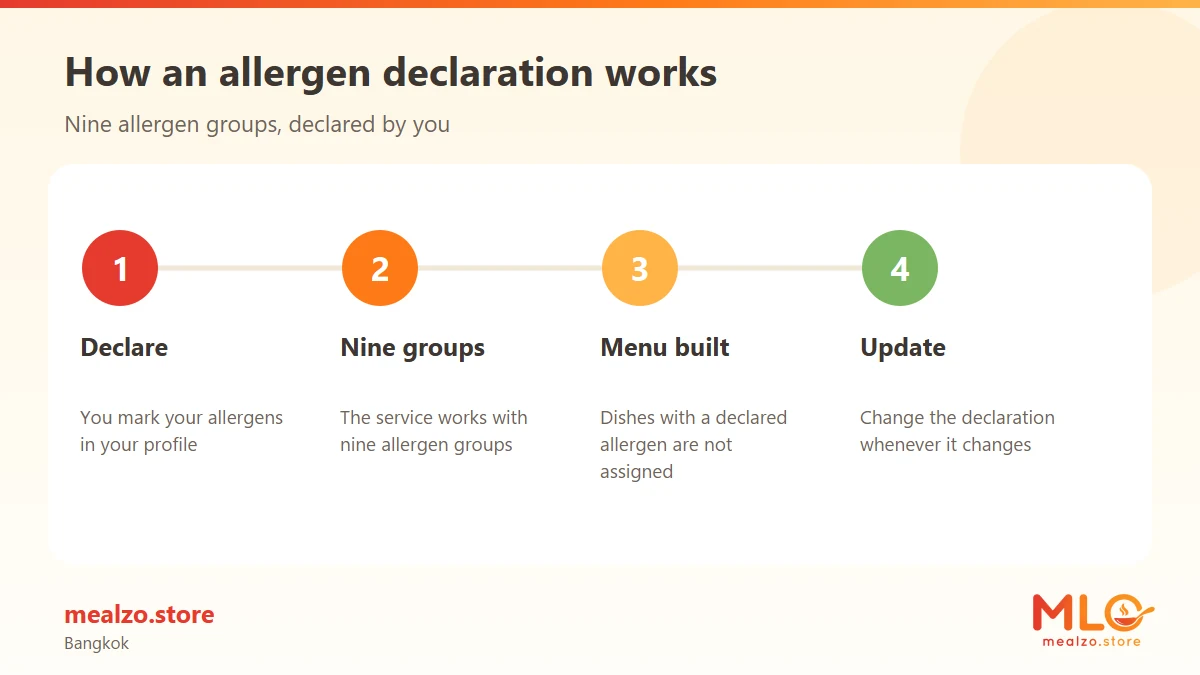
Customers can declare any of nine allergen groups: peanuts, tree nuts, shellfish, fish, milk, egg, soy, wheat/gluten and sesame. When one of those groups is declared, dishes containing that allergen are not assigned to that customer.
That description is deliberately narrow. The declaration changes which dishes the system assigns. It does not turn a shared kitchen into an allergen-free environment, eliminate trace cross-contact or certify a meal as suitable for a severe allergy.
For someone comparing an allergens meal plan Bangkok subscription, understanding that distinction matters more than reassuring labels. This guide explains exactly what the declaration does, how it fits into Mealzo's automated menu system and, just as importantly, where its limits are.

1. What the allergen declaration actually changes
Mealzo's packages are assembled automatically. A customer chooses a meal plan, daily calorie level and whether they want three or five meals per day. Individual dishes for individual days are not selected manually by the customer.
The allergen declaration adds another condition to that assignment process. If you have declared one of the supported allergen groups, a dish containing that declared allergen is not assigned to you.
The logic can be summarized without adding anything more complicated:
- You select your meal-plan configuration.
- You declare any of the nine supported allergen groups you want excluded from dish assignment.
- The system assembles the package menu.
- Dishes containing a declared allergen are not assigned to you.
- The remaining menu is determined by the selected plan, calorie level and meal count.
This is a filtering mechanism inside the menu-assignment system. It is not a claim about the absence of trace amounts in the kitchen environment.
Key takeaway: Declaring an allergen prevents dishes containing that declared allergen from being assigned to your package.
For a broader explanation of how subscriptions and automatic menu assembly work, see how Mealzo meal-plan delivery works in Bangkok.
2. The nine allergen groups you can declare
Mealzo supports declarations for nine groups. The table below gives ordinary food examples simply to make each category easier to recognize; it does not attempt to catalogue every possible ingredient or recipe.
| Allergen group | Everyday examples where it may appear |
|---|---|
| Peanuts | Peanut sauces, crushed peanuts, peanut-based dressings |
| Tree nuts | Cashews, almonds, walnuts, nut toppings |
| Shellfish | Shrimp, prawns, crab, shellfish-based dishes |
| Fish | Fish fillets, fish-based dishes, preparations containing fish |
| Milk | Milk, cheese, cream, dairy-based sauces |
| Egg | Eggs, omelettes, egg-containing preparations |
| Soy | Tofu, soy-based ingredients, soy-containing dishes |
| Wheat/gluten | Bread, noodles, wheat-based products |
| Sesame | Sesame seeds, sesame toppings, sesame-based ingredients |
Declaring more than one group means the same assignment rule applies to each declared group. For example, if peanuts and sesame are declared, dishes containing peanuts are not assigned and dishes containing sesame are not assigned.
The mechanism remains the same whether you declare one group or several. Mealzo is not asking the customer to create a custom recipe specification or redesign each day's menu. It is excluding dishes that contain the declared groups from that customer's assignment.
3. How allergen declarations fit into an automatic meal plan
Mealzo offers 12 plans: Balanced, Weight Loss, High Protein, Vegetarian, Vegan, Keto, Low-Carb, Gluten Free, Easy-to-Digest, Pescatarian, No Fish & Seafood, and Dairy & Egg Free.
Within the subscription setup, there are also six calorie levels per day:
| Daily calorie level | Meals per day available |
|---|---|
| 1200 kcal | 3 or 5 meals |
| 1500 kcal | 3 or 5 meals |
| 1800 kcal | 3 or 5 meals |
| 2000 kcal | 3 or 5 meals |
| 2200 kcal | 3 or 5 meals |
| 2500 kcal | 3 or 5 meals |
Packages are available for 3, 7, 14 or 30 days. Once the plan, calorie level and meal count are selected, the menu for that package is assembled automatically.
The allergen declaration works within that process. It does not replace the chosen meal plan. It adds an exclusion condition so that a dish containing a declared allergen is not assigned to that customer.
This distinction is useful when comparing services. A dietary plan name tells you the general type of plan selected. An allergen declaration tells Mealzo which supported ingredients must prevent a dish from being assigned.
If you are comparing the wider Bangkok market before choosing a subscription, the complete guide to healthy meal delivery in Bangkok covers the broader questions beyond allergen declarations.
4. A declaration is not the same as choosing dishes yourself
Some people hear "allergen settings" and assume that every day's menu becomes individually configurable. That is not how Mealzo works.
Customers do not browse the upcoming package and replace individual dishes one by one. The menu is assembled automatically from the chosen plan, calorie level and meal count, with the allergen declarations applied as exclusions during assignment.
That means the useful question is not, "Which exact dish should I swap Tuesday's lunch for?" The relevant question is, "Does this dish contain one of the allergen groups I declared?" If it does, it is not assigned to that customer.
This keeps the mechanism straightforward, but it also means the service should not be described as a fully bespoke menu-building system.
Key takeaway: An allergen declaration filters dish assignment; it does not give the customer a manual dish-by-dish menu builder.
5. Declaring an allergen and choosing a meal plan are separate choices
Mealzo has plans whose names already refer to certain ingredient patterns, including Gluten Free, No Fish & Seafood, and Dairy & Egg Free. The nine-group declaration system is still a separate concept from selecting a plan.
A plan determines the menu framework used for the subscription. An allergen declaration determines which dishes containing a declared group must not be assigned to that particular customer.
That distinction becomes clearer with examples:
- A customer may choose Balanced and declare shellfish.
- A customer may choose High Protein and declare peanuts and sesame.
- A customer may choose Vegetarian and declare milk.
- A customer may declare several supported groups at the same time.
In every case, the same rule applies: a dish containing a declared allergen is not assigned to that customer.
People avoid ingredients for different personal reasons, but Mealzo's mechanism does not attempt to classify those reasons medically.

6. What the system does not do: shared kitchen and cross-contact limits
This is the most important limitation to understand.
Mealzo operates from a shared kitchen in Bang Na. Declaring an allergen does not mean that the kitchen becomes free from that allergen, and it does not eliminate the possibility of trace cross-contact.
The declaration system controls dish assignment. It prevents dishes containing a declared allergen from being assigned to that customer. It does not certify the resulting meals as allergen-free, guarantee the absence of traces, or make them suitable for a severe allergy.
Anyone with a severe allergy or a history of anaphylaxis should not treat Mealzo's declaration system, or any delivery subscription, as a medical safeguard. That person should speak to their doctor about what level of food preparation control is appropriate for them.
Those limits are not a technical footnote. They define what the feature is.
Key takeaway: Mealzo uses a shared kitchen, so allergen declarations do not eliminate trace cross-contact and must not be interpreted as an allergen-free guarantee.
A service comparison should make this kind of distinction explicit. The Bangkok meal delivery subscription checklist provides a practical framework for comparing what different meal services actually offer before subscribing.
7. Why clear wording matters when comparing allergen handling
Food-service language can become misleading very quickly. Words such as "safe," "guaranteed," "allergen-free" or "certified" imply much more than Mealzo's declaration mechanism provides, so they should not be used to describe it.
The accurate description is shorter: dishes containing a declared allergen are not assigned to that customer.
That wording tells you both what happens and where the boundary sits.
| Statement | Accurate description of Mealzo? |
|---|---|
| Dishes containing your declared allergen are not assigned | Yes |
| The meal is guaranteed allergen-free | No |
| Trace cross-contact is eliminated | No |
| The kitchen is dedicated to allergen-free preparation | No |
| The declaration is a medical safeguard | No |
| Several supported allergen groups can be declared | Yes |
For customers, this kind of precision is more useful than broad reassurance. It lets you compare the system against your own requirements without assuming protections that have not been promised.
8. How this works across different package lengths
The allergen rule is not tied to one particular subscription duration. Mealzo offers 3-, 7-, 14- and 30-day packages, and the menu for the chosen package is assembled automatically.
The same declaration principle applies regardless of package length: a dish containing a declared allergen is not assigned to that customer.
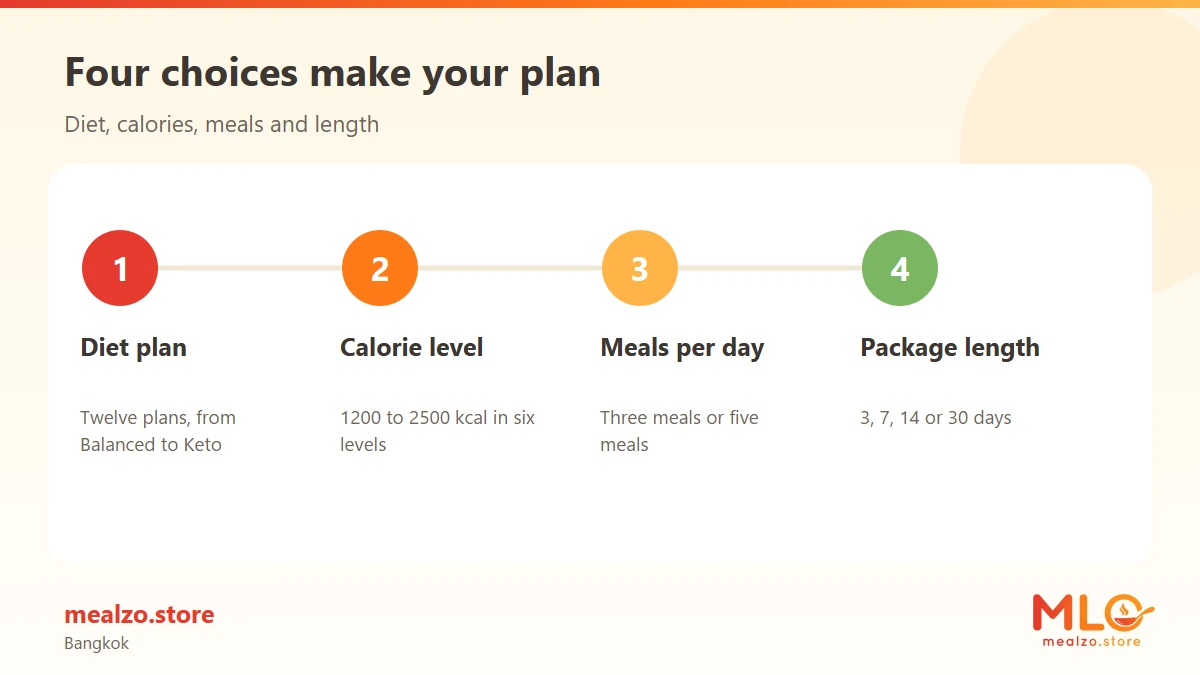
The other configuration choices still matter. A customer selects:
- One of the 12 meal plans.
- One of six daily calorie levels: 1200, 1500, 1800, 2000, 2200 or 2500 kcal.
- Three or five meals per day.
- A package of 3, 7, 14 or 30 days.
- Any of the nine supported allergen groups they need excluded from dish assignment.
Mealzo also has a calorie calculator in the app using the Mifflin-St Jeor formula. Its result is an estimate rather than medical advice. The allergen declaration is separate from that calorie estimate; one concerns menu assignment exclusions, while the other estimates calorie needs.
9. What to check before confirming a subscription
If ingredient avoidance is part of your decision, it helps to separate the questions that Mealzo can answer through its system from assumptions the system does not support.
First, check whether the ingredient you need to avoid falls within one of the nine supported groups. The declaration mechanism covers peanuts, tree nuts, shellfish, fish, milk, egg, soy, wheat/gluten and sesame.
Second, remember that you are selecting a plan rather than individual dishes. Your package menu is assembled automatically from the plan, calorie level and meal count, with declared allergen groups used to prevent relevant dishes from being assigned.
Third, assess the shared-kitchen limitation realistically. If avoiding trace cross-contact is essential, the declaration system does not provide that level of control.
Fourth, compare the rest of the subscription in its own right. Mealzo delivers across Bangkok with morning delivery from 06:00-09:00 or evening delivery from 17:00-20:00. Those operational details are separate from allergen handling, but they still affect whether a particular subscription fits your routine.
10. The practical way to think about Mealzo's allergen feature
The most useful way to understand the system is as an assignment rule.
You tell Mealzo which of the nine supported allergen groups you want declared. The automated menu system then does not assign dishes containing those declared allergens to you.
Nothing needs to be added to make that feature sound more substantial. In fact, adding stronger language would make the explanation less accurate.
It is not certification. It is not a guarantee that traces cannot occur. It is not a dedicated-kitchen protocol. It is not a medical safeguard for severe allergy.
For customers whose requirements fit within that boundary, the declaration adds a concrete exclusion to the automatic menu-selection process. For customers who require protection from trace cross-contact, the shared-kitchen limitation is decisive information and should be considered before subscribing.
Key takeaway: The useful question is whether dish-level exclusion of the nine declared groups is sufficient for your requirements, given that trace cross-contact remains possible.
You can review the available combinations of plans, calorie levels, meal counts and package lengths through Mealzo meal plans and subscription options.
FAQ
Which allergen groups can I declare with Mealzo?
You can declare peanuts, tree nuts, shellfish, fish, milk, egg, soy, wheat/gluten and sesame. If a dish contains a group you have declared, that dish is not assigned to you.
Can I declare more than one allergen group?
Yes. You can declare multiple groups from the nine supported categories. The exclusion rule applies to each group you declare, so dishes containing any of those declared allergens are not assigned to you.
Are Mealzo meals safe for someone with a severe allergy?
No. Mealzo should not be described as safe or guaranteed for a severe allergy. The kitchen is shared, and the declaration system does not eliminate trace cross-contact. Anyone with a severe allergy or a history of anaphylaxis should not treat this or any delivery subscription as a medical safeguard and should speak to their doctor.
Does declaring an allergen make my meals allergen-free?
No. The declaration means dishes containing the declared allergen are not assigned to you. It does not certify the meals as allergen-free and does not guarantee that trace cross-contact cannot occur in the shared kitchen.
Can I choose individual replacement dishes after declaring an allergen?
No. Mealzo does not work as a dish-by-dish menu builder for individual days. The menu is assembled automatically from your selected plan, calorie level and meal count, while dishes containing declared allergens are excluded from assignment.
Does the declaration work with every Mealzo package length?
The same assignment mechanism applies across Mealzo's 3-, 7-, 14- and 30-day packages. Your selected plan, calorie level and meal count determine the menu framework, and dishes containing your declared allergens are not assigned.
Find a Meal Plan That Fits
Compare Mealzo plans or use the calculator to explore meal options for your needs.