Meal Delivery Service Checklist Bangkok: What to Compare Before Subscribing

Signing up for a meal plan can remove a surprising amount of friction from the week. You stop deciding what to order three times a day, spend less time checking delivery apps, and have a clearer idea of what you are actually eating.
But Bangkok has no shortage of businesses selling prepared meals, healthy food, calorie-controlled menus and subscription plans. The difficult part is not finding food. It is working out which service is reliable enough to become part of your routine.
A useful meal delivery service checklist Bangkok residents can apply should go beyond photographs of grilled chicken and vegetables. You need to compare food quality, nutritional transparency, menu rotation, delivery conditions, packaging, flexibility and what happens when something goes wrong.
That matters particularly in Bangkok. A meal that leaves a kitchen in good condition still has to make its way through heat, traffic, condo reception procedures, office security and unpredictable delivery times before reaching you.
This guide gives you a practical framework for comparing providers before paying for a longer plan. For a broader overview of how this category works, start with our complete guide to healthy meal delivery in Bangkok.
1. Why Use a Checklist Before Choosing a Meal Delivery Service?
Most meal-plan websites are designed to make the decision feel simple: attractive meals, calorie numbers, a subscription button and perhaps a few testimonials.
Your actual experience is more complicated.
You are not buying one lunch. You are choosing a system that may be responsible for several meals every day. Small weaknesses become much more noticeable after two or three weeks.
A menu with six appealing dishes might seem sufficient until those dishes keep returning. A narrow delivery window may sound efficient until it clashes with your office schedule. A low-calorie plan can look ideal until you discover that the provider does not show protein amounts or explain how portions are calculated.
The right question is therefore not simply, "Does the food look healthy?"
Ask: Could I realistically rely on this service repeatedly?
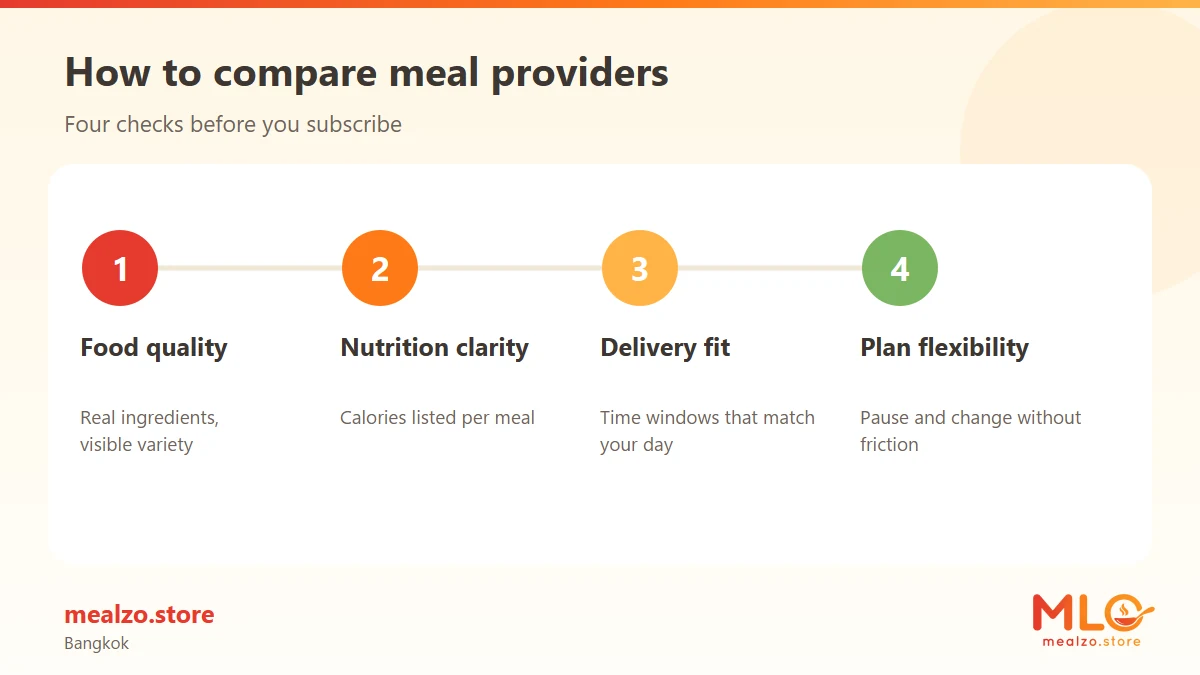
A proper comparison should cover at least these eight areas:
| What to check | Why it matters | Good sign | Red flag |
|---|---|---|---|
| Ingredient and food quality | Affects taste, nutrition and consistency | Recognisable ingredients and clear meal descriptions | Vague descriptions or heavily processed meals |
| Menu variety | Repetition causes subscription fatigue | Visible rotation across days and weeks | Same dishes appearing constantly |
| Calories and macros | Helps match meals to your goals | Clearly stated nutrition information | "Healthy" claims without useful numbers |
| Dietary options | Prevents unsuitable meals and unnecessary substitutions | Clearly defined plan types | Ambiguous allergy or diet wording |
| Delivery logistics | Determines whether meals arrive when you can receive them | Defined windows and clear Bangkok coverage | Unclear timing or delivery rules |
| Packaging and freshness | Important in Bangkok's heat | Secure packaging and clear storage guidance | Leaking, poorly sealed or warm meals |
| Subscription flexibility | Your schedule will eventually change | Practical pause and plan-change rules | Long commitments with unclear cancellation terms |
| Support | Problems happen even with good operators | Easy contact and clear problem resolution | Slow or inaccessible support |
Key takeaway: Compare a meal-plan provider as an ongoing service, not as a single restaurant order.
2. Food Quality: Look Beyond the Photography
Professional food photography tells you almost nothing about what Tuesday's lunch will taste like after a delivery journey across Bangkok.
Instead, look for signals of how meals are actually prepared.
A strong provider should make it reasonably clear what you are eating. A dish called "chicken with brown rice and vegetables" gives you more information than something marketed only as a "Lean Energy Bowl."
Check whether meals appear to contain proper sources of protein, vegetables, carbohydrates and fats rather than relying mainly on sauces, processed meat or decorative greens.
Consistency matters as much as premium ingredients. If you are subscribing for several weeks, you need chicken that is not dry one day and oily the next, vegetables that still have texture and rice or noodles that reheat properly.
You should also consider how the menu is engineered for delivery. Some dishes that are excellent straight from a restaurant kitchen deteriorate badly after storage and reheating. Meal-plan cooking is its own discipline.
A provider that understands this will choose recipes that survive refrigeration, transport and reheating without becoming soggy, separated or unpleasant.
3. Menu Variety and Rotation: Check What Happens After Week One
Variety is one of the most underestimated parts of choosing a subscription.
Nearly every provider can create an attractive first few days. The more important question is what happens later.
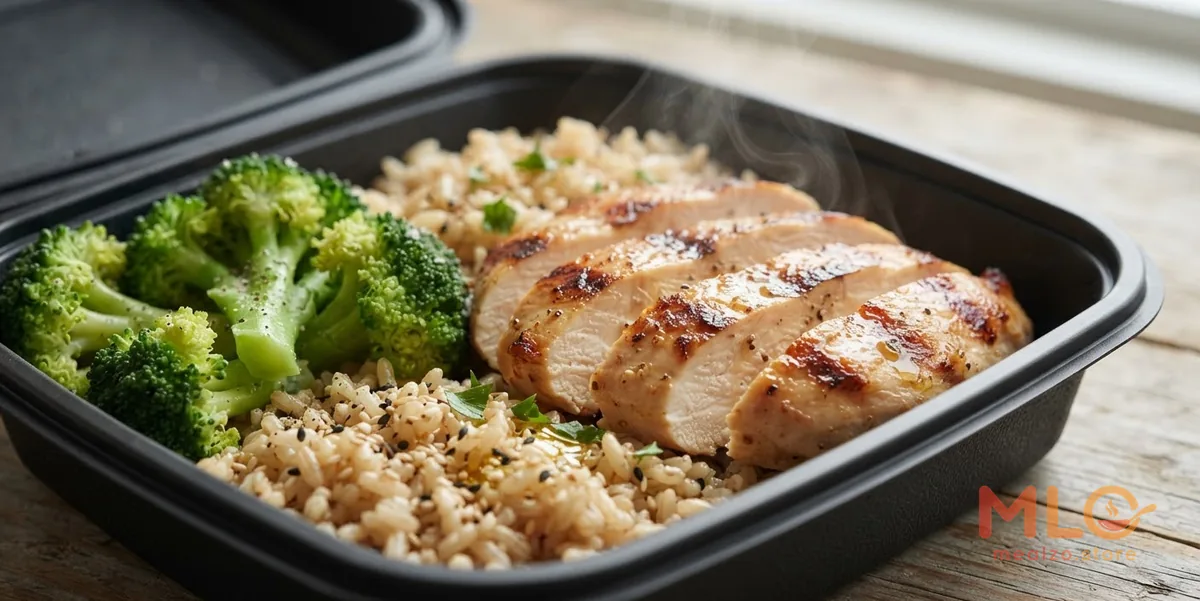
Look at as much of the menu cycle as the company makes available. Are proteins rotated? Do carbohydrate sources change? Are Thai dishes mixed with international options? Do vegetables and sauces vary, or is every meal essentially chicken, rice and broccoli with a different name?
Good rotation does not require hundreds of recipes. It requires enough variation that meals do not feel repetitive.
You should also distinguish between real variety and superficial variety. Chicken with rice and pepper sauce followed by chicken with rice and garlic sauce may technically be two recipes, but the eating experience is almost identical.
For longer subscriptions, weekly and monthly rotation matters far more than the number of meals displayed on the homepage.
4. Calories and Macros: Demand Useful Transparency
"Healthy" is not a measurable portion size.
If you are choosing a structured meal plan, nutritional information should be useful enough to understand what you are buying.
Calories are often the first number people check because they influence total energy intake. But calories alone cannot tell you whether a meal provides enough protein, whether most of its energy comes from carbohydrate or fat, or whether two meals with the same calorie total have very different nutritional profiles.
Macro information is particularly useful for people training regularly, trying to maintain muscle during fat loss or simply wanting better control over protein intake.
You do not need laboratory-style precision printed across every container. You do need a provider whose nutritional claims have an understandable basis.
If a service offers different calorie levels, investigate whether the food portions genuinely change. A "1,500 kcal" and "2,000 kcal" plan should not appear to be the same food with marketing labels attached.
5. Dietary Options: Read the Definitions, Not Just the Labels
Terms such as vegetarian, vegan, keto, low-carb, high-protein and gluten-free can mean different things across providers.
Before subscribing, establish what the label actually changes.
For example, does a vegetarian plan exclude fish? Does a dairy-free plan exclude ingredients containing milk derivatives? Is "no seafood" treated separately from a vegetarian diet? Does a low-carb plan simply reduce rice portions, or is the entire meal composition adjusted?
People with medical food allergies need to be especially careful. A dietary preference and a controlled allergen environment are not the same thing.
A company may be able to exclude an ingredient from recipes while still using the same kitchen, surfaces or equipment for other foods. Never assume that a menu category automatically guarantees protection against cross-contact.
For lifestyle preferences, clearly documented plan definitions are usually a good indication that the operation itself is organised.
6. Bangkok Delivery Logistics Can Make or Break the Service
Food quality means little if your lunch repeatedly arrives while you are in a meeting or your dinner is left somewhere unsuitable for an hour.
Bangkok introduces several delivery-specific questions that matter more here than they might in a smaller city.
First, check the delivery window. A provider saying "morning delivery" may mean a broad period rather than a precise time. Decide whether that works with your routine.
Second, consider your building.
Condominiums may restrict riders from going beyond the lobby. Some require residents to collect deliveries immediately. Offices may have reception desks, loading entrances or building-specific courier procedures.
If you regularly receive food at either type of property, delivery to Bangkok condos and offices is worth reviewing before choosing your plan.
Third, think about geography and traffic. Crossing Bangkok at peak periods is fundamentally different from delivering within one compact neighbourhood. Reliable providers build realistic routes rather than pretending congestion does not exist.
Finally, heat matters. Bangkok temperatures mean chilled prepared food cannot simply spend unlimited time in an uncontrolled environment. Ask how meals are transported and what you should do with them immediately after arrival.
This is one of the clearest differences between diet meal delivery versus regular food delivery. A subscription service has to deliver repeatable logistics, not merely complete an occasional restaurant order.
7. Packaging, Freshness and Storage Instructions
Good meal-plan packaging has several jobs.
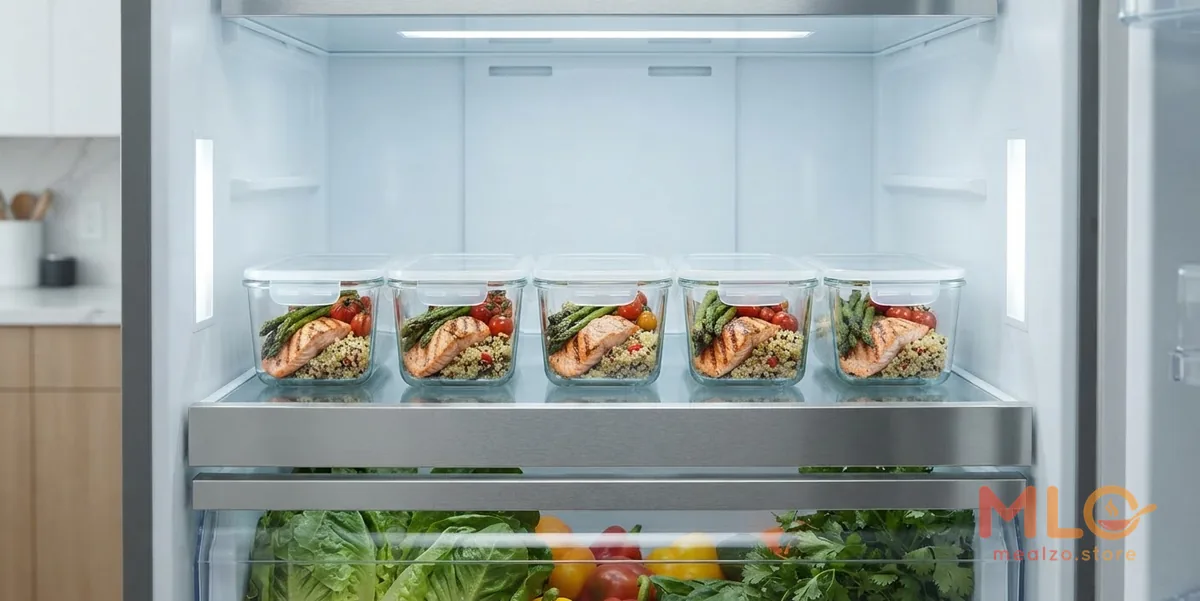
It should protect the food in transit, separate components where necessary, resist leaks, fit efficiently in a refrigerator and make reheating straightforward.
Look for practical details rather than elaborate packaging for its own sake.
Meals should arrive closed securely and in a condition that gives you confidence they have been handled properly. If meals are intended to be refrigerated, the service should explain how quickly they should be chilled after delivery and how long they are intended to be stored.
Reheating guidance also matters. Some containers are microwave-compatible; others require transferring the meal to another dish. Customers should not have to guess.
Portion labelling is helpful when several meals are delivered together. At minimum, you should be able to distinguish the dishes and know which plan or meal each container belongs to.
Environmental concerns may influence your choice too, but sustainability needs to be balanced against food safety and practical delivery requirements. Extremely minimal packaging is not necessarily better if meals leak or lose temperature control.
8. Plan Flexibility: Your Real Life Will Interrupt the Subscription
People often assess a meal subscription based on an ideal week.
Real weeks include travel, late meetings, dinners with friends, holidays, sick days and sudden changes of schedule.
Before paying for a longer package, check how the provider handles those interruptions.
Can you pause deliveries? How much notice is required? Can unused days be moved? Can you change your calorie level or dietary plan? Can the delivery location be changed temporarily?
No service has to allow unlimited last-minute modifications. Kitchens need production schedules and delivery routes.
The important thing is that the rules are clear before you pay.
A provider with firm but understandable cut-off times is preferable to one promising "complete flexibility" and then improvising when customers request changes.
9. Trial Periods and Short Plans Are Valuable
A tasting photo cannot tell you whether a service fits your daily life.
If shorter packages are available, they can be useful before making a longer commitment.
During a trial, evaluate more than flavour.
Check whether portions satisfy you appropriately, whether delivery timing works, how the meals fit into your refrigerator, whether reheating is convenient and how you feel about the menu after several consecutive days.
You should also assess practical consistency. One excellent meal does not compensate for three mediocre ones.
If the provider only offers longer subscriptions, investigate cancellation and modification rules more carefully before paying.
A short plan is particularly valuable if you are unsure about the calorie level. Hunger, activity and body size vary substantially between individuals, so a plan that sounds appropriate on paper may need adjusting in practice.
10. Customer Support Matters More After You Subscribe
Customer support is easy to ignore when everything is working.
Then a delivery goes to the wrong lobby, a meal is missing, your schedule changes or you need to clarify an ingredient.
That is when the quality of the service becomes obvious.
Before subscribing, check how customers actually contact the company. Is there a practical channel for operational problems? Are support hours clear? Does the provider explain what happens when a delivery or order error occurs?
You do not need 24-hour concierge service from a meal company. You do need a reasonable way to resolve genuine problems.
Response quality matters as much as speed. A useful answer should deal with the issue rather than repeatedly sending generic templates.
Long subscriptions depend on trust. Good support protects that trust when an inevitable mistake occurs.
11. Red Flags That Deserve a Second Look
One red flag does not automatically make a service unsuitable, but multiple warning signs should make you cautious.
Be careful when a provider uses broad health claims without explaining the meals behind them. "Clean," "detox," "guilt-free" and "fat-burning" can sound persuasive while communicating very little.
Other warning signs include:
- no clear information about portion or calorie differences between plans;
- very limited menu rotation hidden behind different dish names;
- unclear delivery windows;
- no obvious policy for pauses or schedule changes;
- dietary labels without definitions;
- dramatically restrictive promises or unrealistic weight-loss claims;
- unclear contact options after payment;
- stock-style food photography that does not appear connected to the actual menu.
You should also be cautious when the subscription rules are difficult to find. If you cannot understand what you are buying before checkout, the experience rarely becomes simpler after payment.
Key takeaway: Clear operating rules are usually a stronger quality signal than aggressive wellness marketing.
12. Six Questions to Ask Before You Subscribe
You can learn a great deal about a provider with a small number of specific questions.
| Question | What a good answer sounds like |
|---|---|
| How often does your menu rotate? | A clear explanation of the weekly or monthly menu cycle |
| How are calories calculated? | Portions and recipes are planned around defined calorie levels |
| Can I pause my plan? | Yes, with a clearly stated notice period or policy |
| What time will my meals arrive? | A realistic delivery window for your Bangkok area |
| What happens if I am not home? | A defined handover procedure for condos or offices |
| Can I change my plan later? | Clear rules for changing calories, meal count or dietary option |
Do not worry about sounding demanding. You are considering a recurring purchase, so these are normal operational questions.
Providers that run structured systems should usually be able to answer them without difficulty.
13. Where a Structured MEALZO Plan Fits
Once you have compared the operational basics, you can assess individual providers using the same framework rather than relying on marketing claims.
MEALZO is a Bangkok meal-plan delivery service offering chef-prepared, calorie-controlled meals through structured plans. The service is designed around meal planning rather than one-off restaurant ordering.
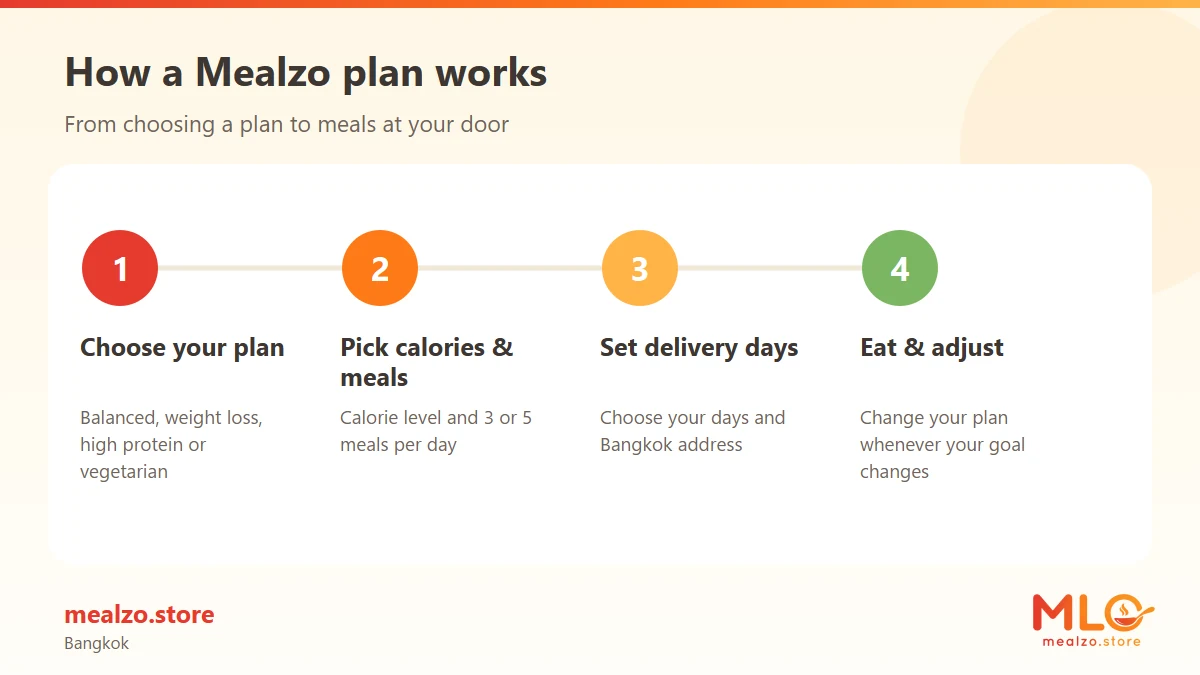
Available plan categories include balanced, weight loss, high protein, vegetarian, vegan, keto, low carb, gluten free, easy digest, pescatarian, no fish or seafood, and dairy and egg free.
Calorie levels are available at 1,200, 1,500, 1,800, 2,000, 2,200 and 2,500 kcal, with options for 3 or 5 meals per day. Packages can cover 3, 7, 14 or 30 days, and cuisine preferences include Thai, international or mixed menus.
Those choices are useful only when matched to your actual routine. Someone who mainly needs predictable workday meals may make a different choice from someone using structured eating across an entire month.
For a closer look at the available configurations, see Mealzo's meal plans.
14. Use a Final Decision Framework Instead of Chasing the "Best" Provider
There is no universally best meal delivery service because customers value different things.
A highly active person may prioritise calorie range and protein. Someone with an unpredictable work schedule may care much more about pausing rules. A resident working from home may accept a broad delivery window that would be impossible for someone moving between client meetings.
A practical way to choose is to score each provider from 1 to 5 in six categories:
Food: Do the meals look like food you genuinely want to eat repeatedly?
Nutrition: Are calories, portions and dietary options clear enough for your goal?
Variety: Would the rotation still feel acceptable after several weeks?
Delivery: Does the system realistically work at your condo or office?
Flexibility: Can the plan cope with normal schedule changes?
Trust: Are the policies, customer support and claims clear?
Do not give every category equal weight automatically. Identify your two most important requirements first.
For example, if you travel frequently, flexibility might matter twice as much as packaging style. If you are tracking energy intake, calorie transparency may be non-negotiable.
MEALZO customers comparing the available configurations can use how to choose your Mealzo plan to narrow the options according to calorie level, meals per day, dietary preference and package length.
The goal is not to find a provider with the longest feature list. It is to find one whose system works reliably for the way you actually eat.
Key takeaway: Choose the plan you can realistically follow on an ordinary Bangkok week, not the one that looks most impressive on a sales page.
15. Your Meal Delivery Service Checklist Before Paying
Before you complete a subscription, run through one final check.
You should know what kind of meals you will receive, how frequently the menu changes, what the nutritional numbers mean, when the food arrives and what happens if your schedule changes.
You should also be comfortable with the storage requirements, delivery process and support arrangements.
If any important part of the service still feels vague, ask before subscribing.
A meal plan should simplify food decisions. If understanding the subscription itself requires detective work, that is useful information about the provider.
For MEALZO specifically, compare your preferred calorie level, number of daily meals, dietary plan, cuisine preference and package length rather than choosing solely by the plan name.
The best subscription is ultimately the one that removes decisions without creating new logistical problems.
Frequently Asked Questions
What should I look for in a meal delivery service in Bangkok?
Start with food quality, menu rotation, calorie transparency, dietary options, delivery windows, packaging and subscription flexibility. Bangkok-specific factors such as traffic, building access and heat should also influence your decision.
Is calorie information enough to compare healthy meal plans?
No. Calories tell you how much energy a meal provides but not how that energy is distributed between protein, carbohydrates and fat. Menu quality, food variety and overall meal composition matter too.
How important is menu rotation for a long subscription?
Very important. A small amount of repetition is normal, but eating essentially the same meals every few days can make a plan difficult to sustain. Check the menu across several weeks rather than judging the provider by a single day's selection.
Should I try a short meal plan before subscribing for a month?
A short package can be a useful way to test portions, taste, delivery reliability, packaging and how the plan fits your schedule. It is particularly helpful when you are unsure which calorie level or dietary format suits you.
Can meal delivery work well for Bangkok condos and offices?
Yes, provided the handover process is compatible with the building. Check whether the rider delivers to reception or another collection point and whether you will be available within the expected delivery window.
How do I choose between 3 and 5 meals per day?
Think about how you naturally prefer to eat rather than assuming that more meals are automatically better. Three larger meals may suit people who prefer traditional meal times, while five smaller eating occasions may fit others better; total daily intake and consistency matter more than meal frequency alone.
Know someone who'd like Mealzo?
If you know someone in Bangkok who might enjoy Mealzo Bangkok, you can share it with them through our referral programme.