Meal Plans and Eating Out in Bangkok: Keeping the Plan and the Social Life
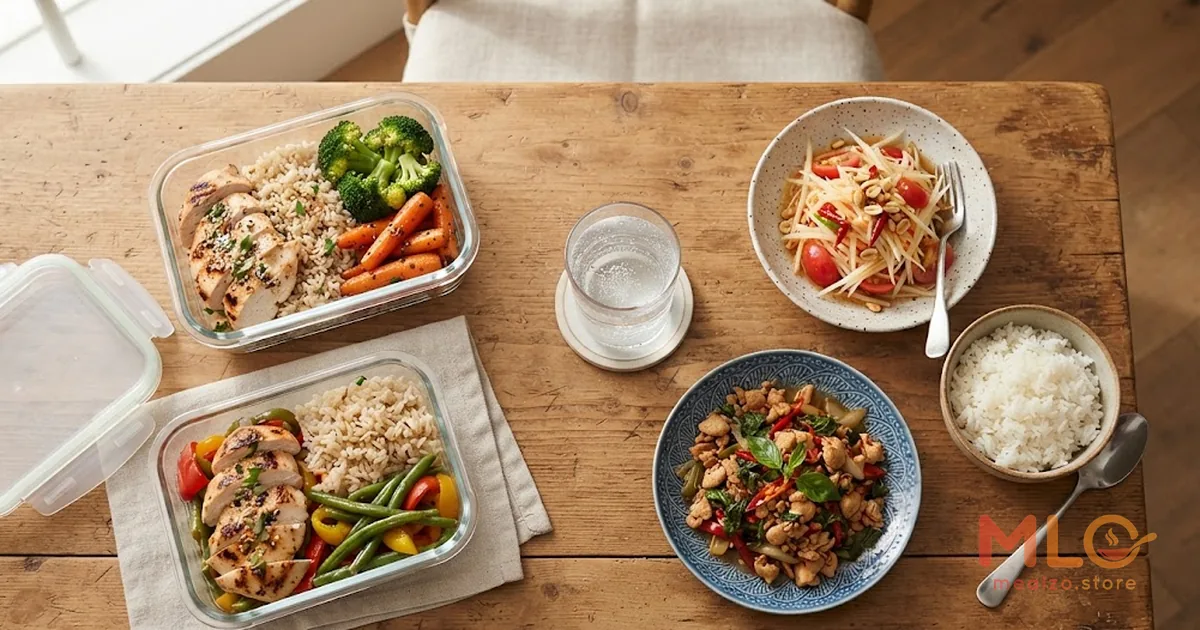
Bangkok makes eating out unusually easy. Street food is everywhere, food courts are part of normal workdays, office lunch runs happen without much planning, and dinner can turn into a late meal with friends simply because everyone is already out.
That does not mean a meal plan has to replace restaurant food. Most people considering a meal plan eating out Bangkok style are not trying to eliminate meals with colleagues, clients, partners or friends. They are trying to stop every meal from becoming an unplanned decision.
The practical solution is to plan around the meals you actually control. A meal plan that assumes you will never eat out is likely to become inconvenient very quickly. A plan that covers the predictable parts of your week can leave room for the rest.
Mealzo Bangkok is designed around that reality. The useful question is not whether you can eat out while using a meal plan. You can. The better question is how many meals you genuinely need delivered, which days are predictable, and how you want to handle the meals that are already spoken for.
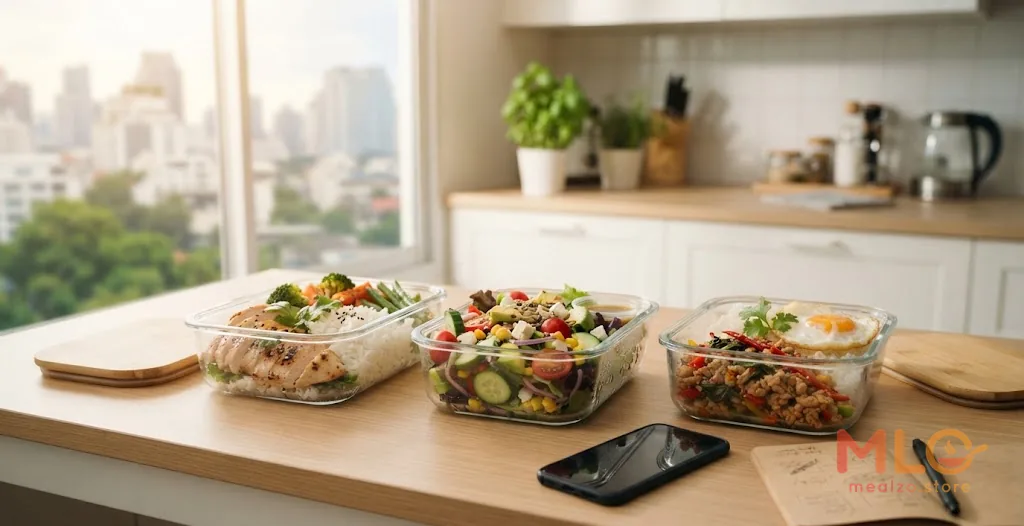
1. The meal plan question in Bangkok is really a question about eating out
In some cities, eating out several times a week might feel like a special occasion. In Bangkok, it is often just Tuesday.
You might grab breakfast near the BTS, eat lunch with colleagues at a food court, order something at the office, meet a client for dinner, and then spend Saturday eating somewhere with friends. None of these meals necessarily feels like an exception.
That changes how a meal plan should be used.
The aim is not to create a rigid schedule in which every meal comes from a delivery box. It is to remove unnecessary decisions from the parts of your week where you have the most control.
For many Bangkok residents, breakfast is predictable. Weekday lunch may be predictable because you are working from home or sitting at a desk. Dinner might be less predictable because of meetings, social plans or the general temptation to stop somewhere on the way home.
Weekends are often even harder to predict.
This is why the question should not be, "Can I stick to a meal plan if I eat out?" It should be, "Which meals should the plan cover so that I still have a normal social life?"
Key takeaway: A meal plan works better when it covers the meals you control instead of pretending that every social meal can be removed from your calendar.
For more on fitting delivered meals around a working schedule, see meal planning for busy professionals in Bangkok.
2. Start by separating the meals you control from the ones you do not
Take a normal week and mark each meal according to how predictable it is.
Breakfast is often the easiest. If you leave home at roughly the same time or work at a desk, there is usually little reason for breakfast to become a daily restaurant decision.
Weekday lunch is also commonly controllable. You may have colleagues who invite you out, but there are usually several weekdays when you know where you will be and when you will eat.
Dinner is different. Some evenings are predictable, while others are already occupied by client meetings, birthdays, dates, family plans or spontaneous invitations.
Weekend meals are the least reliable for many people. One weekend might involve brunch, a shopping-centre food court and dinner at a restaurant. Another might be spent mostly at home.
A useful starting point looks like this:
| Meal | Who usually controls it? | What the plan should cover |
|---|---|---|
| Weekday breakfast | You | Usually easy to cover |
| Weekday lunch | You, unless there is a work lunch | Often worth covering |
| Weekday dinner | Mixed | Cover predictable evenings |
| Weekend breakfast | Mixed | Depends on your routine |
| Weekend lunch | Friends, family or you | Often leave flexible |
| Weekend dinner | Often social | Usually leave flexible |
The table is not a rule. It is a way of seeing where your money and food are most likely to be useful.
If you regularly have three restaurant dinners every week, ordering a plan that expects you to eat delivered dinner every night creates an obvious conflict. You are paying for a meal you may not eat, while still needing to make the restaurant choice.
If you normally control breakfast and lunch but rarely control dinner, those first two meals may be the logical foundation of your plan.
This approach also makes a meal plan less psychologically demanding. You are not constantly deciding whether today's restaurant invitation has "ruined" anything. The restaurant meal was already part of the plan.
3. Match the number of meals per day to your actual week
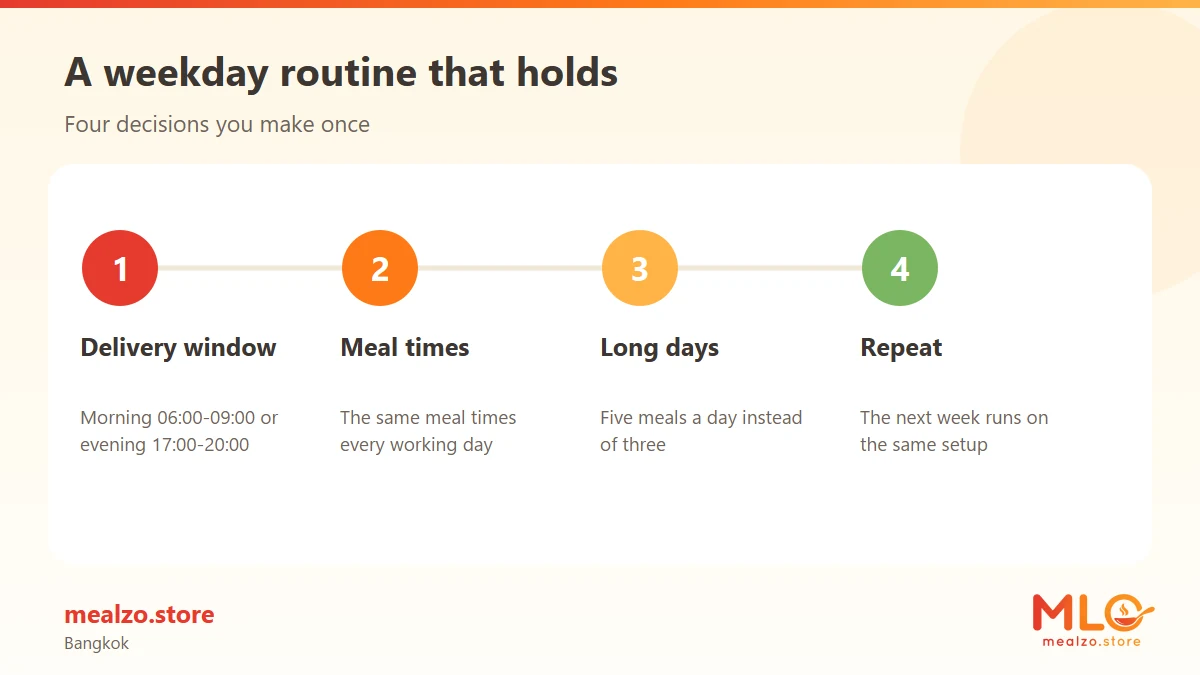
Mealzo Bangkok offers plans with either 3 or 5 meals per day. The right choice depends less on what sounds ideal and more on how often you actually eat meals that you control.
A 3 meal plan can make more sense for someone who eats out frequently. It gives you a structured base without trying to replace every eating occasion.
For example, imagine that you usually have a delivered breakfast and lunch on working days, then eat dinner with friends three nights a week. A 3 meal plan gives you the option to cover the meals you expect to eat from the plan while leaving your social dinners as part of your normal week.
A 5 meal plan is more appropriate when most of your eating happens at home, at your desk or within a routine where delivered meals are convenient. It can also suit someone who prefers smaller, more frequent meals and has relatively few restaurant commitments.
The important point is that five meals on paper does not automatically mean five meals will fit your life.
If you frequently replace delivered meals with restaurant meals, a larger package can become expensive in a very practical way. You still pay for the food even when you do not eat it.
| Weekly pattern | More practical starting point | Why |
|---|---|---|
| Frequent lunches and dinners out | 3 meals/day | Leaves more room for social meals |
| Mostly working from home | 5 meals/day | More meals are under your control |
| Office-based, occasional dinners out | 3 or 5 | Depends on how many meals are normally eaten from the plan |
| Highly unpredictable week | 3 meals/day | Gives more flexibility |
| Very regular home or desk routine | 5 meals/day | The plan can cover more of the week |
Mealzo Bangkok has six daily calorie levels from 1200 to 2500 kcal across its plans. The app's calorie calculator uses the Mifflin-St Jeor formula, but it is an estimate, not medical guidance. It should not be treated as a precise instruction for what you must eat, particularly when restaurant meals are part of your week.
For a more detailed look at the 3 versus 5 meal decision, see choosing between 3 and 5 meals a day.
4. Choose the package length around your social calendar
Package length matters more when your week is unpredictable.
Mealzo Bangkok offers 3, 7, 14 and 30 day packages. There is a straightforward trade-off here.
A shorter package gives you less commitment when you already know that the next few days contain several dinners, celebrations, work events or a trip outside your normal routine.
A longer package makes more sense when your schedule is relatively predictable and you expect to use the plan consistently over a longer stretch.
Suppose the coming week includes a birthday dinner, two client meetings over dinner and a weekend gathering. A 3 or 7 day package may be easier to reconcile with that calendar than committing immediately to a longer period.
On the other hand, if you are entering several ordinary working weeks with breakfast and lunch mostly under your control, a 14 or 30 day package may fit much more naturally.
The mistake is choosing package length based on an imaginary version of your life.
Look at your actual calendar.
Before ordering, check:
- How many meals will definitely be eaten at home or work?
- How many restaurant meals are already scheduled?
- Are there birthdays, meetings or events coming up?
- Are weekends usually predictable or not?
- Is the next month unusually social?
For a broader discussion of package length, see how long your meal plan subscription should be.
The financial side is worth stating plainly: a meal plan costs money whether or not you eat a particular meal. If you know you will eat out most days, a shorter package or fewer delivered meals can be more sensible than paying for food that repeatedly goes unused.
5. Understand what pausing days actually changes
A pause is useful because a social week does not necessarily mean you need to abandon the whole plan.
The mechanism is simple: a package is a pool of days, and pausing shifts the schedule forward rather than causing a day to disappear from the package.
That distinction matters.
Imagine that you have a delivered plan and discover that several days in the coming period are going to be unusually social. Instead of treating those days as wasted, pausing can move the schedule forward so the package continues when you are ready to use it.
There is no need to invent a complicated calculation around this. The exact operational rule that applies to your account is best checked in the Mealzo Bangkok app or confirmed with support.
The important principle is that a pause changes the schedule. It does not turn a meal you did not eat into something you should feel guilty about.
It also means you can think about your plan as a flexible structure rather than a test of consistency.
For the detailed mechanics, see pausing and skipping days on a Bangkok meal plan.
6. What should you do with a delivery on an evening when you eat out?
This is one of the most practical problems.
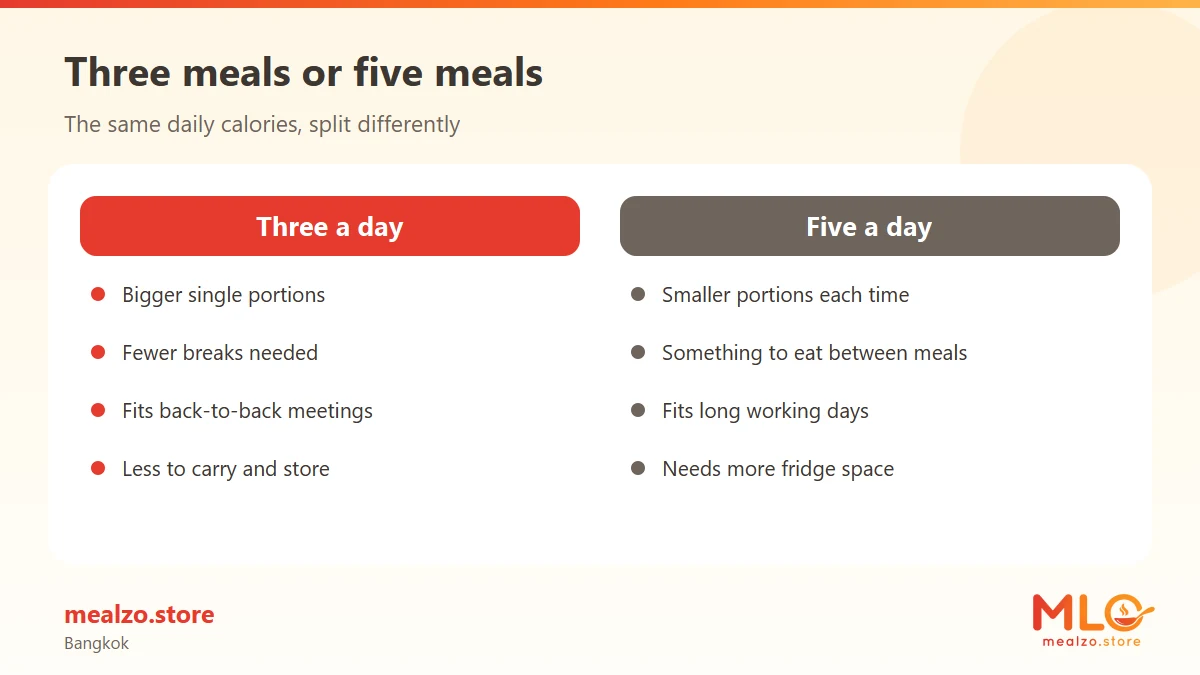
Mealzo Bangkok offers two delivery windows: morning delivery from 06:00 to 09:00 and evening delivery from 17:00 to 20:00. You choose one.
If you normally receive your meals in the morning and already know you are going out for dinner, the fact that the box arrives in the morning does not mean you have to eat every item immediately.
The sensible approach is to keep the delivered food according to the handling instructions that come with it and use it when it fits your day. If you know a particular meal will not be useful because you will be away, plan your day around the meals you can actually eat rather than automatically opening everything.
The same principle applies in reverse. If you normally receive evening delivery but have a late dinner planned, the delivery timing may become inconvenient for that particular day. This is exactly why delivery window choice should be considered alongside your working and social routine.
A meal plan is supposed to reduce friction. If the chosen delivery window regularly clashes with your schedule, the problem is not a lack of discipline. The setup simply needs reconsidering.
For current delivery and account-specific questions, the app and Mealzo Bangkok support are the appropriate authority.
7. Eat at restaurants without turning dinner into arithmetic
A restaurant meal does not need to become a calorie calculation performed at the table.
Restaurant portions vary. Recipes vary. Preparation methods vary. Unless you know exactly how a dish was prepared and what went into it, precise numbers are often impossible to establish.
That uncertainty does not mean you need to give up on making sensible choices.
Instead, use simple visual and practical cues.
For example:
- Look for a clear main dish rather than ordering several large dishes automatically.
- Share dishes when you are eating with other people.
- Notice whether a meal is fried, grilled, steamed or prepared another way.
- If rice is part of the meal, take an amount that suits your appetite rather than automatically treating the full serving as mandatory.
- Choose water or an unsweetened drink when you do not particularly want a sweet beverage.
- Eat normally rather than arriving extremely hungry because you expected to "save" food for dinner.
The point is not to make restaurant eating clinical. You should still be able to enjoy dinner with colleagues or friends.
A useful meal plan gives you structure before and after that dinner, which can make the restaurant meal easier to handle without requiring calculations.
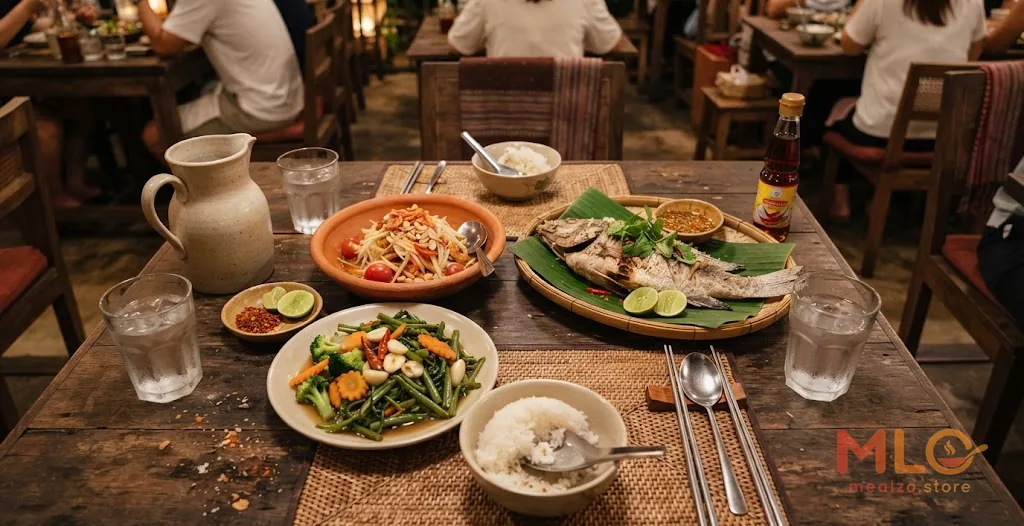
8. Ordering Thai food: a few practical choices make a difference
Thai food works perfectly well within a social meal. The issue is not that Thai food is somehow incompatible with planning. Bangkok's food culture is broad, and the same restaurant can offer very different combinations of rice, noodles, soups, curries, grilled dishes, fried foods and drinks.
The easiest approach is to look at the whole meal.
If you are sharing several dishes, you have more control over how much of each item ends up on your plate. This can be useful when the table contains a mixture of preparations.
Rice is another straightforward variable. You do not have to avoid it. You can simply choose how much you want rather than assuming you must finish the entire serving.
Preparation also matters as a practical cue. Grilled and steamed dishes are different from heavily fried dishes. A soup-based dish creates a different meal from a plate built around fried food. None of these categories needs to be labelled "good" or "bad". They are simply different choices.
Then there are drinks.
Sweetened Thai drinks, milk teas, soft drinks and other sugary beverages can become an easy source of additional energy without feeling like part of the meal. If you genuinely want one, have one. If you are ordering a drink mostly because it is there, water or an unsweetened option is the simpler choice.
The same logic works for street food.
You do not need a special "diet version" of Bangkok. You need a way of making ordinary decisions that you can repeat.
Key takeaway: When eating Thai food socially, focus on the combination of dishes, portion size, preparation and drinks rather than trying to calculate an exact nutritional value for every item.
9. Drinks are often the easiest thing to simplify
Food gets most of the attention, but drinks can quietly change a restaurant meal.
This is particularly relevant in Bangkok, where sweet drinks are widely available and can be part of the experience of eating out. A meal with water is not the same practical choice as a meal accompanied by several sweetened drinks.
There is no need to turn this into a ban on anything.
Instead, ask a simple question: do you actually want the drink, or is it simply part of the automatic order?
If you want a sweet drink, have it and move on. If you do not care, choosing water or an unsweetened option removes one variable without changing the rest of your meal.
The same principle applies to alcohol when it is part of a social dinner. The article is not going to pretend that every Bangkok dinner happens with a glass of water. The useful point is simply that drinks are part of the overall meal, and you can make deliberate choices without trying to calculate the entire dinner.
A meal plan does not require perfection at the restaurant table. It gives you a predictable structure around those meals.
10. The morning after a big dinner
After a large dinner, some people immediately want to compensate by skipping breakfast or avoiding food until later.
That can create a second problem. Instead of returning to a normal routine, the person turns one unusual meal into an entire day of irregular eating.
The simpler response is usually to return to the normal plan.
If breakfast is normally part of your delivered plan, eat breakfast. If lunch is normally part of your working routine, continue with lunch. You do not need to "earn back" the restaurant meal by making the following day unusually restrictive.
This is especially useful when the dinner was social. You enjoyed an evening with friends, then returned to your normal routine. There is no need to classify the evening as a failure that requires correction.
The same applies if the dinner was bigger than expected. Restaurant meals contain uncertainty, and trying to calculate exactly what happened after the fact is often not particularly useful.
A repeatable routine is easier to maintain than a cycle of restaurant meal, compensation, hunger and another unplanned decision.
11. When a meal plan is genuinely the wrong fit
A meal plan is not automatically the best solution for everyone.
If you eat out for nearly every meal, have an unpredictable schedule every day, spend little time at home and rarely know where you will be eating next, a delivered meal plan may create more unused food and cost than convenience.
That is not a failure of the plan. It is a mismatch between the service and the routine.
Think carefully if:
- You eat restaurant or street food for most meals, most days.
- Your working schedule changes constantly.
- You travel away from Bangkok frequently.
- You cannot reliably receive or store the delivered meals.
- You would routinely leave most delivered meals unused.
- You prefer choosing every meal spontaneously.
There is also a middle ground. You may not need a meal plan every day. A shorter package can be useful during a period when your schedule is more predictable, while a more social period may call for less coverage.
Mealzo Bangkok offers 12 meal plans, including Balanced, Weight Loss, High Protein, Vegetarian, Vegan, Keto, Low-Carb, Gluten Free, Easy-to-Digest, Pescatarian, No Fish & Seafood, and Dairy & Egg Free. Every plan uses one mixed cuisine, with Thai and international dishes together. There is no separate choice between different cuisine packages.
For someone who eats out frequently, the most relevant choice may therefore be not "Which plan replaces my restaurant meals?" but "Which plan fits around the meals I already know I will eat elsewhere?"
12. Build a realistic Bangkok week
The easiest way to make the system work is to plan the week before it starts.
Imagine a fairly typical schedule:
Monday: breakfast and lunch at work, dinner at home.
Tuesday: breakfast and lunch from the plan, client dinner outside.
Wednesday: breakfast and lunch from the plan, dinner at home.
Thursday: breakfast from the plan, office lunch outside, dinner with friends.
Friday: breakfast and lunch from the plan, casual dinner outside.
Saturday: brunch and dinner with friends.
Sunday: mostly at home.
That person has several meals they genuinely control. There is no reason to pretend the restaurant meals do not exist.
A possible approach would be to use delivered meals as the predictable foundation, while leaving the already-social meals open. The exact number of meals depends on appetite, routine and the plan selected, but the principle stays the same.
Before each week, look at the calendar and identify fixed points:
- Mark client dinners, birthdays and other social meals.
- Mark the breakfasts and lunches you normally control.
- Decide whether 3 or 5 meals per day actually matches those controllable meals.
- Choose a package length that makes sense for the period ahead.
- If plans change, use the available pause mechanism rather than assuming the whole package has become useless.
- At restaurants, make a few practical choices without trying to calculate every ingredient.
- The following day, return to the normal routine.
The goal is not to make Bangkok behave like a city where nobody eats out. It is to build a meal routine that accepts the way people actually live here.
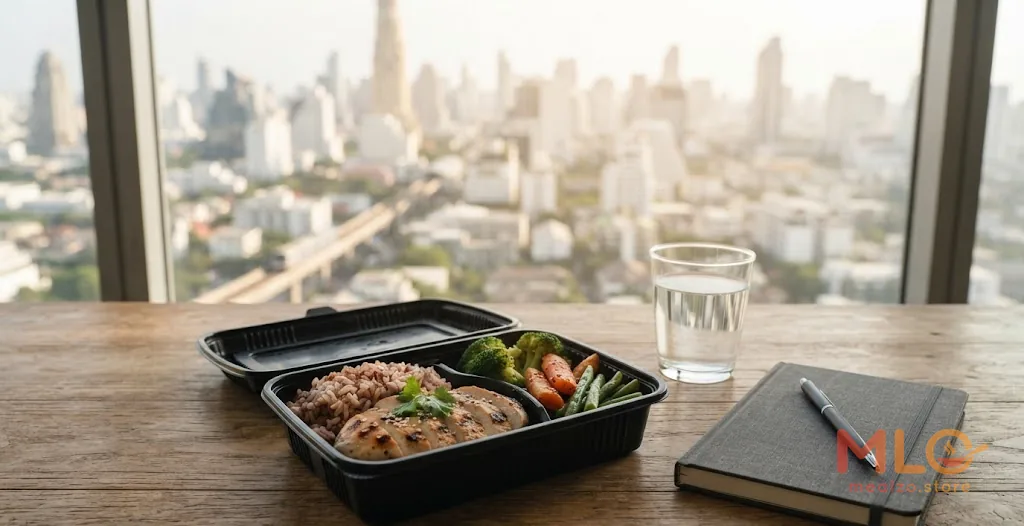
Mealzo Bangkok prepares meals in its kitchen in Bang Na and delivers across Bangkok. Mealzo Bangkok meal plans are available at six daily calorie levels from 1200 to 2500 kcal, with 3 or 5 meals per day and package lengths of 3, 7, 14 or 30 days. Prices are in Thai baht, and payment is online through PromptPay using Thai QR, processed by a payment provider. The courier does not collect cash.
The service and mobile app are available in Thai, English, Polish, German, French, Russian, Simplified Chinese and Burmese. Android users can find the app on Google Play. For questions, the public contact email is [contact@mealzo.store](mailto:contact@mealzo.store).
Allergen handling is also structured around the customer's declarations. You declare allergens from 9 allergen groups, and dishes containing a declared allergen are not assigned to you. This mechanism should not be interpreted as a guarantee that a meal is allergen-free.
The practical takeaway is simple. If eating out is part of your Bangkok life, build that fact into the plan from the beginning. Cover the meals you control, leave space for the meals that matter socially, choose a package that fits the calendar, and use pauses when your schedule changes. A useful meal plan should make ordinary weeks easier, not require you to stop living them.
Mealzo Bangkok is a kitchen and meal delivery service operating exclusively in Bangkok, Thailand. We are not affiliated with similarly named services outside Thailand.
FAQ
Can I use a Mealzo Bangkok meal plan if I eat out several times a week?
Yes. The practical approach is to choose the plan around the meals you normally control rather than expecting every meal to come from the delivery. If you regularly eat out for dinner, for example, a 3 meal plan may fit your routine better than a 5 meal plan, depending on how the rest of your week works.
Should I choose 3 or 5 meals per day if I eat out often?
Start with the number of meals you can realistically use. Three meals per day generally leaves more flexibility for someone with frequent restaurant commitments, while five meals can make more sense when most meals happen at home or at a desk. Your actual weekly schedule should decide.
What happens if I know I will eat out on a delivery day?
A package consists of a pool of days, and pausing shifts the schedule forward rather than losing a day. For the exact rule applicable to your account, check the Mealzo Bangkok app or contact support. If a particular delivered meal will not be eaten that day, handle it according to the food storage and handling instructions provided with the delivery.
Can I eat Thai food while following a meal plan?
Yes. There is no need to avoid Thai food. At a restaurant, practical choices include sharing dishes, being aware of your rice portion, noticing whether dishes are fried, grilled or steamed, and considering whether you want a sweetened drink. Exact nutritional values are often impossible to know for restaurant food, so simple habits are more practical than trying to calculate every dish.
Does the calorie calculator tell me how much I should eat?
The Mealzo Bangkok app's calculator uses the Mifflin-St Jeor formula to provide an estimate. It is not medical advice and should not be treated as a precise prescription for your food intake.
Is a meal plan worth it if I eat out almost every day?
It may not be. If you regularly eat out for most meals, you could end up paying for delivered food that you do not use. In that situation, consider whether a shorter package or fewer delivered meals better matches your routine. The purpose of the plan is convenience and structure, so it should fit your actual week rather than an idealized one.
Find a Meal Plan That Fits
Compare Mealzo plans or use the calculator to explore meal options for your needs.