Complete Guide to Meal Planning for Busy Professionals in Bangkok
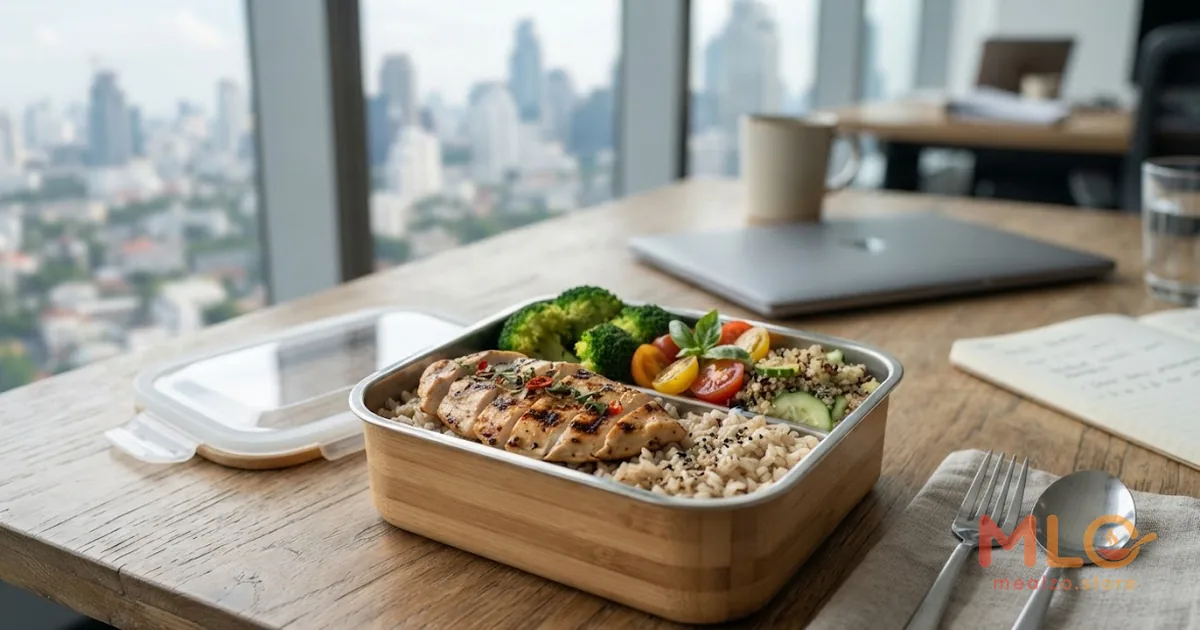
Bangkok can make eating conveniently very easy and eating consistently surprisingly difficult. Food is everywhere, delivery apps are always open, and convenience stores can rescue a late evening. None of that automatically solves the problem of deciding what to eat five minutes before the next meeting.
For people working long hours, the difficult weeks are rarely the ones with an empty calendar. They are the weeks when a meeting runs through lunch, someone else orders food for the team, work continues into the evening, and the vegetables bought on Sunday are still sitting untouched in the condo fridge on Thursday.
Meal planning for busy professionals is therefore less about creating an impressive Sunday routine and more about reducing the number of food decisions that have to be made under pressure. The useful question is not simply, “What should I eat?” It is, “What system still works when this week does not go according to plan?”
There is no single correct answer. Cooking daily, preparing food in batches, ordering meals as needed and using a meal-plan subscription can all work. They simply move the work to different places. The goal of this guide is to make those trade-offs visible so you can build a system around the way you actually work in Bangkok.
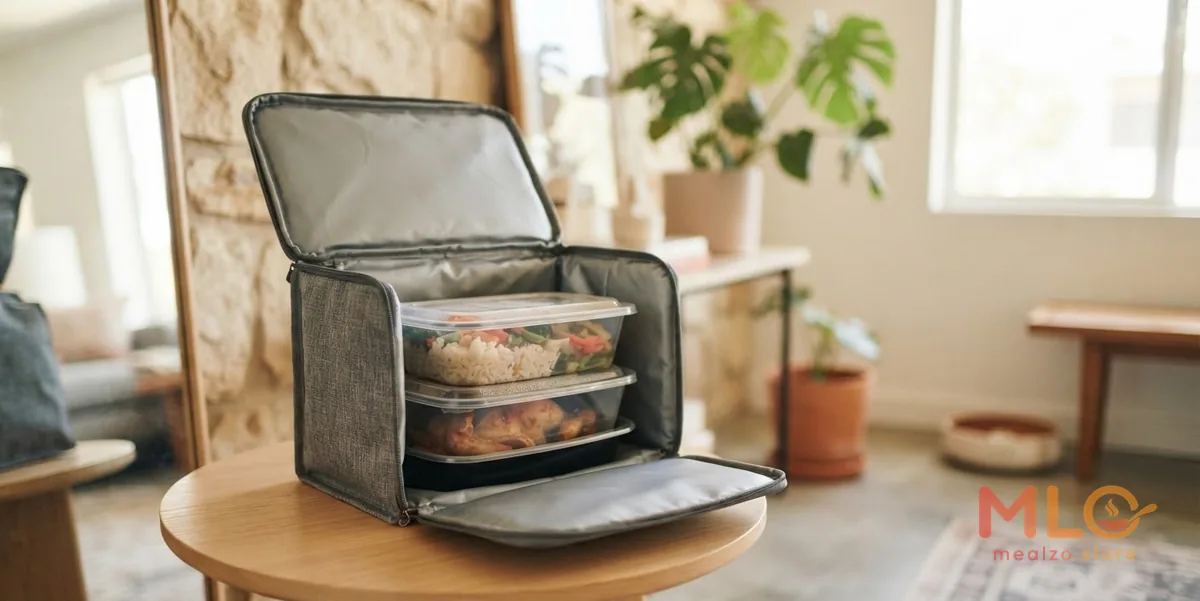
1. Start With the Real Problem: Food Decisions Arrive at Bad Times
Most professionals do not lack the ability to choose a reasonable meal. The problem is timing. At 11:30, choosing lunch may be simple. At 14:20, after three calls and an overdue presentation, it becomes another task competing for attention.
The same pattern repeats at dinner. A normal plan to cook something at home can become much less convincing when you arrive at your condo late, the kitchen is clean because nobody has cooked in it all week, and the easiest remaining option is whatever can reach the lobby quickly.
That is why useful meal planning starts by identifying predictable failure points rather than designing an ideal menu.
Common examples include:
- lunch being delayed because meetings run over;
- a team order replacing the lunch you expected to buy yourself;
- finishing work late and stopping at 7-Eleven at 21:00 because there is nothing ready at home;
- ordering delivery while already very hungry and choosing almost entirely on speed;
- planning to batch cook on Sunday, then losing Sunday to errands, friends or family;
- buying ingredients with good intentions and throwing some of them away several days later.
None of these situations requires a lecture about discipline. They require a different food system.
Key takeaway: A useful meal plan removes decisions from the moments when work has already consumed most of your attention.
2. Map Your Week Before You Plan the Food
Before choosing meals, look at the shape of the week. A food routine that works for somebody working from home three days a week may be inconvenient for somebody moving between an office, client meetings and evening commitments.
You do not need a detailed calendar analysis. Identify the periods where food is usually decided too late.
Find your vulnerable meals
For one normal working week, ask:
- Which breakfasts are rushed or skipped because the morning starts immediately?
- Which lunches are most likely to collide with meetings?
- Which evenings regularly end later than expected?
- On which days are you genuinely willing to cook?
- When does someone else control the food decision, such as an office lunch or client dinner?
This separates meals that need planning from meals that already work without much effort.
If breakfast is easy but weekday dinners repeatedly collapse into ad hoc ordering, there is little value in redesigning breakfast. Fix the dinners first.
Separate predictable days from unpredictable days
Some professionals know exactly where they will be Monday through Friday. Others may know their morning schedule but have no idea where dinner will happen.
Planning should reflect that uncertainty.
A predictable day can support prepared meals, scheduled deliveries or food packed from home. An unpredictable day needs a fallback: something already available, a reliable nearby option, or a short list of orders that require almost no thought.
For a closer look at constructing the office portion of that system, the guide to building a practical Bangkok weekday lunch routine focuses specifically on lunches around meetings and office schedules.
3. Understand the Four Realistic Ways to Handle Weekday Meals
Most busy professionals end up using some combination of four approaches: cooking each meal, batch cooking, ordering food as needed, or using a subscription. The differences are not primarily culinary. They are operational.
| Approach | Upfront time cost | Daily decision load | Consistency on busy weeks | Main limitation |
|---|---|---|---|---|
| Cook each meal | Low before the week, high each day | High | Depends heavily on available time | Cooking and cleaning still have to happen after work |
| Batch cook | High in one or two blocks | Low once prepared | Good if the prep session actually happens | A missed prep day can disrupt the whole week |
| Order ad hoc | Very low | High | Food remains accessible, but choices vary | Repeated ordering and waiting remain daily tasks |
| Meal-plan subscription | Low once configured | Low | High for the meals covered by the package | Less individual dish choice and a fixed service structure |
Cooking daily gives the most direct control over ingredients and dishes, but it keeps preparation and cleanup inside each workday.
Batch cooking moves most of that work into one concentrated session. It can be extremely practical when the session fits naturally into your life. It is much less practical when the weekend is already your only flexible time.
Ad hoc ordering removes cooking but not planning. Someone still has to open the app, compare options, decide, order and wait. That may be trivial on an easy day and irritating on the fifth difficult day in a row.
A subscription moves more decisions upstream. The trade-off is that you generally accept a structured menu rather than treating every meal as a fresh restaurant choice.
There is more detail on the practical time trade-off in how meal delivery changes the daily time burden in Bangkok.
4. Daily Cooking Works Best When Cooking Is Already Part of Your Routine
Cooking at home is often described as the default against which every other approach should be judged. For a busy professional, that is not always useful. The relevant question is whether cooking is already easy to execute within your schedule.
If you enjoy cooking, work from home regularly, have ingredients nearby and do not mind washing up afterwards, daily cooking can be an efficient system. It also gives you direct control over the composition of each meal.
The weak point is not the recipe. It is the sequence around it: checking what is available, shopping, storing food, deciding what to make, preparing it and cleaning the kitchen.
A twenty-minute dish is not necessarily a twenty-minute food system.
Daily cooking tends to work poorly when you repeatedly reach the kitchen already tired and hungry. At that point, even simple preparation can compete badly against food that requires no preparation at all.
A better version may be partial cooking rather than cooking everything from scratch: ready rice, pre-washed vegetables, eggs, tofu, cooked proteins, fruit and a few simple sauces. The objective is not culinary purity. It is reducing the distance between arriving home and having a meal.
5. Batch Cooking Is Efficient Only If the Batch-Cooking Slot Is Reliable
Batch cooking solves one major problem elegantly: it turns repeated cooking into one larger production session.
You shop once, cook several portions, clean the kitchen once and use the refrigerator or freezer to spread that work across several days. For a professional with a stable weekend, that can be one of the cheapest and most controllable systems available.
The weakness appears when the prep window is fragile.
Sunday may look empty when you plan the week on Friday. Then there is brunch, shopping, laundry, an appointment, a friend visiting Bangkok, a short trip outside the city or simply no interest in spending the remaining free hours standing in the kitchen.
If missing one prep session means Monday has no lunch and Tuesday has no dinner, the system has a single point of failure.
A more resilient approach is to prepare components rather than seven identical boxes. For example:
- one or two cooked proteins;
- a pot of rice or another staple;
- vegetables that can be reheated or assembled quickly;
- fruit and other ready snacks;
- one freezer meal for the day when everything else goes wrong.
This gives you some structure without requiring the entire week to be predicted in advance.
Professionals who dislike large Sunday cooking sessions can compare other approaches in meal-prep alternatives that do not require batch cooking.
Key takeaway: Batch cooking saves time only when the preparation session is realistic enough to survive your actual weekends.
6. Ad Hoc Ordering Solves Access, Not Decision Fatigue
Bangkok has no shortage of ways to obtain food quickly. That makes ad hoc ordering a useful part of almost any professional's routine.
It is particularly useful on days when plans change. A meeting moves, you work somewhere unexpected, colleagues decide to eat together, or dinner happens later than planned. A rigid food system can become wasteful in those situations.
The problem comes when every meal becomes an ad hoc decision.
You may start each lunch by browsing, comparing prices, looking at photographs, checking delivery estimates and changing your mind. The food arrives, but the planning task has merely been moved from the kitchen to the phone.
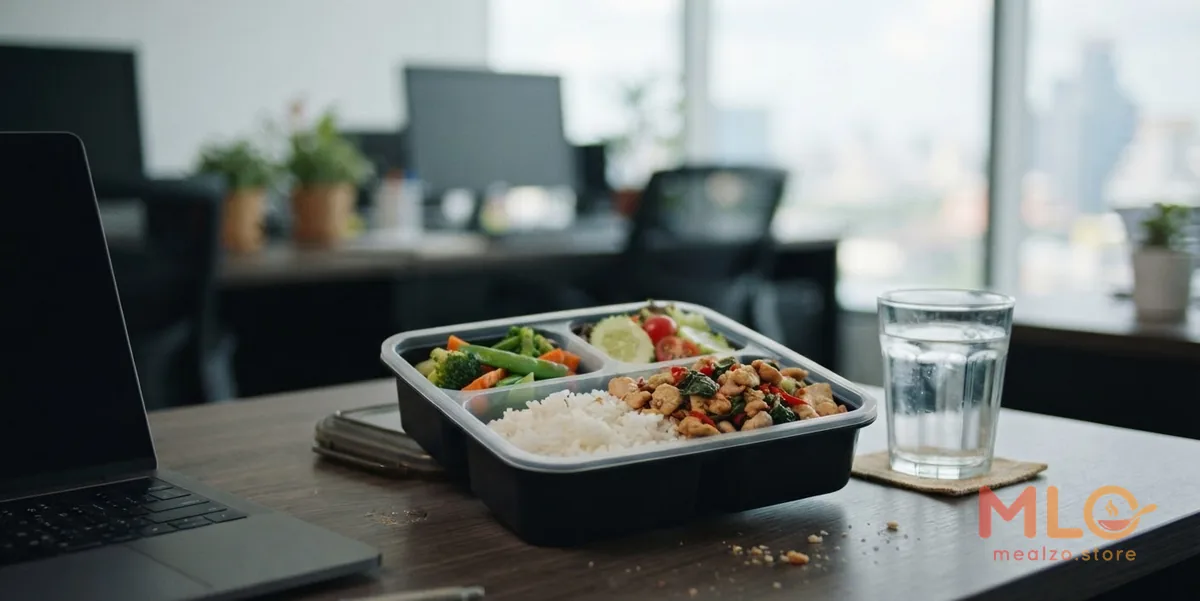
A simple way to improve ad hoc ordering is to create defaults. Keep a short mental list of meals or nearby places you already know. When work is busy, repeat a known choice rather than treating every order as a search for the best available lunch.
The same principle works at 21:00 in a convenience store. A fallback does not have to be exciting. Its job is to prevent “there is nothing planned” from becoming an entirely random food decision.
7. A Meal Subscription Moves More of the Planning Upstream
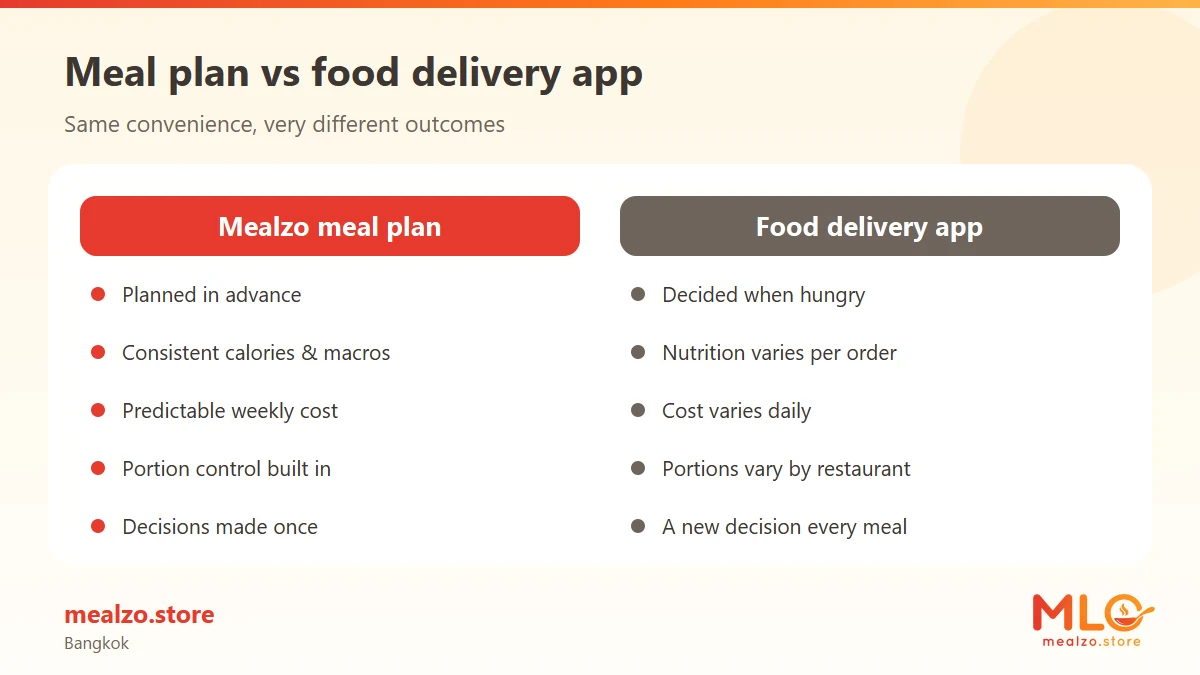
A subscription is different from ordinary delivery because you make several decisions before the workweek rather than repeating them every day.
With Mealzo, for example, a customer selects one of 12 meal plans: Balanced, Weight Loss, High Protein, Vegetarian, Vegan, Keto, Low-Carb, Gluten Free, Easy-to-Digest, Pescatarian, No Fish & Seafood, or Dairy & Egg Free.
There are six daily calorie levels: 1200, 1500, 1800, 2000, 2200 and 2500 kcal. Customers choose either 3 or 5 meals per day and a package lasting 3, 7, 14 or 30 days. There is no one-day package.
The menu is then assembled automatically according to the selected plan, calorie level and meal count. Individual dishes are not chosen separately for each day.
That structure is the main advantage and the main limitation.
It reduces repeated food decisions because you are not rebuilding tomorrow's menu every evening. On the other hand, it is not appropriate for someone who wants to browse individual dishes and decide meal by meal.
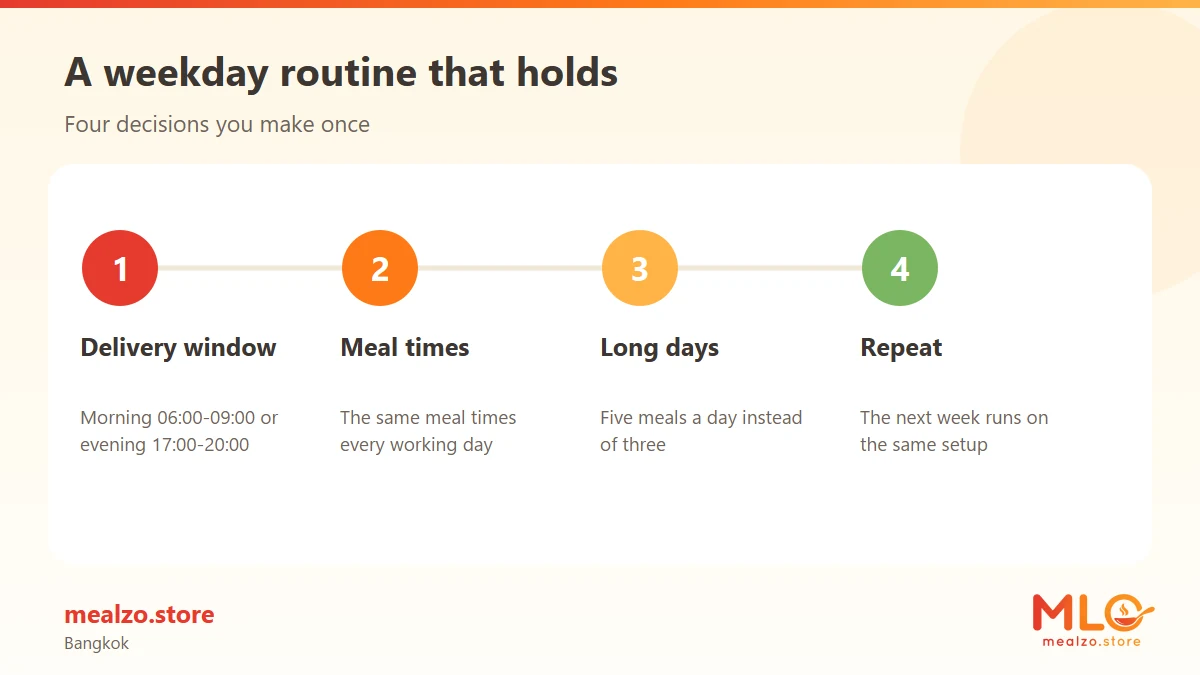
Mealzo delivers across Bangkok from its kitchen in Bang Na, with morning delivery from 06:00-09:00 or evening delivery from 17:00-20:00. Those fixed windows should fit your routine before you consider a package.
You can review Mealzo meal plan options and package structures if you want to compare the available plan formats directly.
8. Choose the Right Level of Structure, Not the Maximum Level
Meal planning often fails because people assume more structure is always better. For somebody with an irregular professional schedule, excessive structure can simply create waste.
The right system covers the meals that are repeatedly difficult while leaving genuinely flexible meals alone.
Consider three hypothetical schedules:
| Work pattern | Useful structure | Where flexibility still matters |
|---|---|---|
| Office every weekday, frequent lunch meetings | Planned breakfasts and dinners | Lunch may need to remain flexible |
| Predictable office hours, evenings often late | Planned lunch and dinner | Weekends can remain open |
| Hybrid work with changing locations | A few prepared meals plus reliable fallbacks | Daily location may determine other meals |
| Long workdays with little interest in cooking | Subscription for core weekdays | Social meals and spontaneous plans remain outside it |
This is why a 3-day solution can sometimes be more useful than attempting to control seven days. Conversely, somebody whose schedule is highly repetitive may prefer 7, 14 or 30 days of structure.
The same applies to meal count. Three meals may cover the difficult part of the day. Five may be more appropriate for someone who wants more of the day's food predetermined. Neither is inherently better without context.
Key takeaway: The best level of meal planning is the smallest amount of structure that reliably covers your recurring failure points.
9. Calories and Plan Labels Are Inputs, Not Guarantees
When a service offers calorie levels and named plans, it is easy to treat those labels as answers. They are better understood as configuration tools.
Mealzo's app includes a calorie calculator using the Mifflin-St Jeor formula. That produces an estimate based on the information entered. It is not medical advice and should not be treated as a personalised clinical assessment.
The practical value is that calorie levels make the amount of food explicit rather than leaving “a meal plan” undefined. The available levels are 1200, 1500, 1800, 2000, 2200 and 2500 kcal per day.
Similarly, plan names describe how the menu is organised. Someone may select Vegetarian because they do not eat meat, or High Protein because that structure matches what they want from their meals. A label does not guarantee an outcome.
This distinction matters beyond subscriptions. Whether you cook, batch cook or order individually, meal planning works better when you know what you are actually trying to standardise: timing, food availability, dietary pattern, portion structure, or simply the removal of repeated decisions.
10. Build a Fallback Layer for the Days the Plan Breaks
No meal system survives every Bangkok workday unchanged.
Someone invites you to lunch. A presentation runs late. You leave the office at a different time. Food is already waiting at home, but the team decides to eat together. A delivery does not match where you will be that evening.
A robust system assumes some disruption.
Useful fallbacks include:
- one simple meal kept at home;
- a small set of known office-area orders;
- something ready in the freezer;
- a convenience-store combination you can choose without browsing;
- deciding in advance what happens to a planned meal when a work dinner appears.
The point is not to eliminate spontaneous eating. It is to avoid turning one changed meal into three days of abandoned planning.
This is especially important for people whose eating becomes inconsistent during long stretches of work. The practical strategies in staying consistent with meals during long workdays develop this fallback idea in more detail.
11. Account for Allergens Without Assuming a System Can Remove All Risk
Food planning becomes more complex when allergens are involved because convenience cannot be the only criterion.
Mealzo allows customers to declare allergens from nine allergen groups. Dishes containing an allergen the customer has declared are not assigned to that customer.
That describes the assignment mechanism. It should not be interpreted as a guarantee that a meal is allergen-free.
Anyone managing a serious allergy needs to evaluate the available information and their own requirements rather than treating a plan label or software filter as an absolute safeguard.
The same caution applies when ordering food individually. A restaurant menu description, delivery-app category or familiar dish name may tell you something about intended ingredients, but that information is not equivalent to a guarantee about all handling or preparation circumstances.
For professionals who need food decisions to be fast, the useful operational lesson is to resolve these questions before the workday whenever possible. Trying to investigate them while a meeting is already starting is the worst possible timing.
12. Design a System You Can Repeat Without Thinking About It Constantly
The final step is not selecting the “best” food method. It is combining methods so the week requires less intervention.
A realistic system might look like this:
- cook breakfast at home because it is already easy;
- use prepared or subscription meals for office lunches;
- leave two evenings open for eating out;
- keep one freezer meal for late work;
- order ad hoc when plans genuinely change.
Another professional might batch cook on Saturday, buy lunch twice during the week and use delivery for the two evenings that regularly finish late.
Someone else may have almost no interest in food preparation and prefer a structured subscription for most working days while leaving weekends completely unplanned.
All three are legitimate forms of meal planning for busy professionals because the objective is not to maximise preparation. It is to allocate preparation, choice and flexibility where they create the least friction.
Review your system after a normal working week. Do not ask whether every meal was ideal. Ask more useful questions: Which meals still required last-minute decisions? Which planned food went unused? Where did waiting become annoying? Did the cooking actually happen? Was the delivery schedule compatible with the day?
Then remove the part that keeps failing.
Key takeaway: A repeatable food system is usually a combination of planned meals, flexible meals and one dependable fallback rather than a perfectly scheduled week.
FAQ
What is the simplest form of meal planning for a busy professional?
Start by planning only the meals that repeatedly fail. If weekday dinner is the problem, create a dinner system rather than redesigning breakfast, lunch and weekends. A short list of ready options can be more useful than a complete weekly menu.
Is batch cooking always cheaper or more efficient than meal delivery?
Not necessarily. Batch cooking can reduce repeated preparation and gives you strong control over ingredients, but it still requires shopping, preparation, storage and cleaning. A subscription costs money to move some of that work outside your home. Which is more efficient depends on whether time, flexibility, control or direct food cost matters most to you.
Is a meal subscription better than ordering from an app every day?
They solve different problems. Ad hoc ordering gives you more day-to-day choice and works well when your schedule changes frequently. A subscription reduces repeated decisions by setting the plan in advance. If choosing individual dishes is important to you, ordinary ordering may suit you better.
How many days should I plan at once?
Use the shortest horizon that creates useful stability. Some people only need to organise three demanding weekdays. Others have predictable schedules and prefer one or several weeks of structure. Mealzo offers 3-, 7-, 14- and 30-day packages, but there is no one-day package.
What if my colleagues regularly order lunch for the whole team?
Do not plan that meal as if you control it every day. Either leave those days open or plan food that can reasonably be used later instead. A meal-planning system should reflect who actually makes the food decision, not who theoretically intended to make it that morning.
When is a subscription not the right answer?
It may be a poor fit if your location changes constantly, you want to choose every individual dish, fixed delivery windows do not suit your schedule, or you genuinely enjoy cooking and already do it consistently. A subscription is one way to reduce planning and preparation. It is not a requirement for eating more systematically.
Know someone who'd like Mealzo?
If you know someone in Bangkok who might enjoy Mealzo Bangkok, you can share it with them through our referral programme.