How Meal Delivery Saves Time in Bangkok

Eating better in Bangkok is not difficult because food is scarce. The harder part is fitting food decisions into an ordinary day: work, commuting, errands, exercise, family time, and the occasional evening when you simply do not want to think about dinner.
Cooking can work beautifully when you enjoy it and have time for shopping, preparation, washing up, and planning ahead. Regular food-delivery apps can also be convenient. But convenience at the moment of ordering is not quite the same thing as reducing the amount of attention food demands across an entire week.
That distinction matters. The main way meal delivery saves time in Bangkok is not by making a meal appear instantly. It is by removing repeated decisions and small tasks: choosing a restaurant, comparing dishes, checking portions, shopping for ingredients, preparing food, and cleaning the kitchen afterward.
A structured meal plan will not suit everyone. Some people value spontaneous restaurant meals or genuinely enjoy cooking every night. But for people whose main problem is the daily logistics of eating, predictable meal delivery can turn food from a recurring project into something already arranged.
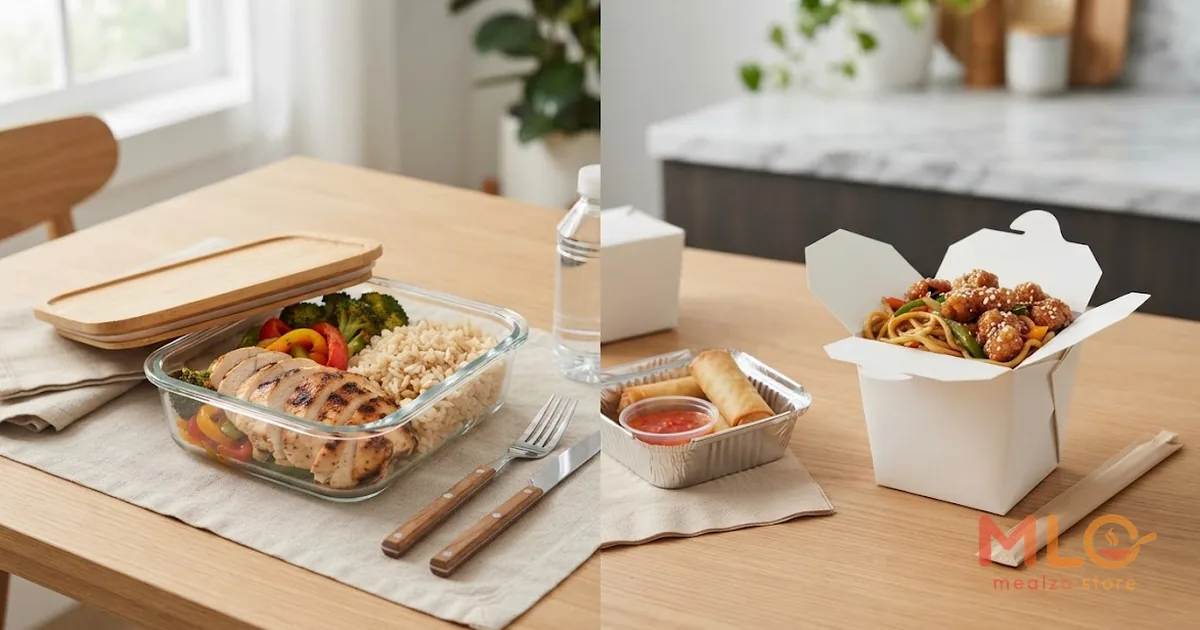
1. Where the time actually goes when you feed yourself
People often compare cooking with delivery by looking only at cooking time. That misses much of the work.
A home-cooked dinner may involve deciding what to make, checking what is already in the fridge, buying missing ingredients, washing and chopping them, cooking, storing leftovers, and cleaning cookware. None of those steps is necessarily difficult. Together, however, they occupy both time and attention.
Regular restaurant delivery removes the cooking and cleaning, but it still leaves another form of work: deciding what to order. You open an app, browse restaurants, compare dishes, check whether today's choice fits what you wanted to eat, place an order, and repeat the process later.
A meal subscription shifts more of those decisions earlier. You choose the structure of the plan, then individual meals can fit into that structure without requiring a fresh restaurant search every time.
For a broader comparison of the two delivery models, see diet meal delivery compared with regular food delivery.
Key takeaway: The biggest time saving often comes from removing repeated food decisions, not merely from removing cooking.
2. Cooking, food apps and meal plans solve different problems
It helps to separate three options that are often treated as interchangeable.
| Option | What you still need to manage | Where it can save time | Main trade-off |
|---|---|---|---|
| Home cooking | Planning, shopping, preparation, cooking, cleaning | Can reduce ordering and give full control over ingredients | Requires regular kitchen time and organisation |
| Regular food-delivery app | Restaurant choice, dish choice and a new order each time | Removes cooking and most washing up | Decision-making repeats for every order |
| Structured meal delivery | Plan choice, calorie level, meals per day and package length | Reduces repeated meal selection and kitchen work | Less spontaneous than choosing every meal individually |
None is automatically superior. Someone who loves visiting fresh markets and cooking may consider kitchen time part of the pleasure of eating. Someone who eats socially most evenings may not need a large meal package. Someone with an unpredictable schedule may prefer ordering only when needed.
Meal delivery becomes especially useful when the recurring process itself is the problem.
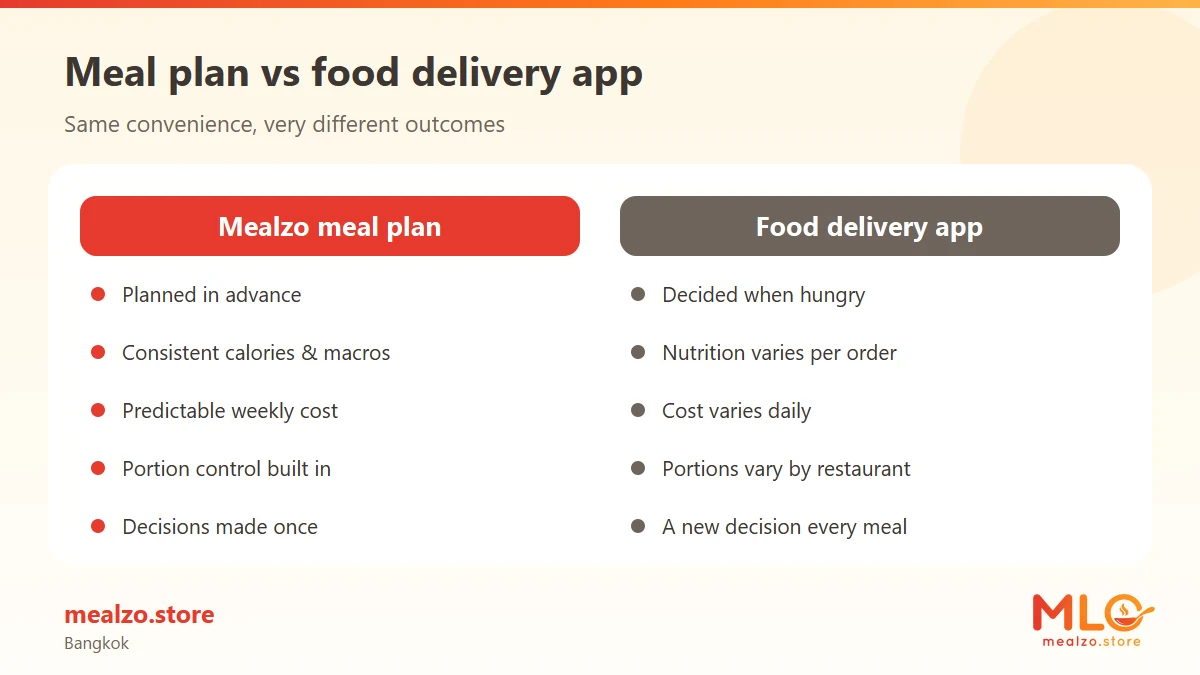
Mealzo is structured around that idea. The service has 12 meal plans, six daily calorie levels, a choice of three or five meals per day, and packages lasting 3, 7, 14 or 30 days. Instead of rebuilding the day's food plan meal by meal, the customer chooses a framework.
3. Fewer decisions can make weekdays simpler
There is a particular kind of tiredness that appears around mealtimes. You may not be physically exhausted, but you do not want another decision.
What should I eat? Thai or international? Something lighter or more substantial? Should I cook? Is there anything at home? Which restaurant should I order from? Did I already eat something similar for lunch?
A structured plan does not eliminate every food decision from life. Nor should it. Restaurants, street food, home cooking and meals with friends remain part of living in Bangkok.
What it can do is give routine weekdays a default.
That default can be useful for people who prefer to spend their decision-making energy elsewhere. Instead of designing breakfast, lunch and dinner repeatedly, they establish the broad structure once and then follow it for the package period.
Useful decisions to make in advance include:
- which general meal plan matches the way you want to eat;
- which calorie level you want to use;
- whether three or five meals per day fits your routine;
- whether you want a short 3-day package or a longer 7-, 14- or 30-day arrangement;
- which delivery window works with your home or work schedule.
If your main difficulty is planning rather than cooking itself, this guide to meal planning for busy professionals in Bangkok looks more closely at how to organise the whole routine.
4. A fixed delivery window reduces another daily task
Meal delivery still has logistics. Food needs to arrive somewhere, and somebody needs to plan around receiving it.
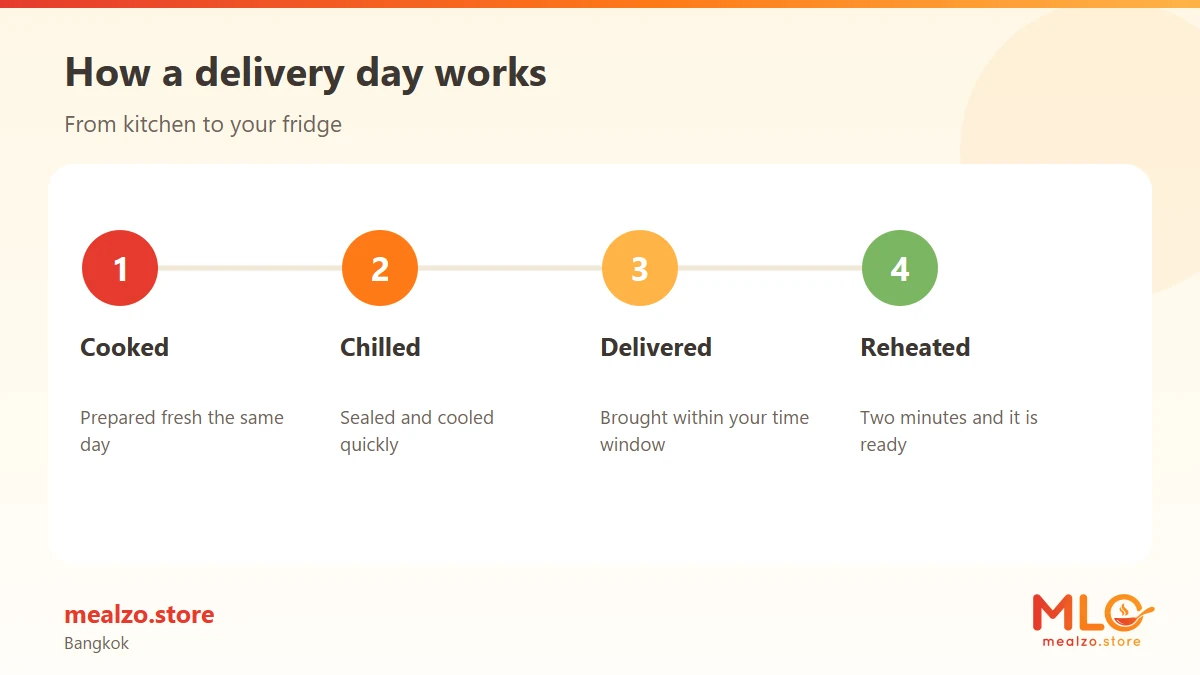
Mealzo offers delivery across Bangkok in two windows: 06:00-09:00 in the morning or 17:00-20:00 in the evening.
The benefit of a defined window is predictability. Instead of placing separate food orders throughout the day, you can organise delivery around the part of the day that already works for you.
Morning delivery may make sense when you want the day's meals available early. Evening delivery may fit better when mornings are rushed or when receiving food after work is easier.
Neither window will suit every schedule. If your day changes constantly, or you are rarely at the same location during either period, one-off ordering may remain more practical.
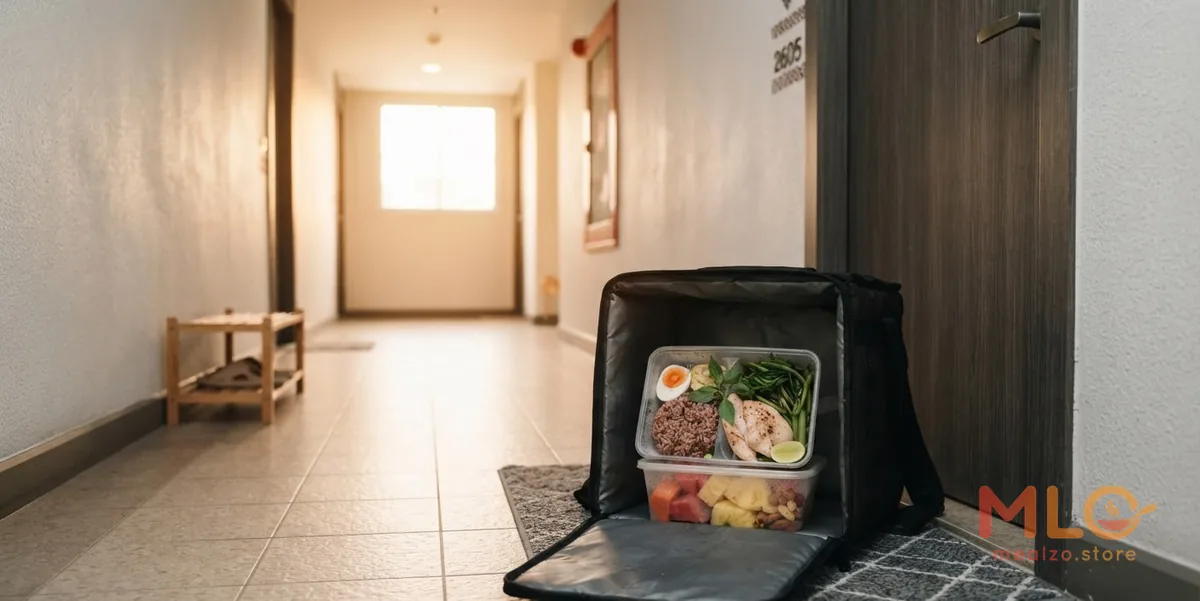
Key takeaway: Predictable delivery is most useful when it removes repeated coordination rather than creating another appointment you have to manage.
5. Choosing a plan once is different from choosing a dish three times
Mealzo has 12 plans:
- Balanced
- Weight Loss
- High Protein
- Vegetarian
- Vegan
- Keto
- Low-Carb
- Gluten Free
- Easy-to-Digest
- Pescatarian
- No Fish & Seafood
- Dairy & Egg Free
The practical value of a plan is that it narrows the field. You are no longer beginning every meal with an empty search box and hundreds of unrelated possibilities.
That does not mean a plan decides what is medically appropriate for you. The plan names describe how the menu is organised. They are not diagnoses, prescriptions or promises of a particular health outcome.
The same principle applies to calories. Mealzo offers six levels:
| Daily level | Available meals per day | Package choices |
|---|---|---|
| 1200 kcal | 3 or 5 | 3, 7, 14 or 30 days |
| 1500 kcal | 3 or 5 | 3, 7, 14 or 30 days |
| 1800 kcal | 3 or 5 | 3, 7, 14 or 30 days |
| 2000 kcal | 3 or 5 | 3, 7, 14 or 30 days |
| 2200 kcal | 3 or 5 | 3, 7, 14 or 30 days |
| 2500 kcal | 3 or 5 | 3, 7, 14 or 30 days |
The app also includes a calorie calculator using the Mifflin-St Jeor formula. It provides an estimate rather than medical advice. That distinction is worth keeping clear: an estimate can help organise a food plan, but it does not determine an individual's medical or nutritional needs.
6. Three meals or five meals changes the rhythm of the day
Time saving is not just about how many minutes you spend in the kitchen. It is also about how often food interrupts what you are doing.
Three meals per day may fit someone who prefers larger gaps between eating occasions and wants fewer containers or meal breaks to manage. Five meals may fit someone who prefers food divided into more eating occasions across the day.
Neither is inherently better. The useful option is the one that fits your actual schedule.
For example, someone working from a fixed office may find it easy to keep several meals available during the day. Someone moving between meetings or locations may prefer fewer eating occasions. A person who regularly eats dinner socially may want to think carefully before committing to a package that covers more food than they realistically intend to use.
This is where meal planning becomes practical rather than theoretical. The best structure is not the one that sounds most disciplined. It is the one you are likely to follow without reorganising your normal life around it.
If batch cooking feels like another job rather than a solution, these meal-prep alternatives for busy people cover other ways to reduce kitchen work.
7. Subscription delivery can reduce shopping and kitchen administration
Home cooking includes a surprising amount of administration.
You keep track of ingredients. You notice when rice, vegetables, protein or cooking oil are running low. You decide what needs using before it spoils. You wash knives, pans, chopping boards and storage containers. Then you begin again.
A meal plan can remove much of that routine for the meals it replaces.
That qualification matters. If you still cook breakfast, eat lunch out and use delivered meals only for dinner, you will still shop and manage a kitchen. If you use delivered meals for most of the day, the amount of food administration can fall much more noticeably.
A simple way to judge the potential value is to ask what tasks the service would genuinely replace in your own week:
- grocery trips for the meals being replaced;
- ingredient preparation;
- cooking time;
- routine washing up;
- repeated restaurant browsing;
- repeated ordering;
- daily portion and calorie comparison.
Meal delivery saves time only when those tasks actually disappear. Ordering a full package and then continuing to shop, cook and order restaurant food at the same frequency simply creates overlap.
For a fuller breakdown, meal subscription versus home cooking in Bangkok compares time, effort and predictability directly.
8. Planning several days at once can be more efficient than solving tonight's dinner
Short-term thinking is convenient until it has to be repeated every day.
At 11:30, you solve lunch. At 18:30, you solve dinner. Tomorrow you do the same thing again. Each individual decision may take only a little effort, but the process keeps returning.
Mealzo packages come in 3, 7, 14 and 30 days. That allows people to decide how much of their future food routine they want to organise in advance.
A 3-day package can make sense if you want a limited commitment or only need coverage for a particularly busy stretch. Seven days creates a weekly structure. Fourteen or 30 days move more decisions out of the daily routine, but they also require greater confidence that the chosen setup fits your schedule.
Longer is therefore not automatically better.
If your calendar includes frequent travel, dinners out or irregular weekends, a shorter package may create less waste and less friction. Predictability saves time only when it matches real life.
Key takeaway: Organising more days in advance can reduce repeated planning, but the most efficient package is the one that matches the days you will actually use it.
9. Allergen declarations can reduce manual checking, but they are not a safety guarantee
People who avoid particular ingredients often spend additional time checking dishes before ordering.
Mealzo allows customers to declare allergens from nine allergen groups. Dishes containing a declared allergen are then not assigned to that customer.
That is a selection mechanism. It should not be described as a guarantee that a meal is allergen-free, and it should not be treated as a medical safeguard for someone who requires certainty around exposure.
From a time-management perspective, the mechanism can reduce the need to reconsider the same declared allergen when meals are being assigned. But the limitation remains important: automated exclusion based on declarations and a guarantee of allergen absence are not the same thing.
People with serious allergy concerns need to judge any food service according to the level of certainty their situation requires rather than assuming that a declaration system makes a meal safe.
10. The real question is what you want to stop doing
Meal delivery is easiest to evaluate when you stop asking whether it is "convenient" and ask a narrower question: what recurring task will it replace?
If you enjoy cooking but dislike shopping, grocery delivery may solve more of your problem. If you enjoy restaurant variety and dislike committing to plans, ordinary delivery apps may be the better fit. If you mainly struggle with planning, cooking, portion decisions and repeated ordering, structured meal delivery addresses more of those tasks at once.
This is also why price should not be the only comparison. A home-cooked meal, a restaurant order and a meal-plan day are not simply three versions of the same product. They require different amounts of your time, attention and flexibility.
Before choosing, consider:
- how many meals you currently cook;
- how often you order spontaneously;
- how much time you spend shopping and cleaning;
- whether you want three or five eating occasions organised;
- how many days you can realistically plan in advance;
- whether morning or evening delivery fits your routine;
- how much spontaneity you want to keep.
For people whose priority is reducing repetitive food logistics, the available Mealzo meal plans provide several ways to choose the level of structure rather than treating every day identically.
The useful version of meal delivery is not one that takes over your life. It is one that removes enough routine work to make the rest of your life easier to organise.
FAQ
Does meal delivery really save more time than ordering from a food app?
It can, depending on how you use both services. A regular food app removes cooking but usually requires a new restaurant and dish decision for each order. A structured meal plan moves more of those decisions into the initial setup, so it can reduce repeated browsing and ordering as well as kitchen work.
Is a 30-day meal package always the most time-efficient choice?
No. A longer package reduces how often you need to organise meals, but it works best for a reasonably predictable schedule. If you travel often, eat out frequently or have irregular weeks, a shorter 3-, 7- or 14-day package may fit your routine better.
Can I choose how many meals I receive each day?
Mealzo offers either three or five meals per day. The useful choice depends on how you normally structure eating around work and other commitments. More meals do not automatically mean a better plan; they simply divide the day differently.
What calorie levels are available?
Mealzo offers 1200, 1500, 1800, 2000, 2200 and 2500 kcal per day. The app includes a calculator based on the Mifflin-St Jeor formula to provide an estimate. That estimate is a planning tool, not medical advice.
When does Mealzo deliver in Bangkok?
Delivery is available across Bangkok in either the morning window from 06:00-09:00 or the evening window from 17:00-20:00. Which one saves more time depends mainly on where you are normally available to receive the delivery.
How does Mealzo handle declared allergens?
Customers can declare allergens from nine allergen groups, and dishes containing a declared allergen are not assigned to them. This describes the assignment mechanism only; it does not guarantee that a meal is allergen-free or provide a safety guarantee for severe allergies.
Find a Meal Plan That Fits
Compare Mealzo plans or use the calculator to explore meal options for your needs.