Healthy Lunches for Bangkok Office Workers: Building a Better Weekday Routine
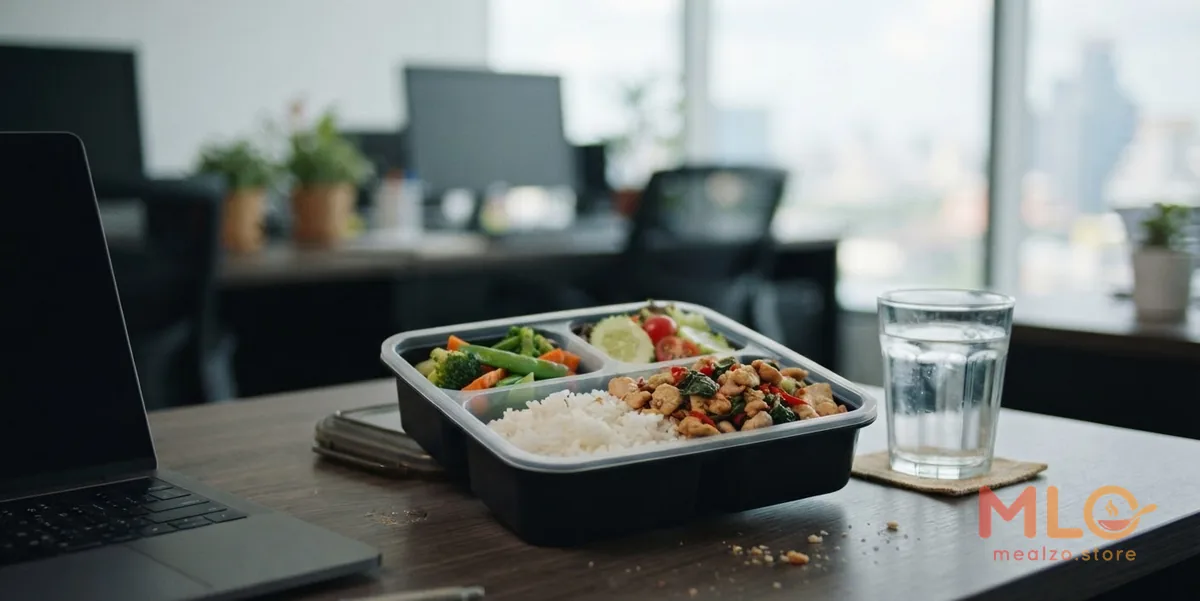
A weekday lunch in Bangkok can become surprisingly complicated. Office schedules run long, meetings shift, traffic makes short errands less predictable, and the easiest available meal is not always the one you would have chosen with more time.
For people trying to build a healthier routine, lunch is often where good intentions collide with normal working life. Bringing food from home requires preparation. Eating out adds decisions. Ordering at the last minute can mean choosing whatever looks fastest rather than what suits the rest of the day.
A useful approach to a healthy lunch for Bangkok office workers is therefore less about finding a perfect dish and more about creating a repeatable system. The best weekday routine is one that reduces unnecessary decisions while still leaving room for colleagues, restaurant lunches and changing schedules.
That can mean planning several lunches ahead, using delivered meals on demanding days, or simply deciding in advance what type of lunch you want to look for. Structure helps, but it should support ordinary life rather than turn lunch into another job.
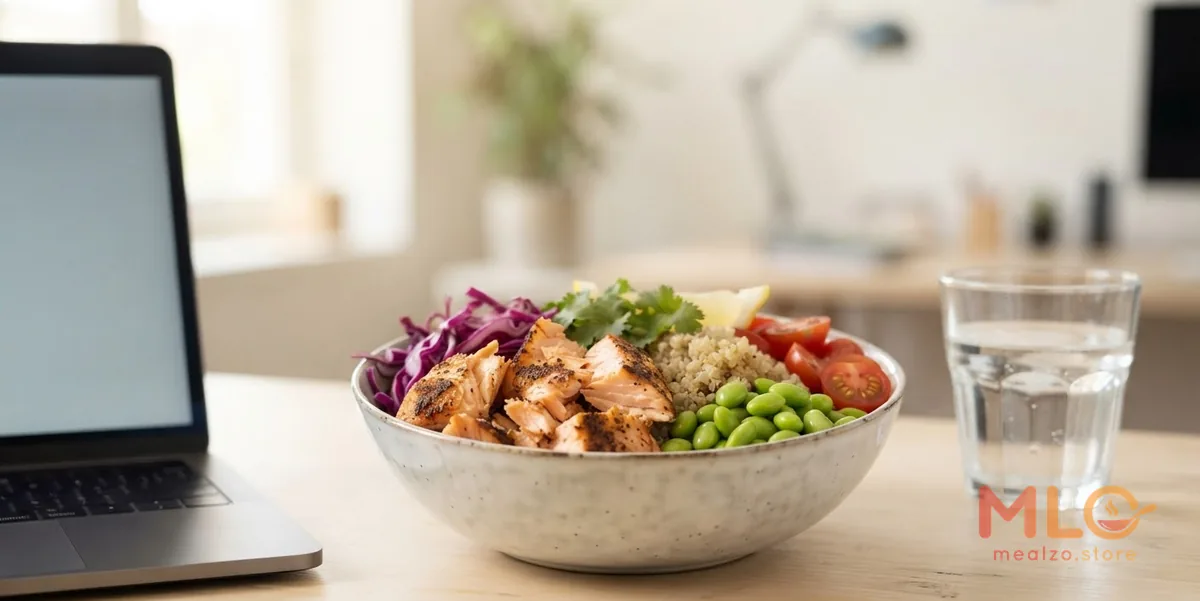
1. Start With the Week, Not With Monday's Lunch
One of the easiest mistakes is planning lunch one day at a time. Monday morning arrives, work starts, and lunch becomes a problem to solve at 11:45. The same process repeats on Tuesday.
A weekly view works better because office days are rarely identical. You may already know that Wednesday is full of meetings, Friday usually includes lunch with colleagues, and one day is quieter enough to eat away from your desk.
Instead of deciding on five specific dishes immediately, begin by identifying which lunches need the most structure.
For example:
- planned meal on two meeting-heavy days;
- flexible restaurant lunch on a social day;
- simple nearby option on a quieter day;
- one backup meal for a schedule that changes unexpectedly.
This is also where broader meal planning becomes useful. The principles in meal planning for busy professionals in Bangkok apply particularly well to office lunches because the goal is not to control every meal. It is to remove predictable points of friction.
Key takeaway: Plan around the difficult parts of your workweek first, rather than trying to make every lunch identical.
2. Decide What a Practical Office Lunch Needs to Do
The phrase "healthy lunch" can become so vague that it stops being useful. A practical office lunch needs clearer criteria.
For most working days, the meal should be substantial enough to function as lunch, convenient enough to fit the available break, and predictable enough that you are not making the same decision every afternoon.
You can think about the meal in parts rather than labels. A lunch might combine a protein source, vegetables, a carbohydrate source and other ingredients depending on the dish. Different eating styles will arrange those parts differently.
The important question is whether the meal fits your routine.
| What to check | Practical question |
|---|---|
| Portion | Does this amount make sense within the rest of my day's food? |
| Protein source | What is providing the main protein component? |
| Vegetables | Is there a meaningful vegetable component rather than a small garnish? |
| Carbohydrate | What type and portion of rice, noodles, grains or other carbohydrate is included? |
| Convenience | Can I store, reheat and eat this during my actual lunch break? |
| Predictability | Can I choose this without rebuilding the decision from scratch every day? |
A lunch that looks ideal on paper but takes too long to collect, cannot be stored at the office, or regularly conflicts with meetings is not especially practical.
3. Reduce the Number of Decisions You Make at Noon
Decision fatigue is one of the less obvious problems with office lunches. Bangkok provides enormous food choice, which is useful when you have time and less useful when you are already hungry and choosing between dozens of possibilities.
The solution does not have to be rigid meal preparation. You can reduce decisions at several levels.
Use a small set of lunch formats
Instead of choosing from every available dish, create a few categories. You might alternate between a rice-based meal, a lighter vegetable-forward lunch, a higher-protein option, a vegetarian meal, and a planned delivery.
That preserves variety without starting from zero each day.
Decide earlier
Choosing lunch in the morning is usually easier than choosing it once the lunch break has already started. Choosing several lunches before the week begins reduces the decision further.
Meal delivery can serve the same function. The main convenience is not simply that food arrives; it removes some of the ordering, travelling and repeated selection involved in individual lunches. how meal delivery saves time in Bangkok looks at that trade-off in more detail.
4. Match the Lunch System to Your Office Schedule
There is no single routine that works for every office worker. Some people have fixed lunch breaks. Others discover at noon that a meeting has been moved into them.
A useful lunch system should reflect how predictable your schedule actually is.
| Workday pattern | Lunch approach that may fit | Main trade-off |
|---|---|---|
| Fixed lunch break | Planned meal or regular nearby restaurant | Less spontaneous |
| Back-to-back meetings | Stored meal ready at the office | Requires storage and possibly reheating |
| Frequent client lunches | Keep other weekday lunches structured | Less control over client-meal days |
| Hybrid work | Use different office and home routines | Requires two systems rather than one |
| Unpredictable afternoons | Keep a practical backup available | Backup choice may be less varied |
The point is not to classify your job perfectly. It is to notice where your current lunch routine repeatedly fails.
If you often lose your lunch break to meetings, walking fifteen minutes to a favourite restaurant may not be a realistic default. If you regularly eat with colleagues, planning five fixed lunches every week may create unnecessary waste.
Key takeaway: A good lunch routine should match your calendar, not an imaginary version of your working day.
5. Think About Daily Intake Without Treating Lunch in Isolation
Lunch is only one part of the day. A large breakfast, small dinner and moderate lunch can form one pattern; a light breakfast and larger lunch form another. There is no reason every office worker needs the same lunchtime portion.
Mealzo offers six daily calorie levels: 1200, 1500, 1800, 2000, 2200 and 2500 kcal. Those numbers refer to the full day's plan, not the lunch alone.
The app also includes a calorie calculator based on the Mifflin-St Jeor formula. It provides an estimate, not medical advice. An estimate can be useful as a planning reference, but it should not be treated as an individual medical prescription.
Mealzo plans can include either 3 or 5 meals per day. For someone focused on office lunches, the practical difference is how the day's food is divided rather than whether one arrangement is universally better.
Look beyond the number
Calorie information can make portions more transparent, but a number does not tell you whether the meal suits your preferences, schedule or appetite. Those still require judgment.
If your goal is simply to make weekdays more organised, consistency of the routine may matter more than repeatedly recalculating lunch.
6. Build a Routine That Still Allows Restaurant Lunches
A structured weekday routine does not require refusing lunch invitations.
Bangkok office culture can involve meals with colleagues, clients or friends, and trying to eliminate all of those occasions usually creates a system that is harder to maintain than necessary.
One approach is to treat social lunches as part of the plan rather than as interruptions to it. If you normally eat out with colleagues on Friday, there is little benefit in preparing or ordering a separate Friday lunch that may go unused.
You can structure the less social days instead:
- keep prepared or delivered meals for busy office days;
- leave known restaurant days open;
- avoid ordering food you are unlikely to eat;
- keep one flexible day when the week's schedule is uncertain.
This creates a routine with enough structure to reduce daily decisions without requiring every weekday to look the same.
For people whose work regularly stretches beyond the expected finishing time, staying consistent with healthy eating during long workdays covers the same problem beyond lunch.
7. Choose Meal Plans Based on Food Preferences, Not Labels Alone
Meal plan names can be helpful, but they should not replace looking at what type of food you actually want to eat.
Mealzo has 12 plans: Balanced, Weight Loss, High Protein, Vegetarian, Vegan, Keto, Low-Carb, Gluten Free, Easy-to-Digest, Pescatarian, No Fish & Seafood, and Dairy & Egg Free.
For an office routine, the relevant question is which plan fits your chosen eating pattern and which meals you are comfortable eating repeatedly during working weeks.
Someone who eats meat may prefer Balanced or High Protein. Someone avoiding animal products may look at Vegan. A pescatarian may naturally start with Pescatarian. Those are preference and planning distinctions, not promises about outcomes.
Packages are available for 3, 7, 14 or 30 days, so the commitment can also match how much structure you want. A short package may suit someone testing a routine, while a longer package reduces repeated ordering decisions.
You can review Mealzo meal plans when comparing the available structures.
8. Plan Delivery Around the Office, Not Just Around the Meal
Delivered food only saves effort when the handoff works smoothly.
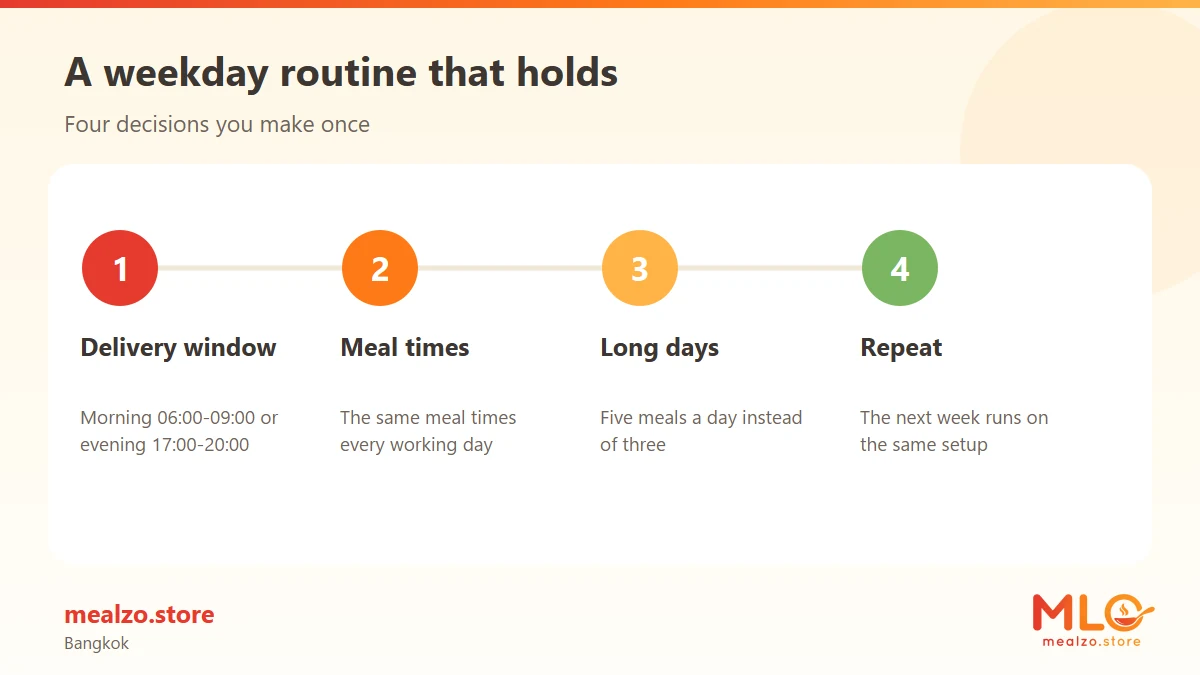
Mealzo delivers across Bangkok in two windows: 06:00-09:00 and 17:00-20:00. Which one makes sense depends on where the food will be stored and when you need it.
Morning delivery may work for someone who can receive food before or around the start of the workday and refrigerate it appropriately. Evening delivery can fit people who prefer to receive the next day's meals outside office hours.
The practical questions are simple:
- Who can receive the delivery?
- Does your building have access procedures?
- Where will the food be stored after arrival?
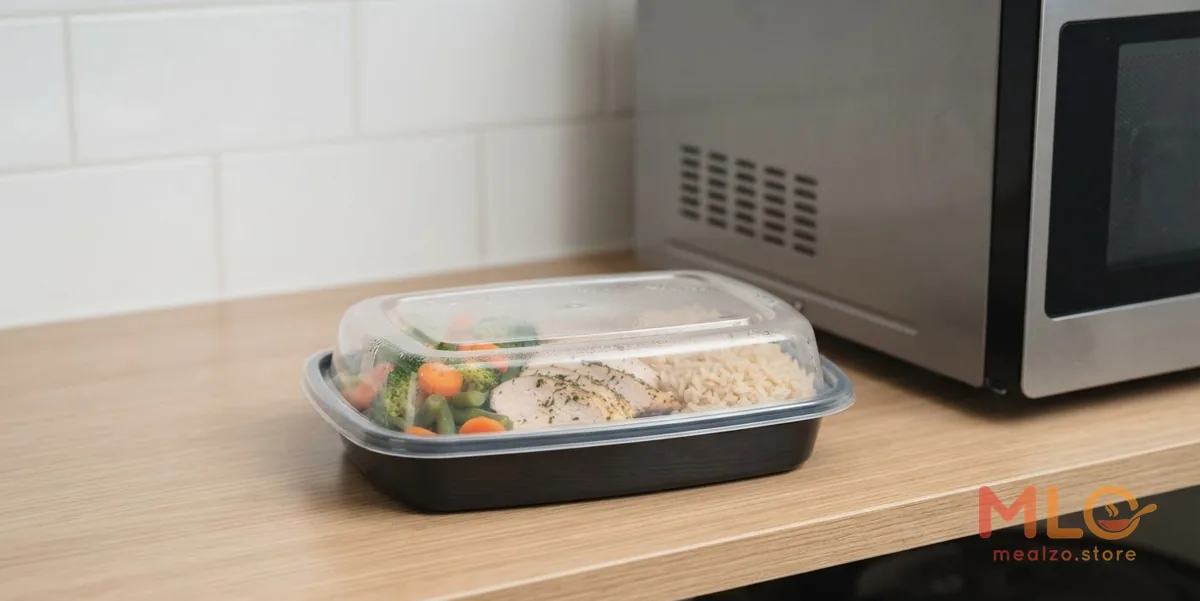
- Do you have refrigeration available?
- If reheating is needed, is suitable equipment available?
- Will you actually be at the delivery address during the selected window?
Office towers and condominiums can have different reception and access arrangements, so these details matter. The Bangkok condo and office delivery checklist covers access, storage and scheduling more closely.
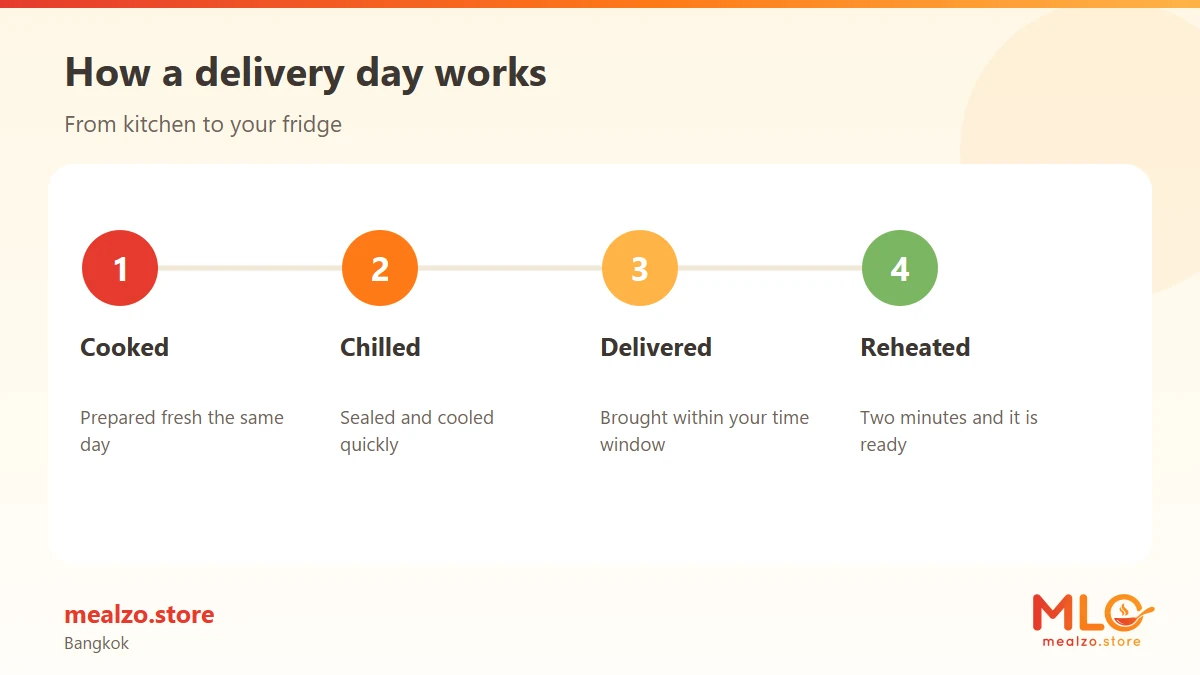
Key takeaway: Delivery convenience depends as much on receiving and storing the food as on the delivery itself.
9. Treat Food Restrictions as a Separate Planning Question
Food preferences and allergen declarations are not the same thing.
Mealzo customers can declare allergens from nine allergen groups. The assignment system then avoids assigning dishes that contain a customer's declared allergen.
That describes the mechanism; it is not a guarantee that a meal is allergen-free.
This distinction matters when comparing plans. Choosing Vegetarian, No Fish & Seafood or Dairy & Egg Free describes the selected plan. An allergen declaration is a separate input used when dishes are assigned.
For everyday preferences, the plan itself may be the main decision. If an allergen is involved, the declaration mechanism needs to be considered separately rather than assuming the plan name answers the question.
10. Make the Routine Easy to Restart
A weekday eating routine eventually gets interrupted. There will be holidays, travel, office events, client lunches, deadlines and days when you simply want something different.
That does not make the system unsuccessful.
The useful test is whether you can return to it without needing a dramatic reset. If the routine depends on perfect preparation every Sunday or five identical office days, one disruption can make the whole system feel broken.
A more resilient structure might be:
- choose the following week's lunch pattern before it begins;
- identify the two or three days that most need a planned meal;
- leave known social meals flexible;
- make sure delivery and storage arrangements are realistic;
- use a repeatable plan rather than searching for a new solution every day.
This is the practical value of planning a healthy lunch for Bangkok office workers. It reduces the amount of weekday improvisation while leaving enough flexibility for Bangkok life to remain Bangkok life.
A packed calendar does not necessarily call for a stricter food routine. Often it calls for a simpler one.
FAQ
What is a practical healthy lunch for Bangkok office workers?
There is no single correct lunch. A practical option generally fits your preferred eating pattern, portion needs and work schedule while being realistic to obtain, store and eat during the available break. Convenience matters because a lunch plan that repeatedly conflicts with work is difficult to maintain.
Is meal delivery better than buying lunch near the office?
Not automatically. Delivery reduces some ordering and travel decisions, while buying lunch nearby can provide more spontaneity and social flexibility. The better option depends on your schedule, access to nearby food, storage facilities and how much advance planning you want.
Should I choose 3 meals or 5 meals per day?
That depends on how you prefer to distribute food across the day. Mealzo offers both 3-meal and 5-meal structures. Neither format is universally preferable; the practical choice is the one that fits your daily routine and eating pattern.
How do I choose a calorie level?
Mealzo offers 1200, 1500, 1800, 2000, 2200 and 2500 kcal daily levels. The app's calculator uses the Mifflin-St Jeor formula to provide an estimate, not medical advice. The level refers to the full day's plan rather than one individual lunch.
Can Mealzo accommodate declared allergens?
Customers can declare allergens from nine allergen groups. Dishes containing a declared allergen are not assigned to that customer. This is an assignment mechanism and should not be interpreted as a guarantee that meals are allergen-free.
Which delivery window works best for office lunches?
Mealzo delivers across Bangkok from 06:00-09:00 or 17:00-20:00. The more practical window depends on where you can receive the order, whether refrigeration is available, and whether you want meals delivered around the start of the day or during the evening.
Find a Meal Plan That Fits
Compare Mealzo plans or use the calculator to explore meal options for your needs.