How to Stay Consistent With Healthy Eating During Long Workdays
A long workday changes the way food decisions are made. The breakfast that seemed sensible at 7 a.m. can feel irrelevant by late afternoon, when a meeting has overrun, messages are piling up and dinner is still several hours away. At that point, convenience usually wins.
That does not mean healthy eating during long workdays requires exceptional discipline. More often, it requires fewer decisions. When meals, snacks and backup options are arranged before hunger becomes urgent, there is less pressure to improvise under bad conditions.
Bangkok adds its own complications. Food is everywhere, but availability is not the same as predictability. A quick lunch can become a delayed delivery, an office snack can replace a proper meal, and a commute can push dinner much later than planned.
A workable routine therefore needs to survive real working life: unexpected calls, traffic, client dinners, late finishes and days when cooking is simply not appealing. The aim is not a flawless menu. It is a structure that remains usable when the day stops cooperating.
1. Build the routine around your hardest hours
Many eating plans are designed around an imaginary calm day. Breakfast happens on schedule, lunch gets a proper break and dinner is prepared at home. That may describe some days, but it is a poor foundation if your actual working pattern includes ten-hour office stretches, irregular meetings or a long Bangkok commute.
Start with the part of the day that usually goes wrong. For one person, that may be lunch because meetings run through noon. For another, it may be the journey home, when hunger turns a convenience store into the default dinner plan.
A useful first check is:
- When do you usually become genuinely hungry?
- Which meal is most likely to be delayed or skipped?
- Where are you physically at that time?
- What food can realistically be available there?
- What happens when the original plan fails?
This is less elegant than designing an ideal menu, but much more practical. A routine should be built around its weakest point rather than its easiest one.
For a broader framework, meal planning for busy professionals in Bangkok can help turn these recurring problems into a weekly structure rather than treating each day separately.
Key takeaway: Design your eating routine around the part of the workday most likely to break down, not the part that already works.
2. Reduce the number of food decisions you make at work
Decision fatigue matters because food choices rarely happen in isolation. By lunchtime, you may already have dealt with dozens of messages, meetings, requests and small problems. Asking yourself what to eat from a large delivery menu becomes another task.
Consistency gets easier when some choices repeat. That does not mean eating the same chicken and rice every day. It can mean using a limited set of dependable breakfasts, knowing where lunch will come from on office days or deciding in advance whether you need three eating occasions or five.
A simple weekday structure might look like this:
| Workday pattern | Practical food structure | Main advantage | Main trade-off |
|---|---|---|---|
| Regular office hours | Breakfast, lunch, dinner | Simple to remember | Long gaps may not suit everyone |
| Long day with late dinner | Three meals plus planned snack | Reduces dependence on emergency food | Requires carrying or arranging the snack |
| Very early start | Early breakfast plus later meal | Fits the actual schedule | Morning preparation may be inconvenient |
| Meetings across lunch | Pre-arranged meal with flexible timing | Less searching during a busy period | Requires planning before the day begins |
The purpose is not to force every day into an identical schedule. It is to create defaults. Defaults remove negotiations with yourself when you are already tired.
3. Decide whether three or five meals actually fits your day
Meal frequency is often treated as a rule when it is really a logistical choice. Some people prefer three substantial meals and dislike thinking about food between them. Others find that a long working day is easier to manage with smaller eating occasions spread across more hours.
Neither structure automatically makes the food better.
With three meals, portions generally need to carry you through longer gaps. With five meals, there is more frequent access to food but also more planning, packaging and timing to manage. The better choice is the one that fits your work pattern without making eating feel like another project.
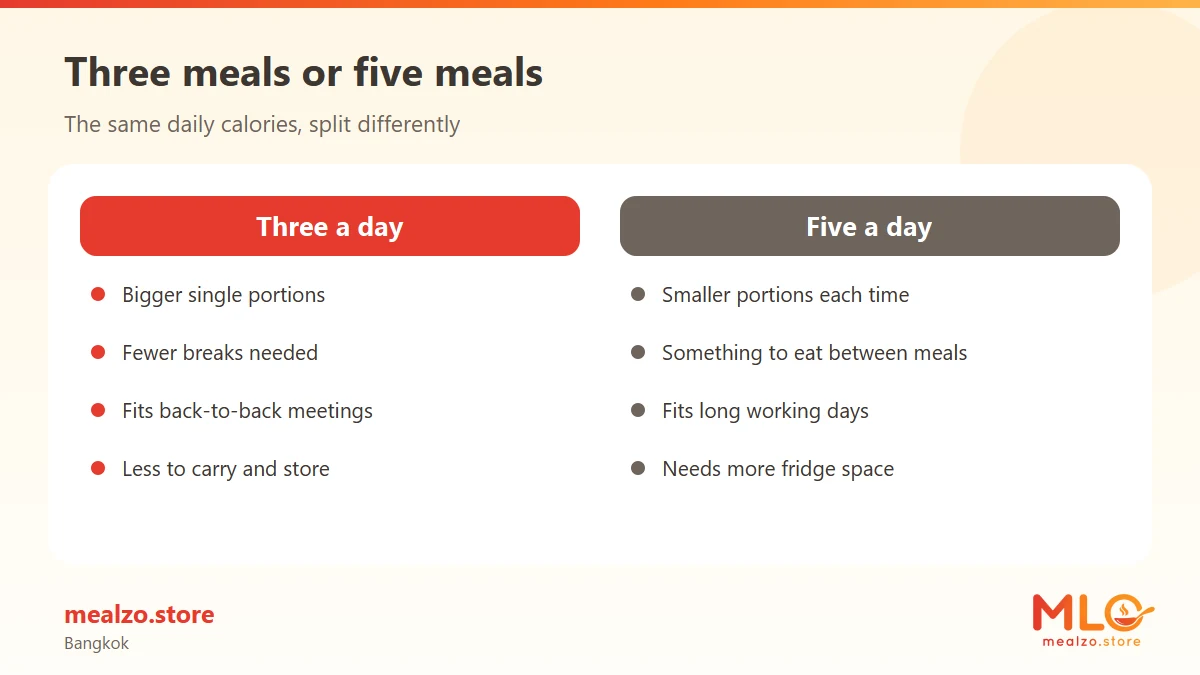
Mealzo offers either 3 or 5 meals per day. That can be useful when comparing a delivery routine with the structure you already follow, but the number itself should not become a target. Someone who is comfortable with three meals does not need five simply because five are available.
When three meals may be simpler
Three meals can make sense when your work calendar has clear breaks, you prefer larger portions and you do not want to manage food repeatedly throughout the day.
When five eating occasions may be more practical
Five can fit days that start early, finish late or contain a very long gap between lunch and dinner. The practical benefit is scheduling flexibility rather than a claim that eating more frequently is inherently healthier.
Key takeaway: Meal frequency should solve a scheduling problem; it does not need to become another nutrition rule.
4. Treat lunch as an appointment rather than an afterthought
For many office workers, lunch is the first meal sacrificed when work becomes busy. The meeting starts at 11:30, another task appears at 12:45, and suddenly it is mid-afternoon.
There are days when that cannot be avoided. But if it happens regularly, the problem is often not motivation. Lunch simply has no protected place in the day.
You do not necessarily need a long restaurant break. You do need some workable access to food. That may mean bringing lunch, arranging delivery before the busiest period or keeping a dependable option near the office.
Bangkok office routines vary enormously, so building a better weekday lunch routine is more useful than assuming everyone has the same lunch hour.
A realistic lunch check includes:
- whether you can store food at work;
- whether reheating is possible or desirable;
- how much time you normally have to eat;
- whether delivery riders can easily reach the building;
- what your backup option is when meetings change.
The important point is predictability. If lunch requires a fresh search, order and decision every single day, a difficult day has many opportunities to disrupt it.
5. Use calories as a planning estimate, not a badge of discipline
Calorie levels can help compare meal plans, but they should not become a competition to choose the smallest number.
Mealzo offers six daily levels: 1200, 1500, 1800, 2000, 2200 and 2500 kcal. Its app also includes a calorie calculator based on the Mifflin-St Jeor formula. That output is an estimate rather than medical advice, and individual requirements can differ.
| Daily calorie level | Available with Mealzo | What the number tells you |
|---|---|---|
| 1200 kcal | Yes | Approximate daily energy supplied by the selected meals |
| 1500 kcal | Yes | Approximate daily energy supplied by the selected meals |
| 1800 kcal | Yes | Approximate daily energy supplied by the selected meals |
| 2000 kcal | Yes | Approximate daily energy supplied by the selected meals |
| 2200 kcal | Yes | Approximate daily energy supplied by the selected meals |
| 2500 kcal | Yes | Approximate daily energy supplied by the selected meals |
The useful question is whether the level corresponds reasonably with the amount of food you intend the service to provide. If you routinely add breakfast, café drinks, snacks or dinners outside the plan, those are part of your actual day too.
This matters during long workdays because an overly rigid plan often generates its own workaround. If the planned food leaves you wanting something substantial at 5 p.m., pretending that appetite does not exist is unlikely to make the routine simpler.
6. Plan for the 4 p.m. problem before 4 p.m.
Late afternoon is where many tidy eating plans meet reality. Lunch has worn off, dinner may still be hours away, and work has not finished.
The solution does not have to be a special “healthy snack.” It has to be something intentionally available. Depending on your normal diet, that might be fruit, yoghurt, nuts, a sandwich, leftovers or another planned meal. The exact choice matters less than avoiding the situation in which urgent hunger makes every nearby option equally attractive.
This is also where definitions of healthy eating can become unnecessarily restrictive. practical clean-eating principles for everyday Bangkok life offers a more useful way to think about food quality without turning every packaged or convenient food into a failure.
If you know the workday regularly continues until 8 or 9 p.m., planning only until lunch is not really a full-day plan.
7. Make convenience part of the system
Convenience is often framed as the enemy of good eating. During long workdays, it can be exactly what keeps the routine functioning.
The relevant distinction is between planned convenience and desperate convenience.
Planned convenience might mean having food delivered before you need it, keeping a simple breakfast at home or ordering several days of meals in advance. Desperate convenience is reaching the end of the day with no food available and choosing from whatever can arrive fastest.
Meal delivery does not remove every decision, and it costs more than cooking everything from basic ingredients yourself. It can also be less flexible than ordering a different restaurant meal every day. Its value is primarily operational: someone else handles a portion of shopping, preparation and daily meal logistics.
Mealzo offers packages for 3, 7, 14 or 30 days, with delivery across Bangkok. Deliveries are scheduled for either 06:00-09:00 or 17:00-20:00.
For a closer look at that trade-off, how meal delivery can reduce food-related time in Bangkok explains where the time saving comes from and where delivery still requires planning.
Key takeaway: Convenience works best when it is arranged before the busy period rather than used only after the original plan has failed.
8. Build a weekday routine with two levels of backup
A robust food routine has a normal plan and a failure plan.
The normal plan might be straightforward: breakfast at home, arranged lunch, afternoon snack, dinner after work. The failure plan answers the questions that usually get ignored. What if lunch is delayed? What if you leave the office two hours later? What if you forget the food in the fridge?
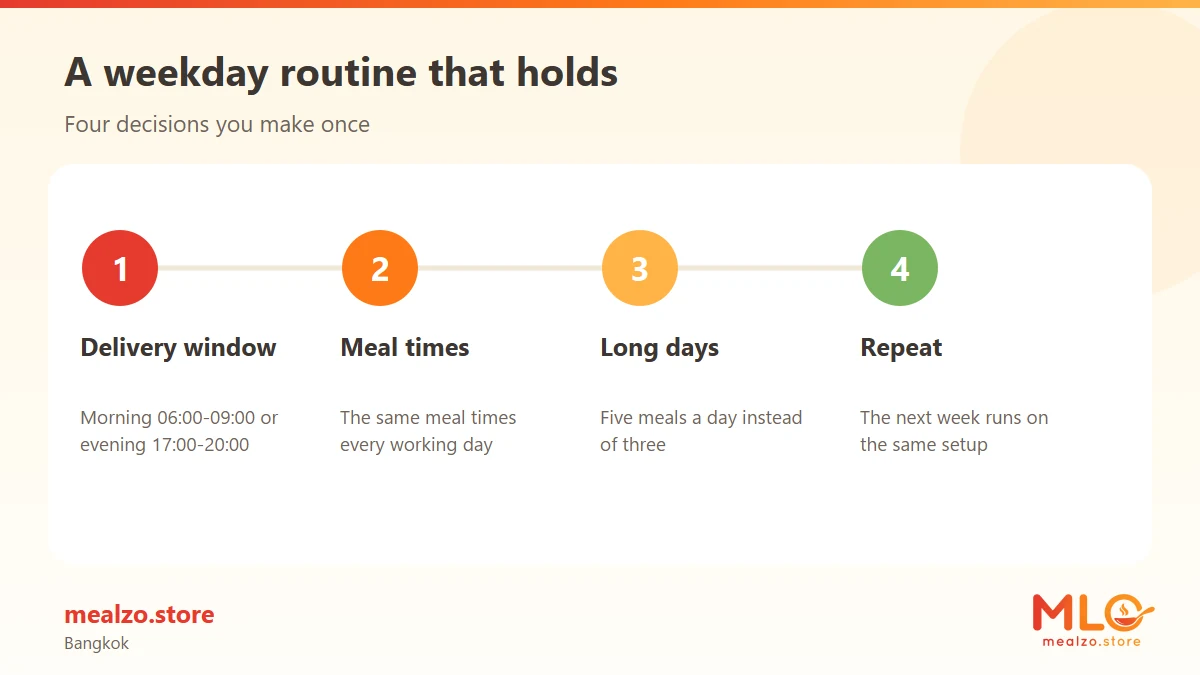
A useful two-level system can look like this:
- Primary plan: the meals you expect to eat when the day runs normally.
- Backup plan: one or two acceptable options available at the office, near home or through delivery.
- Emergency option: something shelf-stable or easy to obtain when both previous plans fail.
The emergency option does not need to be nutritionally perfect. Its job is to prevent a disrupted schedule from turning into an all-or-nothing decision.
That matters because consistency is built from ordinary imperfect days. why consistency matters more than a perfect diet is especially relevant when the temptation is to judge an entire week by one late dinner or one convenience meal.
9. Choose a food pattern you can tolerate repeatedly
Healthy eating during long workdays becomes much harder when the food itself feels like an obligation.
Variety matters, but so does familiarity. A workable weekday diet usually contains foods you already enjoy, portions that feel normal and flavours you do not need to persuade yourself to accept.
Mealzo has 12 plan categories: Balanced, Weight Loss, High Protein, Vegetarian, Vegan, Keto, Low-Carb, Gluten Free, Easy-to-Digest, Pescatarian, No Fish & Seafood, and Dairy & Egg Free.
Those labels describe different plan structures and food-selection preferences. They are not a substitute for medical advice, and choosing a plan with a particular name does not establish that it is appropriate for a medical condition.
When comparing plans, ask practical questions:
- Would I willingly eat this style of food on an ordinary Tuesday?
- Does it match foods I already tend to choose?
- Is the meal frequency realistic for my schedule?
- Will I still want restaurant meals or social dinners during the week?
- Do I need a short package first rather than committing to a longer routine?
If meal delivery fits those answers, compare Mealzo meal plans can be used to review the available plan, calorie, meal-frequency and package combinations.
10. Handle dietary exclusions as a separate practical issue
Food preferences and allergen declarations are not the same thing.
With Mealzo, customers can declare allergens from nine allergen groups. Dishes containing a declared allergen are then not assigned to that customer. That describes the assignment mechanism; it should not be interpreted as a guarantee that a meal is allergen-free.
This distinction matters especially for people who need strict allergen avoidance. A menu filter can be useful information, but it does not by itself establish the level of risk appropriate for an individual.
For everyone else, exclusions still affect consistency in a more ordinary way. If a meal plan repeatedly contains foods you dislike or choose not to eat, you are more likely to replace those meals at the last minute. The practical plan should therefore reflect what you will actually eat, not just what looks appropriate on paper.
11. Leave room for Bangkok life outside the plan
A consistent routine should not require you to refuse every dinner invitation, street-food stop or weekend brunch.
This is where many plans become too brittle. They work only if work finishes on time, nobody suggests dinner and nothing interesting happens. That is not much of a routine for someone living and working in Bangkok.
Instead, decide which meals need the most structure and which can remain flexible. You may care most about weekday breakfast and lunch because those are the meals most affected by work. Dinner might stay open several nights a week. Another person may need exactly the opposite.
A useful routine can contain both planned meals and deliberate gaps. What matters is that the gaps are intentional rather than evidence that the plan has collapsed.
Key takeaway: A food routine is more sustainable when social meals and unpredictable workdays are treated as normal events rather than exceptions that invalidate the plan.
The test is simple: can you return to your normal structure at the next practical opportunity without compensating for the meal that went differently? If so, one restaurant dinner, late meeting or missed snack does not need to become a bigger issue than it is.
FAQ
How can I maintain healthy eating during long workdays without meal prepping?
Reduce the number of decisions you need to make during the day. You can arrange delivery, use a small set of dependable office lunches, keep backup food at work and decide in advance what you will do if dinner is delayed. Batch cooking is one option, not a requirement.
Is it better to eat three meals or five during a long workday?
There is no single schedule that suits everyone. Three meals may be simpler if you prefer larger meals and have reliable breaks. Five eating occasions may fit an early start or late finish more comfortably. The useful choice is the one that matches your actual timetable.
Should I choose a lower calorie meal plan if I want to eat healthier?
Not automatically. A calorie figure describes an amount of energy, not the overall quality or suitability of a diet. Mealzo's calculator uses the Mifflin-St Jeor formula to provide an estimate, but it is not medical advice. Your total intake can also include food and drinks outside the delivered plan.
What if my work schedule changes every day?
Use flexible anchors rather than exact meal times. For example, arrange access to lunch within a broad part of the day, keep a backup snack available and know what you can eat if work continues into the evening. A changing schedule makes backup planning more important, not less.
Can meal delivery completely replace food planning?
No. It can remove some shopping, cooking and day-to-day meal decisions, but you still need to choose a plan, calorie level, meal frequency and package length and decide how delivered meals fit around restaurant meals, travel and other food you eat.
Find a Meal Plan That Fits
Compare Mealzo plans or use the calculator to explore meal options for your needs.