Pad Thai, Som Tam and Tom Yum on a Diet: Eating Thai Food Without Losing Track of Calories
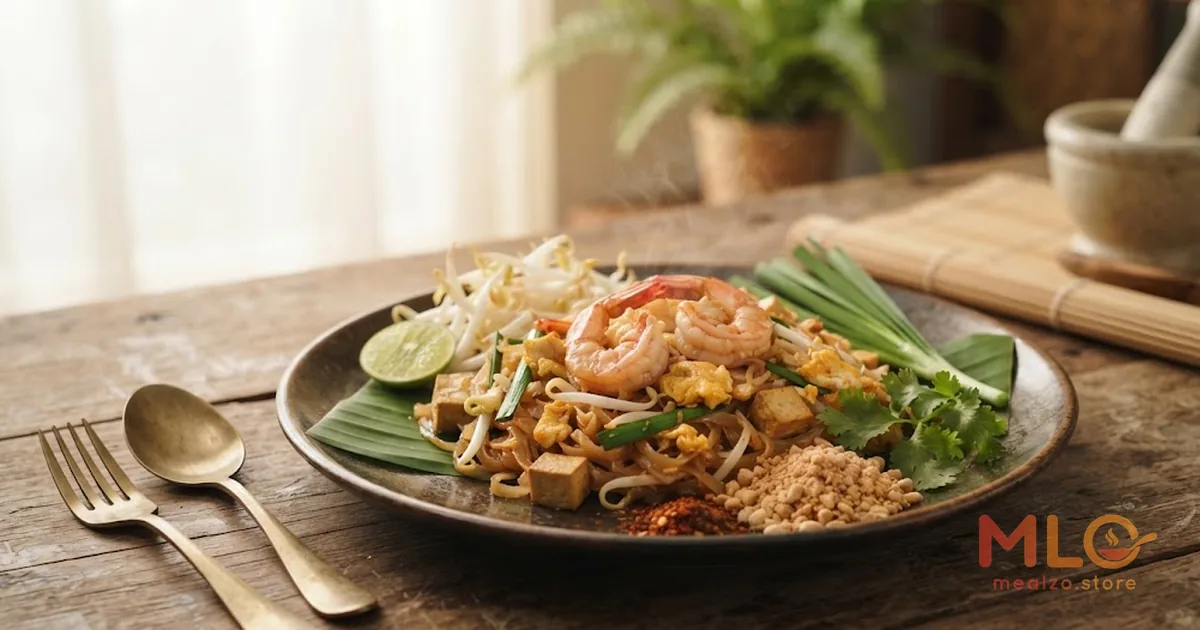
Thai food does not have to disappear from your meals just because you are paying closer attention to calories. For people living in Bangkok, that would be an unrealistic approach anyway. Pad Thai, som tam, tom yum, curries and rice are part of everyday eating, not occasional restaurant treats.
The more useful question is what actually changes the calorie content of a Thai dish. In many cases, it is not the name of the dish. It is the amount of noodles or rice, the oil used during cooking, the quantity of sauce, coconut milk, sugar and the final portion on the plate.
That is the practical side of understanding Thai food calories diet choices. You can keep familiar Thai flavours while changing the composition of the meal around them.
This does not mean turning every meal into a stripped-down version of Thai food. It means knowing which ingredients carry the most energy and which adjustments make the biggest difference.
1. Why Thai food can be easy to underestimate
A Thai meal can look relatively small while containing several concentrated sources of calories. A stir-fried noodle dish may contain carbohydrates from noodles, fat from cooking oil, sugar in the sauce and protein from egg, chicken, prawns or tofu. None of those ingredients is unusual. Together, they determine the energy density of the meal.
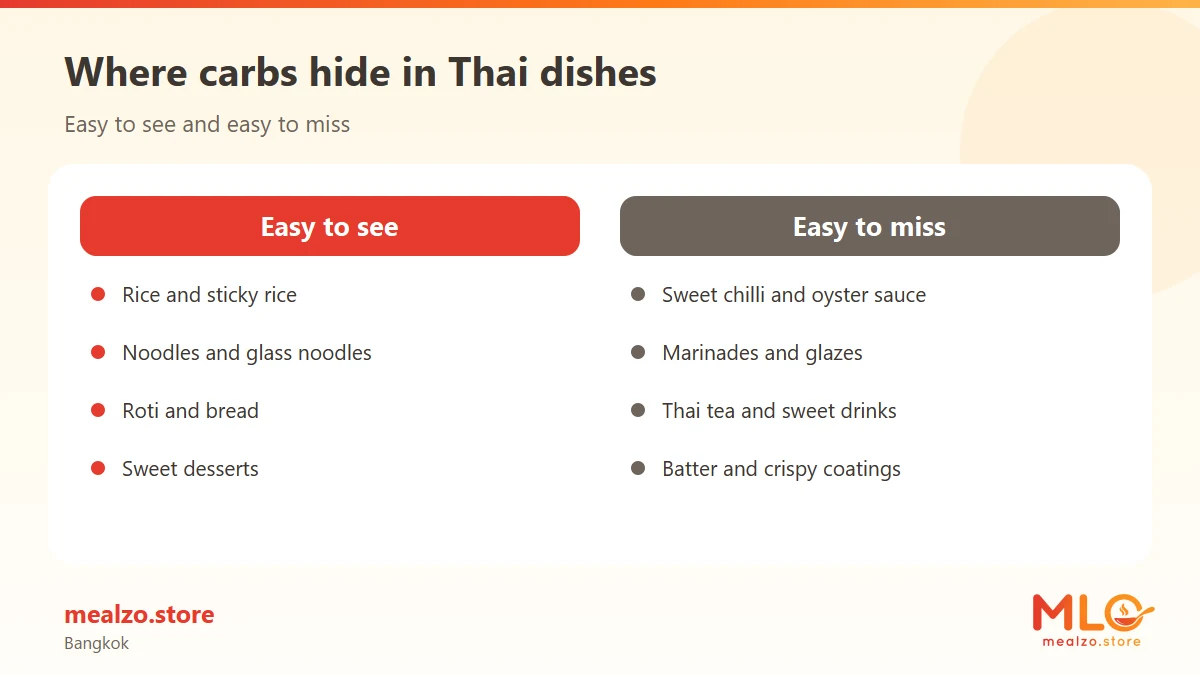
Sauces are particularly easy to overlook. Tamarind sauce, palm sugar, sweet chilli sauce, oyster sauce and sweetened drinks can add carbohydrates without making the plate look much larger.
The opposite is also true. A bowl of clear tom yum with prawns can contain plenty of flavour without relying on a large amount of fat. Som tam can also be relatively light before toppings and sweeteners are added.
Portion size is therefore one of the simplest variables to control. Eating a familiar dish in a measured portion can be more useful than avoiding it altogether and then compensating with snacks later.
Key takeaway: The calorie content of a Thai meal depends heavily on portion size and concentrated ingredients such as oil, sugar, coconut milk and sauces.
A useful way to think about Thai food is to separate the dish into components:
- Carbohydrate base: rice, rice noodles, noodles or sticky rice.
- Protein: prawns, chicken, fish, eggs, tofu or other protein ingredients.
- Cooking fat: oil, coconut milk or fat contained in sauces and pastes.
- Flavour components: tamarind, fish sauce, chilli, herbs, palm sugar and other seasonings.
This approach also makes it easier to compare Thai meals with international dishes. The cuisine changes, but the basic composition does not.
2. Pad Thai: noodles, sauce and oil are the main story
Pad Thai is a good example of why a dish can be deceptively difficult to estimate by appearance alone.
The noodle base is the first major contributor. Rice noodles provide most of the carbohydrate in the dish, and the quantity used makes a substantial difference. A large portion of noodles can raise the total energy of the meal even before sauce, oil and toppings are considered.
Then comes the sauce. Traditional Pad Thai flavour comes partly from tamarind and palm sugar, usually balanced with salty and savoury ingredients. Palm sugar contributes carbohydrate and calories, while tamarind provides acidity and flavour. The sauce itself is not necessarily the largest component, but it adds to the total.
Cooking oil is another factor. Stir-fried noodles absorb some of the oil used in the wok. More oil means more energy without necessarily producing a visibly larger serving.
Protein can help balance the meal. Egg, prawns, chicken or tofu add protein alongside the noodle base. That does not make the dish automatically low-calorie, but it changes its composition and can make a portion more substantial.
The single most effective adjustment is usually portion size, followed by controlling the amount of oil and sauce.
| Dish | What drives the calories | Single most effective adjustment |
|---|---|---|
| Pad Thai | Rice noodles, oil, palm sugar in the sauce, toppings | Reduce the noodle portion |
| Som tam | Palm sugar, peanuts, dried shrimp and accompanying foods | Control sugar and toppings |
| Tom yum nam sai | Protein and paste; usually limited added fat in the clear broth | Keep the broth clear |
| Tom yum nam khon | Evaporated or coconut milk plus the paste | Choose nam sai more often |
| Green curry | Coconut milk and curry paste | Limit the amount of sauce served |
| Red curry | Coconut milk and curry paste | Control the coconut-rich sauce |
| Massaman curry | Coconut milk plus a richer curry composition | Use a smaller sauce portion |
| Jasmine rice | Rice quantity | Measure the rice serving |
| Sticky rice | Glutinous rice quantity | Use a defined portion rather than eating from the basket |
For a deeper look at the relationship between portions and everyday Thai meals, see managing Thai food portions in everyday meals.
The goal is not to remove Pad Thai from the menu. It is to recognise that the noodle quantity is often the biggest lever.
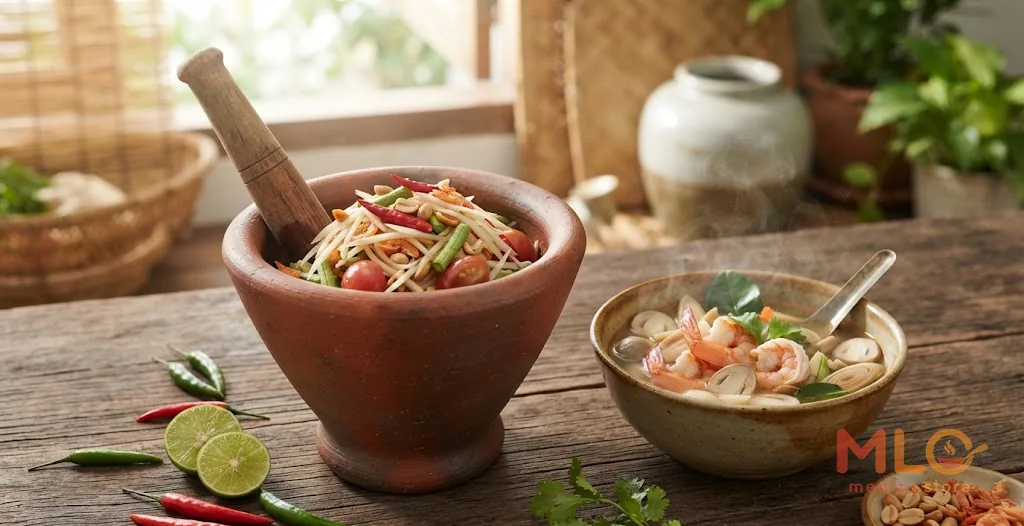
3. Som tam: naturally light, until the extras accumulate
Som tam starts from a relatively light base. Green papaya is mostly water and carbohydrate fibre, and the dish is built around shredded papaya, chilli, lime and other flavouring ingredients.
The calorie picture changes depending on what goes into the mortar.
Palm sugar adds sweetness and carbohydrate. Peanuts add fat and calories in a small volume. Dried shrimp contribute protein and flavour. Fish sauce adds very little energy compared with oil or sugar, but it can contribute a significant amount of sodium.
This is where two bowls of som tam can be compositionally different even if they have the same name.
Som tam Thai commonly includes peanuts and sweet-sour seasoning. Som tam pu pla ra can include fermented fish ingredients and crab, giving it a different flavour profile and sodium composition. The absence or presence of peanuts, dried shrimp and sugar can matter more to calorie intake than the papaya itself.
The practical adjustment is straightforward: control the palm sugar and high-energy toppings, and consider what you eat alongside the salad.
Som tam served with a large amount of sticky rice, fried chicken or another substantial side is a different meal from som tam eaten as part of a lighter plate.
Salt deserves separate attention. Fish sauce and fermented ingredients contribute sodium without adding many calories. That does not mean they need to be eliminated. It simply means that calorie tracking does not tell you everything about the composition of a meal.
Key takeaway: Som tam's papaya base is relatively light, but sugar, peanuts, dried shrimp, fermented ingredients and the foods served alongside it can change the overall meal substantially.
4. Tom yum: clear versus creamy is the biggest distinction
Tom yum demonstrates one of the clearest composition differences in Thai cooking.
Tom yum nam sai uses a clear broth. With prawns, mushrooms, herbs, chilli and lime, it can provide a flavourful meal component without the large amount of added fat found in coconut-rich dishes.
The curry or soup paste still matters. Thai pastes contain a mixture of herbs, spices and aromatics, and some recipes contain oil. So “clear” does not mean calorie-free. It means the soup does not have the additional creamy layer found in nam khon.
Tom yum nam khon has a richer texture because evaporated milk or coconut milk may be added, depending on the recipe. That creamy component changes the energy density of the soup.
For someone trying to keep calories predictable, this distinction is more useful than simply saying “tom yum is healthy” or “tom yum is low calorie.” The recipe matters.
Shrimp are another useful part of the equation. They provide protein without being a major source of fat. A clear tom yum with prawns therefore has a very different composition from a creamy tom yum served with a large amount of rice.
| Dish type | Main composition | Main calorie consideration |
|---|---|---|
| Tom yum nam sai | Clear broth, herbs, chilli, lime, protein | Paste and protein; usually limited added fat |
| Tom yum nam khon | Broth, paste, protein and evaporated/coconut milk | Creamy milk layer adds energy |
| Coconut-based curry | Coconut milk, curry paste, protein | Coconut-rich sauce is the major lever |
When ordering in Bangkok, simply knowing whether the tom yum is nam sai or nam khon can give you more useful information than relying on the dish name alone.
5. Curries: the coconut milk layer changes everything
Thai curries are often discussed as though green, red and massaman curry are interchangeable. They are not.
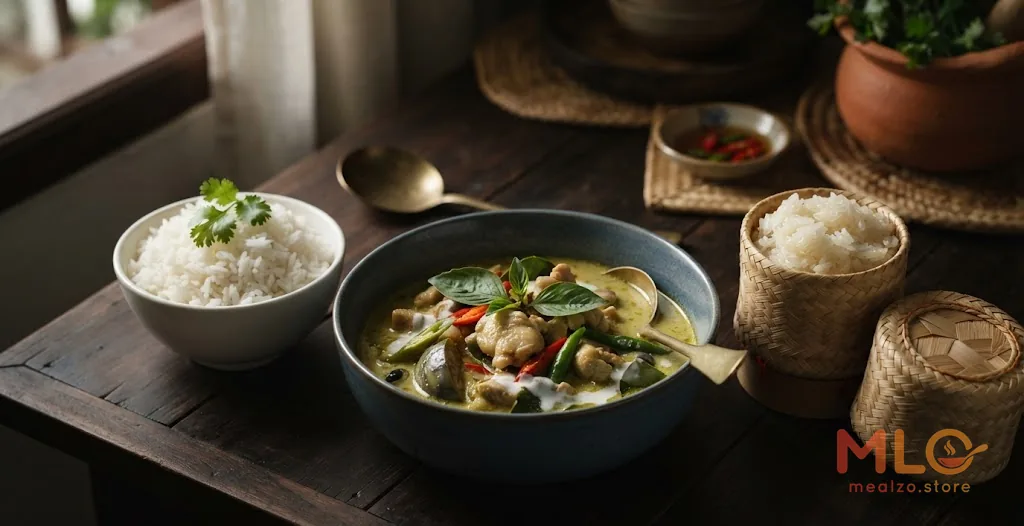
Green curry and red curry commonly use coconut milk as part of the sauce. Coconut milk provides fat, which makes the sauce rich and energy-dense. The amount actually served matters. A plate containing a small quantity of curry sauce over protein and vegetables is compositionally different from one covered in sauce.
Massaman curry tends to have an even richer overall composition, with coconut milk accompanied by ingredients such as peanuts and starchy components depending on the recipe. The sauce can therefore become a substantial part of the meal rather than merely a flavouring.
This does not make one curry “bad.” It simply means that coconut milk creates a concentrated source of energy, so the sauce quantity becomes important when calories are being managed.
A practical curry plate can be adjusted without changing the basic character of the dish:
- Keep the protein portion.
- Include the vegetables from the curry.
- Control how much coconut-rich sauce reaches the plate.
- Measure the rice separately.
- Avoid assuming that a small bowl automatically means a low-calorie meal.
This is one reason a meal plan can make calorie control easier: the sauce and carbohydrate portions can be determined before the meal arrives rather than estimated while eating.
6. Rice: sticky rice versus jasmine rice
For many Thai meals, rice is the largest single lever.
Jasmine rice is commonly served as a separate portion, making it relatively straightforward to control. Sticky rice is often eaten from a small basket or container, with pieces pulled off by hand. That serving style can make it harder to notice how much has been eaten.
Both provide carbohydrate. The practical difference is often less about one being inherently “better” and more about how the portion is served and consumed.
A controlled portion of jasmine rice can fit comfortably into a meal containing protein and vegetables. Sticky rice can do the same. The problem for calorie tracking is that repeated handfuls can turn a modest-looking serving into a considerably larger carbohydrate portion.
Rice also interacts with the rest of the meal. A curry with a generous amount of coconut-rich sauce and a large rice portion has two concentrated energy sources. A clear soup with prawns and a measured rice serving has a different composition.
Key takeaway: When a Thai meal includes rice, controlling the rice portion is often the simplest high-impact change you can make.
The same principle applies to noodle dishes. If the carbohydrate base is already substantial, adding another large carbohydrate side is a different proposition from keeping the side modest.
For more on carbohydrates that are easy to miss in Thai meals and drinks, see hidden carbohydrates in Thai food.
7. Sauces and condiments on the table
Thai meals often come with a collection of condiments that can quietly change the final composition.
Fish sauce itself is not a major calorie source. Its main nutritional consideration is sodium. Oyster sauce contains more carbohydrate and can include sugar, although the amount used in a particular meal varies.
Sweet chilli sauce is more straightforward: sweetness means added sugar, and the amount can increase quickly when the sauce is poured rather than measured.
Nam prik varies enormously by recipe. Some versions are relatively concentrated in chilli, herbs and seasonings, while others contain ingredients that add more fat or carbohydrate.
The useful habit is not to fear condiments. It is to distinguish between flavour quantity and sauce quantity.
A teaspoon or small spoonful used to season food is very different from several tablespoons covering a whole plate.
If you are eating out regularly, try these simple habits:
- Taste the food before adding extra sauce.
- Use a spoon rather than pouring directly from the bottle.
- Treat sweet chilli sauce as a carbohydrate-containing condiment.
- Remember that fish sauce affects sodium intake even when calories are minimal.
- Consider the sauce already used during cooking before adding more at the table.
Understanding macronutrients makes these choices easier because you can see how carbohydrate, protein and fat fit together rather than focusing only on a single ingredient. A useful reference is protein, carbohydrates and fat explained simply.
8. Drinks can add more than the meal itself suggests
Thai drinks deserve the same attention as food.
Cha yen, the familiar Thai iced tea, is usually sweetened and often contains milk or condensed milk. The tea itself is not the issue. The added sugar and dairy ingredients change the composition.
Sweetened coffee follows the same principle. A coffee beverage can begin with very few calories from the coffee itself and become considerably more energy-dense after sugar, condensed milk or other sweetened ingredients are added.
Fruit smoothies can also be misleading. Fruit contributes natural sugars and carbohydrates, but syrup, sweetened condensed milk or other added sweeteners can increase the total further.
Liquid calories are particularly easy to overlook because they do not occupy the same physical space as a plate of food.
If you are already eating a substantial rice or noodle meal, choosing an unsweetened or less-sweetened drink can be a simple way to keep the overall meal composition more predictable.
This does not mean every drink has to be unsweetened. Frequency and portion still matter.
9. How to order Thai food with a lighter composition
You do not need to ask a Bangkok restaurant to redesign its menu. Small requests can change the composition while keeping the dish recognisable.
For noodle dishes, ask for a smaller noodle portion when the restaurant can accommodate it. For curries, take less sauce relative to rice and protein. For som tam, control the sweetness and peanuts if those ingredients are not essential to what you want.
With soup, the nam sai versus nam khon distinction is one of the clearest choices available.
For drinks, decide on sweetness before ordering rather than after the drink arrives.
A simple restaurant decision tree looks like this:
- Noodles: watch the noodle and oil quantities.
- Som tam: watch palm sugar and toppings.
- Tom yum: choose between clear and creamy based on the composition you want.
- Curry: control coconut-rich sauce.
- Rice: decide the portion before you start eating.
- Drinks: check for added sugar and syrup.
- Condiments: add deliberately rather than automatically.
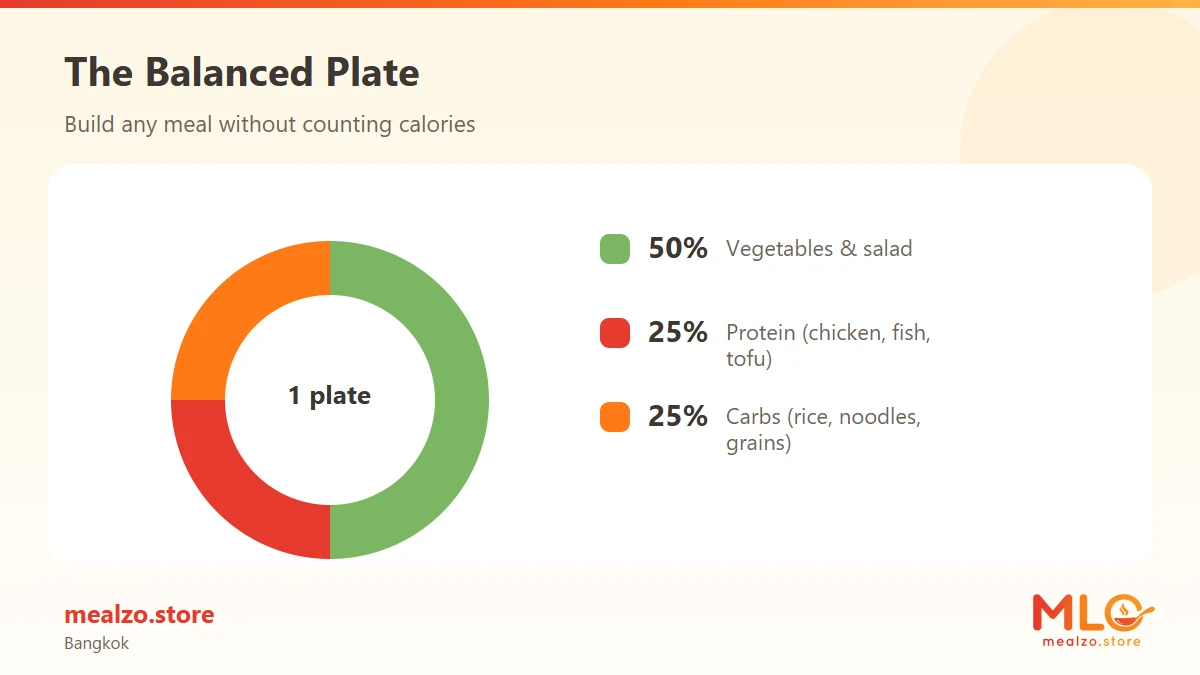
There are limits to this approach. Restaurant recipes vary, and you rarely know exactly how much oil or sugar went into a wok. If exact calorie control matters, estimates remain estimates unless ingredients and portions are measured.
That is why a meal plan can offer a different level of predictability.
10. How a portioned meal plan handles the same Thai dishes
A mixed Thai and international meal plan does not require Thai food to be removed. The practical difference is that the components can be portioned before the meal reaches you.
Mealzo Bangkok uses one mixed cuisine plan, meaning Thai and international dishes are included together in the same plan. There is no separate Thai-only or international-only cuisine choice.
The kitchen is located in Bang Na, Bangkok. Meals are prepared in the Bang Na kitchen and delivered across Bangkok, with customers selecting either the morning delivery window of 06:00-09:00 or the evening window of 17:00-20:00.
For Thai dishes, portion control can be applied directly to the elements discussed above. A Pad Thai-style meal can have its noodle quantity defined. A curry can be served with a controlled amount of coconut-rich sauce. Rice can be portioned separately. A clear tom yum can sit alongside a measured carbohydrate and protein component.
The calorie level is also selected upfront. Mealzo Bangkok offers six daily calorie levels from 1200 to 2500 kcal, alongside 12 plan types:
- Balanced
- Weight Loss
- High Protein
- Vegetarian
- Vegan
- Keto
- Low-Carb
- Gluten Free
- Easy-to-Digest
- Pescatarian
- No Fish & Seafood
- Dairy & Egg Free
Plans are available with 3 or 5 meals per day, and package lengths are 3, 7, 14 or 30 days.
The point is not that a calorie-labelled plan makes every individual ingredient perfectly measurable. It creates a defined framework in which portions and components are planned together.
The app also includes a calorie calculator using the Mifflin-St Jeor formula. That calculation is an estimate, not medical advice, so it should be treated as a planning reference rather than a clinical measurement.
If you want to see how the food and delivery operation fits together, read how Mealzo Bangkok cooks and delivers meal plans.
A meal plan can also be useful for people who want Thai food but do not want every daily meal to be Thai. Because the cuisine is mixed, a day might contain a Thai-inspired dish alongside international meals while staying within the selected calorie framework.
For customers managing allergens, the mechanism is also based on information supplied when ordering. The customer declares allergens from 9 allergen groups, and dishes containing a declared allergen are not assigned to them. This mechanism should not be interpreted as a guarantee that meals are completely allergen-free.
11. What to keep and what to swap
The most sustainable approach is usually to keep the flavours you actually enjoy and change the parts that have the biggest effect on composition.
There is no requirement to replace Pad Thai with a salad every time. If Pad Thai is one of your favourite meals, the more useful question is whether the noodle portion, sauce and protein balance fit the rest of your day.
The same applies to curry. You can keep green, red or massaman curry while paying attention to the amount of coconut-rich sauce and rice.
Som tam can remain part of a regular eating pattern while the palm sugar and peanut quantities are considered. Tom yum can remain a familiar option, with nam sai providing a different composition from nam khon.
A useful weekly pattern can therefore include:
- Pad Thai in a controlled portion.
- Som tam with an appropriate amount of toppings and a measured carbohydrate side.
- Clear tom yum with prawns or another protein.
- Coconut-based curry with controlled sauce and rice.
- Jasmine or sticky rice in a defined serving.
- Thai drinks less frequently or with less added sugar.
The exact choice depends on your calorie target, meal frequency and preferences. A person eating 1200 kcal per day has a very different amount of room for a large noodle dish than someone following a 2500 kcal plan. That is why the same Thai meal cannot be labelled universally as high or low calorie without knowing the portion and the rest of the day.
If you want to use a structured calorie level as a starting point, the Mealzo Bangkok calorie calculator can provide an estimate based on the Mifflin-St Jeor formula.
FAQ
Can I eat Pad Thai while following a calorie-controlled diet?
Yes. The main variables are the noodle portion, cooking oil, sauce and protein. A smaller noodle serving with a defined amount of sauce can fit into a calorie-controlled day more easily than a large restaurant portion. The appropriate portion depends on your overall calorie target.
Is som tam low in calories?
The papaya base is relatively light, but the complete dish can contain more calories depending on palm sugar, peanuts and other ingredients. Fish sauce and fermented ingredients also affect sodium without necessarily contributing many calories. The foods served alongside som tam can be just as important as the salad itself.
Which is lighter, tom yum nam sai or nam khon?
From a composition perspective, tom yum nam sai generally has the simpler calorie profile because it does not contain the additional evaporated or coconut milk layer found in nam khon. The paste and other ingredients still contribute to the final composition.
Is jasmine rice better than sticky rice for a diet?
Neither needs to be categorised as inherently better or worse. Both provide carbohydrate, and portion size is the main practical variable. Sticky rice can be easier to overeat when it is served in a basket and consumed by hand, while jasmine rice is often easier to portion separately.
Can Thai curries fit into a calorie-controlled meal plan?
Yes. The main consideration is the coconut-rich sauce and the amount of rice served with it. Green, red and massaman curries can have different compositions, and the quantity of sauce reaching the plate can materially change the meal.
Can a meal plan include Thai food without every meal being Thai?
Yes. Mealzo Bangkok uses one mixed cuisine plan, combining Thai and international dishes in the same plan. The calorie level is selected upfront, and meals are portioned as part of the chosen plan rather than requiring a separate Thai or international cuisine selection.
Mealzo Bangkok is a kitchen and meal delivery service operating exclusively in Bangkok, Thailand. We are not affiliated with similarly named services outside Thailand.
Find a Meal Plan That Fits
Compare Mealzo plans or use the calculator to explore meal options for your needs.