Macronutrients 101: Protein, Carbohydrates and Fat Explained

Macronutrients sound more complicated than they really are.
If you have ever looked at a nutrition label, opened a calorie-tracking app or heard someone in a Bangkok gym talk about “hitting protein” or “cutting carbs”, you have already come across them.
Macronutrients are simply the nutrients your body needs in relatively large amounts: protein, carbohydrates and fat.
They are also the main sources of calories in food, which is why they appear so often in conversations about weight management, fitness, meal planning and healthy eating.
The confusing part usually begins when people try to turn a simple idea into a complicated one.
Protein becomes “the good macro”. Carbs become something to fear. Fat gets blamed for being calorie-dense. Then someone says you should eat 40/30/30, somebody else says keto is better, and suddenly a bowl of rice feels like a nutrition exam.
It does not need to work like that.
A useful understanding of macronutrients should make food easier to interpret, not harder. It should help you look at a plate of chicken, jasmine rice and vegetables and understand what each part contributes without needing to weigh every grain of rice.
If you want to see how macronutrients fit into an entire day rather than looking at them one by one, start with the complete guide to balanced meal plans.
What Are Macronutrients?
Macronutrients are nutrients the body uses in larger quantities.
The three main macronutrients are:
- protein
- carbohydrates
- fat
Alcohol also provides calories, but it is not treated as one of the three core macronutrients in everyday meal planning.
Each macro has a different role.
Protein is strongly associated with building and maintaining body tissues and is also important in the structure of many meals.
Carbohydrates are a major energy source and are especially common in foods such as rice, noodles, bread, fruit and potatoes.
Fat provides concentrated energy and is naturally present in foods such as oils, nuts, seeds, coconut products, fish, eggs and dairy.
The point is not to choose one and eliminate the others.
For most general eating patterns, the question is how they work together.
How Macronutrients Turn Into Calories
Key takeaway: Protein, carbohydrates and fat all have distinct roles, and a balanced meal usually contains a combination of all three.
Calories and macros are closely related.
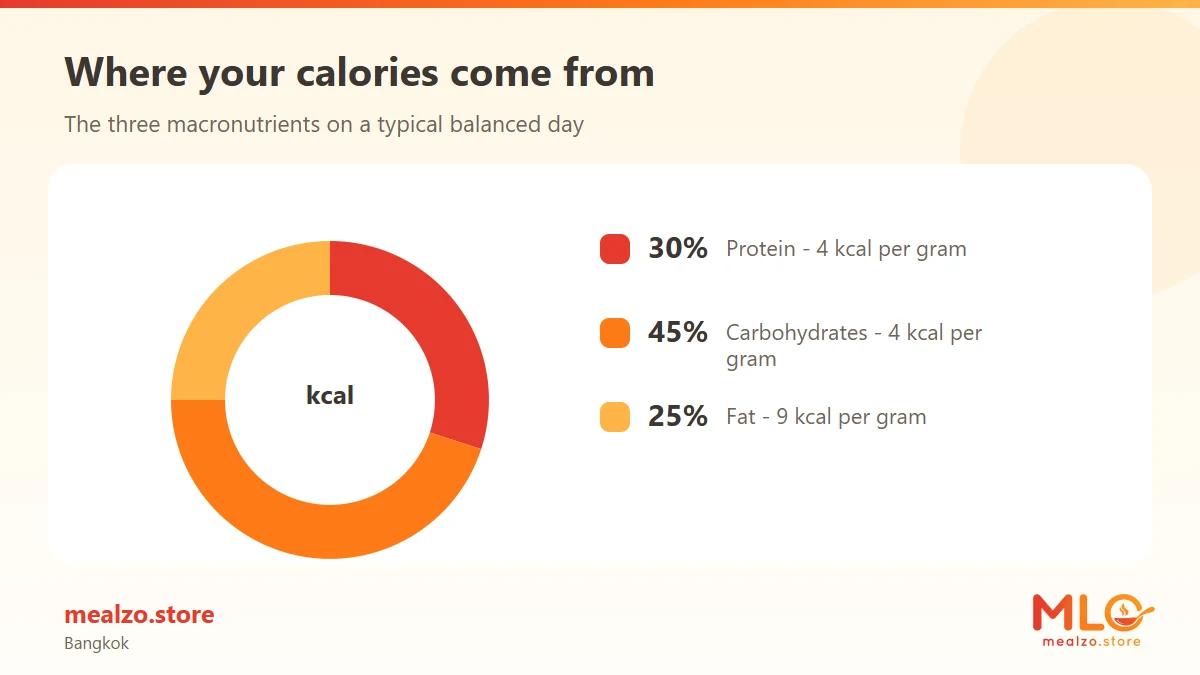
Every gram of protein, carbohydrate or fat contributes energy.
The basic numbers are:
- protein: 4 calories per gram
- carbohydrates: 4 calories per gram
- fat: 9 calories per gram
That explains why foods high in fat can be relatively calorie-dense even when the portion does not look large.
For example, adding extra oil to a stir-fry may not make the plate look much bigger, but it can increase the energy content noticeably.
The same is true for coconut milk, creamy dressings, nuts and seeds.
This does not make fat “bad”. It simply means fat carries more energy per gram.
It also explains why a meal can contain the same amount of food by volume but have a very different calorie total depending on how it is prepared.
Calories tell you how much. Macros tell you where it comes from.
Imagine two meals with similar total calories.
One might contain more protein and fewer carbohydrates.
Another might contain more carbohydrates and less fat.
A third might be much higher in fat.
The calorie total could still end up similar.
That is why calories and macronutrients answer different questions.
Calories help with the total energy picture.
Macros help explain the composition of that energy.
If you are trying to decide how many calories to start with, a rough estimate can be useful before worrying about macro percentages. estimate your daily calorie needs
Protein: More Than a Fitness Word
Protein gets a lot of attention, especially in gyms, weight-loss content and meal-prep culture.
Some of that attention is justified. Protein plays important roles in the body and is often one of the easiest ways to give a meal more structure.
But the internet also tends to turn “protein matters” into “more protein is always better”.
That is not a useful way to think about it.
What protein does
Protein provides amino acids, which are used in many processes throughout the body.
From a practical meal-planning perspective, protein is useful because it gives you a clear anchor for the meal.
If you look at a plate and can immediately identify the main protein source, the rest is usually easier to organise.
That could be:
- chicken
- fish
- eggs
- tofu
- yoghurt
- dairy products
- legumes
- lean meat
- seafood
A Thai meal with chicken, rice and vegetables has an obvious protein source.
So does a tofu stir-fry.
So does fish with rice and vegetables.
A bowl that is almost entirely noodles with a few tiny pieces of meat has less protein structure, even if it technically contains some.
How much protein do you actually need?
There is no single number that works for every person.
Protein needs depend on factors such as body size, activity level, training and overall goals.
A sedentary office worker, a regular gym-goer and someone training hard several times a week may not want the same intake.
This is where people often make the mistake of copying somebody else’s target.
A friend says they eat 160 grams of protein per day, so that suddenly becomes the new standard.
It should not.
The better approach is to estimate based on your own situation. If you want to go deeper into this, see how much protein you need per day.
For a beginner, the simplest practical habit is not to chase a huge protein number immediately. Start by making sure your main meals have a meaningful protein source.
That one change already makes many meals easier to assess.
Carbohydrates: Not the Enemy
| Macro | Energy per gram | Main role in the body | Everyday food sources |
|---|---|---|---|
| Protein | 4 kcal | Builds and maintains body tissues | Chicken, fish, eggs, tofu |
| Carbohydrates | 4 kcal | Main source of usable energy | Rice, noodles, fruit, sweet potato |
| Fat | 9 kcal | Energy, hormones and nutrient absorption | Cooking oil, nuts, seeds, avocado |
Carbohydrates have probably had the strangest reputation of all three macros.
One decade they are treated as essential fuel. The next they are blamed for everything.
Then rice gets removed from the plate, noodles disappear, fruit becomes suspicious and somebody decides that eating a banana is somehow a dietary mistake.
That level of fear is rarely helpful.
Carbohydrates are simply one of the main macronutrients and an important source of energy.
Common carbohydrate sources
You find carbohydrates in foods such as:
- rice
- noodles
- bread
- oats
- potatoes
- fruit
- beans
- grains
- many vegetables
- sweets and sugary drinks
Obviously, these foods are not nutritionally identical.
A bowl of oats and a sugary drink both contain carbohydrates, but they do not provide the same overall nutritional package.
That is why saying “carbs are carbs” can be technically convenient but practically misleading.
Carbohydrates in Bangkok are part of normal food
In Thailand, rice and noodles are part of everyday eating.
Trying to build a normal long-term diet while treating every bowl of jasmine rice like a problem usually makes life unnecessarily difficult.
A more useful question is not:
“Should I eat carbs?”
It is:
“How much carbohydrate makes sense in this meal, and what is it paired with?”
A plate of jasmine rice, grilled chicken and vegetables has a very different structure from a large serving of rice with very little protein and a heavy sauce.
A noodle soup with protein, vegetables and a reasonable portion of noodles is different from a huge bowl built almost entirely around noodles.
The carbohydrate itself is not the whole story.
Fast and slow carbohydrates: useful idea, easy to oversimplify
People often talk about “fast” and “slow” carbs.
The basic idea is that different carbohydrate-containing foods are digested and absorbed at different rates.
That can be a useful concept, but it becomes misleading when used as a rigid ranking system.
The speed of a meal is influenced not only by the carbohydrate source but also by the rest of the meal.
Protein, fat, fibre, portion size and food preparation all change the picture.
So instead of obsessing over whether one rice variety is “good” and another is “bad”, it is usually more practical to look at the meal as a whole.
Rice with chicken and vegetables is not nutritionally the same experience as rice eaten alone.
Fat: Necessary, Concentrated and Easy to Miss
Fat is another macro that gets misunderstood because of one simple fact: it contains more calories per gram than protein or carbohydrates.
That makes it easy to underestimate.
A spoonful of oil does not take up much space. Coconut milk blends into a curry. Nuts disappear quickly while working at a laptop. Dressing coats a salad without looking like a separate portion.
Yet all of these contribute energy.
Common sources of fat
Fat appears in:
- cooking oils
- coconut milk
- coconut cream
- nuts
- seeds
- avocado
- cheese
- eggs
- fatty fish
- meat
- dressings
- sauces
Some foods contain a mix of macros.
Eggs, for example, provide protein and fat.
Nuts contain fat, some protein and carbohydrate.
That is another reason not to think of foods as belonging to one macro category only.
Fat in Thai cooking
Thai food provides plenty of practical examples.
A clear soup and a coconut-based curry may contain similar-looking ingredients but very different amounts of fat.
A stir-fry cooked with more oil can be considerably more calorie-dense than one made with less.
A salad may sound light until a rich dressing is added.
Again, the point is not that coconut, oil or richer sauces should be avoided.
The point is to understand why two dishes that appear similar in size may contain very different amounts of energy.
Different types of fat
You may also hear terms such as saturated, monounsaturated and polyunsaturated fat.
These describe different types of fatty acids.
For a beginner, it is enough to understand that dietary fat is not one single thing and that food quality still matters.
You do not need to memorise the fatty acid profile of every meal in Bangkok to eat sensibly.
The more useful habit is to include a variety of foods and pay attention to how much added fat comes from cooking oils, sauces and high-fat extras.

Why Macro Ratios Are Not Universal
Key takeaway: Fat contains more than twice as much energy per gram as protein or carbohydrates, so portion size can significantly affect total calories.
Once people understand protein, carbs and fat, the next question is usually:
“What should my macro ratio be?”
That sounds like there should be one correct answer.
There is not.
A person focused on general balanced eating may choose a different macro distribution from someone prioritising higher protein.
A low-carb plan will obviously look different from a balanced plan.
A keto plan changes the ratio even more dramatically.
Goals, preferences, calorie level and food style all affect what makes sense.
That is why copying 40% carbs, 30% protein and 30% fat from somebody else is not automatically useful.
The ratio only becomes meaningful when it fits your actual situation.
For a deeper explanation, see how macro ratios change depending on your goal.
You Do Not Need to Count Every Gram
Macro tracking can be useful for some people.
It is not mandatory.
There is a big difference between understanding macros and turning every meal into a spreadsheet.
If you are a beginner, learning to recognise the main components of a meal is often enough to improve your food choices.
A simple way to read a plate
Ask four questions:
Where is the protein?
Chicken, fish, tofu, eggs, yoghurt, legumes or another clear source.
Where are the carbohydrates?
Rice, noodles, bread, potatoes, oats, fruit or another main source.
Where is the fat coming from?
Oil, sauce, coconut milk, nuts, seeds, cheese, eggs or the protein source itself.
What else is on the plate?
Vegetables, fruit, herbs and other foods that contribute fibre and micronutrients.
That last question matters because macros are not the whole diet.
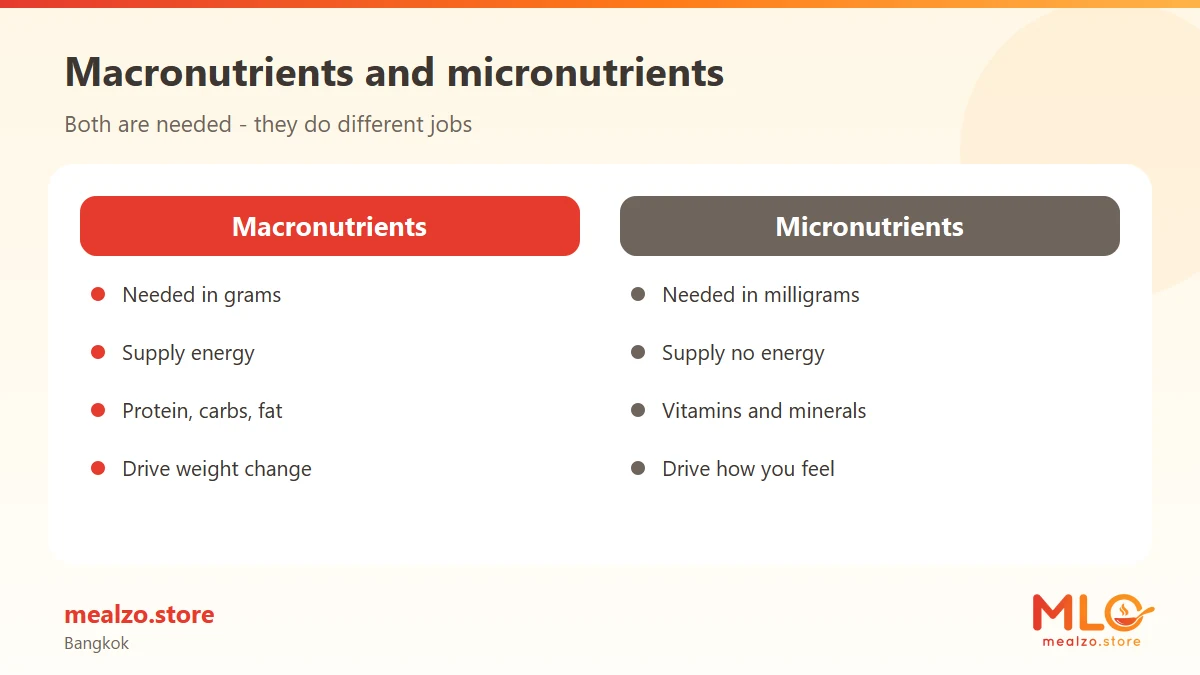
learn the difference between macronutrients and micronutrients if you want to understand why hitting protein, carbs and fat targets alone does not make a diet complete.
Use portions before percentages
For many people, visual portion awareness is more useful than starting with percentages.
You can notice that one meal is mostly rice.
Another has very little protein.
Another is covered in a heavy sauce.
Another looks balanced without knowing a single gram.
That is already useful information.
Tracking can come later if you actually need it.
Common Macronutrient Misunderstandings
| Meal component | Main macro | Also provides |
|---|---|---|
| Grilled chicken breast | Protein | Small amount of fat |
| White rice | Carbohydrates | Small amount of protein |
| Olive oil / cooking oil | Fat | Fat-soluble compounds |
| Mixed vegetables | Carbohydrates | Fibre and micronutrients |
| Eggs | Protein and fat | Vitamins and minerals |
| Nuts and seeds | Fat | Protein and fibre |
Macro advice becomes confusing because simple ideas are often pushed too far.
“Protein foods are always healthy”
Not automatically.
Protein is useful, but the whole meal still matters.
A highly processed meal does not become balanced simply because someone added extra protein.
“Carbs make you gain weight”
Carbohydrates contain calories, just like protein and fat.
Body-weight management depends on the broader energy picture, not on the existence of rice or noodles alone.
Removing carbs can reduce calories for some people, but that is not the same as proving that carbohydrates themselves are uniquely responsible.
“Fat makes you fat”
Fat is calorie-dense, so portion size matters.
But dietary fat is also part of normal eating.
The useful distinction is between understanding its energy contribution and treating it as something that must be eliminated.
“Low-fat always means low-calorie”
Not necessarily.
A food lower in fat may contain more sugar, starch or simply a larger portion.
Labels are useful, but they still need context.
“If the macros fit, food quality does not matter”
This is one of the most persistent misunderstandings.
You can theoretically hit a protein, carbohydrate and fat target with a narrow range of foods.
That does not mean the diet is complete.
Food variety, micronutrients and fibre still matter.
“Everyone should use the same macro split”
There is no universal split.
A balanced eater, a high-protein eater, someone following low-carb and someone following keto may intentionally have very different macro distributions.
The right question is not “what is the best ratio?”
It is “what ratio fits this goal and this person?”
How Macronutrients Fit Into a Normal Bangkok Day
The easiest way to understand macros is to stop thinking about them as abstract percentages.
Look at actual food.
Breakfast
Eggs with rice and fruit:
- eggs contribute protein and fat
- rice contributes carbohydrates
- fruit contributes carbohydrates, fibre and micronutrients
Yoghurt with oats and fruit:
- yoghurt contributes protein, with varying amounts of carbohydrate and fat depending on the type
- oats contribute carbohydrates and some protein
- fruit adds carbohydrates and other nutrients
Lunch
Chicken with jasmine rice and vegetables:
- chicken is the main protein source
- rice is the main carbohydrate source
- cooking oil or sauce contributes some fat
- vegetables add volume, fibre and micronutrients
Dinner
A coconut curry with tofu, rice and vegetables:
- tofu provides protein and fat
- rice provides carbohydrates
- coconut milk contributes a significant amount of fat
- vegetables add variety and micronutrients
No meal needs to match a perfect formula.
The point is simply to understand what is actually on the plate.
Where MEALZO Fits Into Macro-Based Meal Planning
Key takeaway: You do not need to identify every gram of each macro to understand a meal; start by recognising the main protein, carbohydrate and fat sources on the plate.
Once you understand macros, meal plans become much easier to compare.
You stop looking only at dish names and start thinking about structure.
MEALZO offers 12 diet plans with delivery in Bangkok, including balanced, high_protein, low_carb and keto.
These plans are not identical because their nutritional emphasis differs.
A balanced plan and a low-carb plan should not be expected to use the same macro structure. A high-protein plan places more emphasis on protein. Keto shifts the balance further toward a different macronutrient distribution.
MEALZO offers calorie levels from:
- 1,200 kcal
- 1,500 kcal
- 1,800 kcal
- 2,000 kcal
- 2,200 kcal
- 2,500 kcal
Customers can choose 3 or 5 meals per day, with packages for 3, 7, 14 or 30 days.
Cuisine is not selected separately.
Every plan uses one mixed menu.
The mixed menu includes Thai dishes.
It also includes international dishes.
Menus are arranged by an algorithm rather than selected meal by meal from an à-la-carte marketplace.
Understanding macros helps make sense of those choices.
It also helps explain why the same calorie level can look different across different diet plans.
A 1,800 kcal balanced plan does not need to have the same protein, carbohydrate and fat distribution as a 1,800 kcal low-carb or keto plan.

Start With Understanding, Not Precision
For a beginner, the best first step is not calculating the exact percentage of every macro.
It is learning to recognise them.
Look at your next lunch.
Where is the protein?
Where are the carbohydrates?
Where is most of the fat likely coming from?
Are there vegetables or fruit?
Does the meal look dominated by one component?
That is already macronutrient literacy.
Once that becomes easy, you can decide whether you need more precision.
Maybe you only need a better sense of portions.
Maybe you want to estimate your calorie needs.
Maybe you want to adjust macros for a specific goal.
Maybe you simply want to stop thinking of rice as “bad” and protein as something you need to maximise at all costs.
The useful point is not to know more nutrition vocabulary.
It is to look at normal food, Thai, international or mixed, and understand what role each part of the meal is playing.
That makes calories easier to understand, meal planning easier to evaluate and food much less confusing.
**
Frequently Asked Questions
Do I need to count macros?
No. Macro tracking can be useful for people who want more detailed control over their food intake, but it is not required for eating balanced meals. A simpler approach is to build meals around a clear protein source, a sensible carbohydrate portion, vegetables and an appropriate amount of fat.
Is fat bad for you?
No. Fat is an essential macronutrient and plays important roles in energy storage, hormone production and the absorption of certain vitamins. The type of fat and the overall quantity in the diet matter more than simply trying to avoid fat altogether.
Are carbohydrates necessary?
Carbohydrates are a major source of energy and are common in foods such as rice, noodles, fruit, vegetables and grains. They do not need to be eliminated for a meal to be balanced, although the amount can vary depending on personal preferences and overall eating pattern.
How much protein should a meal contain roughly?
There is no single amount that suits everyone because protein needs vary with body size, activity level and the rest of the day's food intake. For a beginner, it is often more useful to make sure each main meal contains a clearly identifiable protein source rather than focusing immediately on exact gram targets.
Do macros matter more than calories?
They answer different questions. Calories describe how much energy a meal provides, while macros describe where that energy comes from and help explain characteristics such as protein content, carbohydrate load and fat density. Both can matter when assessing how a meal fits into an overall eating pattern.
How does a meal plan keep macros consistent?
A structured meal plan uses repeatable portion standards and controlled amounts of protein sources, carbohydrates, vegetables and cooking fats. When recipes and serving sizes are prepared consistently, the macro profile of meals becomes more predictable from day to day.
Find a Meal Plan That Fits
Compare Mealzo plans or use the calculator to explore meal options for your needs.