Complete Guide to Balanced Meal Plans: Calories, Macros and Variety
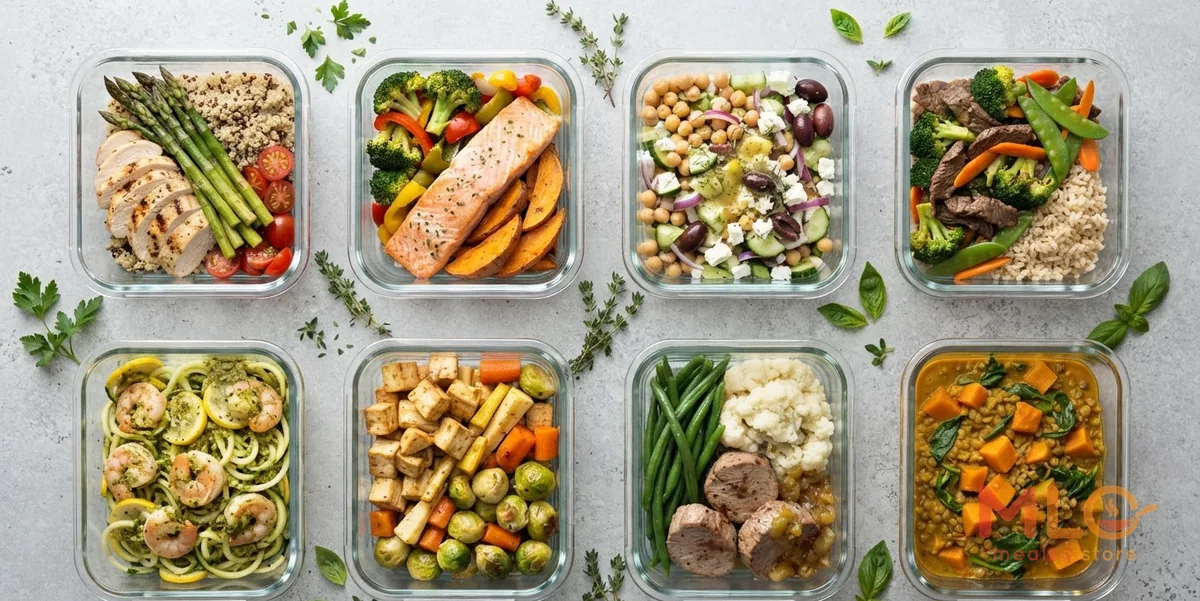
A balanced meal plan is not a rigid menu, a list of “clean” foods or a mathematical formula you have to follow perfectly. It is simply a way of organising food so that your daily intake gives you enough energy, a sensible balance of protein, carbohydrates and fat, and enough variety to make the plan practical for more than a few days.
That becomes more complicated in real life. In Bangkok, breakfast may be grabbed near the BTS, lunch might come from a food court, dinner could be Thai street food, Japanese rice bowls or pasta with friends, and a late evening at the office can easily end with whatever looks easiest at 7-Eleven. The problem is rarely access to food. It is consistency.
A useful balanced meal plan should therefore answer practical questions: how much should you eat, how should protein, carbs and fat fit together, what does a balanced day actually look like, how much variety do you need, and how do you keep the whole thing working when you are busy?
What Is a Balanced Meal Plan?
A balanced meal plan combines several things at once:
- an appropriate amount of food and energy,
- a reasonable distribution of protein, carbohydrates and fats,
- a mixture of different food groups,
- variety across the week,
- portions that fit your needs,
- and a structure you can realistically follow.
The key word is balance, not perfection.
One meal may contain more carbohydrates. Another may be higher in fat. Breakfast may be lighter than dinner. A Thai lunch with jasmine rice will look different from an international-style dinner with roasted potatoes and grilled chicken. That is completely normal.
What matters more is the pattern across the day and over time. Someone eating rice with stir-fried vegetables and chicken at lunch does not need the meal to contain exactly the same macronutrient ratio as dinner. The goal is for the overall day to make sense.
This is also why a balanced plan should not be confused with simply eating less. A 1,500-calorie diet can be poorly balanced, while a 2,200-calorie diet can be well balanced. Calories tell you how much energy food provides. They do not tell you everything about the nutritional structure of that food.
Calories and Macros Solve Different Problems
Key takeaway: A balanced meal plan combines appropriate portions with protein, vegetables, carbohydrates, fats and enough variety to stay enjoyable.
Calories and macronutrients are related, but they answer different questions.
Calories tell you how much energy you are consuming. Macronutrients tell you where that energy comes from.
The three main macronutrients are protein, carbohydrates and fat. Each affects how meals are built and how they fit into the rest of the day.
If you want a deeper explanation of what each macronutrient does, start with macronutrients explained simply.
Calories: the size of the daily energy budget
Think of calories as the overall size of your daily food budget.
A person with lower energy needs may require smaller total portions than someone who is taller, heavier, more active or training frequently. Two people can eat nearly identical foods but need very different serving sizes.
This is why copying somebody else’s meal plan rarely makes much sense. A colleague may comfortably eat a large rice-based lunch because they train after work. Someone with a mostly sedentary routine may feel better with a smaller lunch and a lighter afternoon snack. The food itself does not have to change dramatically. Often, the portions do.
If you do not know where to begin, a calorie estimator can give you a useful starting point instead of relying on guesswork. estimate your daily calorie needs
It will never describe your body or lifestyle perfectly, but it is more useful than choosing a calorie number because it happens to be popular online.
Protein: the structural part of the meal
Protein is often the easiest macronutrient to spot on the plate. Chicken, fish, tofu, eggs, dairy products and legumes can all contribute.
In practical meal planning, having a recognisable protein source in the main meals usually makes the whole day easier to structure.
Compare two lunches:
Lunch A: a large serving of white rice with a small amount of meat and sauce.
Lunch B: rice with a more substantial serving of chicken or tofu, vegetables and an appropriate amount of sauce.
Both could fit into a balanced diet, but the second meal has a clearer structure.
That does not mean protein should become an obsession. More is not automatically better, and the appropriate amount depends on the person and their goals. That is why the question “What percentage of my calories should come from protein?” needs more context than one universal answer. how macro ratios change by goal
Carbohydrates: fuel, not the enemy
Carbohydrates are often the first thing people remove when they decide to “eat healthy.” That is not always necessary.
Rice, noodles, potatoes, oats, fruit, bread and other carbohydrate-containing foods can all fit into a balanced meal plan. In Thailand, trying to build a normal diet while pretending rice does not exist can make eating far more complicated than it needs to be.
The better questions are practical: how large is the portion, what is eaten with it, and how does it fit into the rest of the day?
A plate with rice, chicken, vegetables and fruit can be balanced. So can a bowl of noodles. So can pasta. Balance comes from context, not from banning an entire food category.
Fat: easy to underestimate
Fat contributes heavily to flavour and texture, and it is energy-dense. Cooking oil, coconut milk, nuts, seeds, cheese, creamy dressings and rich sauces can add a lot of energy without making a meal look much bigger.
That matters with Thai and international food alike. A coconut-based curry may contain more fat than a clear soup. A salad covered in a heavy dressing may contain far more energy than the vegetables themselves suggest. A small handful of nuts can fit easily into a balanced diet; several casual handfuls are a different portion altogether.
None of these foods has to be removed. The point is to understand how portions, ingredients and the rest of the day fit together.
Balance Is More Than Macronutrients
People often reduce nutrition to protein, carbohydrates and fat because those numbers are easy to track. But food also provides vitamins, minerals, fibre and many other components that macros do not describe.
This is where variety matters.
Eating chicken, white rice and the same vegetable every day might make tracking very easy. It does not automatically make the overall diet well rounded.
macronutrients vs micronutrients explained looks at that distinction in more detail.
In practice, variety can come from rotating protein sources, vegetables, fruit, carbohydrate sources, herbs, seasonings and cooking styles. You do not need 30 different meals every week, but eating the exact same lunch and dinner for weeks because the numbers are easy to calculate misses part of the point of balanced eating.
What Does a Balanced Day of Eating Actually Look Like?
| Daily calories | Typically suits | Meals per day | Notes |
|---|---|---|---|
| 1200-1400 | Smaller appetites, lower energy targets | 3 or 5 | Individual needs vary |
| 1500-1700 | Moderate calorie targets | 3 or 5 | Adjust to appetite and routine |
| 1800-2000 | Many active everyday routines | 3 or 5 | Flexible middle-range option |
| 2100-2300 | Higher energy requirements | 3 or 5 | Activity level matters |
| 2400+ | Very active lifestyles | 3 or 5 | Higher intake, same balance principles |
There is no single correct version of a balanced day.
A useful example is not a menu you have to copy. It is a way to see how different meals can work together.
Imagine an office worker in Bangkok who eats three main meals.
Breakfast
Breakfast could be eggs with whole-grain toast or rice, fruit and some vegetables. Another person might prefer oats, yoghurt, fruit and nuts or seeds. A Thai-style breakfast could use rice, eggs, vegetables and a lean protein.
The cuisine is not the deciding factor. The question is whether breakfast gives the day a sensible combination of energy, protein and supporting foods instead of being made almost entirely from sugar or refined carbohydrates.
Lunch
Lunch might be grilled chicken with jasmine rice, vegetables and fruit. It could also be tofu with rice and vegetables, or an international-style meal with roasted chicken, potatoes and salad.
Again, the principle matters more than the recipe. There is a protein source, a carbohydrate source, vegetables and an appropriate total portion.
Afternoon
Not everyone needs a snack. For somebody eating five times per day, an afternoon meal or snack might be planned rather than improvised.
Fruit with yoghurt is one option. A smaller savoury meal is another. What matters is how it fits the daily structure.
The problem begins when “snacking” means repeatedly eating small amounts without noticing how much has accumulated by evening. A packaged drink, a pastry at work, some chips from 7-Eleven and a few bites of dessert may each feel insignificant, but together they can become a meaningful part of the day.
Dinner
Dinner might be lighter than lunch or about the same size, depending on preference and schedule. It could be fish with rice and vegetables, tofu with noodles, chicken with potatoes and salad, or a Thai stir-fry with rice.
There is no rule saying dinner must exclude carbohydrates. The more useful question is whether the total day matches your needs.
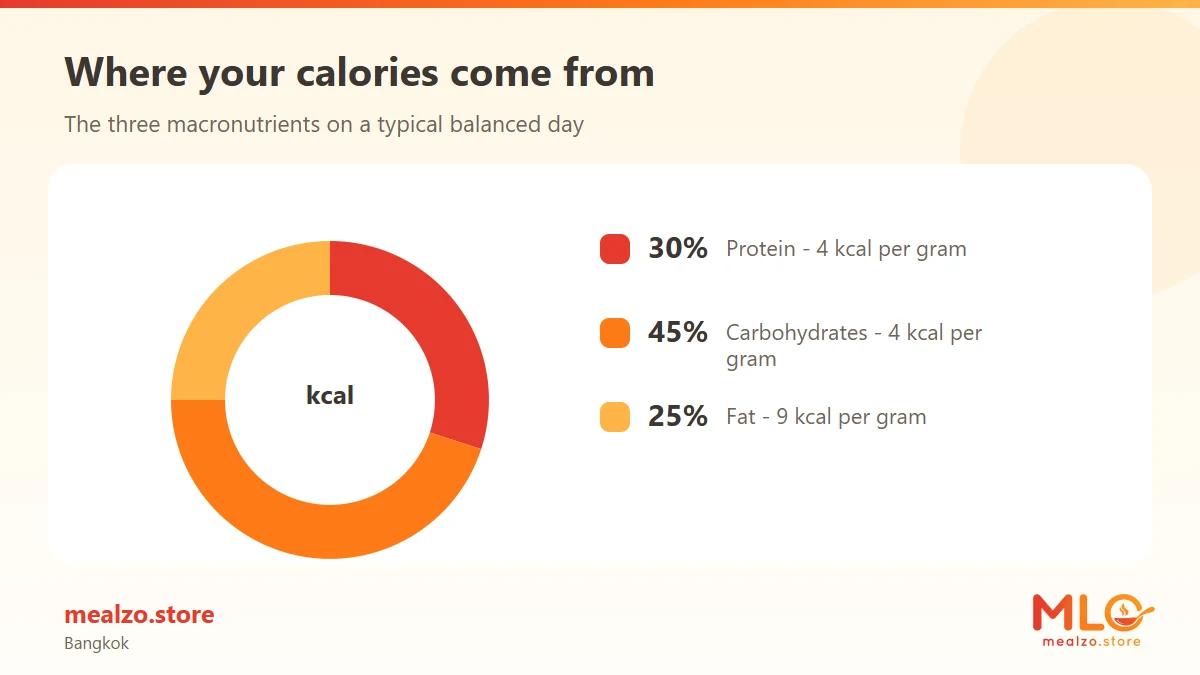
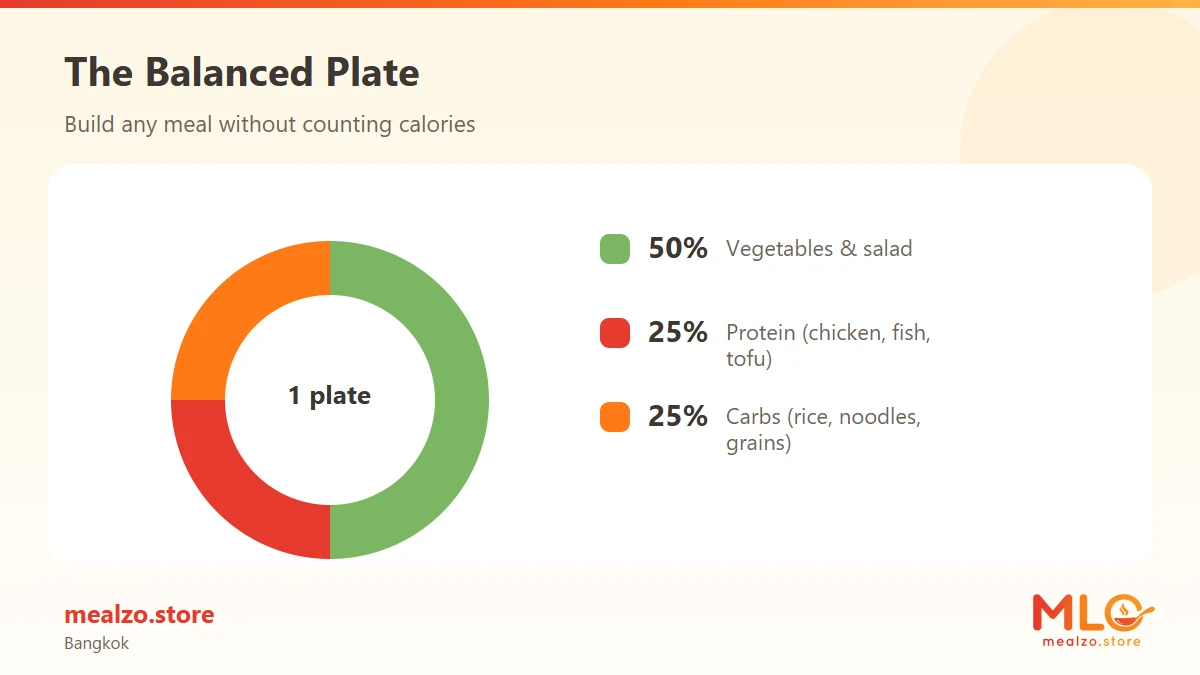
The Balanced Plate Method Is Useful, but It Is Not a Law
One simple way to stop overthinking meals is to build the plate visually.
You might start with:
- a clear protein component,
- vegetables,
- a controlled carbohydrate portion,
- and fat coming naturally from ingredients or cooking.
This works because it creates structure without requiring you to weigh every gram. For a more detailed visual framework, see how to build a balanced plate.
But the plate method has limits. A noodle soup does not divide neatly into sections. Neither does curry, fried rice or a mixed bowl.
That does not make those meals unbalanced.
For mixed dishes, look at what is actually inside. How much protein is there? How large is the rice or noodle portion? Are there vegetables? How oily is the dish? Is the sauce light or energy-dense?
That is more useful than trying to force every cuisine into the same visual template.
Variety Matters More Across the Week Than Within One Meal
Key takeaway: The best calorie level is one that fits your usual appetite, activity and goal rather than an arbitrary number.
Trying to include every possible food group in every meal makes planning exhausting. A better approach is to think in rotations.
If Monday lunch uses chicken, Tuesday might use fish, Wednesday tofu, Thursday chicken again and Friday eggs, legumes or another fish dish. The point is not to avoid repetition completely. It is to avoid building the whole week around one protein, one vegetable and one cooking method simply because they are easy to track.
The same applies to carbohydrates. Jasmine rice may appear several times a week, especially in Bangkok, but it does not have to be the only option. Potatoes, noodles, oats, bread, fruit or other grains can create variety without changing the basic structure.
Flavour matters too. Chicken with Thai basil tastes very different from grilled chicken with herbs, chicken in a light curry or chicken served with roasted vegetables. That matters because a meal plan has to compete with real food. If every planned meal feels like a compromise while restaurants, food courts and street vendors surround you with more appealing options, the plan will become harder to follow.
A good plan should be enjoyable enough that it does not feel like a daily exercise in saying no.
The Most Common Mistakes in a Balanced Meal Plan
Most problems do not come from misunderstanding protein or carbohydrates. They come from taking a reasonable idea too far.
Mistake 1: Treating “balanced” as another word for low-calorie
A balanced meal is not automatically a small meal.
Someone who needs more energy can eat a balanced 2,200- or 2,500-calorie plan. Someone with lower requirements may use 1,200 or 1,500 calories. The structure can stay similar while portions change.
This distinction matters because people often cut food aggressively and then call the result “healthy” because there are vegetables on the plate. A tiny lunch that leaves you extremely hungry two hours later is not necessarily a useful meal just because it looks clean.
Mistake 2: Focusing on protein and forgetting everything else
Protein gets enormous attention in fitness and nutrition content, but a plan made mostly from protein shakes, chicken breast and a few convenient snacks is not automatically balanced because the protein target was reached.
Vegetables, fruit, carbohydrate sources, fats and variety still matter. Macros provide structure; they do not replace the rest of nutrition.
Mistake 3: Eliminating carbohydrates without a reason
Rice is often one of the first foods removed when somebody decides to improve their diet.
For many people, that makes everyday eating harder for no useful reason. Bangkok is full of meals built around rice and noodles, so trying to avoid them entirely can turn ordinary social meals into unnecessary negotiations.
Instead of asking, “Can I eat rice?”, ask, “How much rice fits this meal and the rest of my day?”
Mistake 4: Ignoring cooking oil and sauces
This is especially relevant when eating outside.
A meal can contain chicken, vegetables and rice and still be much more energy-dense than expected if a large amount of oil or sauce was used. That is not a reason to fear restaurant food. It simply means visible ingredients are not the whole story.
When prepared meals are a regular part of the week, consistency in preparation can make calorie planning easier than repeatedly estimating unknown portions.
Mistake 5: Building the diet around “healthy” snacks
Nuts, protein bars, smoothies, yoghurt and fruit can all fit into a balanced plan, but snacks can quietly become an extra meal.
A few nuts at the desk, an iced coffee later, fruit on the way home and something from 7-Eleven before dinner may feel small individually. Together, they can materially change the day.
Planned snacks are usually easier to manage than continuous grazing.
Mistake 6: Making the plan too repetitive
There is a difference between consistency and monotony.
Repeating a few reliable meals can be useful. Eating the exact same combination twice a day for weeks is different.
Food boredom is one reason carefully prepared diets fall apart. People do not suddenly stop caring about eating well; they simply become tired of the same meal.
A better plan builds in some controlled variety from the start.
Mistake 7: Making the plan too complicated
The opposite problem is just as common. People collect recipes, calculate everything, build elaborate shopping lists and decide that every day needs completely different meals.
The plan becomes another job.
If dinner needs 20 ingredients and an hour of preparation after a long workday, the nutrition may look excellent on paper but the system itself is weak.
A balanced meal plan should simplify decisions, not multiply them.
Mistake 8: Assuming one bad meal ruins the day
Lunch ran late. Someone ordered pizza for the office. You had dessert. Dinner was heavier than expected.
None of that means you need to abandon the plan until Monday.
The next meal can simply return to the normal structure. People often create more damage by reacting dramatically to one imperfect meal than by the meal itself.
The useful skill is not avoiding every deviation. It is returning to the usual pattern quickly.
the benefits of balanced meals every day are better understood as the result of regular habits than perfect compliance.
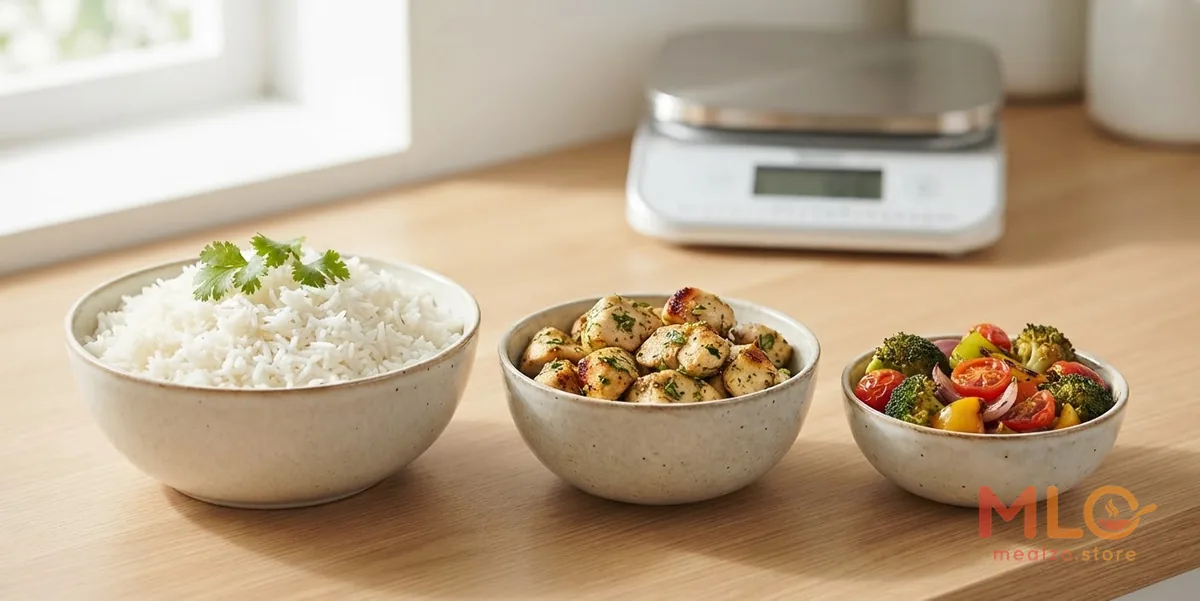
Thai Food Can Fit a Balanced Meal Plan
| Element | What to look for | Why it matters |
|---|---|---|
| Protein at every meal | A clear protein source | Supports fullness and meal structure |
| Vegetable volume | Vegetables across the day | Adds volume, fibre and variety |
| Carb quality | Mostly minimally processed sources | Provides useful everyday energy |
| Fat sources | Sensible portions of quality fats | Adds flavour and meal satisfaction |
| Meal variety | Different ingredients and dishes | Helps prevent menu fatigue |
| Portion consistency | Similar portions for similar meals | Makes intake easier to predict |
A balanced diet in Bangkok should not require you to eat as if you live somewhere else.
Thai food already gives you plenty of useful building blocks: rice, eggs, chicken, fish, tofu, vegetables, herbs, fruit, soups and stir-fries.
The challenge is usually not “Thai food” itself. It is portion size, cooking method and the composition of the complete meal.
Take pad kra pao. Depending on how it is prepared, the meal may include a large amount of rice, meat, oil, sauce and a fried egg. That does not automatically make it unsuitable. A sensible rice portion, a meaningful protein serving and vegetables either in the dish or alongside it can create a much more balanced meal.
The same logic applies to noodles. A large portion with very little protein and almost no vegetables is different from a more complete bowl.
Sauces and cooking oil are harder to judge when food is prepared outside the home. Street-food vendors are cooking for taste and speed, not your personal calorie target. That does not mean street food has to disappear from your life. It simply means the portions and ingredients are less predictable.
If most of your weekly meals are structured, an occasional less predictable meal is much easier to accommodate than trying to calculate every street-food dish with laboratory precision.
International Food Can Be Balanced Too
“Balanced” is sometimes mistaken for bland Western diet food: grilled chicken, broccoli and brown rice.
There is no reason for that.
International meals can include pasta with chicken and vegetables, fish with potatoes, rice bowls, wraps, soups, sandwiches or grain bowls. The same principles apply.
A pasta dish made mostly from pasta and creamy sauce is different from a moderate serving combined with protein and vegetables. A salad made mainly from lettuce may look “healthy” but can be less complete than a rice bowl with chicken, vegetables and a sensible dressing.
Labels are much less useful than looking at the actual meal.
Turning Nutrition Theory Into Something You Can Actually Follow
Key takeaway: Consistency becomes easier when meals are planned, portioned and delivered instead of decided from scratch every day.
Knowing how to build a balanced plate is easy while reading about it. Doing it at 20:30 after meetings, traffic, a BTS ride and a walk through Bangkok heat is different.
That is where nutrition becomes less about knowledge and more about reducing friction.
Start with your real week, not your ideal week
Before planning food, look at your schedule.
Which days are long? Which mornings are rushed? When do you train? Which evenings are usually social? When do you realistically have time to cook?
If Tuesday and Thursday regularly end late, pretending you will cook fresh meals on those nights is not planning. Build around the constraint instead.
You might cook on quieter days, prepare several meals in advance, use prepared meals for part of the week or combine several approaches. There is no prize for doing everything yourself.
Decide where consistency matters most
You do not have to control every meal equally.
For many office workers, breakfast and lunch are the easiest places to create consistency because they happen at predictable times. Dinner can remain more flexible.
For someone who often eats socially in the evening, the opposite may work better.
The useful question is: which meals give you the greatest return from planning?
Create a few default meals
If every lunch involves searching delivery apps for 20 minutes, comparing restaurants and guessing portions while hungry, convenience will eventually win.
A few default structures remove much of that decision-making.
For example:
Default Thai lunch: protein + rice + vegetables.
Default international lunch: chicken, fish or tofu + potatoes, rice or pasta + vegetables.
Default quick breakfast: eggs or yoghurt + a carbohydrate source + fruit.
Default convenience snack: fruit, yoghurt or another deliberately portioned option.
The dishes can change. The structure stays recognisable.
Keep emergency options
Bangkok makes emergency food easy to find, which is useful if you treat it as a backup system instead of a random snack hunt.
If you know you sometimes get stuck at work, have a few acceptable convenience-store combinations in mind. Do the same with food courts or delivery apps.
You do not need hundreds of choices. You need a few reliable ones.
Separate hunger from convenience
Sometimes you are hungry. Sometimes food is simply nearby.
Bangkok provides constant prompts to eat: drinks, snacks, stalls, bakeries, cafés and delivery promotions. A meal plan helps because it gives eating a structure.
If lunch is normally at 12:30 and you have a planned afternoon meal, a snack at 14:00 becomes a conscious choice rather than an automatic reaction. That small difference adds up over time.
Three Meals or Five Meals?
There is no universal meal frequency that makes a diet balanced.
Some people prefer three larger meals. Others do better with five smaller eating occasions. Schedule is usually more useful than abstract rules.
Three meals may work well for someone who likes larger portions, does not enjoy frequent snacking and has predictable meal breaks.
Five may suit somebody who prefers smaller portions, has a long workday, wants planned food around training or simply finds smaller meals easier to manage.
The question is not “Which is healthier?” It is “Which structure can I follow without constantly improvising?”
Choosing a Calorie Level Without Turning It Into Guesswork
Balanced meal plans are often available at different calorie levels because portion requirements vary significantly between people.
Body size matters. Activity matters. Daily routine matters. Training matters. Goals matter.
That is why selecting a calorie level purely because a friend uses it is rarely useful.
A calorie calculator can provide a reasonable starting estimate. calculate your estimated calorie needs
From there, the meal structure can be adjusted. The same basic meal can appear in different calorie plans with different portions or supporting components.
That is far more logical than assuming everyone should eat the same amount because they are following the same general style of diet.
Where a Structured Meal Service Can Help
For some people, understanding balanced nutrition solves the problem. They learn a few meal patterns, cook regularly and settle into a routine.
For others, the main obstacle was never knowing what protein or carbohydrates are. It was time.
Planning several days of meals involves much more than cooking. You have to decide what to eat, buy ingredients, store them, prepare them, portion them, clean up and then repeat the process.
That can work very well if you enjoy it. It can also be the first thing abandoned during a busy week.
A subscription meal plan can therefore be useful not because it replaces nutrition knowledge, but because it removes repeated decisions.
How the MEALZO Balanced Plan Fits This Framework
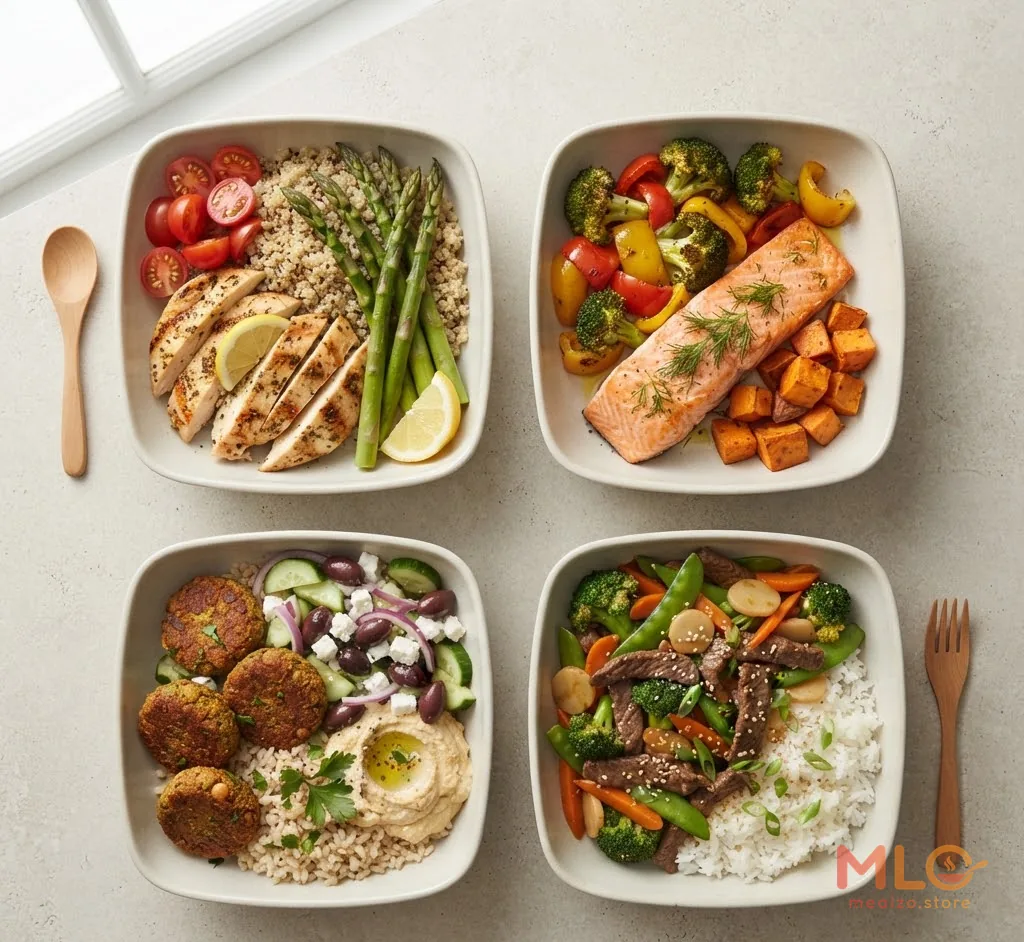
MEALZO includes balanced as one of its 12 available diet plans for delivery in Bangkok.
The plan is available across six calorie levels:
- 1,200 kcal
- 1,500 kcal
- 1,800 kcal
- 2,000 kcal
- 2,200 kcal
- 2,500 kcal
Customers can choose 3 or 5 meals per day and packages lasting 3, 7, 14 or 30 days.
Cuisine can be selected as:
- Thai
- international
- mixed
The menu itself is arranged by an algorithm, so the service is structured around a plan rather than asking customers to browse an à-la-carte marketplace and choose every dish individually.
For someone who understands the basics of balanced eating but does not want to keep planning meals throughout the week, that can remove a lot of daily decision-making. It also allows different people to use the same broad balanced approach while choosing a calorie level and meal frequency that better fit their routine.
The balanced option is only one of the available diet types. People with different preferences may choose another plan instead.
You can compare the available options here: explore MEALZO diet plans.
Using prepared meals does not make the nutrition principles disappear. It still helps to understand why calorie level matters, what macros are doing and why food variety matters. The service simply handles more of the execution.
A Practical Weekly Check
You do not need a complicated scoring system to work out whether your plan is functioning.
After several normal days, ask yourself a few simple questions.
Are my portions broadly consistent with my calorie needs?
If you are constantly hungry, constantly overfull or regularly adding large amounts of unplanned food, the structure may need adjusting.
Do my main meals contain a clear protein source?
You should usually be able to identify it without searching the plate.
Am I eating vegetables and fruit regularly?
Not every possible type every day. Regularly.
Is there variety across the week?
Look at protein sources, vegetables, carbohydrate sources and cuisine. If every day is almost identical, rotate a few components rather than rebuilding the entire plan.
Are sauces, drinks and snacks changing the plan more than I realise?
This is one of the easiest places for intake to drift without attracting much attention.
Does the plan survive busy days?
This may be the most important question.
If your eating structure only works on quiet weekends, it is not yet a useful weekday system.
Balanced Eating Should Make Life Simpler
The purpose of a balanced meal plan is not to turn food into another source of stress.
You do not need a perfect plate at every meal, you do not need to remove rice, and you do not need to calculate every gram forever. You also do not need to eat the same chicken and vegetables seven days a week.
What you need is a structure that makes the important decisions easier: enough food for your needs, a sensible balance of protein, carbohydrates and fat, regular vegetables and fruit, enough variety across the week, portions that make sense, and a practical way to keep doing it when work runs late and cooking is the last thing you want to think about.
That is the difference between understanding balanced nutrition and actually living with it.
Frequently Asked Questions
Does every meal have to contain protein, carbohydrates and fat?
Not in identical proportions. The overall day matters more than forcing every plate into the same formula. In practice, however, giving main meals a clear protein source, an appropriate carbohydrate portion and some vegetables creates a useful default.
Can Thai food be part of a balanced meal plan?
Yes. Rice, noodles, fish, chicken, tofu, eggs, vegetables, soups and many other common Thai foods can fit. Portion size, preparation method and the overall composition of the meal matter more than whether it is Thai or international.
Is a balanced meal plan only for people trying to lose weight?
No. “Balanced” describes the structure of eating, not one specific calorie goal. The same general principles can be used at different calorie levels.
Do I need to track macros?
Not everyone needs to track them precisely. Understanding macros can help you recognise how meals are structured, even if you later use portions and repeatable meal patterns instead of weighing ingredients. If you want to go deeper, learn how macro ratios change by goal.
Why does food variety matter if calories and macros are correct?
Because calories and macros do not describe the entire diet. Different foods contribute different micronutrients, fibre, flavours and textures, and variety also makes a plan easier to live with over time. understand the difference between macros and micronutrients
Frequently Asked Questions
How do I pick the right calorie level?
Start with your usual food intake, activity level, appetite and whether your goal is to reduce, maintain or increase your overall intake. Choose a practical starting point rather than chasing perfect precision. Individual needs vary, so the plan can be adjusted if the portions consistently feel too small or too large.
Is it better to eat 3 or 5 meals a day?
Neither option is automatically better. Three meals can suit people who prefer larger meals and fewer eating occasions, while five meals can spread the same daily intake across smaller portions. MEALZO offers both 3-meal and 5-meal plan formats so customers can choose the structure that fits their routine.
Does meal variety really matter when following a plan?
Yes, especially over several weeks. Repeating the same few dishes can make a structured plan harder to enjoy, even when the nutrition is well designed. Variety in proteins, vegetables, carbohydrates and flavours makes the routine easier to maintain.
Can I adjust my meal plan over time?
Yes. Your preferred calorie level, meal frequency or diet style may change as your routine and goals change. A structured plan should be practical enough to adapt rather than forcing you to stay with a setup that no longer fits.
Are weight-loss meal plans different from maintenance plans?
The main difference is usually the total calorie target rather than a completely different approach to balanced eating. Both should still include sensible portions, protein, vegetables, quality carbohydrate sources, fats and variety. MEALZO offers calorie-controlled plans across different diet preferences and calorie levels.
How does meal delivery help keep a plan consistent in Bangkok?
Bangkok makes it easy to eat spontaneously, but that can also make portions and daily intake unpredictable. MEALZO delivers chef-prepared, portioned meals in Bangkok according to the selected plan, reducing the number of food decisions needed during the day. That makes it easier to follow the same structure through busy workdays, commuting and changing schedules.
Find a Meal Plan That Fits
Compare Mealzo plans or use the calculator to explore meal options for your needs.