How to Build a Balanced Plate Without Counting Every Gram
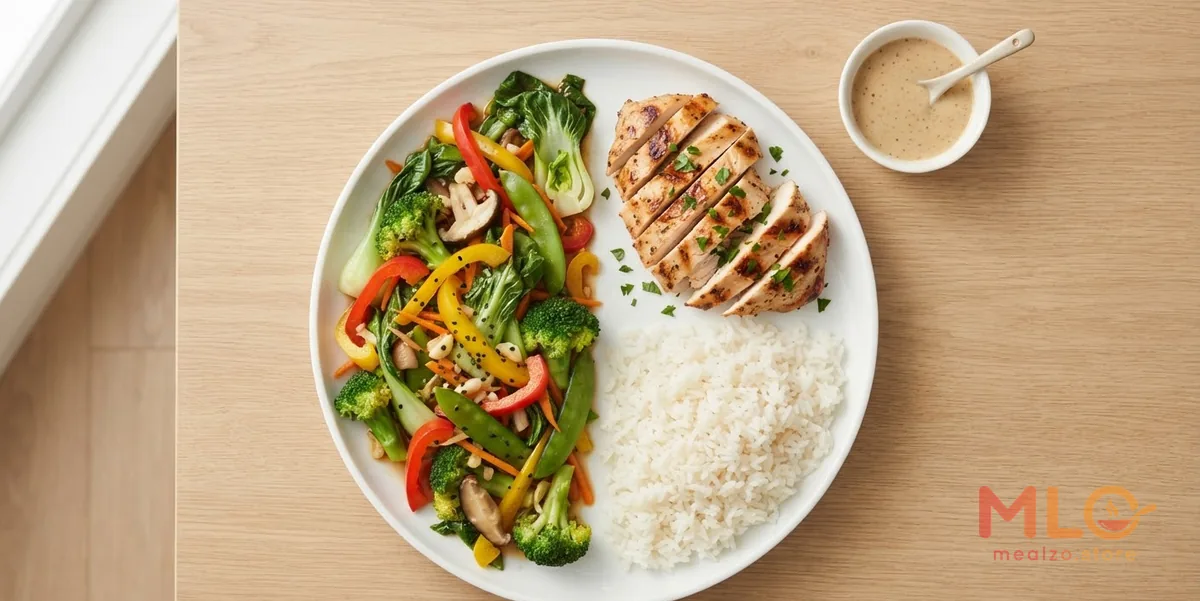
Eating well sounds simple until someone tells you to weigh 137 grams of chicken, measure 82 grams of cooked rice and calculate exactly how much oil went into the pan.
For most people in Bangkok, that is not how lunch works.
You might be eating between meetings, grabbing something from a food court near the BTS, ordering a curry from a neighbourhood restaurant or opening a takeaway box at your desk. You usually do not know precisely how much oil, rice or sauce went into the meal.
Fortunately, you do not need laboratory-level accuracy to build a more balanced plate.
Learning how to build a balanced plate is mostly about recognising proportions: enough protein, plenty of vegetables, an appropriate amount of carbohydrate and some fat. Once you understand what those parts look like, you can make better decisions without carrying a kitchen scale everywhere you go.
This guide shows you how to do it in everyday Bangkok life, including Thai food, international meals, food courts, noodle shops and mixed dishes where the ingredients are not conveniently separated into four perfect sections.
What Does a Balanced Plate Actually Mean?
A balanced plate is not one specific meal and it does not require every meal to contain an identical percentage of nutrients.
It is a practical visual framework.
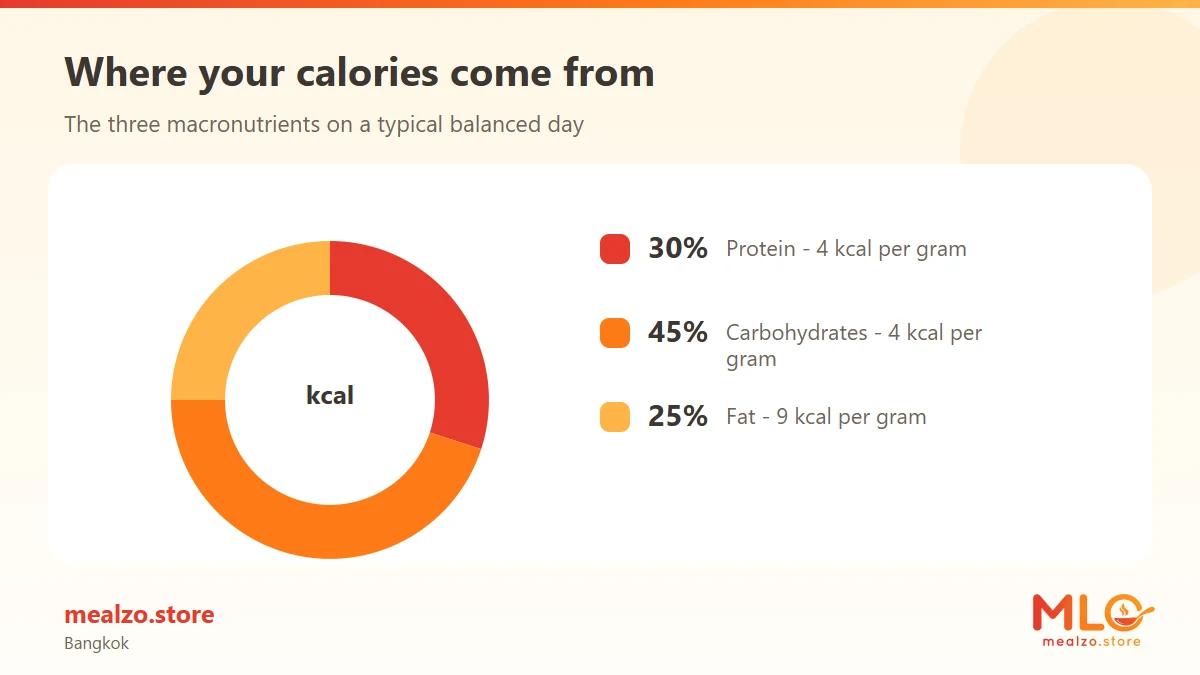
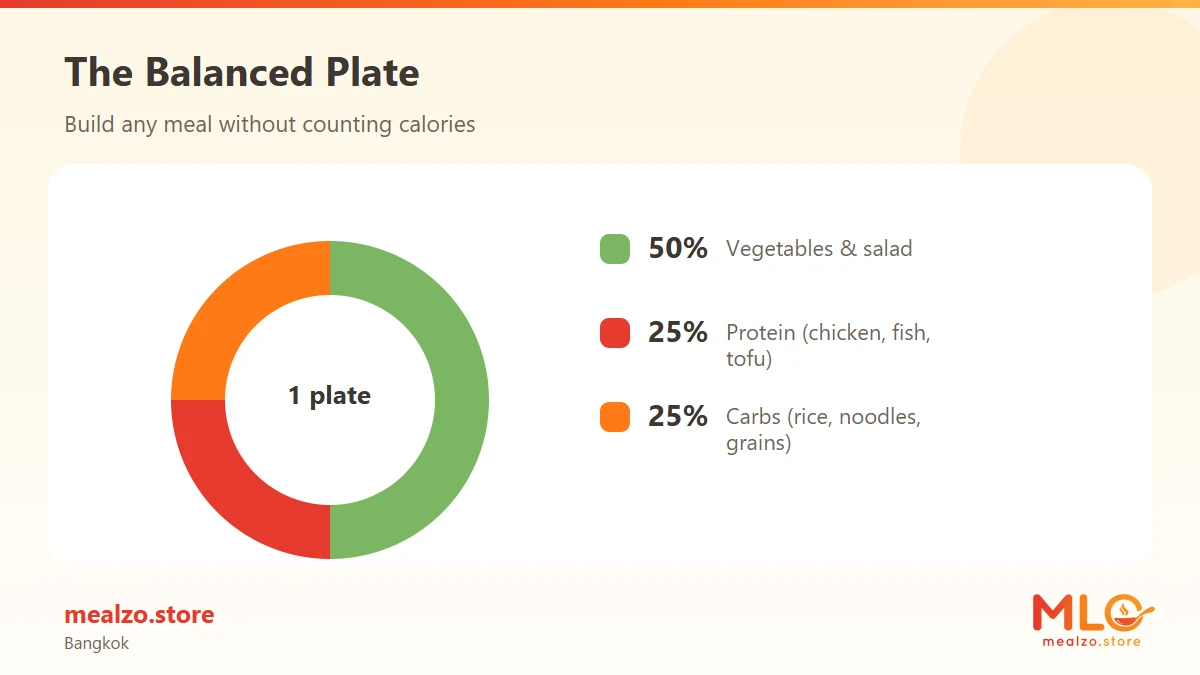
A useful starting point for many everyday meals is:
- roughly half the plate vegetables
- roughly one quarter protein
- roughly one quarter carbohydrate
- a moderate amount of dietary fat
That does not mean you need to arrange every lunch like a diagram.
The principle matters more than the geometry.
A chicken rice bowl, green curry, pasta dish or noodle soup can still be balanced even though the protein, vegetables, carbohydrate and fat are mixed together.
Think of the plate method as a way to answer four basic questions:
Where is my protein?
Where are my vegetables?
Where is my main carbohydrate source?
How much added fat, sauce or dressing is involved?
If one of those categories completely dominates the meal, the balance probably needs adjusting.
For a broader look at how these pieces fit into an overall eating pattern, see what a balanced eating plan looks like.
Start With Protein, Then Build Around It
Key takeaway: A simple starting point is half the plate vegetables, one quarter protein and one quarter carbohydrates.
One of the easiest ways to improve a meal is to identify the protein first.
Protein sources might include:
- chicken
- fish
- prawns or other seafood
- eggs
- tofu
- tempeh
- beans and legumes
- lean beef or pork
- Greek-style yoghurt or other dairy foods
- suitable plant-based alternatives
In Bangkok, this could mean grilled chicken with rice, tofu in a vegetable stir-fry, fish with jasmine rice, eggs in a breakfast bowl or prawns added to a noodle dish.
A practical portion does not have to be weighed.
Use Your Palm as a Rough Guide
Your palm provides a simple visual reference.
A piece of chicken, fish or tofu roughly around the size and thickness of your palm is an easy starting point for a main meal.
People with higher energy requirements, larger body size or higher activity levels may naturally need more. A smaller person or someone eating five times during the day may use smaller portions.
The goal is not to turn your hand into another precision measuring instrument.
It is simply a reference that works when there is no scale available.
Protein also makes a meal feel more complete. A plate of vegetables and rice may look colourful, but without a meaningful protein component it is structurally different from a meal containing rice, vegetables and chicken, fish, tofu or another protein source.
Make Vegetables Visible
Vegetables are often the first thing to disappear when convenience becomes the priority.
This happens easily in Bangkok.
A plate of pad kra pao may arrive with plenty of rice and meat but only a few basil leaves. Fried rice may contain a spoonful of diced carrot and onion, which technically means there are vegetables in the dish, but not necessarily enough to make them a major part of the meal.
When thinking about how to build a balanced plate, ask whether vegetables are actually visible.
Ideally, they should occupy a substantial part of the meal rather than appearing as decoration.
Examples that work well include:
- stir-fried morning glory
- mixed vegetables
- broccoli
- cabbage
- mushrooms
- green beans
- cucumber
- tomato
- leafy greens
- carrots
- peppers
- pumpkin
- aubergine
- fresh herbs and salad vegetables
You do not need exactly six varieties at every meal.
Even adding one proper vegetable side dish to a rice-and-protein meal can change the overall composition considerably.
The Fist Method
A closed fist is another useful visual tool.
One or two fist-sized portions of vegetables is a straightforward target for many main meals.
Again, this is deliberately approximate.
The purpose is to stop vegetables from becoming the tiny green garnish sitting beside a mountain of rice.
Carbohydrates Are Part of the Plate, Not the Enemy
| Meal | Vegetables | Protein | Carbs | Example |
|---|---|---|---|---|
| Breakfast | 1/3 plate | 1/3 plate | 1/3 plate | Veggie omelet with brown rice |
| Lunch | 1/2 plate | 1/4 plate | 1/4 plate | Basil chicken with rice |
| Dinner | 1/2 plate | 1/4 plate | 1/4 plate | Grilled fish with vegetables |
| Post-workout meal | 1/3 plate | 1/3 plate | 1/3 plate | Chicken rice with stir-fried greens |
Rice is everywhere in Bangkok for a reason.
It is convenient, familiar, versatile and works with almost every style of Thai meal.
Carbohydrates also include noodles, potatoes, bread, oats, pasta, fruit and grains. They provide energy and can absolutely be part of a balanced eating pattern.
The common problem is not that a meal contains carbohydrates.
The problem is proportion.
At a food court, it is easy to receive a plate that is mostly jasmine rice with a relatively small spoonful of protein and vegetables on top. A large noodle dish can have the same issue: plenty of noodles, a few slices of meat and almost no vegetables.
A simple visual approach is to keep the main starch around one quarter of the plate as a starting point.
For rice, a portion roughly comparable to one cupped hand can be a useful reference. Requirements differ between people, so treat this as a visual guide rather than a rule.
If you are especially active, you may want more carbohydrate. On a quieter office day, you may naturally choose less.
There is no need to categorise rice, noodles or bread as “good” or “bad.” They are components of a meal.
Balance depends on what surrounds them.
Fat Is Easy to Miss Because You Cannot Always See It
Fat is different from rice or vegetables because much of it may be invisible.
The chicken is visible.
The rice is visible.
The tablespoon or two of cooking oil absorbed into a stir-fry usually is not.
Dietary fat is a normal part of food and has legitimate nutritional functions. The practical issue is that it is energy-dense, so portions can increase quickly when meals contain several sources at once.
For example:
fried chicken + oily stir-fry + creamy dressing + nuts
can contain considerably more fat than:
grilled chicken + vegetables + rice + a small amount of dressing.
Thai food creates similar situations.
Coconut milk adds richness to curries. Cooking oil is common in stir-fried dishes. Fried garlic, crispy toppings, peanuts and sauces can all contribute additional fat.
None of these ingredients needs to be automatically avoided.
Just notice when several of them appear in the same meal.
A simple thumb-sized portion is sometimes used as a rough visual reference for concentrated fats such as nut butter or dressing. With restaurant cooking, where oil cannot be measured, the more useful skill is simply recognising whether the dish appears lightly cooked, heavily fried or swimming in sauce.
How to Balance Mixed Dishes
Key takeaway: Thai meals can fit the plate method by keeping rice portions moderate and adding more vegetables and protein.
The neat plate diagram becomes less obvious when everything arrives in one bowl.
That is where the method becomes useful rather than restrictive.
Rice Bowls
Imagine a bowl containing rice, grilled chicken, vegetables and sauce.
Instead of asking whether the ingredients are physically separated, estimate the overall ratio.
If almost the entire bowl is rice, with four small pieces of chicken and a few vegetables, the balance is tilted heavily toward carbohydrate.
You could improve it by:
- asking for less rice
- adding extra vegetables
- choosing a larger protein portion
- using some of the sauce rather than automatically pouring in all of it
The same logic works for poke-style bowls, Korean bowls, burrito bowls and Thai rice dishes.
Curry With Rice
Thai curries are more complicated because protein, vegetables, coconut milk and sauce are combined.
Take green curry as an example.
The rice provides the main carbohydrate.
Chicken, tofu or another main ingredient provides protein.
Aubergine and other vegetables contribute the vegetable portion.
The coconut-based curry provides fat as well as flavour.
To make the meal feel more balanced, the answer is not necessarily to remove the curry. It may simply mean choosing a reasonable amount of rice and making sure the curry contains enough protein and vegetables.
If the curry is mostly sauce, consider adding vegetables on the side.
Fried Rice
Fried rice combines starch, protein, vegetables, oil and seasonings in one pan.
The most common issue is that rice remains overwhelmingly dominant.
Look for versions with a meaningful amount of egg, chicken, prawns or tofu and visible vegetables.
If the serving is large, you do not have to finish every grain simply because it was served.
A side of cucumber, vegetables or a separate vegetable dish also helps.
Noodle Soup
Noodle soup can be surprisingly easy to assess.
Ask:
How much of the bowl is noodles?
How much protein is included?
Are there vegetables, bean sprouts or greens?
Is the broth relatively light, or are there rich additions and fried toppings?
A balanced bowl might include noodles, sliced chicken or pork, vegetables, bean sprouts and herbs.
If the standard portion is mainly noodles and broth, you can often add protein or vegetables instead of ordering another serving of noodles.
Your Hand Is More Useful Than a Food Scale at Lunch
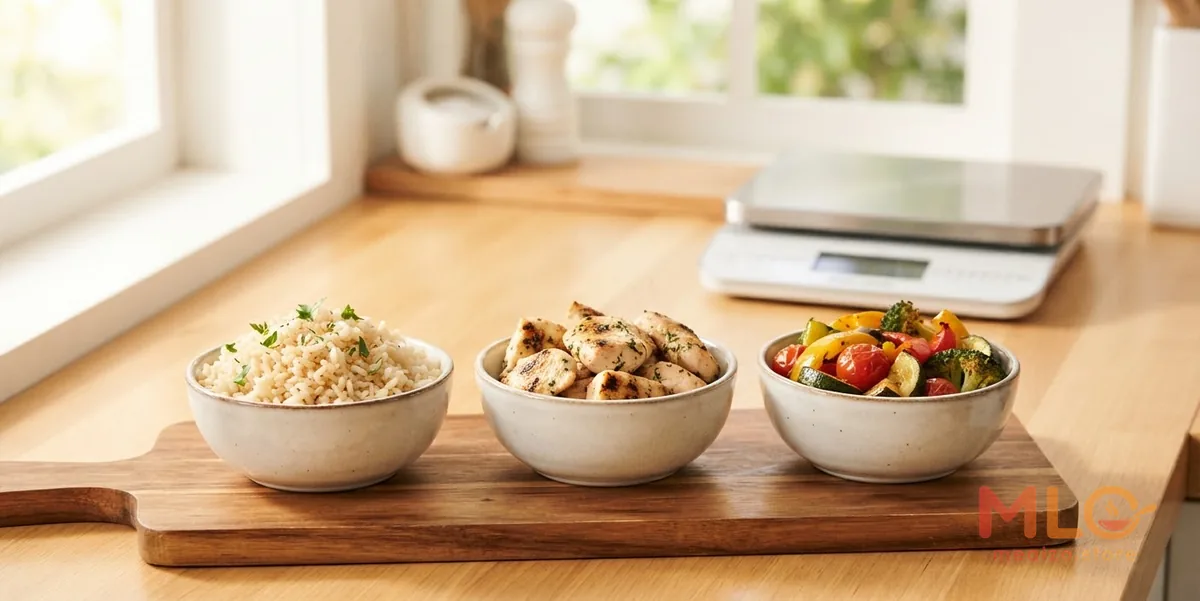
For everyday meals, a simple hand-based system is usually easier to maintain than weighing everything.
A practical visual framework is:
Protein: approximately one palm
Vegetables: approximately one or two fists
Carbohydrate: approximately one cupped hand
Concentrated fats: approximately one thumb
These are not universal prescriptions.
Your needs depend on your body size, activity, goals, appetite and how many meals you eat during the day.
That flexibility is the point.
If you walk extensively, train after work or have a particularly active day, you may want more food. If you spend most of the day at a desk and eat several meals, your portions may look different.
Balanced nutrition works better when you understand the structure instead of trying to hit an identical number at every lunch.
If you want to understand the difference between the nutrients that provide energy and the vitamins and minerals required in smaller quantities, see macros vs micronutrients explained.
What a Balanced Plate Can Look Like in Bangkok
| Common mistake | Why it matters | Simple fix |
|---|---|---|
| Too little vegetables | Less volume, fiber and variety | Fill about half the plate |
| Oversized carb portion | Carbs can crowd out other foods | Keep carbs around 1/4 plate |
| Low protein at breakfast | The meal may feel less substantial | Add eggs, tofu or lean protein |
| Hidden cooking oil | Extra oil can add calories quickly | Use measured amounts when cooking |
| Drinking calories | Drinks may add energy without much fullness | Choose water or unsweetened drinks |
| Skipping meals then overeating | Extreme hunger can make portions harder to manage | Eat regular balanced meals |
Theory becomes much easier when you attach it to actual food.
Thai-Style Example
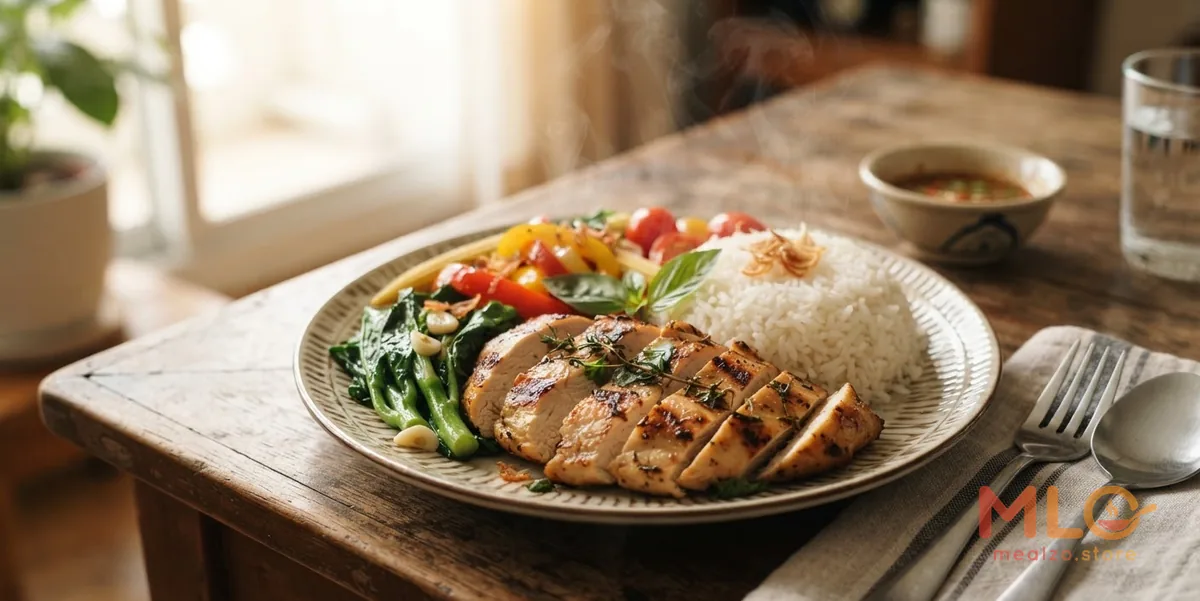
Grilled chicken
Jasmine rice
Som tam or mixed vegetables
A small amount of dressing or sauce
Here, the chicken is the protein, rice is the main carbohydrate, vegetables take up a meaningful part of the meal, and sauce contributes flavour without becoming the entire meal.
Food Court Example
Suppose you are ordering from a rice counter.
Instead of choosing rice plus two fried meat dishes, you might choose:
rice
one grilled or stir-fried protein
one vegetable dish
This is not about creating a “perfect” lunch. It is simply a more balanced composition.
International Example
Grilled salmon
Roasted potatoes
Large mixed salad
Olive oil-based dressing
The same plate principle works even though nothing about the meal is Thai.
Office Lunch Example
Chicken or tofu wrap
Side salad
Fruit
This is another version of the same structure: protein, carbohydrate, vegetables and a moderate fat source.
The format changes.
The underlying logic does not.
The Most Common Balanced-Plate Mistakes
Most mistakes are not caused by choosing one forbidden ingredient. They happen because proportions drift.
Mistake 1: The Meal Is Mostly Rice or Noodles
A huge rice portion with a small amount of chicken is still essentially a rice-dominant meal.
Instead of removing the rice entirely, rebalance the plate by increasing protein and vegetables or reducing the starch portion.
Mistake 2: Vegetables Become Decoration
Three slices of cucumber do not suddenly make a plate vegetable-rich.
Look for vegetables in quantities large enough to matter.
This is particularly useful when eating fried rice, noodle dishes or rice topped with meat.
Mistake 3: Sauce Is Treated as Free
Sauce can contain oil, sugar, coconut milk or other concentrated ingredients.
You do not need to eat everything dry.
Just remember that flavourings contribute to the overall meal too.
If a restaurant serves a large amount of sauce separately, start with less and add more if you actually need it.
Mistake 4: Several Rich Ingredients Stack Up
A meal might contain fried meat, creamy dressing, cheese, nuts and an oily side dish.
Individually, each ingredient can fit into normal eating.
Together, they can completely change the character of the meal.
Mistake 5: Healthy-Looking Automatically Means Balanced
A salad is not automatically balanced.
A bowl made entirely of lettuce, cucumber and tomato may have plenty of vegetables but almost no protein or carbohydrate.
Likewise, a smoothie bowl covered in fruit and granola can look healthy while being heavily weighted toward carbohydrate.
Judge the structure, not the marketing label.
For more context on why meal composition matters beyond individual ingredients, read benefits of balanced meals.
How to Eat More Balanced Meals at Bangkok Food Courts
Key takeaway: Consistent portions and meal structure usually matter more than making every plate mathematically perfect.
Food courts are useful because you can often see the food before ordering.
Use that advantage.
Before choosing a dish, scan the counter for:
- a clear protein source
- a vegetable option
- a reasonable rice or noodle portion
- dishes that are not all fried or heavily sauced
At Thai curry-and-rice counters, selecting one protein dish and one vegetable dish over rice is often a straightforward way to create better balance.
At made-to-order stalls, you may be able to ask for extra vegetables or slightly less rice.
At noodle stalls, adding vegetables, egg or meat can help if the standard bowl is mainly noodles.
You do not have to turn lunchtime into an interrogation of the vendor.
Simply recognising what is missing is already useful.
What About 7-Eleven and Convenience Food?
Bangkok life sometimes means a proper food court is not available.
You may have ten minutes before getting back on the BTS or need something quickly between meetings.
Convenience-store food can still be assembled using the same framework.
Rather than looking for one magical “balanced” packaged meal, combine components.
For example, you might look for:
- a protein-containing main item
- a vegetable or salad option
- fruit
- an appropriate carbohydrate source
The exact available products will vary, so focus on categories rather than specific branded items.
The biggest mistake is buying several snack foods and expecting them to somehow become a complete meal.
A sweet drink, pastry and bag of crisps may provide plenty of energy, but they do not follow the same structure as a meal containing protein, vegetables and a more substantial carbohydrate source.
Bangkok Heat Can Change What You Actually Want to Eat
Bangkok's heat also affects food choices in very practical ways.
After walking outside at midday, you may have little interest in a huge fried meal covered in heavy sauce.
Lighter meals can feel easier: grilled protein, rice, fresh vegetables, fruit or broth-based dishes.
At the same time, hot weather can push people toward iced drinks and sweet beverages throughout the day.
Those drinks are easy to overlook because they are not sitting on the plate.
The balanced-plate method focuses on meals, but your overall eating pattern also includes drinks, snacks and extras.
There is no need for perfection.
Just notice them.
Balance Across the Day Matters Too
Not every meal needs identical proportions.
Breakfast may contain more fruit and grains.
Lunch may be built around rice, protein and vegetables.
Dinner may contain fewer carbohydrates and more vegetables, or the opposite if you trained after work.
What matters is the overall pattern.
This is especially relevant if you eat three meals a day versus five smaller meals. Individual portions naturally change depending on meal frequency.
Balanced eating should reduce unnecessary decision-making, not create more of it.
For people who avoid meat, dairy or other food groups, the same principle still applies, but the food sources change. You can explore balanced vegetarian vegan and pescatarian meals for more examples.
When Meal Planning Becomes the Hardest Part
Knowing how to build a balanced plate is one thing.
Doing it every day in Bangkok is another.
You can understand protein, carbohydrates, vegetables and fats perfectly and still end up ordering whatever is fastest because a meeting runs late, traffic is heavy or you simply do not want to decide what to eat again.
This is where structured meal planning can become useful.
MEALZO is a subscription meal service delivering in Bangkok. Its meal planning system includes 12 diet options: balanced, weight_loss, high_protein, vegetarian, vegan, keto, low_carb, gluten_free, easy_digest, pescatarian, no_fish_seafood and dairy_egg_free.
Available energy levels are 1200, 1500, 1800, 2000, 2200 and 2500 kcal, with 3 or 5 meals per day and subscription packages lasting 3, 7, 14 or 30 days.
Menus can be based on Thai, international or mixed food styles, while the menu algorithm organises meals within the selected plan.
The point is not that everyone needs a meal subscription.
It is that people who already understand balanced eating sometimes struggle with the daily logistics of shopping, choosing, portioning and preparing food.
For those who prefer a more structured approach, you can explore MEALZO meal plans in Bangkok.
A Balanced Plate Does Not Need to Be Perfect
The most useful thing about the plate method is that it works in imperfect situations.
You can use it at home.
You can use it at a Bangkok food court.
You can use it with Thai curry.
You can use it with pasta.
You can use it while ordering delivery to the office.
You can even use it while standing in 7-Eleven trying to assemble lunch before your next meeting.
Instead of counting every gram, look at the structure.
Do you have a real protein source?
Are vegetables taking up meaningful space?
Is the carbohydrate portion reasonable for the rest of the meal?
Are oils, sauces and rich toppings supporting the meal rather than dominating it?
If the answers are mostly yes, you are already applying the basic principles of a balanced plate.
And if one meal is not perfectly balanced, nothing has been ruined.
Your next meal is another opportunity to adjust the proportions.
That is far more practical than trying to eat with mathematical precision every day.
**
Frequently Asked Questions
Does the plate method work without weighing food?
Yes. The plate method is designed as a visual portioning approach, so you can build a balanced meal without weighing every ingredient. Using approximate fractions for vegetables, protein and carbohydrates can make everyday meals easier to structure.
How can I adapt the balanced plate to Thai rice-based dishes?
Start with the rice rather than letting it dominate the plate. Aim for roughly one quarter of the meal as rice, add a clear protein portion such as chicken, fish, eggs or tofu, and use vegetables for much of the remaining space. For mixed dishes, you can apply the same proportions across the whole meal rather than separating every ingredient.
What portion sizes should I use for weight loss?
A common starting structure is about half a plate of vegetables, one quarter protein and one quarter carbohydrates. Total portion size still depends on your individual energy needs and the rest of your daily intake. Calorie-controlled meal plans can make consistent portions easier to maintain.
Does fruit count as the vegetable half of the plate?
Not usually. Fruit can be part of a balanced diet, but the vegetable section of the plate is best filled mainly with vegetables. Fruit can be included alongside the meal or as part of breakfast or a snack.
Can I use the plate method for muscle gain?
Yes, but the proportions may need to shift depending on your energy and training needs. A post-workout meal may use a larger protein and carbohydrate share than a standard lunch or dinner while still including vegetables. The plate method is a framework rather than a fixed formula.
Can I use this approach with a delivered meal plan?
Yes. A prepared meal plan can apply the same principles through controlled portions and a structured mix of protein, carbohydrates and vegetables. MEALZO delivers chef-prepared, balanced, calorie-controlled meal plans in Bangkok with flexible plan options, so you can follow a consistent meal structure without assembling every plate yourself.
Find a Meal Plan That Fits
Compare Mealzo plans or use the calculator to explore meal options for your needs.