How Much Protein Do You Need Per Day?

How much protein per day you need depends mainly on your body size, activity level, training, age and overall diet. There is no single gram target that makes sense for everyone.
Protein matters because the body uses amino acids to build and maintain tissues, enzymes, hormones and other structures. But eating more protein is not automatically better. Once basic needs are covered, the useful range depends on what you are asking your diet to support.
For people in Bangkok trying to eat better while still having a normal workday, social life and occasional restaurant meal, the practical question is usually not how to maximise protein. It is how to get enough consistently without turning every meal into a calculation.
A sensible approach starts with an estimated daily range, then divides that amount across ordinary meals. From there, you can adjust according to appetite, training and the rest of your calorie intake.
1. How Much Protein Per Day Does an Adult Need?
A basic protein target for a generally healthy adult is commonly estimated at around 0.8 grams of protein per kilogram of body weight per day.
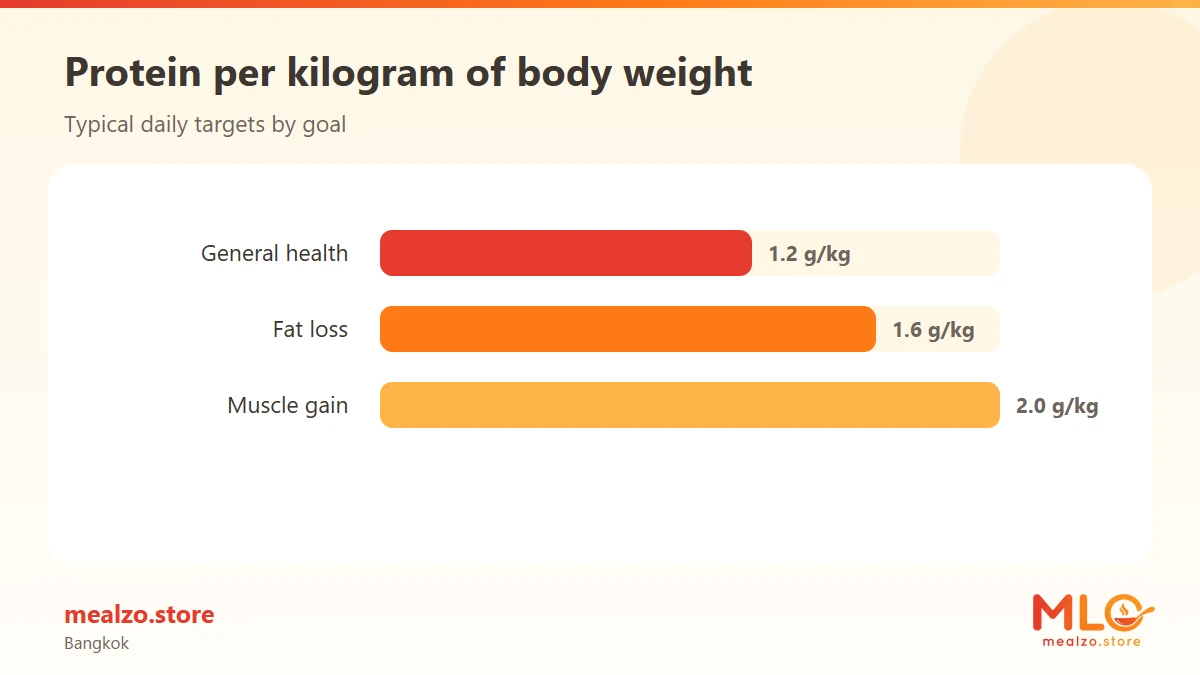
That figure is better understood as a baseline than as an ideal target for every lifestyle. Someone who weighs 70 kg, for example, would reach 56 g per day at 0.8 g/kg. A person who trains regularly, is trying to maintain muscle while eating fewer calories or simply prefers a more protein-focused diet may choose a higher intake.
A practical way to think about protein is therefore in ranges rather than one supposedly perfect number.
| Situation | Practical daily protein range |
|---|---|
| Basic adult needs | Around 0.8 g/kg body weight |
| Regular recreational activity | Roughly 1.0-1.4 g/kg |
| Frequent resistance or demanding training | Roughly 1.4-2.0 g/kg |
| Higher-protein eating pattern | Often toward the upper part of the appropriate range |
These ranges are not prescriptions. Training volume, energy intake, age, food preferences and individual circumstances all matter. People with medical conditions that affect protein intake should follow individual professional advice rather than a general nutrition article.
Key takeaway: Start with protein per kilogram of body weight rather than copying somebody else's daily gram target.
2. Why Does Your Body Need Protein?
Your body needs protein because amino acids are continually used to maintain and replace body tissues and to produce many functional compounds.
Muscle is the most obvious example, but protein is not only a bodybuilding nutrient. Skin, connective tissue, enzymes and many other structures also contain or depend on proteins.
Unlike a supplement-style approach that treats protein as an isolated number, everyday nutrition works as a complete system. Protein shares the plate with carbohydrate, fat, fibre-rich foods and total energy. If those relationships are unfamiliar, this practical guide to protein, fat and carbohydrates explains the three main macronutrients together.
Protein and carbohydrate each provide about 4 kcal per gram, while fat provides about 9 kcal per gram. That matters because a high-protein target still has to fit inside your total daily calorie intake.
For example, adding several protein-heavy foods without changing anything else can raise total calories substantially. In another diet, increasing protein may simply replace some carbohydrate or fat. The result depends on the whole menu, not the protein number alone.
3. How Do You Calculate Your Own Protein Target?
You calculate a starting protein target by multiplying your body weight in kilograms by an appropriate grams-per-kilogram range.
The arithmetic is simple:
Body weight in kg × protein target in g/kg = grams of protein per day
For a 75 kg person:
| Protein level | Calculation | Daily amount |
|---|---|---|
| 0.8 g/kg | 75 × 0.8 | 60 g |
| 1.2 g/kg | 75 × 1.2 | 90 g |
| 1.6 g/kg | 75 × 1.6 | 120 g |
| 2.0 g/kg | 75 × 2.0 | 150 g |
This does not mean a 75 kg person should automatically eat 150 g. The table shows how different targets translate into real numbers.
For somebody who is mostly sedentary, a lower range may be entirely reasonable. Someone lifting weights several times a week may have a reason to choose more. Someone eating within a relatively low calorie budget also needs to make sure protein does not crowd out vegetables, fruit, carbohydrates, fats and other foods they want or need.
If you are first trying to estimate how much energy you eat in a day, Mealzo's calorie calculator for choosing a daily meal-plan level uses the Mifflin-St Jeor equation. It provides an estimate rather than medical advice.
4. Do Active People Need More Protein?
Active people often benefit from more protein than the basic adult minimum because exercise increases the demand for repair and adaptation.
The amount depends heavily on the activity. A person walking around Bangkok and doing two relaxed gym sessions each week is not in the same situation as someone following a demanding resistance-training programme.
Useful questions include:
- How often do you train?
- Is the training mainly resistance, endurance or a mixture?
- How demanding are the sessions?
- Are you currently eating enough total calories?
- Are you trying to maintain, gain or reduce body weight?
- Can you realistically eat the target every day?
People who want a more protein-focused prepared-food option can also compare high-protein meal delivery options in Bangkok rather than trying to rebuild every meal around protein from scratch.
Consistency matters here. A moderate protein target that fits easily into your routine is often more practical than an aggressive number that makes normal meals difficult.
5. How Much Protein Do You Need for Muscle Gain?
Protein for muscle gain should generally sit above basic maintenance needs while resistance training and sufficient overall energy provide the main context for building muscle.
For people doing regular resistance training, commonly used practical ranges extend to roughly 1.4-2.0 g/kg per day. Higher numbers are not automatically more productive, and protein cannot compensate for poor training, inadequate recovery or an overall diet that does not support the person's goal.
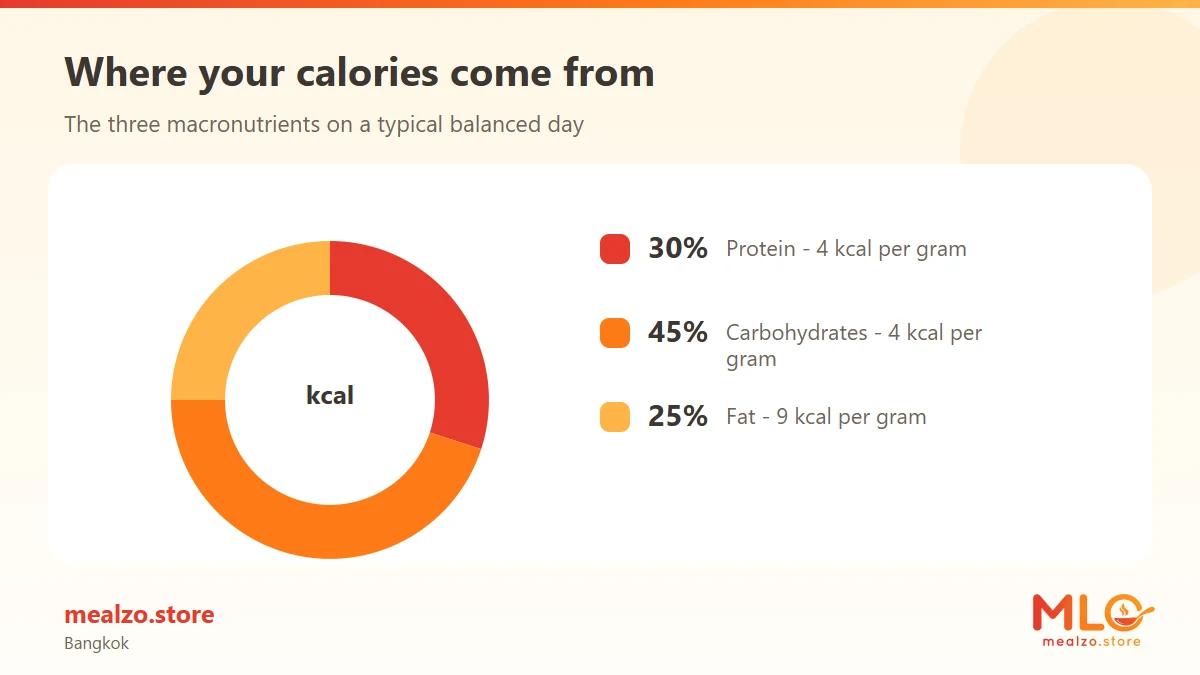
Different goals also change how you distribute calories between protein, carbohydrate and fat. comparing macro ratios for different nutrition goals is useful when protein is only one part of the decision.
A few practical considerations matter more than chasing an exact number:
- Include a meaningful protein source in several meals rather than relying on one very large serving.
- Keep enough carbohydrate available if it helps you train effectively.
- Do not reduce dietary fat to an impractically low level just to create room for more protein.
- Choose foods you are willing to keep eating after the first enthusiastic week.
For training-focused meal ideas, high-protein meals designed around muscle-gain eating looks more closely at how complete meals can be structured.
Key takeaway: Muscle-focused eating requires training, adequate energy and a sensible overall diet; protein is only one part of that system.
6. Is More Protein Better When Eating Fewer Calories?
More protein can be useful during a lower-calorie diet because it helps allocate a larger part of the available food intake to protein, but it does not guarantee weight loss or any particular result.
Body weight changes are influenced primarily by the relationship between energy intake and energy expenditure over time. Protein changes the composition of the diet; it does not override energy balance.
There is also a practical trade-off. If somebody chooses a very high protein target while eating relatively few calories, less room remains for carbohydrate, fat and other foods.
That can make meals unnecessarily restrictive. A diet has to work outside a spreadsheet: office lunches happen, friends choose restaurants, travel interrupts schedules, and Bangkok has plenty of food worth eating that does not arrive with a macro label.
For many people, the better strategy is to establish a reasonable protein floor and allow the rest of the diet some flexibility.

7. Should You Spread Protein Across the Day?
Spreading protein across several meals is a practical way to reach a daily target without needing an unusually large serving at night.
You do not need to divide the number with mathematical precision. If your target is 100 g, four meals containing roughly 20-30 g each already put you in a workable area.
A normal day could be structured like this:
| Meal | Example protein source | Approximate role |
|---|---|---|
| Breakfast | Eggs, dairy, soy food or another protein source | Starts the day's intake |
| Lunch | Chicken, fish, tofu, legumes or similar | Main protein serving |
| Snack or smaller meal | Yogurt, soy food or another convenient option | Helps close the daily gap |
| Dinner | Meat, fish, tofu, legumes or mixed dish | Completes the day's target |
Exact protein content varies with product, portion size and preparation, so the table is about meal structure rather than guaranteed grams.
The advantage is mostly practical. Three or four ordinary servings are usually easier to eat than discovering at 9 p.m. that you still have 70 g left.
8. Which Foods Make It Easier to Reach Your Protein Target?
Foods that provide a substantial amount of protein per normal serving make daily targets easier to reach without excessively increasing meal size.
Animal and plant foods can both contribute. The useful choice depends on diet style, budget, appetite and what else is in the meal.
Common options include:
- chicken, turkey, beef and other meats;
- fish and seafood;
- eggs;
- milk, yogurt and other dairy foods;
- tofu, tempeh and soy foods;
- beans, lentils and other legumes;
- mixed meals combining grains, legumes, dairy, eggs, meat or fish.
A vegetarian or vegan diet can provide substantial protein, but the planning may look different. Plant foods often contribute protein alongside meaningful amounts of carbohydrate or fat, so portions and combinations matter when someone has a relatively high target.
Protein powder can be convenient, but it is not mandatory. If food already covers your intake comfortably, there is no nutritional rule that says a shake must be added.
Key takeaway: The easiest protein target is one built from foods that already fit your normal meals, budget and appetite.
9. How Much Protein Should You Eat at Each Meal?
There is no single compulsory protein amount per meal; a useful serving is one that helps you reach your daily total comfortably across the day.
If your daily target is 90 g and you normally eat three times, meals averaging around 30 g would be one straightforward pattern. With five eating occasions, smaller amounts can contribute to the same total.
You do not need to force every meal to contain exactly the same amount. Lunch may be larger, breakfast smaller and dinner somewhere between the two.
Meal frequency is partly behavioural. Some people prefer three substantial meals. Others feel better with five smaller ones. Mealzo therefore offers both 3- and 5-meal daily formats across its meal plans, rather than assuming one schedule suits everyone.
The broader point is simple: plan around the way you actually eat.
10. Can You Get Too Much Protein?
Yes, protein intake can become unnecessarily high when it crowds out the rest of the diet, exceeds a person's practical needs or conflicts with individual medical advice.
This is different from saying that every intake above a basic minimum is excessive. Active people can reasonably eat more than sedentary people.
The problem is treating "more" as the goal itself.
For example, somebody might remove most rice, fruit and fats from a diet simply to hit an arbitrary protein number. That may technically create a high-protein menu while producing a meal pattern they dislike and cannot sustain.
Protein also does not make total calories disappear. Large portions of meat, cheese, nuts, protein snacks and shakes can contribute considerable energy.
People who have been advised to control protein because of kidney disease or another medical issue should not use general fitness ranges as personal recommendations.
11. How Can Protein Fit Into Normal Life in Bangkok?
Protein fits into normal life best when you plan a few reliable meals and leave enough flexibility for eating out, work and social occasions.
You do not need to know the exact protein content of every noodle bowl or restaurant dinner. Instead, build a routine around the meals you can control.
A workable approach might be:
- Estimate your daily protein range.
- Decide whether three or five eating occasions suit you better.
- Put a recognisable protein source into the meals you control.
- Let less predictable restaurant meals remain less predictable.
- Review the weekly pattern rather than judging one meal in isolation.
This is particularly useful in Bangkok, where eating away from home is normal and meals can vary enormously in ingredients and portion size.
Meal preparation is one way to reduce that variability. Mealzo operates in Bangkok with 12 plans: Balanced, Weight Loss, High Protein, Vegetarian, Vegan, Keto, Low-Carb, Gluten Free, Easy-to-Digest, Pescatarian, No Fish & Seafood, and Dairy & Egg Free.
Daily calorie levels are 1200, 1500, 1800, 2000, 2200 and 2500 kcal, with either 3 or 5 meals per day and packages lasting 3, 7, 14 or 30 days.
12. What Else Should You Consider Besides Protein?
Protein should be considered alongside total calories, carbohydrate, fat, food quality, meal timing preferences and dietary restrictions.
That wider view prevents a common mistake: constructing a technically high-protein diet that is poor at everything else.
Mealzo's package settings also allow six spice levels: not spicy, mild, medium, standard, hot and Thai-spicy. A level is selected for the package and can be changed later.
Customers can declare allergens from nine groups. The assignment mechanism prevents dishes containing a declared allergen from being assigned, but this should not be interpreted as a guarantee that a meal is allergen-free.
Delivery is available across Bangkok in two windows: morning from 06:00-09:00 or evening from 17:00-20:00. The kitchen is in Bang Na.
None of those logistics changes how protein metabolism works, of course. They matter because nutrition only becomes useful when it can be turned into meals that actually fit the person's day.
Key takeaway: Protein is one variable in a complete diet, not a score that needs to be maximised.
FAQ
How much protein per day should I eat if I do not exercise?
A commonly used baseline for a generally healthy adult is around 0.8 g per kilogram of body weight per day. Individual needs can differ with age, total energy intake and personal circumstances.
Is 100 grams of protein per day enough?
It depends on your body weight and activity level. For a 60 kg person, 100 g equals about 1.67 g/kg; for a 100 kg person, it equals 1.0 g/kg. Grams per kilogram are therefore more informative than the number 100 by itself.
Do I need protein immediately after a workout?
You do not need to panic about consuming protein the moment a workout ends. Regular protein intake across the day and an adequate overall daily amount are more useful foundations than treating a few post-workout minutes as a strict deadline.
Can I get enough protein without eating meat?
Yes. Tofu, tempeh, soy products, legumes, dairy and eggs can all contribute, depending on whether your diet includes them. People with higher protein targets may need to pay more attention to portions and meal combinations.
Is protein powder necessary for a high-protein diet?
No. Protein powder is mainly a convenient concentrated source of protein. It can make a high target easier to reach, but ordinary food can also provide the required amount.
Should I count protein every day?
You can count it temporarily if you want to learn what your usual meals provide, but permanent tracking is not required for everyone. Once you recognise the portions and meals that consistently put you near your target, a repeatable routine may be enough.
Find a Meal Plan That Fits
Compare Mealzo plans or use the calculator to explore meal options for your needs.