How to Read Ingredient and Allergen Information When Choosing Prepared Meals

Ingredient lists and allergen declarations can look reassuringly precise. A few highlighted ingredients, a row of icons, perhaps a note saying what a meal contains. But the usefulness of that information depends just as much on what has been left unstated.
When comparing prepared meals in Bangkok, the central question is not simply whether a provider publishes allergen information. It is whether that information tells you enough to understand how ingredients are identified, how exclusions are handled and what happens inside the kitchen.
That distinction matters because several statements that sound similar can mean very different things. “Contains milk,” “made without milk as an ingredient” and “may contain milk” are not interchangeable. Neither is silence.
The best way to read allergen information prepared meals providers publish is therefore quite literal: establish what the declaration says, identify what it does not say, and avoid filling the gaps with assumptions.

1. Start by separating ingredients from allergen information
An ingredient list and an allergen declaration answer related but different questions.
The ingredient list tells you what the recipe is intended to contain. An allergen declaration draws attention to particular ingredients or ingredient groups. Depending on the provider, that declaration might appear beside each dish, inside a recipe description, in an app or as part of a customer preference system.
Neither format automatically tells you everything about kitchen handling.
| Information shown | What it can tell you | What it does not automatically tell you |
|---|---|---|
| Full ingredient list | What ingredients are intentionally used in the recipe | Whether trace cross-contact is possible |
| “Contains” declaration | A named allergen is intentionally present | Whether other undeclared allergens could be present through shared handling |
| “May contain” statement | The provider is warning about possible unintended presence | How likely that presence is |
| Allergen icon | A quick indication that a listed allergen applies | How the provider defines or verifies that icon |
| Dietary plan name | The general recipe framework used for that plan | The complete allergen status of every meal |
| No allergen statement | Nothing beyond the absence of a statement | That the allergen is absent |
This is why a broad overview of meal plans for common food restrictions can help when comparing plan types, but an individual meal still needs to be read on its own terms.
Key takeaway: An ingredient list describes the recipe; it does not by itself describe every possible source of cross-contact.
2. Understand exactly what “contains” means
“Contains” is one of the clearest statements you can see.
If a meal says “contains soy,” you should read that as soy being intentionally present in the dish or one of its components. There is no need to infer beyond the wording. The declaration has already answered that particular question.
The useful discipline is to avoid reversing the logic. A label that says “contains soy” and “contains sesame” does not necessarily mean those are the only allergens relevant to the meal unless the provider explicitly explains that its declaration is comprehensive.
That is especially important with compound ingredients. A sauce, paste, seasoning blend, dressing or processed ingredient may itself contain several components. A detailed provider may break those down. A less detailed menu may simply name the sauce.
When information is abbreviated, treat it as abbreviated.
Read the dish and its components together
Suppose a menu says:
- Chicken with sesame dressing
- Contains sesame and soy
- Served with rice and vegetables
You know sesame and soy are intentionally present. You do not know, from those three lines alone, how every component was sourced or handled.
That does not make the label useless. It simply defines its limits.
3. Treat “may contain” as a different category
“May contain” does not mean the same thing as “contains.”
“Contains” points to an ingredient deliberately used in the recipe. “May contain” usually signals possible unintended presence associated with production, equipment, ingredients or handling.
The two statements should therefore remain separate when you compare providers.
| Wording | Practical reading |
|---|---|
| Contains milk | Milk is intentionally present |
| Contains egg | Egg is intentionally present |
| May contain milk | Milk is not being declared as an intended ingredient here, but unintended presence is being flagged |
| Prepared in a shared kitchen | Other ingredients handled in that kitchen may create trace cross-contact |
| No statement about milk | The menu has not told you enough to conclude that milk is absent |
A provider that distinguishes “contains” from “may contain” is giving you more useful information than one that collapses everything into a single vague warning. You still need to understand its kitchen context, but at least the categories remain visible.
4. Pay close attention to what is not stated
Absence is where many bad assumptions begin.
If a dish description does not mention peanuts, that does not mean “peanut-free.” If an allergen icon is not shown, that does not prove the allergen is absent unless the provider clearly states that the icon system is exhaustive and explains how it is maintained.
Silence can mean several things:
- the allergen is not an intended ingredient;
- the menu description is abbreviated;
- only selected allergens are declared;
- compound ingredients are not fully expanded;
- the provider has not supplied allergen information for that item;
- kitchen cross-contact is addressed somewhere else rather than on the dish page.
Those possibilities are not equivalent.
A useful habit is to translate missing information into a question rather than a conclusion. Instead of thinking “there is no wheat symbol, so there is no wheat,” think “the menu does not show wheat; does the provider state that all wheat sources are identified?”
For a concrete example of why terminology matters, what gluten-free changes in meal planning covers the difference between choosing recipes around gluten and making assumptions about kitchen exposure.
Key takeaway: No declaration is evidence of no declaration, not evidence that an allergen is absent.
5. Check whether the provider uses exclusions or declarations
Prepared-meal services can manage food restrictions in different ways.
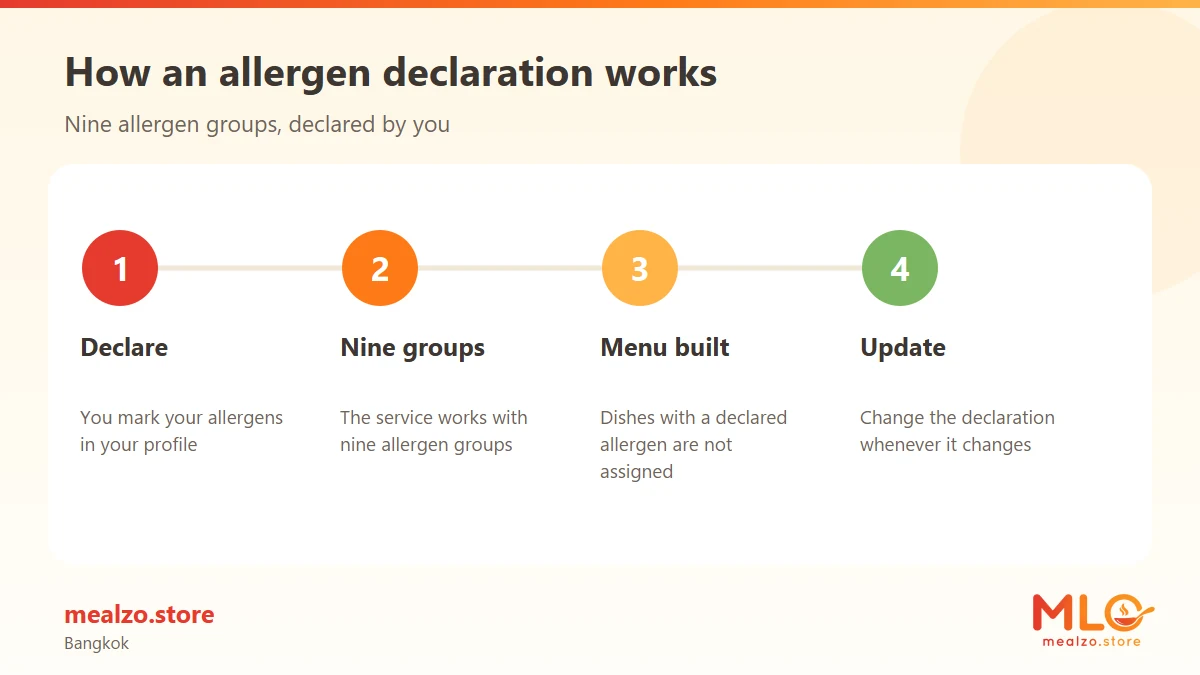
One system may let the customer declare ingredients to avoid and then prevent dishes containing those ingredients from being assigned. Another may offer fixed plan categories. Another may simply publish meal-by-meal allergen information and leave the comparison to the customer.
These are different functions.
An allergen declaration describes information associated with a dish.
An exclusion system changes which dishes are selected for a particular customer.
A meal plan defines a broader menu pattern.
Do not assume that one function replaces another. A “No Fish & Seafood” plan, for example, is a plan category. A separate customer declaration concerning fish or shellfish is an exclusion mechanism. Neither statement, on its own, tells you that trace cross-contact has been eliminated in a shared kitchen.
People specifically avoiding seafood can also use the practical guide to meal planning without fish or seafood to understand what changes nutritionally and operationally without turning a plan name into an allergen guarantee.
6. Shared kitchens change how you should read the label

A shared kitchen is one of the most important pieces of information a prepared-meal provider can disclose.
Different dishes may be prepared in the same facility. Ingredients can move through common storage areas, preparation benches, utensils, cooking equipment or packing workflows. Procedures may reduce cross-contact, but a shared kitchen statement means you should not interpret recipe-level exclusions as proof that trace cross-contact has been eliminated.
This is precisely why “the recipe does not contain peanuts” and “peanuts cannot be present” are completely different claims.
Anyone with a severe allergy should treat prepared meals as unsuitable and speak to their doctor.
For everyone else comparing labels, the useful question is whether the provider states the shared-kitchen limitation openly. A clear limitation is more informative than reassuring language that does not explain kitchen conditions.
Key takeaway: A recipe exclusion and a cross-contact guarantee are different things, and a shared kitchen prevents you from treating them as equivalent.
7. Look beyond the name of the meal plan
Plan names are convenient navigation tools. They are not complete ingredient declarations.
A Vegetarian plan tells you something about the framework of the meals. A Dairy & Egg Free plan tells you something different. A Gluten Free plan is another category again. But a plan name cannot reasonably substitute for reading the individual recipe information and the provider's explanation of how its kitchen operates.
The same principle applies when a provider offers overlapping plans. A person interested in avoiding dairy and eggs, for example, should not infer the full composition of a Vegan meal solely from the plan label. It is better to compare the actual recipes and declarations. dairy- and egg-free meal planning in practice discusses that distinction in more detail.
Plan labels are most useful when you treat them as the first filter, not the final answer.
Check whether personal exclusions operate inside the plan
If a provider combines plan selection with declared exclusions, ask what happens when a scheduled dish conflicts with one of those declarations.
Does the system replace the dish? Does someone review it? Is the exclusion based on recipe ingredients, allergen tagging or both?
The mechanics matter because “we record your preference” says less than “dishes tagged with the declared allergen are not assigned.”
8. Use Mealzo as an example of how to read a real system
Mealzo provides a useful worked example because its plan system and allergen-declaration system are separate.
Customers can declare nine allergen groups: peanuts, tree nuts, shellfish, fish, milk, egg, soy, wheat/gluten and sesame. Dishes containing a declared allergen are not assigned to that customer.
That tells you something specific: declared allergens affect dish assignment.
It does not establish that trace cross-contact has been eliminated. Mealzo uses a shared kitchen, and trace cross-contact is not eliminated.
The same distinction applies to its 12 plan categories: Balanced, Weight Loss, High Protein, Vegetarian, Vegan, Keto, Low-Carb, Gluten Free, Easy-to-Digest, Pescatarian, No Fish & Seafood, and Dairy & Egg Free. Those categories guide menu construction; they are not declarations that the kitchen is isolated from other ingredients.
Menus are assembled automatically from the selected plan, calorie level and meal count. Customers can choose 1200, 1500, 1800, 2000, 2200 or 2500 kcal per day, with 3 or 5 meals daily and packages of 3, 7, 14 or 30 days.
If you are comparing those options commercially, Mealzo meal plans and package options is the relevant place to view the available plans. The useful reading habit remains the same: distinguish the plan, the declared exclusions and the shared-kitchen limitation.
9. Ask questions before subscribing
Good allergen information should reduce the number of things you need to guess.
Before paying for a multi-day package, it is reasonable to ask a provider how its labels and exclusions actually work. The most useful questions are concrete rather than broad.
Questions worth asking include:
- Which allergen groups do you identify on individual meals?
- Does “contains” refer only to intentional recipe ingredients?
- Do you use a separate “may contain” statement?
- Are sauces, marinades, dressings and seasoning mixes included in the ingredient information?
- If I declare an allergen, what exactly changes in meal assignment?
- Is the kitchen shared with dishes containing the ingredient I am avoiding?
- Do you state whether trace cross-contact can be eliminated?
- Are allergen declarations available before I subscribe, or only after meals are assigned?
- If a recipe changes, how is the ingredient or allergen information updated?
- Who can clarify a menu item when the published information is incomplete?
Notice what is missing from that list: “Is this meal safe for me?” That question asks the provider to make a conclusion that the available information may not support.
A stronger question is: “What exactly does your declaration cover, and what does it not cover?”
10. Compare providers by clarity, not by reassuring language
The strongest allergen information is not necessarily the longest. It is the information that lets you understand the boundaries of the claim.
A provider deserves more scrutiny if it uses broad phrases without defining them. Statements such as “allergy-friendly,” “clean,” “carefully prepared” or “made for sensitive diets” tell you much less than a plain explanation of intended ingredients, exclusion logic and shared-kitchen conditions.
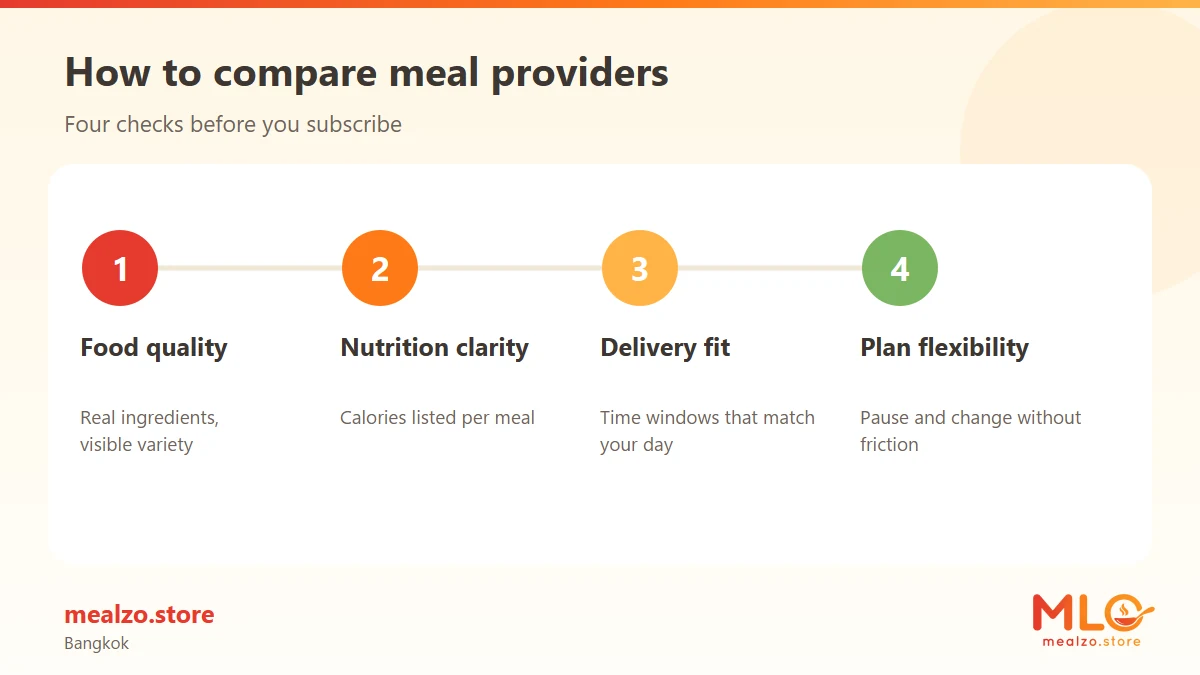
When comparing services, look for four layers:
- Recipe information: What is intentionally in the dish?
- Allergen declaration: Which allergen groups are explicitly identified?
- Assignment logic: What happens when a customer declares an ingredient to avoid?
- Kitchen limitation: Can trace cross-contact occur?
If one layer is missing, do not silently substitute information from another.
A plan called Dairy & Egg Free may answer part of the recipe question. It does not automatically answer the shared-kitchen question. An allergen declaration may tell you that a dish contains soy. It does not automatically tell you whether the provider has reviewed every possible source of soy in every compound ingredient unless that process is explained.
Key takeaway: The best comparison is not “which provider sounds safest,” but “which provider tells me clearly what each statement does and does not mean.”
FAQ
Does “contains” mean the same thing as “may contain”?
No. “Contains” indicates that the named allergen is intentionally present in the recipe or one of its components. “May contain” flags possible unintended presence. They communicate different kinds of information and should not be treated as interchangeable.
If an allergen is not listed, can I assume it is absent?
No. A missing declaration only tells you that the allergen has not been declared in that location. You need to know whether the provider's allergen system is comprehensive, how compound ingredients are handled and whether separate shared-kitchen information applies.
Is choosing a dietary plan enough to manage an allergen?
Not necessarily. A dietary plan describes the general structure of the menu, while an allergen declaration or exclusion system deals with specific ingredients or allergen groups. Providers may combine these systems, but you should check how each one works.
What does a shared-kitchen statement tell me?
It tells you that different ingredients and dishes are handled within the same kitchen environment. Even when a recipe excludes a particular ingredient, trace cross-contact may not be eliminated.
Is an allergen declaration system a safeguard for a severe allergy?
No. An allergen declaration system can communicate ingredients and exclusions, but it is not a safeguard that makes prepared meals suitable for a severe allergy, particularly where the kitchen is shared.
What should I look for when comparing prepared-meal providers?
Look for clear ingredient information, a defined difference between “contains” and “may contain,” an explanation of what happens when exclusions are declared, and an explicit statement about shared-kitchen limitations. Just as importantly, notice where information is absent rather than assuming the most reassuring interpretation.
Find a Meal Plan That Fits
Compare Mealzo plans or use the calculator to explore meal options for your needs.