Gluten-Free Meal Plans: What Gluten-Free Actually Means
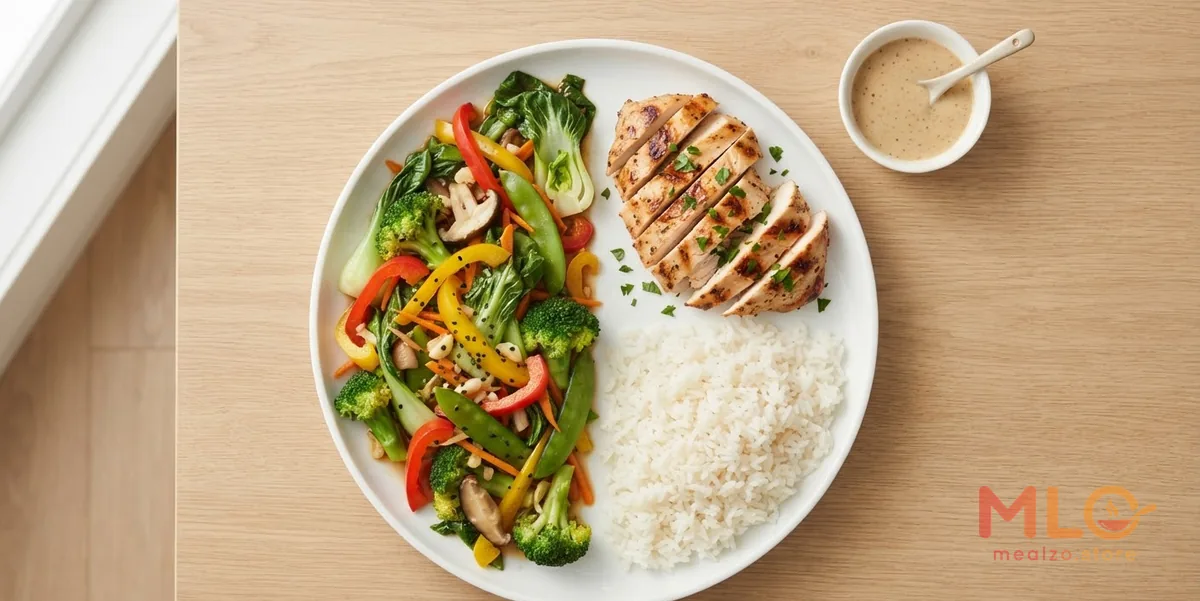
A gluten free meal plan sounds straightforward until you look closely at the sauces, noodles and seasonings used in everyday cooking. In Bangkok, that matters. Rice may dominate the plate, but wheat can still arrive through a spoonful of soy sauce, a bottled seasoning, a fried coating or noodles that look similar to rice noodles at first glance.
People avoid gluten for different reasons. From a practical meal-planning perspective, the useful question is not simply whether a dish contains bread or pasta, but which ingredients are used throughout the whole recipe.
Thai food offers plenty of naturally rice-based building blocks: jasmine rice, sticky rice, rice noodles, vegetables, meat, tofu, herbs and many curries. Yet the finished dish may still contain wheat because of its sauce, marinade, stock seasoning or coating.
This guide explains what changes when you choose a gluten free meal plan, where wheat commonly appears in Thai cooking, and how Mealzo separates the choice of a plan from an allergen declaration.
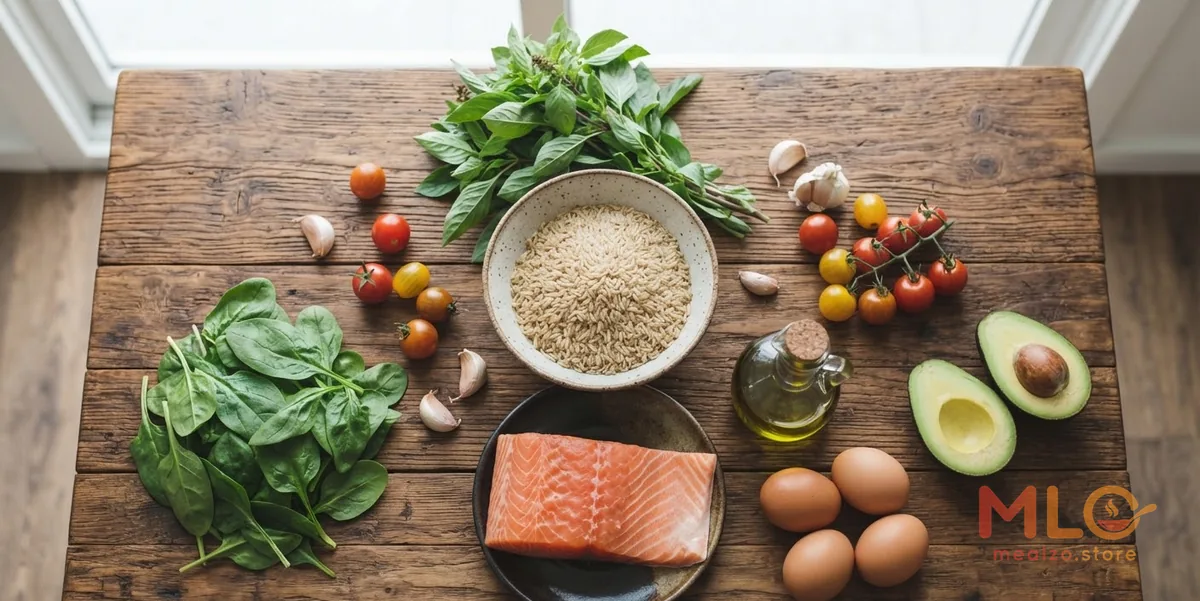
1. A gluten free meal plan changes more than the obvious foods
The first foods most people associate with gluten are bread, cakes, pasta and baked goods. Removing those is only the visible part of the job.
In prepared meals, wheat can appear in less obvious places: soy sauce used in a stir-fry, oyster sauce added to vegetables, seasoning sauce in a marinade, flour dusted over meat before frying, or wheat noodles served in a soup.
That is why a meal can be built around rice and still contain an ingredient derived from wheat.
A practical gluten-aware approach therefore looks at the complete recipe:
- the main carbohydrate, such as rice, rice noodles or wheat noodles;
- sauces and marinades;
- seasoning powders, stocks and bottled condiments;
- coatings used before frying;
- garnishes or side components prepared separately.
For a broader overview of how different restrictions affect prepared food, the guide to meal plans for common food restrictions explains how plan selection and ingredient exclusions can work together.
Key takeaway: A rice-based Thai dish is not automatically free from wheat because sauces, marinades and coatings also matter.
2. Where wheat commonly hides in everyday Thai cooking
Thai cooking is often friendly to rice, vegetables, herbs and simple proteins, but many restaurant-style dishes depend on bottled sauces. Those sauces are where ingredient reading becomes especially useful.
The exact formulation varies by brand, so the ingredient list matters more than the name on the bottle.
| Thai ingredient or component | Where wheat may appear |
|---|---|
| Soy sauce | Many standard soy sauces are brewed with wheat |
| Dark soy sauce | Formulations vary and may include wheat |
| Light soy sauce | Commonly made with soybeans and wheat |
| Oyster sauce | Some products include wheat-containing soy sauce or thickeners |
| Seasoning sauce | Recipes vary; wheat or wheat-based soy sauce may be present |
| Stir-fry sauce | Often combines several sauces, some of which may contain wheat |
| Stock powder or bouillon | Formulations vary and can contain wheat-derived ingredients |
| Fried coating | Wheat flour is commonly used for crisp coatings |
| Batter | Often based on wheat flour |
| Wheat noodles | Made from wheat by definition |
| Egg noodles, ba mee | Usually wheat noodles with egg |
| Wonton wrappers | Commonly made from wheat flour |
| Breadcrumbs | Generally wheat-based unless a different crumb is specified |
Soy sauce deserves particular attention because it turns up everywhere: fried rice, stir-fries, noodle dishes, marinades and dipping sauces.
Oyster sauce is another common example. The name tells you that oyster is part of the flavour profile, but it does not tell you whether the complete bottled sauce contains wheat. The same principle applies to seasoning sauces and ready-mixed stir-fry sauces.
If you regularly compare prepared meals, the guide to reading ingredient and allergen information is useful alongside this article.
3. Rice noodles and wheat noodles are not the same thing
Bangkok noodle menus can be confusing because "noodles" covers several very different products.
Rice noodles
Common Thai rice noodles include sen lek, sen yai and sen mee. Pad Thai is generally made with rice noodles. Kuay teow soups may also use different sizes of rice noodle.
The noodle itself can therefore be rice-based rather than wheat-based. That does not settle the question for the whole dish. The broth, stir-fry sauce, seasoning mixture or garnish still needs to be considered.
Wheat noodles
Ba mee is the major contrast. These yellow noodles are typically made with wheat and often egg. They appear in dry noodle bowls, soups and dishes such as ba mee moo daeng.
Wonton wrappers are another wheat-based component commonly served in noodle shops.
Glass noodles
Woon sen, or glass noodles, are commonly made from starch such as mung bean starch rather than wheat. Again, the noodle base is only one component. A woon sen stir-fry can still contain soy sauce, oyster sauce or another seasoning containing wheat.
| Noodle type | Typical base | What still needs checking |
|---|---|---|
| Sen lek | Rice | Broth, sauces, seasoning |
| Sen yai | Rice | Stir-fry sauces and seasoning |
| Sen mee | Rice | Broth and condiments |
| Pad Thai noodles | Rice | Sauce and additional ingredients |
| Woon sen | Starch, commonly mung bean | Sauce, seasoning and stock |
| Ba mee | Wheat, often with egg | Wheat is already part of the noodle |
| Wonton wrappers | Wheat flour | Wheat is already part of the wrapper |
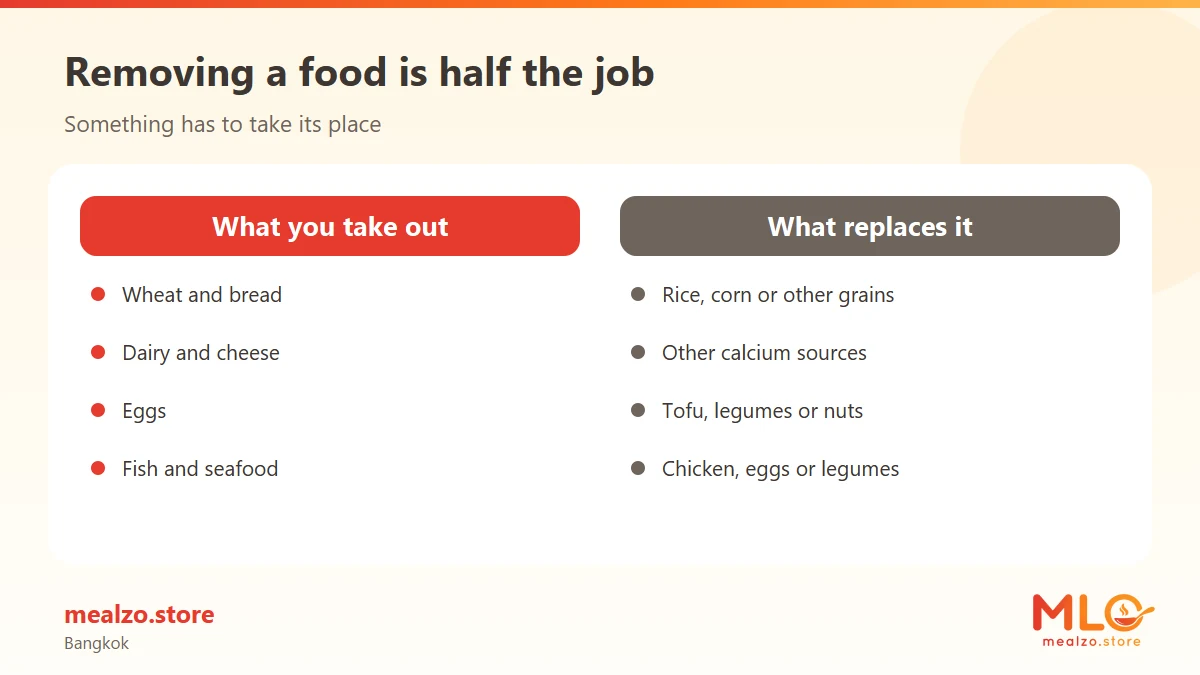
4. Familiar Thai dishes show why recipe details matter
Consider pad see ew. The wide sen yai noodles are rice noodles, but the dish usually relies heavily on soy-based sauces. Looking only at the noodles would miss an important part of the recipe.
Pad kee mao can present the same issue. Rice noodles may form the base, while soy sauce, oyster sauce or seasoning sauce supplies much of the savoury flavour.
Pad kra pao is another useful example. Rice, meat and holy basil are not the concern. The sauce mixture is. Different cooks use different combinations of fish sauce, soy sauce, oyster sauce and seasoning sauce.
Fried rice, khao pad, also shows why "served with rice" and "contains no wheat ingredients" are not equivalent statements. Soy sauce or seasoning sauce can be used during cooking.
Other dishes worth examining ingredient by ingredient include:
- rad na, where rice noodles may be served with a thickened savoury gravy;
- gai tod and moo tod, which may use flour in a coating or marinade;
- crispy pork or fried meat dishes, where flour or seasoning mixes may be involved;
- noodle soups, where the noodle type and broth seasoning both matter;
- stir-fried vegetables, which are frequently seasoned with oyster sauce or soy-based sauces;
- curries, where the curry itself may be rice-friendly but prepared pastes, stocks or seasonings still require ingredient checking.
Thai food is therefore less about memorising a list of "good" and "bad" dishes and more about knowing which recipe components need attention.
Key takeaway: In Thai food, the sauce can change the status of a dish even when its main carbohydrate is rice.
5. The Mealzo Gluten Free plan and allergen declaration are two separate things
Mealzo includes a Gluten Free plan among its 12 meal plans. The other plans are Balanced, Weight Loss, High Protein, Vegetarian, Vegan, Keto, Low-Carb, Easy-to-Digest, Pescatarian, No Fish & Seafood, and Dairy & Egg Free.
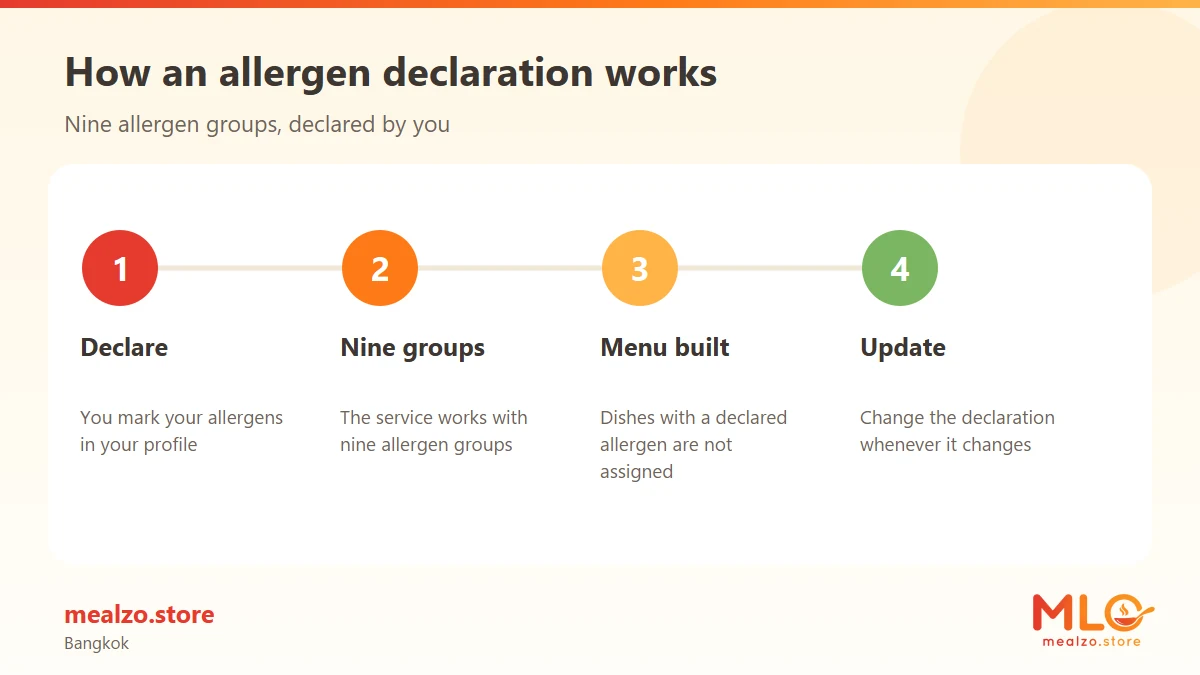
Choosing the Gluten Free plan determines the type of menu the system assembles. Separately, a customer can declare wheat/gluten among Mealzo's nine allergen groups. When wheat/gluten is declared, dishes containing that allergen group are not assigned.
These are related tools, but they are not the same instruction.
| Choice | What it does in the Mealzo system |
|---|---|
| Gluten Free plan | Sets the selected meal-plan category used to assemble the package menu |
| Wheat/gluten allergen declaration | Prevents dishes containing the declared wheat/gluten allergen group from being assigned |
| Other allergen declarations | Can separately cover peanuts, tree nuts, shellfish, fish, milk, egg, soy and sesame |
The kitchen is shared, and trace cross-contact is not eliminated.
That distinction matters. A PLAN describes how meals are selected. An ALLERGEN DECLARATION is an additional exclusion instruction used during assignment. Neither should be interpreted as a certification statement about the kitchen environment.
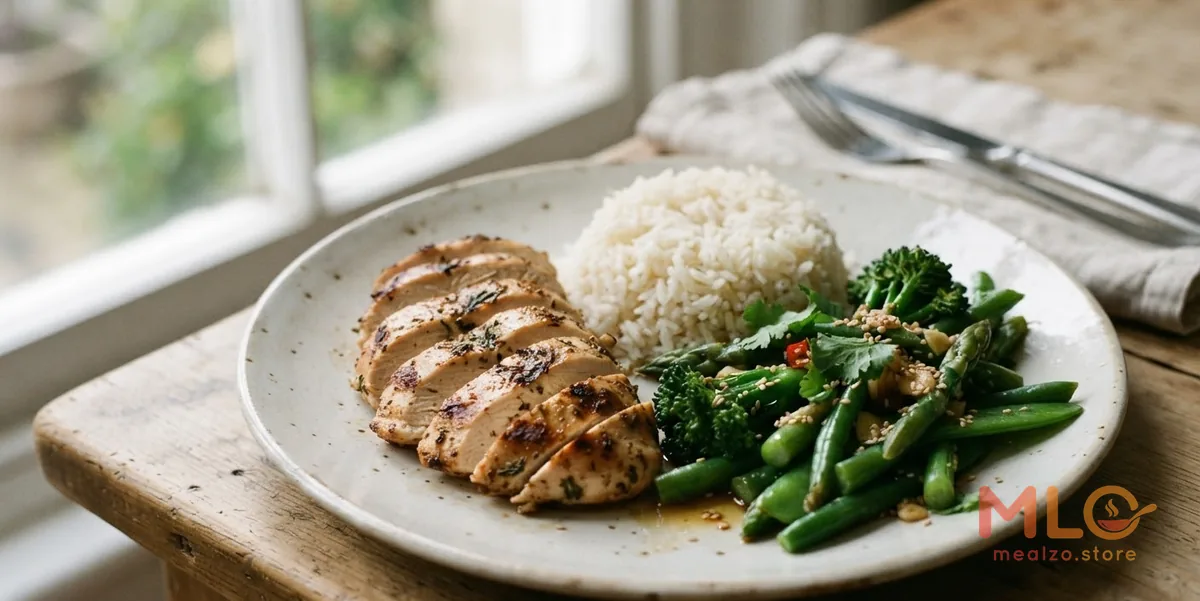
6. What gets swapped when wheat-based components are removed
A useful gluten-conscious meal plan does not have to replace every Thai dish with a specialised substitute. Often, the more natural approach is to build meals from ingredients that already fit the recipe direction.
Rice can replace wheat noodles in some meal formats. Rice noodles can work where a noodle dish is appropriate. A simple protein with vegetables and rice may need fewer bottled components than a heavily sauced stir-fry.
Typical planning changes can include:
- choosing rice or an appropriate rice noodle instead of wheat noodles;
- avoiding ba mee, wonton wrappers and standard breadcrumbs;
- selecting sauce combinations whose ingredient profiles fit the restriction;
- replacing wheat-flour coatings with a recipe that does not require that coating;
- using dishes where the flavour comes primarily from herbs, chillies, lime, aromatics and other suitable ingredients rather than a complex bottled sauce blend.
The objective is not to make every meal imitate a wheat-based dish. Variety usually improves when the menu uses different cooking styles rather than relying on substitute versions of bread, noodles or batter every day.
For another example of how removing common ingredients changes meal structure rather than simply subtracting foods, see dairy- and egg-free meal planning in practice.
7. Variety still matters after the restriction is applied
A restrictive menu becomes tedious quickly if every meal turns into grilled chicken and rice. Thai ingredients offer many other directions.
Meals can rotate among rice bowls, curries, soups, salads, stir-fries, rice-noodle dishes and combinations of protein, vegetables and herbs. International-style dishes can also be structured around potatoes, rice and other appropriate carbohydrate sources rather than wheat-based pasta or bread.
The most useful variety comes from changing several elements at once:
- protein source;
- vegetable combination;
- starch or noodle type;
- sauce profile;
- cooking method;
- herbs, aromatics and garnishes.
A clean, relatively simple ingredient list can also make meal selection easier to understand. The principles behind everyday clean eating choices discusses this kind of ingredient-focused thinking without requiring a particular dietary label.
Key takeaway: Removing wheat works better as a menu-design problem than as a search for one substitute ingredient.
8. Calorie level and meal count are separate choices
A gluten free meal plan still needs to function as a complete package rather than a collection of exclusions.
Mealzo offers six daily calorie levels: 1200, 1500, 1800, 2000, 2200 and 2500 kcal. Customers can choose either 3 or 5 meals per day and packages of 3, 7, 14 or 30 days.
The menu for a package is assembled automatically from the selected plan, calorie level and meal count. This means the Gluten Free plan is one part of the configuration rather than the only factor determining what is assigned.
Someone choosing 3 meals at one calorie level is therefore using a different package configuration from someone choosing 5 meals at another level, even when both select the same plan.
For people comparing all available configurations, Mealzo meal plans and package options provides the commercial overview.
9. Ingredient awareness matters more than dish names
Dish names are useful shorthand, but they are unreliable as ingredient declarations.
Two versions of pad kra pao can use different sauce combinations. Two bowls of kuay teow can use different noodles and different stock seasonings. One fried chicken recipe may use a wheat-flour coating while another may be prepared differently.
This is especially relevant in Bangkok, where the same familiar dish can be cooked differently by households, street-food vendors, restaurants and prepared-meal kitchens.
A sensible reading order is:
- Identify the main starch or noodle.
- Check the sauce and marinade.
- Check stock powders and seasoning blends.
- Look at coatings, wrappers and crumbs.
- Consider garnishes and side sauces.
- Treat the complete recipe as the unit that matters.
That approach is more precise than trying to memorise which Thai dish names "count" as gluten-free.
10. What a practical Bangkok menu might emphasise
For Bangkok diners avoiding wheat/gluten ingredients, the easiest meals to understand are often those built from recognisable components rather than long chains of prepared sauces.
That can mean rice with a clearly specified protein and vegetables, suitable rice-noodle preparations, soups with checked seasonings, or curries and stir-fries where the sauce ingredients have been reviewed as part of the recipe.
At the same time, some familiar choices deserve more scrutiny precisely because they look uncomplicated. Fried rice can contain soy sauce. A rice-noodle stir-fry can contain wheat through its sauce. Fried meat can contain flour. A dipping sauce served on the side may matter just as much as the main dish.
The practical lesson is simple: "rice-based" describes one ingredient. A gluten-aware meal plan has to consider the whole plate.
Key takeaway: The useful question is not whether Thai food uses rice, but whether every component of the selected recipe fits the restriction.
FAQ
Is a rice dish automatically suitable for a gluten free meal plan?
No. Rice itself does not contain wheat, but a rice dish can still use soy sauce, oyster sauce, seasoning sauce, stock powder, flour coatings or other ingredients that contain wheat. The full recipe needs to be considered.
Are Thai rice noodles the same as wheat noodles?
No. Sen lek, sen yai and sen mee are rice noodles, while ba mee is typically made from wheat and often contains egg. Wonton wrappers are also commonly wheat-based. Even with rice noodles, the accompanying sauce or broth still needs checking.
Does choosing Mealzo's Gluten Free plan automatically make an allergen declaration?
No. The Gluten Free plan and the allergen declaration are separate mechanisms. Customers can separately declare wheat/gluten among the nine allergen groups so dishes containing it are not assigned.
Is the Mealzo Gluten Free plan suitable as a safeguard for coeliac disease?
No. It should not be used as a safeguard for coeliac disease. Mealzo uses a shared kitchen, and trace cross-contact is not eliminated.
Which Thai sauces most often need attention when avoiding wheat?
Soy sauce is a major one because many standard versions are brewed with wheat. Oyster sauce, seasoning sauce, ready-mixed stir-fry sauces and some stock or seasoning products also need ingredient checking because formulations vary.
Can I combine a Gluten Free plan with other declared allergens?
Mealzo allows customers to declare allergens from nine groups: peanuts, tree nuts, shellfish, fish, milk, egg, soy, wheat/gluten and sesame. Declared allergens are used so dishes containing those groups are not assigned.
Find a Meal Plan That Fits
Compare Mealzo plans or use the calculator to explore meal options for your needs.