Bangkok Food Courts: How to Build a Balanced Tray in the Lunch Queue
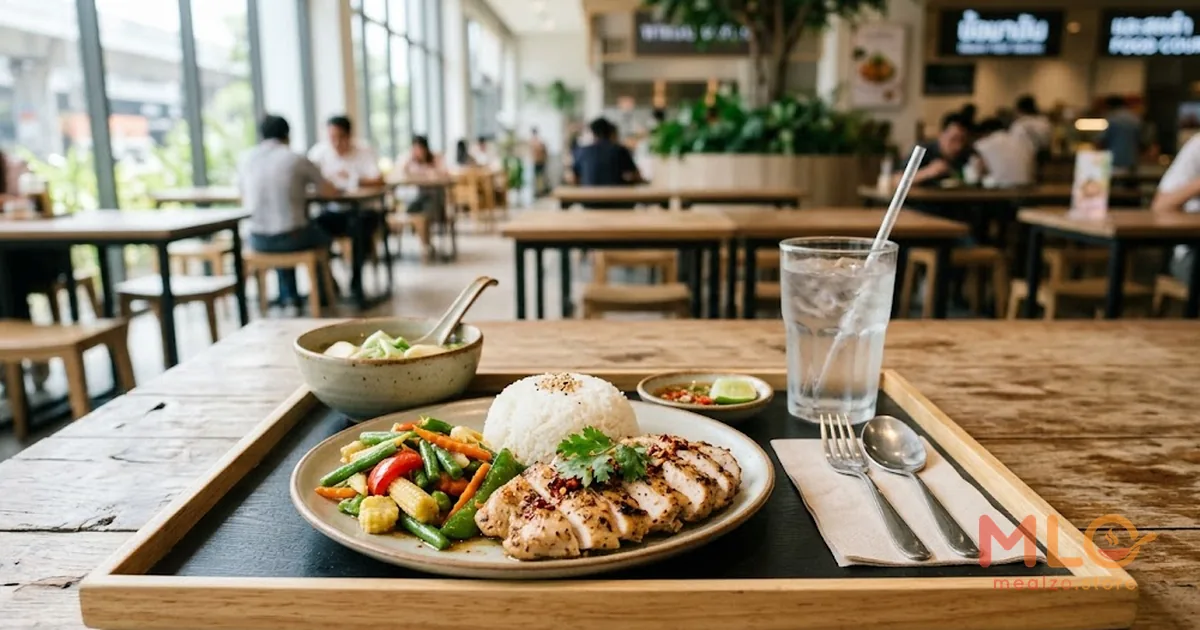
A Bangkok food court might be one of the best places in the city to put together a balanced lunch. You can see what is being cooked, compare several dishes before ordering, and collect different parts of your meal from different stalls. In many restaurants, you order one finished dish and accept whatever arrives. A food court gives you more control.
Yet the experience rarely feels that deliberate at lunchtime. The queue is moving, someone behind you is waiting, and the familiar fried rice looks easier than thinking through another set of choices. You order what you ordered yesterday, collect your plate, and find a seat before the lunch break disappears.
The problem is not necessarily the food. It is the speed of the decision. Bangkok food courts offer vegetables, grilled proteins, soups, rice dishes and freshly cooked meals, but having those choices available does not automatically mean they end up together on your tray.
You do not need to turn lunch into a nutrition project. A short look around the counters, a familiar combination and a few useful ordering requests can make eating at a food court considerably simpler.
1. Why a Bangkok food court gives you more control than you think
Walk through a typical mall or office-building food court before ordering. You will probably find several distinct ways of buying lunch.
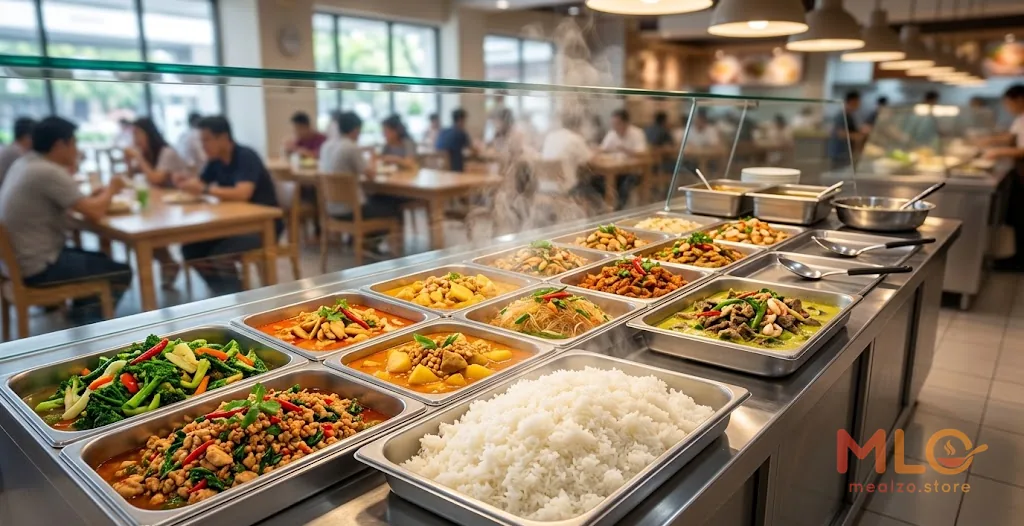
One stall has cooked dishes arranged in metal trays. Another prepares noodles in steaming bowls. A wok station cooks individual orders, while a nearby counter might serve grilled chicken, papaya salad or vegetables. Some larger food courts also have salad and prepared-meal counters.
This variety is useful because you are not restricted to one restaurant's finished dish.
You might buy rice with chicken and vegetables at one counter. On another day, you might choose noodle soup and add something from a separate stall. Where the layout and payment system permit it, combining stalls is straightforward.
The biggest advantage is visibility.
At a point-and-pick counter, you can inspect the actual food rather than relying on a menu photograph. You can see whether the vegetable dish contains substantial vegetables, whether the meat is sitting in a thick sauce, and whether a curry appears to have a considerable layer of oil.
That does not tell you everything about its ingredients or preparation. It does, however, give you more information than a printed menu alone.
The trade-off is that every visit introduces another decision. A sit-down restaurant might present a limited menu, while a food court asks you to make choices across many counters.
During a relaxed shopping trip, that freedom is pleasant. During a short office lunch break, it can become tiring.
The solution is to develop a familiar way of selecting food without insisting on eating exactly the same dish every day.
Key takeaway: A Bangkok food court makes balanced eating practical because you can see the food and combine different dishes before committing to your meal.
2. The payment card changes how you make decisions
Many Bangkok food courts use a stored-value card or coupon system rather than having every stall handle ordinary cash payments.
The arrangement varies between locations. At some courts, you load money onto a card at a payment counter, use it to purchase food and return afterward to collect the unused balance. Other courts use different payment arrangements.
The system makes ordering convenient. You can walk between counters without repeatedly reaching for your wallet.
It also makes additional purchases feel effortless.
You have already loaded money onto the card. Your lunch is finished, and the dessert counter is beside the exit. Adding a sweet drink or dessert can feel like a minor continuation of the same purchase rather than a separate decision.
There is nothing inherently wrong with that.
The useful habit is simply to decide whether you actually want those extras.
Before walking to the payment counter, consider what you intend to eat. You might want rice, vegetables, chicken and water. You might also want dessert. Either choice is easier to make deliberately than while standing directly in front of a display.
If the court refunds unused credit, you can return the balance according to its particular arrangements. There is no need to spend everything simply because money remains on the card.
The payment system should make lunch convenient, not determine how much food you buy.
3. The point-and-pick rice stall is your biggest advantage
The Thai point-and-pick counter, commonly called khao rad gaeng, is particularly useful for building a balanced meal.
Cooked dishes sit in trays behind the counter. You select one or more dishes to serve with rice, usually by pointing at what you want.
This format gives you something valuable: a chance to inspect the actual components of lunch.
Instead of choosing a finished plate, think of the counter as a selection of ingredients that happen to be cooked already.
A useful starting combination is:
- One dish containing a clear protein source, such as chicken, fish, pork, eggs or tofu.
- One dish consisting mainly of vegetables.
- A portion of rice that suits your appetite and the rest of your meal.
- Water as your usual drink.
This is a repeatable habit, not a rigid formula.
Some dishes combine protein and vegetables already. Others are mostly sauce, with relatively little meat or fish. A vegetable curry might contain substantial vegetables but also arrive with considerably more sauce than you intended.
You can often identify the difference just by looking.
Read the counter in ten seconds
Start with the surface of the trays.
Is there a visible layer of liquid fat? Is the dish mostly meat or fish, or does it appear to contain considerably more sauce? Is there a vegetable dish with recognizable pieces of greens?
Then look at the rice being served.
If the standard portion is larger than you want, ask for less.
The simple Thai phrase khao noi means less rice. You can use it while indicating the amount you would prefer.
If you choose curry, you can also indicate that you want a lighter serving of sauce. Whether a particular stall can accommodate this depends on how its dishes are prepared and served.
The aim is not to remove every sauce or avoid curry. It is to avoid receiving considerably more sauce than you wanted simply because that is the default serving.
A point-and-pick stall also helps when you are uncertain about a dish. You can select something whose ingredients are visible rather than committing to an unfamiliar menu description.
You may still choose a rich curry. Pairing it with a vegetable dish and deciding how much rice you want can make the whole tray more balanced than ordering the curry alone.
4. Made-to-order wok stalls: know what you can change
The made-to-order wok counter serves a different purpose.
Dishes such as pad krapow, pad see ew and fried rice are prepared quickly, usually in front of you. They arrive hot, and you can watch the cook work.
For a short lunch break, that is convenient.
The limitation is that much of the dish is assembled inside the wok. Oil, seasoning and sometimes sugar are added during cooking. The cook generally determines the serving size and proportions.
You have less control than you do at a point-and-pick counter.
You can still make useful requests.
If you prefer less heat, mai phet means not spicy. If you want no added sugar, mai sai nam tan communicates that request.
Neither phrase guarantees that a dish contains no sugar or that every stall will change its usual recipe. Prepared sauces and premixed ingredients may already contain seasonings, and some cooking methods are less flexible than others.
You can also consider what comes alongside the main dish.
A serving of pad krapow with rice and a fried egg offers a recognizable protein component, but the accompanying vegetables may be limited. A separate vegetable dish can address that gap.
With fried rice, look at what is actually mixed into it. Some versions contain recognizable pieces of meat, egg and vegetables. Others are predominantly rice.
If the queue is long and fried rice is the fastest option, order it. You do not need a perfect lunch every time.
You can make a different choice at your next meal rather than treating one hurried lunch as a failure.
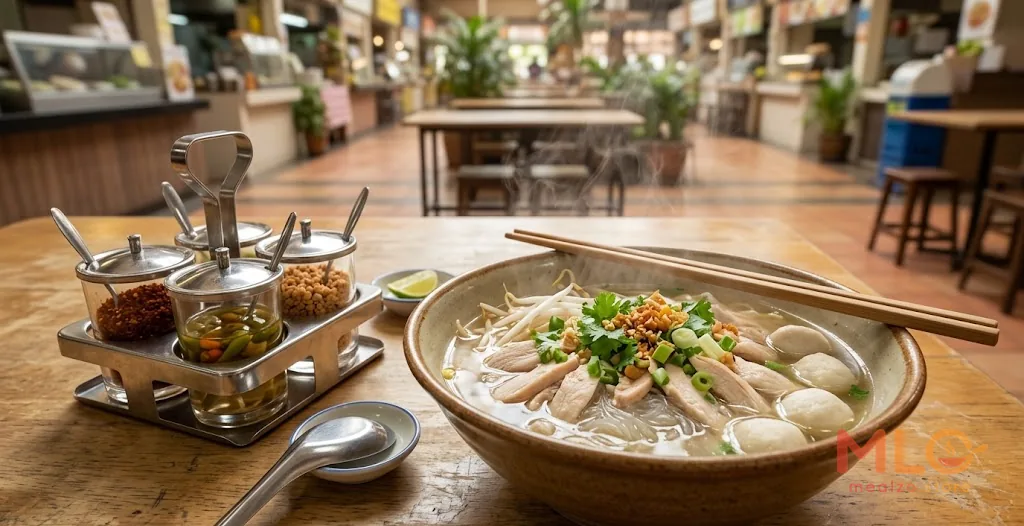
5. Noodle soup stalls can make lunch refreshingly simple
A noodle soup counter is often among the lighter-feeling options in a food court.
You receive a bowl with noodles, broth and whatever meat, fish balls, tofu or vegetables belong to the particular recipe.
Compared with a heavily sauced rice dish, the meal may feel less substantial. That does not automatically tell you its nutritional composition, but it can be a convenient alternative when you do not want another large plate of rice.
Look at the bowl before adding anything from the condiment tray.
Bangkok noodle counters commonly offer extra seasonings. The broth itself may already be heavily seasoned, and fish sauce or other salty condiments can add more salt.
Taste first.
If you want more information about managing sodium when eating Thai food, consult our dedicated sodium guide rather than assuming a clear-looking broth is low in salt.
A noodle soup may contain only a small amount of vegetables. Where available, you can ask about adding greens or choose vegetables from another counter.
There is also no reason to assume that all noodle soups are interchangeable. Broths, noodle types, toppings and preparation methods vary considerably.
Choose the bowl you enjoy, look at what it contains, and decide whether anything is missing from the meal.
Key takeaway: Noodle soup can be a convenient alternative to a rice plate, but clear broth does not automatically mean little salt, and vegetables still deserve attention.
6. Som tam and grilled meat make a useful combination
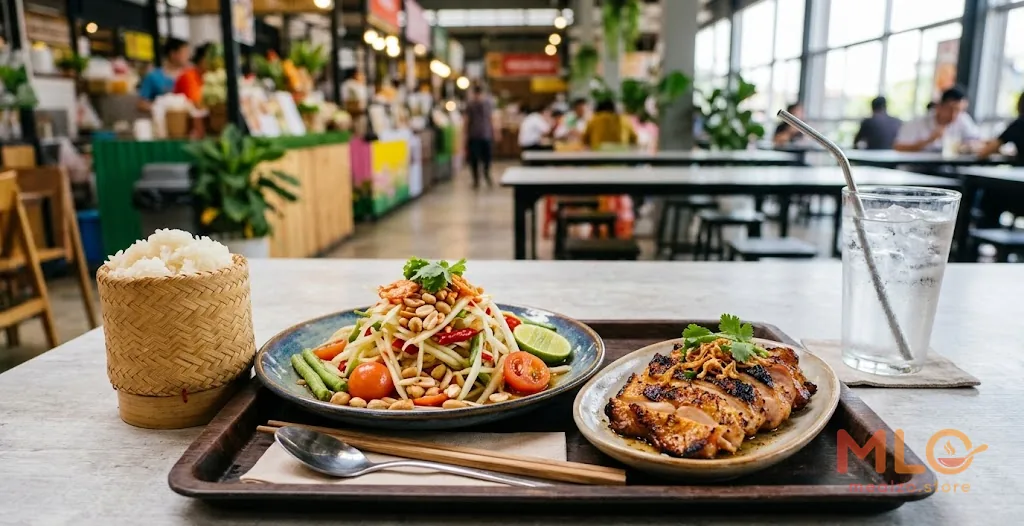
A counter serving som tam alongside grilled chicken or grilled pork offers another straightforward way to assemble lunch.
The combination works because the components are distinct.
The grilled meat provides a recognizable protein source. Papaya salad contributes shredded green papaya and other ingredients, while sticky rice can complete the meal.
You can decide how much sticky rice suits you instead of automatically ordering the usual amount.
The other consideration is the dressing.
Som tam commonly combines sweet, salty, sour and spicy flavours. Sugar and salty seasonings contribute to that balance.
If you want no added sugar, you can ask mai sai nam tan. For a milder salad, ask mai phet.
What can be changed depends on the stall and whether the salad is prepared fresh or its dressing is already mixed.
The goal is not to remove the character of the dish. A papaya salad without its usual flavour balance may simply be less enjoyable.
If you want to explore how familiar Thai dishes fit into different eating patterns, read our guide to pad Thai, som tam and tom yum.
Remember that som tam is not necessarily equivalent to a large serving of mixed green vegetables. Its ingredients and proportions vary, so you may still want vegetables elsewhere in the day.
7. Salad and prepared-meal counters deserve the same scrutiny
Some Bangkok food courts offer salad, sandwich or counters advertising prepared meals as clean food.
These can be useful, particularly when you want a straightforward combination of vegetables and protein without visiting multiple stalls.
They are also often pricier than more traditional food court options.
The important point is to judge the actual plate rather than the words on the sign.
A salad containing mostly leaves and a small amount of protein may not satisfy you for a long afternoon. A sandwich might contain a substantial filling but very few vegetables.
A prepared meal marketed as healthy might be well suited to your preferences, but the label alone tells you little about its composition.
Ask the same questions you would at an ordinary rice counter.
Where is the protein? Are there substantial vegetables? What supplies the main carbohydrate? How much dressing or sauce comes with the dish?
A well-assembled rice plate from a traditional Thai counter may suit your needs just as well as a more expensive prepared meal.
There is no need to pay extra for a label when the food itself is what matters.
Here is a practical comparison of the main food court options.
| Stall type | What it mostly brings to the tray | What to watch | Easiest adjustment |
|---|---|---|---|
| Point-and-pick rice | Rice with your choice of cooked protein and vegetables | Large rice portions, substantial sauce and limited vegetables | Choose one protein dish and one vegetable dish; request less rice |
| Made-to-order wok | A hot, complete dish with rice or noodles | Oil and seasoning added during cooking, limited control over portions | Request a feasible seasoning adjustment or add vegetables separately |
| Noodle soup | Noodles, broth and selected toppings | Salty broth, extra condiments and small vegetable servings | Taste before seasoning; choose additional greens where available |
| Som tam and grilled protein | Papaya salad, grilled meat and optional sticky rice | Sweet or salty dressing and automatic sticky rice portions | Choose your rice amount and request seasoning changes when possible |
| Salad or prepared-meal counter | Convenient assembled meals, often with vegetables | Small protein portions, dressing and assumptions based on labels | Judge the ingredients and request dressing separately if available |
| Drinks and desserts | Refreshment or a sweet finish to lunch | Added sugar and purchases made without much thought | Start with water and decide separately whether you want something sweet |
The table is not a ranking. Each counter can provide a useful lunch, depending on what you order and what is available that day.
8. The vegetable gap is easier to fix than it looks
Consider a familiar food court order: rice topped with chicken curry.
It looks like a complete meal. There is rice, chicken and sauce, perhaps with a few pieces of vegetables mixed into the curry.
Yet there may be surprisingly little plain vegetable food on the plate.
This is the vegetable gap.
Thai food contains many vegetables, but their presence in a cuisine does not mean every individual meal contains a substantial serving.
The simplest adjustment at a point-and-pick counter is to make one of your selections a vegetable dish.
Look for cooked greens, mixed vegetables or another preparation where vegetables are the principal ingredient rather than decoration.
If your chosen stall does not have anything suitable, a separate plate of stir-fried vegetables may be available elsewhere.
The Thai phrase pad pak means stir-fried vegetables. It is useful when identifying or requesting this kind of dish.
Stir-fried vegetables can still contain oil and sauce. They do not need to be completely plain to contribute vegetables to your lunch.
The distinction is between adding a meaningful vegetable component and assuming a few scattered pieces in fried rice are enough.
For a closer look at this issue, see why Thai meals can still leave a vegetable and fibre gap.
You do not need to make every plate identical. Some lunches will contain more vegetables than others.
The habit is simply to notice their presence before you collect your tray.
9. Drinks and desserts are a separate lunch decision
The drink counter is sometimes beside the entrance, sometimes near the exit, and sometimes positioned close to the payment area.
Desserts may appear in the same part of the court.
Their placement makes them convenient to visit after you have already chosen lunch.
This is often where a substantial share of a meal's added sugar can be decided.
A sweetened tea, flavoured drink or dessert can contribute sweetness independently of whether your main plate was carefully assembled.
You might spend time choosing grilled chicken and vegetables, then purchase a very sweet drink almost automatically.
There is nothing inconsistent about enjoying dessert. The distinction is whether you genuinely want it.
Water is a useful default because it does not require you to make another complicated decision about sweetness.
If you prefer a prepared drink, consider its sweetness and ask whether adjustments are possible. Not every drink can be modified in the same way.
Our article about drinks in Bangkok explains this decision in more detail.
A useful approach is to finish selecting your main meal before deciding whether to purchase a drink or dessert.
If you want something sweet, choose it deliberately.
If you do not, return the unused card balance where the payment system permits it and continue with your day.
Key takeaway: Choose your main meal first, make water the default, and treat a sweet drink or dessert as a separate decision rather than an automatic addition.
10. Build your balanced tray in ten seconds
By now, the process should be simple enough to use during an ordinary lunch break.
You do not need to study every counter or calculate the nutritional content of every ingredient.
Use four familiar components:
- Protein: Choose a recognizable serving of chicken, fish, meat, eggs, tofu or another protein source.
- Vegetables: Include a dish containing substantial vegetables rather than relying on a small garnish.
- Rice or another carbohydrate: Choose the amount that suits your appetite and the meal.
- Drink: Start with water and decide separately whether you want something else.
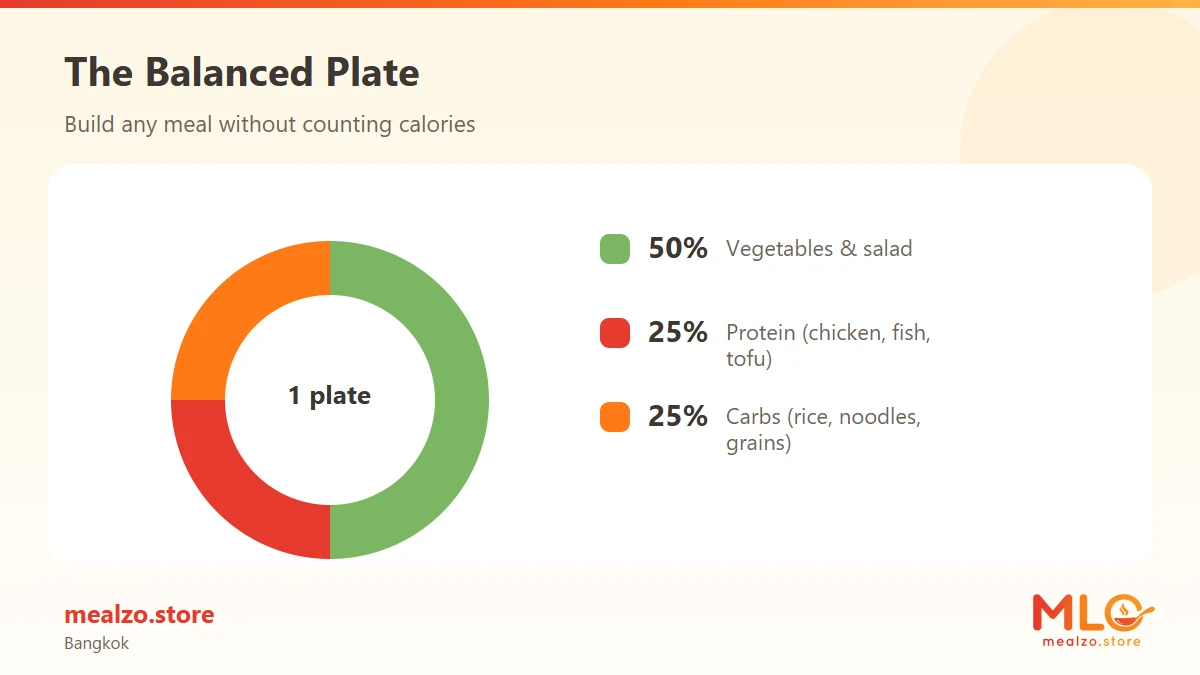
This is a way of organizing your choices, not a requirement to measure food precisely.
At the point-and-pick counter, the combination might be chicken, stir-fried greens and rice.
At the som tam stall, it might be grilled chicken, papaya salad and a chosen amount of sticky rice.
At the noodle counter, it might be soup with a suitable protein topping and additional vegetables where available.
The food will look different, but the decision-making process remains familiar.
You can also apply the approach when the available options are limited. A balanced meal does not require every component to come from the same stall.
Most importantly, do not allow the method to become another source of pressure.
If the only practical option today is a familiar wok dish, eat your lunch. The purpose of a routine is to make decisions easier, not to create a test you can fail.
11. Make the approach work during a real Bangkok workday
Food court advice is only useful if it survives the lunch rush.
At peak hours, seating can be crowded and queues can extend across the room. You may have colleagues waiting or very little time before another meeting.
The simplest improvement is to recognize your situation before joining a queue.
If you have only a short break, walk toward a familiar counter where you already know a suitable combination.
At a point-and-pick stall, selecting prepared dishes can be quicker than waiting for an individual wok order. Actual waiting times will depend on the queue.
When eating with colleagues, everyone may prefer the same stall. You do not need to insist on visiting a different counter.
Choose the most suitable combination available at the group's preferred stall. If vegetables are limited, you can address that elsewhere in the day.
The same flexibility applies when shopping with family or eating alone in the evening.
| Situation | What to build on the tray | What to skip |
|---|---|---|
| Fifteen minutes between meetings | A familiar point-and-pick combination with protein, vegetables and rice | Walking around every counter searching for an ideal dish |
| After training | A substantial meal with a clear protein source, vegetables and enough rice or noodles for your appetite | Assuming a meal is suitable solely because its sign says healthy |
| Late dinner alone | Noodle soup with appropriate toppings or a simple rice-and-vegetable combination | Adding condiments before tasting the dish |
| Lunch with colleagues | A balanced selection from the stall the group chooses | Making the group visit several counters unnecessarily |
| Weekend with family | A combination of dishes everyone enjoys, with vegetables included where practical | Turning a relaxed meal into a rigid checklist |
For days when even visiting a food court becomes impractical, our guide to eating from a Bangkok convenience store offers another way to think about an improvised meal.
One final practical consideration is freshness.
Busy food courts often have steady customer turnover, prepared dishes kept in heated trays and food cooked continuously during service. These features can work in your favour.
They are not guarantees. Choose food that appears properly handled and avoid items that seem poorly maintained or have been sitting without appropriate temperature control.
There is no reason to turn ordinary lunch into a hygiene investigation.
Anyone managing a medical condition, an allergy or a salt restriction should follow their doctor's guidance rather than relying on this article.
12. Create a weekday routine, and know when a meal plan helps
Eating well in a Bangkok food court is achievable, but there is a genuine trade-off.
You have flexibility, a wide selection and meals that are usually cheaper than those in a sit-down restaurant.
You also face the same decision every working day.
Five food court lunches mean choosing lunch five times. Even when each decision takes very little effort, the repetition can become tiresome.
A practical routine might look like this:
- Identify two or three stalls where you can reliably assemble a meal you enjoy.
- Alternate your main protein or vegetables when the available dishes change.
- Keep water as your normal drink and decide separately about sweet options.
- Allow unfamiliar dishes and spontaneous meals without abandoning the general approach.
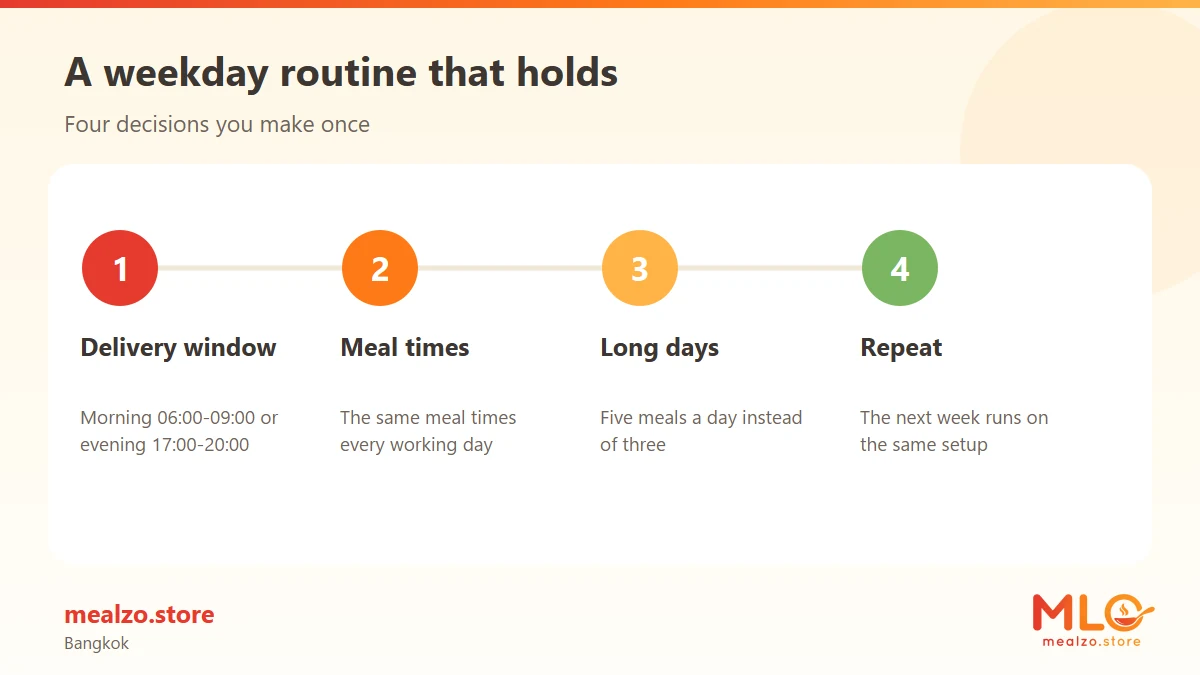
You might have a rice-counter lunch on Monday, noodle soup on Tuesday and grilled chicken with som tam on Wednesday.
The details can change without requiring you to rethink your entire approach.
This is also where a prepared meal plan offers a different kind of convenience.
Mealzo Bangkok operates a kitchen in Bang Na, Bangkok, where meals are cooked fresh daily and delivered across Bangkok.
Rather than choosing lunch repeatedly, customers select a plan and a daily calorie level, with meals portioned across the day.
Mealzo Bangkok offers twelve plan types, including Balanced, Weight Loss, High Protein, Vegetarian, Vegan, Keto, Low-Carb, Gluten Free, Easy-to-Digest, Pescatarian, No Fish & Seafood, and Dairy & Egg Free.
There are six daily calorie levels ranging from 1200 to 2500 kcal, with options for three or five meals per day. Packages are available for 3, 7, 14 or 30 days.
Every plan uses a single mixed cuisine combining Thai and international dishes. Customers do not choose between separate cuisine programmes.
The app also includes a calorie calculator based on the Mifflin-St Jeor formula. Its result is an estimate, not medical advice.
Customers declare allergens from nine allergen groups, and dishes containing a declared allergen are not assigned to them. This describes the assignment process, not a guarantee that meals are allergen-free.
For delivery, customers choose either the morning window, 06:00-09:00, or the evening window, 17:00-20:00.
Payment takes place exclusively online through PromptPay, Thai QR or credit card, processed by a payment provider. Couriers do not collect cash.
The website and mobile app are available in Thai, English, Polish, German, French, Russian, Simplified Chinese and Burmese.
You can explore the available options through Mealzo Bangkok meal plans.
A plan removes a recurring decision at a chosen calorie level. It also requires more commitment than buying lunch spontaneously.
It does not help you choose food on a day when you are already shopping in a mall. It does not prevent you from purchasing dessert, and it does not replace the flexibility of deciding what you want five minutes before eating.
If you alternate between planned meals and eating out, our guide to combining meal plans with eating out in Bangkok explains how those approaches can coexist.
A food court remains useful precisely because you can arrive without planning ahead and choose according to your appetite, schedule and company.
The most sustainable routine is often the one that requires the least unnecessary thought while leaving room for food you genuinely enjoy.
FAQ
Can I eat a balanced lunch at a Bangkok food court every day?
Yes, a food court provides enough variety to make balanced combinations practical on many days. Look for a clear protein source, a substantial vegetable dish, an appropriate amount of rice or noodles, and water as your default drink. Available choices vary between locations, so flexibility matters more than following an identical menu.
Is point-and-pick rice healthier than fried rice?
The name of the dish alone cannot answer that. Point-and-pick rice gives you more direct control over the combination and serving amounts, which can make it easier to include vegetables and protein. Fried rice varies according to its ingredients and preparation. Judge the actual meal rather than assuming one category is always better.
What should I order if I only have a few minutes?
Choose a familiar stall where you already know a suitable combination. A point-and-pick counter can be convenient because dishes are prepared in advance, although queues vary. Select protein, vegetables and rice without examining every option in the court. A quick, practical choice is more useful than searching indefinitely for a perfect one.
Are noodle soups always a lighter choice?
Not necessarily. Ingredients, noodle portions, toppings and broth vary. Some bowls are relatively simple, while others contain richer broths or substantial toppings. Broth and additional condiments can also contribute considerable salt. Taste before adding seasoning and consider whether the bowl contains enough vegetables for your intended meal.
Should I choose a meal plan instead of eating at a food court?
They solve different problems. A food court offers immediate choice, flexibility and the freedom to eat spontaneously. A Mealzo Bangkok plan provides meals portioned across the day at a selected daily calorie level, reducing repeated meal decisions. A plan requires advance commitment, while a food court lets you decide what to eat when you arrive.
Mealzo Bangkok is a kitchen and meal delivery service operating exclusively in Bangkok, Thailand. We are not affiliated with similarly named services outside Thailand.
Find a Meal Plan That Fits
Compare Mealzo plans or use the calculator to explore meal options for your needs.