Vegetables and Fibre in Bangkok: Why Thai Food Can Still Leave You Short
Mealzo Bangkok works in a city where vegetables seem to be everywhere. Basil leaves flash through stir fries, coriander sits on soups, cucumber appears beside rice, green papaya fills a som tam mortar, and chilli, garlic and shallot provide much of the character people associate with Thai food.
That visual impression can be misleading. A meal can contain several vegetables and still contain a fairly small vegetable portion. The issue is not whether the ingredients count. They do. The issue is how much space they occupy compared with the rice, noodles, meat and sauce around them.
This matters particularly if you eat Thai food most days and wonder why a plate that looks colourful does not keep you full for very long, or why your usual diet contains less fibre than you assumed. You may not be avoiding vegetables at all. You may simply be eating dishes where vegetables function mainly as seasoning, garnish or supporting ingredients.
The useful question, then, is not "Does this meal contain vegetables?" It is "How much of this meal is actually vegetables?"
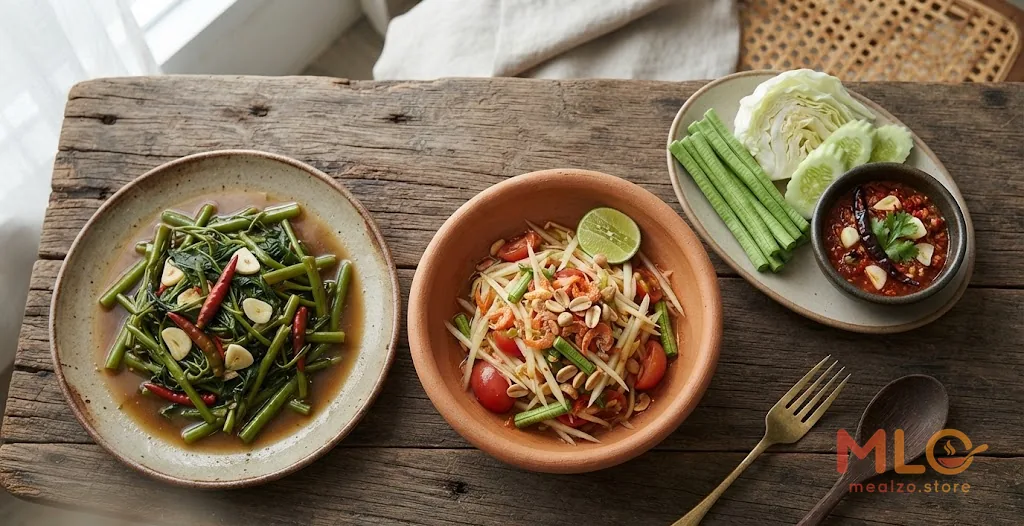
1. Why a plate full of green things can still contain little vegetable volume
Pad kra pao is a perfect example. Holy basil is essential to the dish. Without it, the flavour changes completely. But basil leaves scattered through minced meat do not usually form a substantial vegetable component of the plate.
The same pattern appears across everyday Bangkok meals. A stir fry may contain carrot slices and pieces of long bean. A bowl of soup may arrive covered with coriander. A rice plate may include cucumber. A noodle dish can contain bean sprouts, spring onion and Chinese chives.
All of those ingredients count as plant foods. None should be dismissed.
The problem is volume, not virtue.
Imagine removing the rice, noodles, meat and sauce from your next meal. Look at what remains. If the vegetables that are left would fit into one corner of the plate, that is a more honest picture of the vegetable portion than the number of different green ingredients in the dish.
Key takeaway: A meal can contain several vegetables without vegetables forming a substantial part of the meal.
This distinction between an ingredient and a component is the spine of the problem. A component occupies real space on the plate. An ingredient may provide flavour, texture or colour while contributing very little volume.
That is why the simplest test works so well: look at the plate and estimate how much would remain if the rice, noodles and sauce disappeared. You do not need an app, kitchen scale or nutrition database. You only need to look at what is physically there.
2. Aromatics create enormous flavour, but they are not a vegetable portion
Thai cooking uses plant ingredients brilliantly. Lemongrass, galangal, kaffir lime leaf, garlic, shallot and chilli can transform a bowl of food with relatively small quantities.
That intensity is exactly why they can confuse our intuition about vegetable intake.
A tom yum can taste intensely of lemongrass, galangal, lime leaf and chilli. The bowl feels full of plants because those plants dominate the aroma and flavour. Yet some of those ingredients are not eaten at all. The woody lemongrass pieces, galangal slices and lime leaves are often pushed to the side.
Even the aromatics you do eat are present mainly for flavour rather than volume.
This does not make them unimportant. It simply means they should not be mentally counted as though they were equivalent to a separate plate of morning glory or mixed vegetables.
A useful distinction is:
- Aromatics: garlic, chilli, shallot, lemongrass, galangal and lime leaf used mainly to build flavour.
- Garnish: coriander, spring onion, cucumber or herbs added in relatively small amounts.
- Vegetable component: vegetables occupying a noticeable part of the dish or served as a separate side.
- Vegetable-led dish: food such as pad pak bung, pad pak ruam or a substantial raw vegetable plate where vegetables are central rather than decorative.
Once you start seeing those categories, everyday Thai meals become much easier to read.
3. What fibre actually is, and where it comes from
Dietary fibre is the part of plant food that your body does not break down in the same way it handles protein, fat and digestible carbohydrate.
There are different kinds, but you do not need a biology lecture to understand the practical distinction. Some fibre holds water and slows the movement of food through the digestive process. Other fibre adds bulk and helps material move through the gut.
Fruit, vegetables, whole grains, beans, pulses, nuts and other plant foods are the main places you encounter it.
Meat does not contain fibre. Fish does not contain fibre. Eggs and dairy do not contain fibre. Oil does not contain fibre. These foods can be prepared carefully, taste excellent and fit comfortably into a meal, but they cannot provide something they do not contain.
That is why a rice plate with meat, sauce, oil, basil and a few cucumber slices may contain less fibre than its colourful appearance suggests.
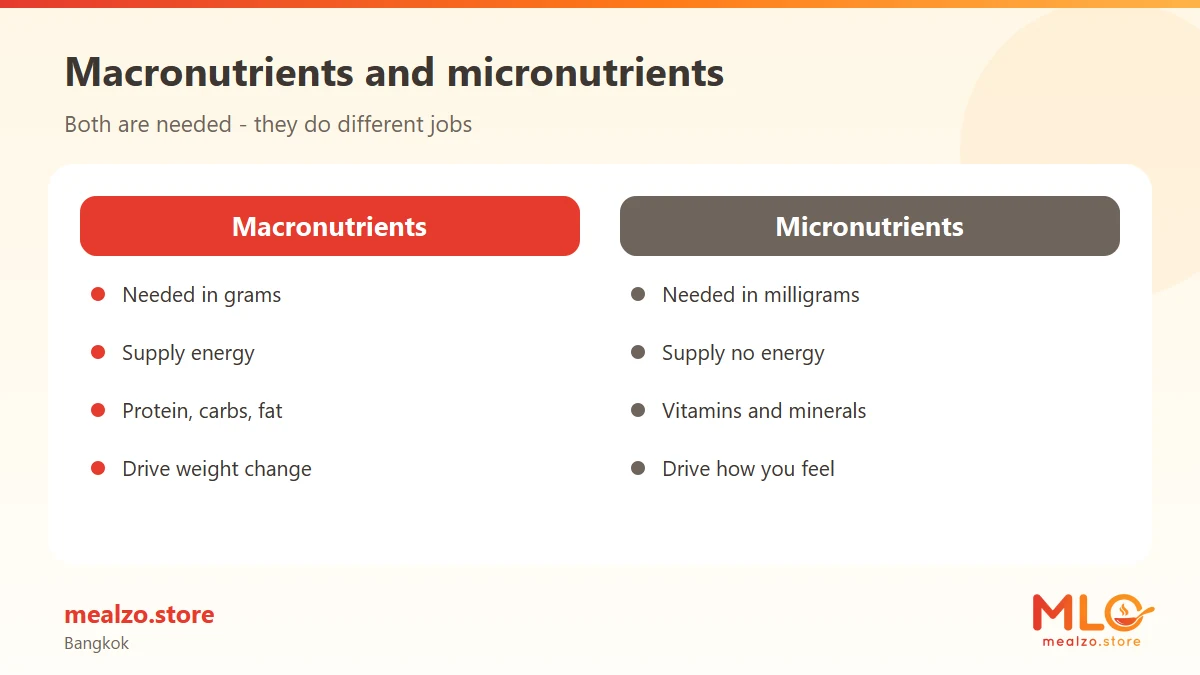
This is also why the question cannot be answered by looking only at whether a meal contains protein, carbohydrate and fat. Those tell you important things about the structure of the meal, but fibre comes primarily from the plant portion.
If you want a broader framework for organising the whole meal rather than focusing only on fibre, this guide to building a balanced plate without counting every gram explains the same problem from the perspective of the whole plate.
Key takeaway: Fibre comes from the plant part of the meal, so a meal can contain plenty of protein and carbohydrate while still providing relatively little fibre.
4. Why fibre changes how a meal behaves
Fibre matters because it changes the physical structure of the food you eat.
When carbohydrate arrives together with a larger amount of intact plant material, digestion has more structure to work through. Fibre can hold water, add bulk and slow how quickly the contents of a meal move and are absorbed.
That is one reason two meals with similar amounts of rice or noodles can feel different afterward. A plate dominated by refined carbohydrate and sauce behaves differently from one where a substantial vegetable dish sits beside the same staple.
Fibre also adds volume without relying entirely on rice, noodles, meat or oil to fill the plate. More physical food has to be chewed and eaten, which can change how long the meal occupies you and how long it feels substantial afterward.
Regularity is another practical reason people notice fibre. Fibre contributes bulk and interacts with water in the digestive tract. For many people, changing the amount of fibre they eat changes how predictable their normal bowel routine feels.
That is a mechanism, not a promised outcome. Digestion varies from person to person, and fibre is not something to increase aggressively just because an article says more is useful.
The useful point is simpler: if your meals are built mostly from refined rice or noodles, meat and sauce, a small scattering of vegetables may not provide as much fibre as you assumed.
5. The white rice question is usually about adding, not replacing
Jasmine rice is central to everyday eating in Bangkok. It works with curries, stir fries, grilled meat, soups, chilli pastes and countless combinations. It is also refined rice.
Brown and less polished varieties exist in Bangkok, but they taste different and change the experience of the meal. Plenty of people simply prefer jasmine rice.
There is no need to turn that preference into a moral argument.
The more useful observation is geometric. Rice often occupies a large share of the plate. Vegetables frequently occupy a much smaller share. If you do not want to replace the rice, the obvious alternative is to add something beside it.
That might mean ordering pad pak bung with your usual rice plate rather than expecting the basil in pad kra pao to do the same job. It might mean adding a bowl of clear vegetable soup. It might mean accepting the raw vegetables beside nam prik as an important part of the meal rather than decoration.
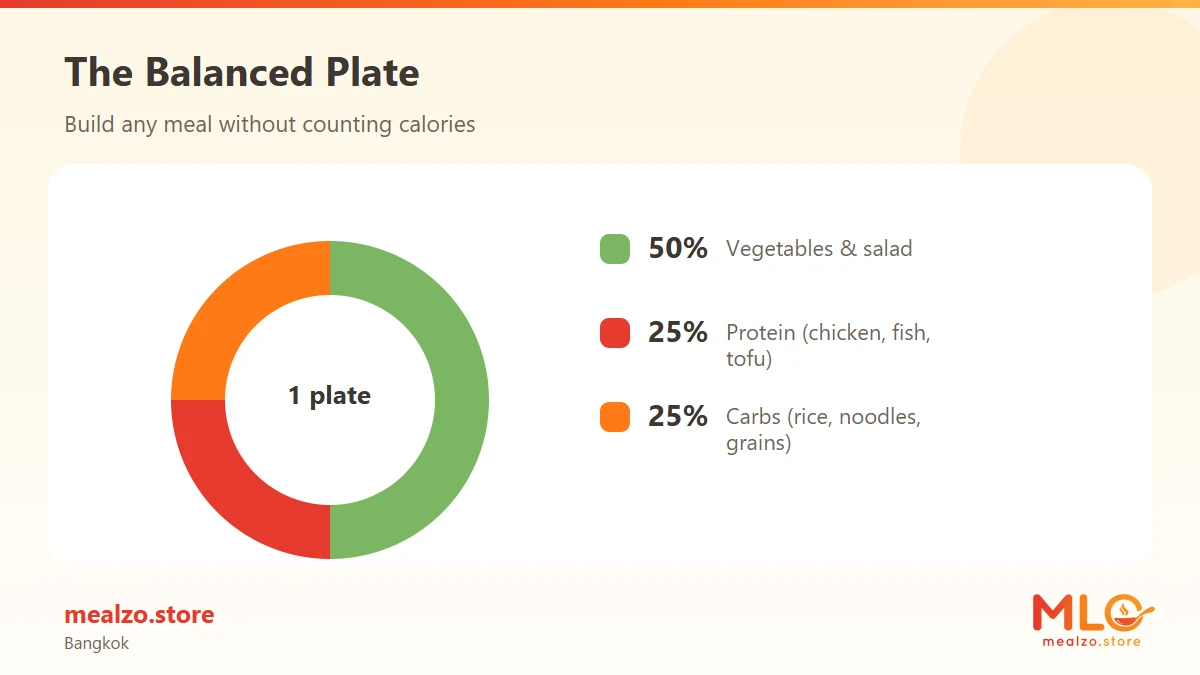
Think in terms of visible components. The rice can stay. The protein can stay. The question is whether vegetables have their own meaningful place beside them.
For some people, replacing white rice with a less refined rice is an easy change. For others, it removes one of the things they enjoy most about Thai food. Adding vegetables works in both situations.
6. Thai food can deliver a lot of vegetables when you order the dishes that do it
Thai cuisine has no shortage of vegetable-led dishes. The challenge is that they do not automatically appear in sufficient quantity inside every rice or noodle dish.
Once you know what to order, the situation changes quickly.
Som tam places shredded green papaya at the centre of the dish. Pad pak bung makes morning glory the main event. Pad pak ruam provides mixed vegetables as a dedicated dish rather than a few pieces distributed through something else. Gaeng liang can contain a clearly visible vegetable component. Nam prik is often served with raw or boiled vegetables specifically intended for dipping.
Certain clear soups also provide meaningful vegetable volume, depending on what is actually in the bowl.
Here is a practical way to read several common choices:
| Thai dish or meal | Where the vegetables actually sit | Most effective addition |
|---|---|---|
| Pad kra pao with rice | Basil is mainly a flavour ingredient, cucumber may be a small side | Add a separate vegetable dish |
| Stir fry with meat and vegetables | Vegetables are mixed through the main dish, but may remain secondary | Ask for extra vegetables |
| Pad pak bung | Vegetables are the main component | Pair it with your usual rice and protein |
| Pad pak ruam | Mixed vegetables form their own dish | Treat it as a full side rather than a garnish |
| Som tam | Green papaya forms much of the dish | Use it as a vegetable component beside the rest of the meal |
| Nam prik with raw vegetables | Vegetables are served separately for dipping | Eat the vegetable plate rather than leaving it behind |
| Clear vegetable soup | Vegetables can occupy meaningful bowl volume | Choose the version where vegetables are clearly visible |
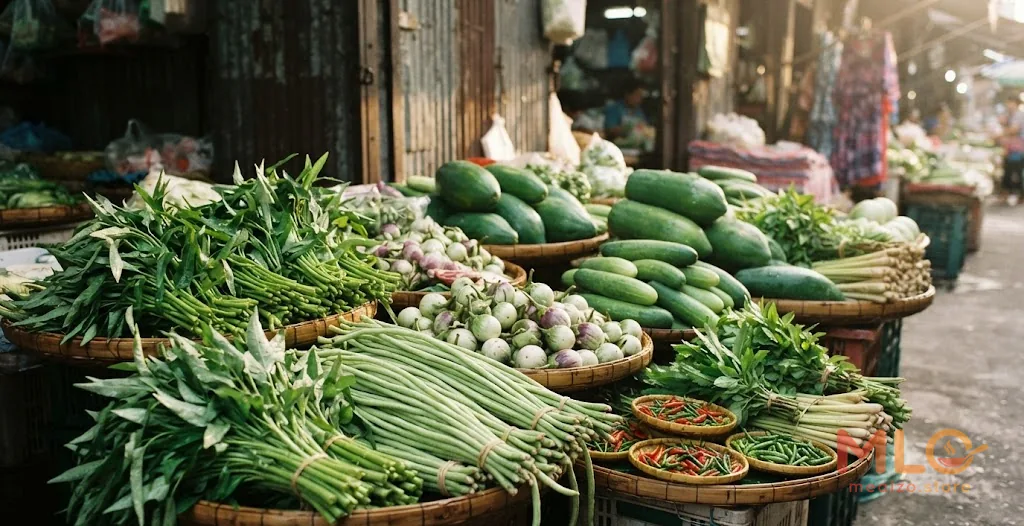
Som tam deserves one qualification. It is a vegetable-led dish, but it does not need to become the answer to every meal. Variety still matters in practical eating. Morning glory, mixed vegetables, soups, boiled vegetables and raw plates provide different textures and make it easier to keep vegetables present without repeatedly ordering the same thing.
Thai salads, or yam dishes, can also contribute useful plant ingredients, although the exact vegetable volume varies considerably by dish. Look at what is actually in the bowl rather than assuming the word "salad" guarantees a particular structure.
If you are comparing classic Thai dishes from a broader meal-planning perspective, this practical look at pad Thai, som tam and tom yum covers how familiar favourites fit into an ordinary day of eating.
7. Fruit in Bangkok counts, and it is often the easiest addition
Bangkok makes fruit unusually easy to eat. Fresh fruit is widely available, often ready to eat, and easy to use as a snack when preparing vegetables is unrealistic.
Fruit counts as plant food and contributes fibre. There is no reason to treat it as a consolation prize because you did not cook vegetables.
There are only two caveats worth making here.
First, ready-cut fruit is often sold with a sugar and chilli dip. The fruit itself has not stopped being fruit, but the dip is an additional part of what you are eating.
Second, fruit blended into a smoothie with syrup no longer behaves like eating intact pieces of fruit. Blending changes the physical structure, and added syrup changes the drink again.
Neither point is an argument for avoiding fruit.
For a person working long hours, a piece of fruit may be the most realistic plant food available between meals. That is considerably more useful than designing a perfect theoretical snack you never actually eat.
The same principle applies to vegetables.
| Change | What it costs in taste or effort | When it is worth it |
|---|---|---|
| Add a separate vegetable dish | Extra ordering and another plate on the table | When the main dish contains only scattered vegetables |
| Ask for extra vegetables in a stir fry | May slightly change the balance of sauce and protein | When you already like the dish and want more plant volume |
| Replace white rice with less polished rice | Changes texture and flavour | When you genuinely prefer it or do not mind the difference |
| Keep the rice and add vegetables | More food to order or prepare | When you want to preserve the original dish |
| Choose fruit as the default snack | Very little preparation | When the alternative is usually a snack with no meaningful plant component |
| Add beans or pulses where they already fit | Some dishes simply do not suit them | When the cuisine or meal already uses them naturally |
Key takeaway: Adding a vegetable side is often easier to sustain than redesigning the entire meal around substitutions.
8. The food court and condo problem is real
Advice about vegetables often assumes you have a large kitchen, plenty of equipment and enough time to prepare several components every evening.
That is not how many people live in Bangkok.
A condo kitchen may consist of an induction hob, a small preparation area and no oven. A workday may end late. At a food court, the vegetable dish may be the item you wanted but did not manage to order.
None of this means vegetables are difficult to find in Bangkok. Fresh vegetables are abundant at wet markets and supermarkets, and cost is often not the main obstacle. The problem is turning ingredients into something you will actually eat when you are tired and not cooking.
When you are ordering instead, use a simple method:
- Order a vegetable dish separately rather than hoping enough vegetables are hidden inside the main dish.
- Ask for extra vegetables when ordering a stir fry if the vendor or restaurant can accommodate the request.
- Eat the raw vegetable plate when it accompanies nam prik.
- When choosing between soups, look for one with visible vegetables rather than assuming a strongly flavoured broth provides the same thing.
- Add fruit when another vegetable dish is not realistic.
If the entire day has fallen apart and you are choosing food from a convenience store, this guide to eating from a Bangkok convenience store when there is no real plan deals with that situation directly.
There is also a separate issue with heavily seasoned restaurant food. Fibre and vegetables should not be confused with questions about salt. where salt and sodium hide in Thai food covers that topic separately.
9. The thirty-second plate test and what to do when you have no time
At your next meal, ignore the name of the dish for a moment.
Mentally remove the rice, noodles and sauce. Then look at what would remain.
Would there be a substantial amount of vegetables left, or mainly meat, a few herbs and several pieces of garnish?
That is the thirty-second test.
It works because it measures what people often misjudge: volume. A dish does not become vegetable-heavy simply because five different plant ingredients appear in it.
Once you have identified the problem, additions are usually the easiest response.
You could add:
- a separate vegetable stir fry,
- a clear soup containing visible vegetables,
- som tam beside a rice dish,
- raw or boiled vegetables with chilli dip,
- fruit as the default snack,
- beans or pulses where they already make sense in the meal.
A boiled egg can also be paired with a vegetable-led dish when you want another component without turning the meal into a complicated project. The egg itself does not add fibre, but it can make the vegetable dish easier to build into a complete meal.
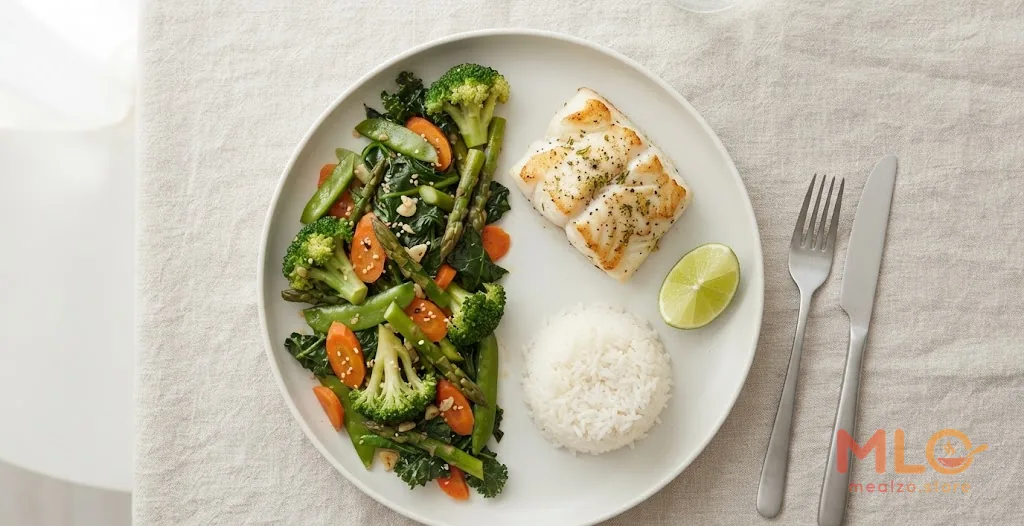
On a day with no time at all, a bag of pre-cut vegetables or a piece of fruit is a valid practical answer. It does not need to become a recipe.
Planning the perfect meal and then eating none of its planned vegetables is less useful than eating the simple option that was available.
10. Going from very little fibre to a lot can backfire
If you have eaten relatively little fibre for a long time, suddenly loading several meals with large amounts of vegetables, fruit, whole grains and beans can leave you feeling bloated and uncomfortable.
That does not automatically mean fibre is the problem forever. It may simply mean the change was abrupt.
Fibre interacts with water and adds bulk. Increasing it quickly while drinking too little can make the situation more uncomfortable rather than less.
A more realistic approach is gradual.
Add one reliable vegetable component. Let that become normal. Add fruit more consistently. Order a vegetable side more often. Use beans or pulses where they already fit. Increase water intake as the amount of fibre in your food rises.
There is no prize for changing everything in one day.
For most people, this is easier than moving from a low-fibre routine to an aggressively high-fibre menu overnight.
Key takeaway: If your usual fibre intake is low, increase plant food gradually and increase fluids alongside it rather than making a sudden jump.
11. Where a portioned meal plan helps, and where it does not
A portioned meal plan solves one specific practical problem: the vegetable component can already be inside the meal instead of becoming the thing you remember to add after making every other decision.
That can matter on ordinary Bangkok workdays when choosing, shopping and cooking are the main barriers.
Mealzo Bangkok operates a kitchen in Bang Na. Meals are cooked fresh daily and delivered across Bangkok. Customers choose either a morning delivery window from 06:00 to 09:00 or an evening window from 17:00 to 20:00.
The plans use one mixed cuisine combining Thai and international dishes. There is no separate Thai-versus-international cuisine selection. Mealzo Bangkok offers twelve plan types, six daily calorie levels from 1200 to 2500 kcal, options for three or five meals per day, and packages lasting 3, 7, 14 or 30 days.
The practical advantage in the context of this article is not that a meal plan somehow solves fibre intake automatically. It is that portioning and meal composition have already been decided for the meals covered by the plan.
That limit matters.
If you eat three planned meals and then add two unplanned meals or snacks, the plan does not control what happens in those other eating occasions. Most of the decision-making still belongs to you.
Anyone considering this approach can view Mealzo Bangkok meal plans.
Mealzo Bangkok also allows customers to declare allergens from nine allergen groups. Dishes containing a declared allergen are not assigned to that customer. This describes the assignment mechanism only and should not be interpreted as a guarantee that a meal is allergen-free.
Payment is exclusively online through PromptPay, Thai QR or credit card processed by a payment provider. Couriers do not collect cash.
The website and mobile app are available in Thai, English, Polish, German, French, Russian, Simplified Chinese and Burmese. The Android app is available through Google Play.
The calorie calculator in the app uses the Mifflin-St Jeor formula. It provides an estimate and is not medical advice.
12. Who should ignore the general advice to eat more fibre
General nutrition advice stops being useful when it conflicts with individual medical instructions.
Anyone with a diagnosed digestive condition such as IBS or inflammatory bowel disease, anyone recovering from surgery, and anyone who has been advised by a doctor to limit fibre should follow that advice rather than this article. For some people, increasing fibre is exactly the wrong instruction.
For everyone else, the narrow point of this article remains practical rather than medical: Thai food can contain many plant ingredients while the vegetable component on the plate remains smaller than it appears.
You do not need to stop eating jasmine rice. You do not need to reject Thai food. You do not need to transform every meal.
You need to notice whether vegetables are acting as garnish and flavour, or whether they have actually earned their own space on the plate.
FAQ
Does the basil in pad kra pao count as a vegetable?
Yes. Holy basil is a plant food and it counts. The issue is quantity. In a typical pad kra pao, basil functions mainly as a flavour ingredient rather than a substantial vegetable component, so it should not automatically be treated as equivalent to a separate vegetable dish.
Is som tam a good way to add more vegetables to a Thai meal?
Som tam is one of the Thai dishes where the vegetable component is clearly central because shredded green papaya makes up much of the dish. It can therefore work well beside rice, protein or another main dish when your original meal contains only a small amount of vegetables.
Do I need to stop eating white jasmine rice to get more fibre?
No. Less polished rice can contribute more plant structure, but changing the rice is not the only option. If jasmine rice is an important part of the meal for you, keeping it and adding a substantial vegetable side is often the simpler change.
Does fruit count if I am not eating enough vegetables?
Fruit contributes fibre and absolutely counts as plant food. The two practical qualifications are that ready-cut fruit may come with a sugar and chilli dip, and fruit blended into a smoothie with syrup no longer behaves like intact fruit.
What is the easiest way to get more vegetables when I eat Thai food outside every day?
Stop relying on the vegetables hidden inside the main dish. Order a separate vegetable dish, ask for extra vegetables in a stir fry where possible, eat the raw vegetable plate served with nam prik, or choose a soup where vegetables form a visible part of the bowl.
Why do I feel uncomfortable if I suddenly eat much more fibre?
A rapid increase adds considerably more plant material and bulk to the digestive system at once. Fibre also interacts with water, so increasing fibre sharply without increasing fluids can make discomfort worse. Gradual changes are generally more practical than changing the entire diet overnight.
Mealzo Bangkok is a kitchen and meal delivery service operating exclusively in Bangkok, Thailand. We are not affiliated with similarly named services outside Thailand.
Find a Meal Plan That Fits
Compare Mealzo plans or use the calculator to explore meal options for your needs.