Salt and Sodium in Thai Food: Where It Hides and What to Do About It in Bangkok
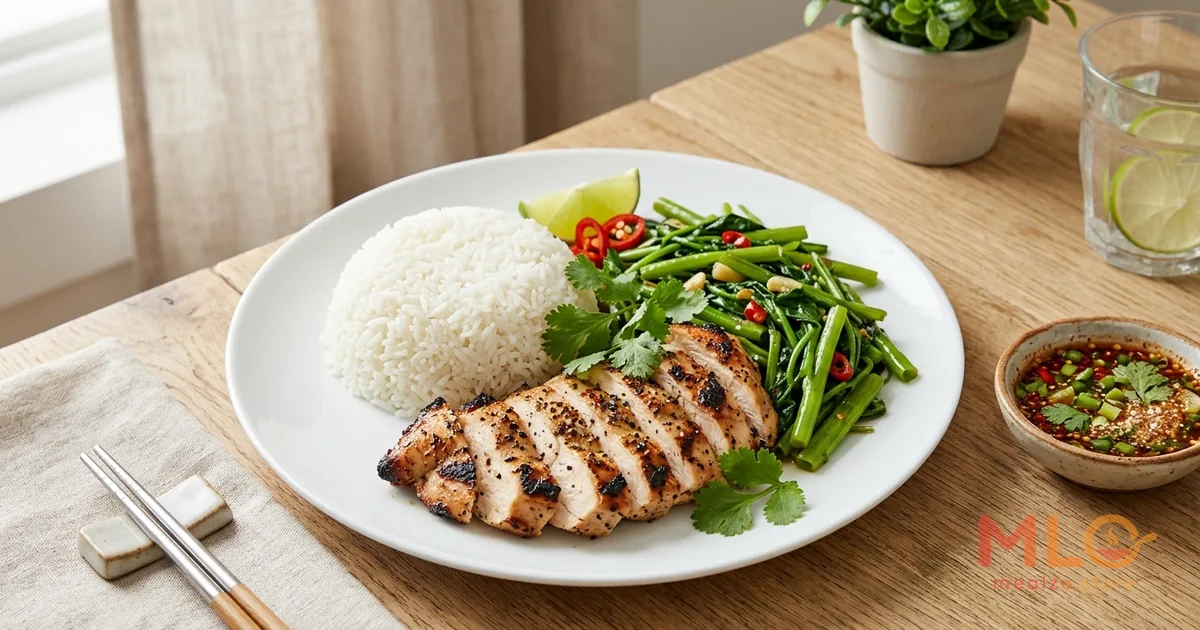
If you eat Thai food regularly in Bangkok, you probably do not think of salt as something you add yourself. You taste fish sauce in a stir-fry, a spoonful of curry, a dipping sauce with grilled chicken, or the seasoning in a bowl of noodles. The salt is already there, built into the food.
That is the key to understanding sodium in Thai food. The biggest sources are often not visible grains of salt. They are sauces, pastes, broths, marinades and fermented ingredients used to create the flavours Thai food is supposed to have.
This also explains why "just add less salt" is often poor advice. A cook can leave the salt shaker untouched and still produce a very salty meal. Conversely, removing every salty ingredient would remove much of the character of the dish.
The useful question is therefore not whether Thai food is salty. It is where the sodium is coming from, how much control you have over it, and which small choices make sense when eating in Bangkok.
1. Why salt in Thai food is a different question from salt in general
Salt and sodium are related, but they are not the same thing. Sodium is a mineral found in salt and in many other ingredients. When people talk about reducing salt in the diet, sodium is generally the nutrient they are concerned with.
The practical difficulty in Thai food is that sodium is often part of the seasoning system rather than a final decoration.
Thai cooking uses salty ingredients for several reasons. Fish sauce adds saltiness but also fermentation and depth. Soy sauce brings colour and savouriness. Oyster sauce contributes sweetness and umami as well as salt. Shrimp paste, fermented soybean pastes and curry pastes bring their own distinctive flavours.
That means sodium can be spread across several components of one dish.
Consider a simple plate of stir-fried vegetables. The vegetables themselves may contain little sodium, but the finished dish could include seasoning sauce, soy sauce or oyster sauce. If it comes with a dipping sauce, that adds another source. If the protein has been marinated first, there may be another layer.
This is why the preparation matters more than the name of the dish.
The World Health Organization publishes population-level guidance on salt and sodium, but individual needs and medical circumstances are different. WHO guidance on sodium
Key takeaway: In Thai cooking, sodium is often part of the recipe itself, so choosing how a dish is prepared is usually more useful than simply asking for less salt.
Thai food is not the villain here. The problem is much simpler: when a dish is unlabelled and seasoned by someone else, you have less information and less control.
2. The salty backbone of Thai seasoning
The easiest way to understand sodium in Thai food is to look at the ingredients that form its salty backbone.
Common examples include:
- Fish sauce, or nam pla
- Light and dark soy sauces
- Oyster sauce
- Seasoning sauces
- Shrimp paste, or kapi
- Fermented soybean pastes
- Curry pastes
- Stock cubes and prepared soup bases
- Chilli sauces and dipping sauces
- Nam pla prik and chilli mixed with fish sauce
Many of these ingredients are concentrated. A small amount can season an entire pan of food.
This is also why asking a restaurant to "use less salt" may not change much. The kitchen may not be adding table salt in the first place. The sodium may be coming from fish sauce, soy sauce or a prepared seasoning mixture.
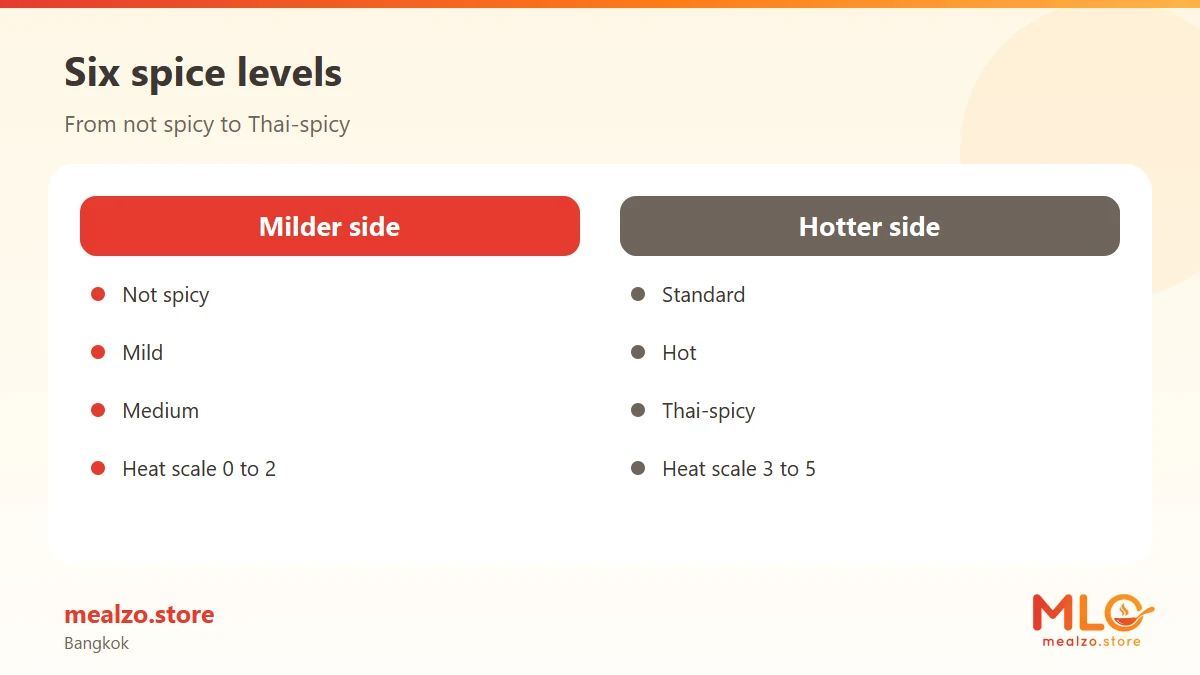
There is another important distinction between saltiness and heat. A dish can be extremely spicy without necessarily being extremely salty, while a mild dish can contain substantial salty seasoning. Chilli does not tell you how much sodium is present.
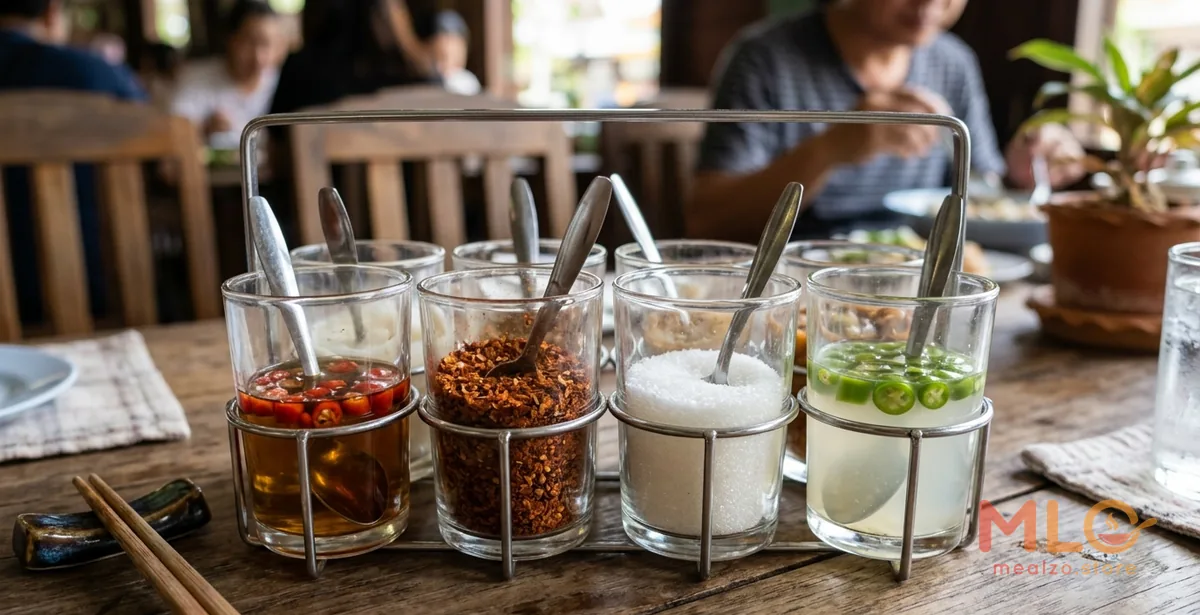
The condiment caddy adds another variable. In a typical Thai eating environment, you may have fish sauce, chilli in fish sauce, vinegar, sugar, chilli flakes or other seasonings within easy reach. The food arrives seasoned, but the meal can become significantly more seasoned after several spoonfuls from the caddy.
The simplest intervention costs nothing: taste first.
If the food already tastes balanced, there is no reason to automatically add fish sauce or another salty condiment.
Key takeaway: "Less salt" only works when salt is actually the ingredient being reduced. In Thai cooking, the more useful question is often which salty sauces and pastes are being used.
3. Where sodium hides that people never check
The obvious salty dishes are not always the biggest surprise. Sodium often appears in foods that do not taste dramatically salty.
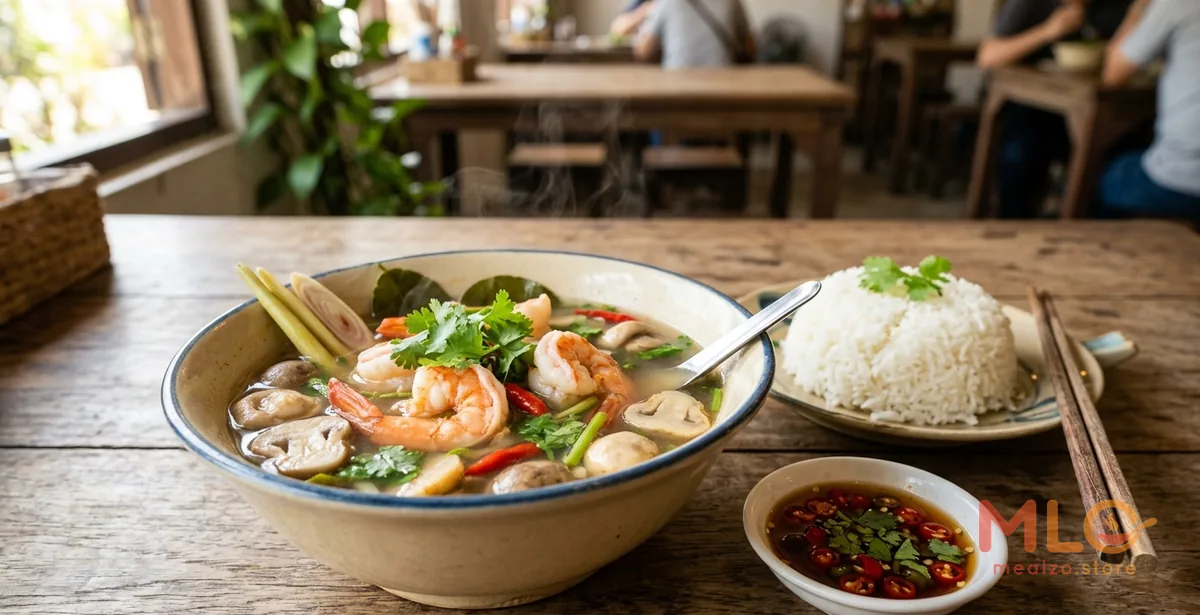
Broth is a good example. A bowl of soup can contain vegetables, herbs, meat or seafood, but the liquid itself may be seasoned with fish sauce, soy sauce, stock cubes or prepared soup bases.
Marinades are another overlooked source. Fresh chicken, pork, beef or seafood may be transformed before cooking with sauces and seasoning mixtures. By the time it reaches the grill or pan, the sodium is already part of the preparation.
Processed proteins deserve attention too. Sausage, ham, luncheon meat, dried fish and salted fish are not equivalent to freshly cooked meat or seafood. Preservation and processing often involve salt or salty ingredients.
Then there are foods eaten between meals:
- Crisps and savoury crackers
- Dried squid and other dried seafood
- Roasted or seasoned nuts
- Instant noodles
- Packaged snacks
- Stock cubes
- Prepared salad dressings
- Sauces used as dips
Some sweet drinks can also contain sodium. Sweetness is therefore not a reliable signal that a drink contains little sodium.
The important point is not to memorise a list of forbidden foods. It is to recognise where sodium can enter the day without looking like a salt-heavy meal.
| Item | Why it can be salty | Practical swap |
|---|---|---|
| Instant noodles | Seasoning powder and soup base | Use less of the seasoning and do not automatically drink all the broth |
| Dried squid | Salt is commonly part of drying and seasoning | Choose a less-seasoned fresh protein instead |
| Seasoned nuts | Salt and flavour coatings | Choose unsalted or lightly seasoned nuts when available |
| Crisps | Salt is added during processing | Choose fresh fruit or plain nuts for a different snack |
| Sausage or luncheon meat | Processing and curing can involve salt | Choose freshly cooked meat, poultry or seafood |
| Salad dressing | Prepared dressings can contain salty ingredients | Ask for dressing on the side |
| Stock cubes | Concentrated seasoning | Use a controlled amount in home cooking |
| Dipping sauce | Concentrated salty seasoning | Keep it on the side and use only what you need |
The swap does not have to be perfect. The objective is simply to move sodium from places where you do not notice it into places where you can make a deliberate choice.
4. Higher and lower sodium dishes by preparation
It is tempting to create a list of "safe" and "salty" Thai dishes. That approach is too simplistic.
The same general type of food can be prepared very differently. A grilled protein served with sauce on the side gives you more control than a protein that has been heavily marinated and coated in sauce. A vegetable dish cooked quickly with several salty sauces can behave differently from steamed vegetables served separately.
Clear soup is not automatically low in sodium, either. The broth may be highly seasoned even when the visible ingredients are vegetables and fresh protein.
Likewise, a thick curry can contain salty curry paste and additional sauces, but the exact preparation matters.
A useful way to think about the choices is this:
| Thai food preparation | Where sodium usually sits | Simple lower-sodium alternative |
|---|---|---|
| Clear soup | Broth and soup base | Eat the solids and leave some broth |
| Thick curry | Curry paste, fish sauce, soy sauce or other seasoning | Choose a less sauce-heavy preparation |
| Stir-fry in sauce | Cooking sauces added directly to the pan | Ask for lighter seasoning where practical |
| Grilled protein | Marinade and dipping sauce | Freshly grilled protein with sauce on the side |
| Steamed protein | Seasoning and accompanying sauce | Keep sauce separate |
| Salad with dressing mixed in | Dressing and seasoning throughout the dish | Request dressing on the side |
| Noodles in broth | Soup base and seasoning | Eat the noodles and toppings without automatically finishing the broth |
| Fresh vegetables with dip | Dipping sauce | Dip lightly rather than coating each bite |
This is not a ranking of Thai dishes from good to bad. It is a ranking of control.
When sodium is concentrated in a separate sauce, you can decide how much you use. When it is mixed throughout a curry, marinade or broth, you cannot separate it afterwards.
Key takeaway: The lower-sodium choice is often the preparation that gives you control, not a particular dish name.
5. The table caddy and the habit of tasting first
The condiment caddy is a small detail with a surprisingly large effect on how a meal develops.
Thai food is often served already seasoned. The caddy exists because people have different preferences for sourness, sweetness, saltiness and heat. Adding seasoning at the table is part of the eating experience.
There is nothing inherently wrong with that. The problem comes when seasoning becomes automatic.
A spoonful of fish sauce here and another spoonful of chilli in fish sauce there can turn an already balanced dish into something much saltier. Because the seasoning is added gradually, it may not feel like a major decision.
Try a simple sequence instead:
- Taste the food as it arrives.
- Decide whether it actually needs more seasoning.
- If it does, add a small amount.
- Taste again before adding anything else.
- Remember that chilli heat, sourness and sweetness can change how salty the food feels.
This approach also respects the food. A good Thai dish has multiple flavours working together. More seasoning is not automatically more flavour.
When ordering, a few short requests can sometimes help, although restaurant kitchens vary and may not always be able to accommodate them exactly:
- ไม่เค็มมาก: not too salty
- ขอน้ำจิ้มแยก: sauce on the side
- ไม่ใส่น้ำปลาเพิ่ม: no extra fish sauce
- แยกน้ำราด: dressing or sauce separately
Do not assume the kitchen will produce a completely different recipe. In a busy street-food stall, the cook may already have a standard preparation. A request is useful when it works, but choosing a different preparation is often more reliable.
6. Soups, broths and what you actually swallow
Soup deserves separate attention because people often think of the ingredients and forget about the liquid.
If a bowl contains vegetables, herbs and pieces of meat, you are eating the solids. But if the broth has been seasoned with fish sauce, soy sauce, stock or other salty ingredients, drinking the entire bowl means consuming the seasoned liquid too.
Leaving some broth behind does not make the underlying recipe less salty. It simply means you did not consume all of the liquid in the bowl.
This distinction matters with noodle soups, clear soups and other dishes where much of the seasoning is suspended in the broth.
It also explains why two people can eat the same bowl differently. One person might drink nearly all the liquid. Another might eat the noodles, vegetables and protein while leaving a substantial amount of broth.
Neither approach needs to be moralised. It is simply a difference in what is actually consumed.
For home cooking, the same principle makes the seasoning easier to manage. You know what went into the pot, and you can decide whether the finished dish needs additional sauce at the table.
7. Sauce on the side is the one habit worth remembering
If you want one practical habit from this entire article, make it this: ask for sauces on the side whenever that is realistic.
This works because it changes where the sodium is located.
When sauce is mixed into food, every bite carries the seasoning. When sauce sits separately, you control how much reaches the food.
This applies well beyond Thai food. It works with grilled chicken, vegetables, salads, seafood, fried foods and many mixed dishes.
It also changes the way you experience flavour. Instead of covering an entire plate with sauce, you can dip individual bites. Some bites may have more sauce, others less.
There are obvious exceptions. Curry paste, stir-fry seasoning and marinades are integrated into many Thai dishes during cooking. You cannot simply remove them after the fact.
That is why choosing the preparation is more powerful than trying to modify every finished dish.
If a menu offers freshly grilled or steamed food with a separate dipping sauce, you have more control than with a dish where several salty sauces are cooked into every component.
This is especially useful when eating out frequently in Bangkok. Small decisions repeated across many meals matter more than trying to make one meal perfect.
8. Processed and cured proteins are different from fresh protein
Protein is another area where the preparation can completely change the sodium picture.
Fresh chicken, pork, beef, fish or seafood is one thing. Sausage, ham, luncheon meat, dried fish and salted fish are different products.
Processing and curing can involve salt as part of preservation, texture or flavour. Dried seafood can be particularly deceptive because the product is compact and strongly seasoned.
This does not mean processed protein has to disappear from your diet. It means you should recognise it as a separate category when thinking about where sodium comes from.
At a Bangkok market or convenience store, a fresh piece of protein and a packaged cured product may sit only a short distance apart. They can play the same role in a meal while bringing very different preparation histories.
If you are building a meal yourself, freshly cooked protein gives you more control over the seasoning added during preparation. If you are eating out, look at how the protein is presented rather than assuming all grilled, fried or stir-fried proteins are equivalent.
9. Snacks, dried food and drinks
Main meals get most of the attention, but snacks can quietly add another layer of sodium to the day.
Crisps are an obvious example. Dried squid is another. Seasoned roasted nuts can also contribute, even though nuts themselves are not inherently salty.
The issue is frequency. A small packaged snack may not seem significant when considered alone, but a snack, a bowl of noodles, a salty dipping sauce and a heavily seasoned dinner are all part of the same day's intake.
Bangkok's convenience stores make this especially easy to overlook. Salty snacks are compact, portable and ready to eat. They do not require the same attention as sitting down to a bowl of curry or noodles.
Drinks deserve a quick mention too. Sweetness does not guarantee the absence of sodium. Some prepared drinks and beverages contain sodium even when their dominant taste is sweet.
The practical response is not to inspect every drink obsessively. It is to remember that taste alone does not tell you the whole nutritional story.
If you are hungry between meals, simple foods such as fresh fruit can provide a different option from a heavily seasoned packaged snack. Plain or less-seasoned nuts may also be useful when available.
10. Reading a label when there is one
Packaged food has one major advantage over street food: it may have a nutrition label.
When a sodium line is available, look at what the number refers to. A label can give sodium per serving, per 100 grams, or both, depending on the product and local labelling rules.
The serving size is where people get caught.
A package may look like one portion but define a serving as only part of the package. If you eat the entire package, the sodium you consume is not the number shown for one serving. It needs to be considered in relation to how much you actually ate.
This is why "per serving" can be misleading when the real serving is larger than the manufacturer's reference.
When comparing products, a consistent reference such as sodium per 100 grams can make comparison easier. But even then, the amount you actually eat matters.
For restaurant and street food, there is usually no nutrition label. That means the exact sodium content cannot be known from appearance alone.
Do not compensate for this uncertainty by inventing precision. If a street-food vendor does not publish the recipe or nutrition information, you cannot honestly know the sodium content of the finished dish.
Instead, use the variables you can see:
- Is the food heavily sauced?
- Is there a separate dipping sauce?
- Is the protein processed or freshly cooked?
- Is the dish based around broth?
- Are you adding more fish sauce at the table?
- Can you request lighter seasoning?
This is a much more useful response to uncertainty than pretending an exact figure exists.
11. Heat, sweat and thirst in Bangkok
Bangkok's heat adds another layer of confusion.
People sweat. They drink more. They may feel thirsty after walking outside, commuting, exercising or simply spending time in a hot environment. Then they eat a salty meal and feel even thirstier.
The relationship between fluid and salt is more complicated than "I sweat, therefore I should add salt" or "I am thirsty, therefore I must have eaten too much salt."
For everyday eating, it is enough to recognise the experience without turning it into a medical calculation.
A very salty meal can leave you noticeably thirsty. Some people also notice temporary puffiness after eating particularly salty food. Those experiences do not tell you exactly how much sodium you consumed.
Likewise, drinking plenty of fluids does not make the sodium in a meal disappear.
Bangkok's climate is a reason to pay attention to your overall eating and drinking habits, not a reason to start making personal electrolyte or sodium prescriptions from an article.
If you have a medical condition affecting fluid or salt balance, general food advice is not an appropriate substitute for individual guidance.
12. Vegetables, fruit and the ordinary balanced plate
There is no need to turn sodium into the only thing you think about when eating Thai food.
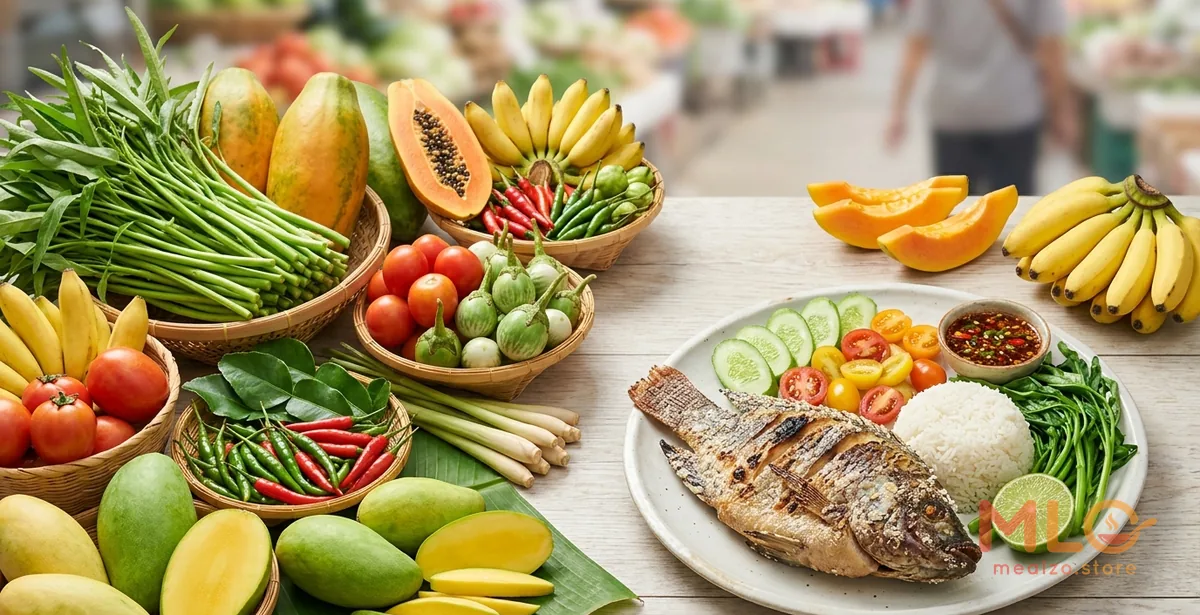
A balanced meal can include vegetables, fruit, protein, carbohydrates and fats alongside whatever seasoning makes the food enjoyable. Potassium-rich vegetables and fruits can be part of that ordinary pattern of eating.
Examples include leafy greens, tomatoes, bananas, papaya, citrus fruits and other produce. The point is not that potassium-rich foods "cancel out" sodium or treat a medical problem. They do not turn a salty meal into a nutritionally neutral one.
The better approach is simply variety.
If one meal is a salty noodle soup, another meal might include fresh vegetables and a simply prepared protein. If dinner comes with a rich sauce, breakfast or lunch does not need to revolve around another heavily seasoned dish.
For readers also watching carbohydrates or calories, sodium is only one part of the picture. Thai dishes can contain rice, noodles, sugar and coconut-based ingredients as well as salty seasonings. hidden carbohydrates in Thai food explores that side of Thai eating in more detail.
Similarly, meals such as Pad Thai, Som Tam and Tom Yum can vary considerably depending on preparation and portion. a practical look at popular Thai dishes and calories
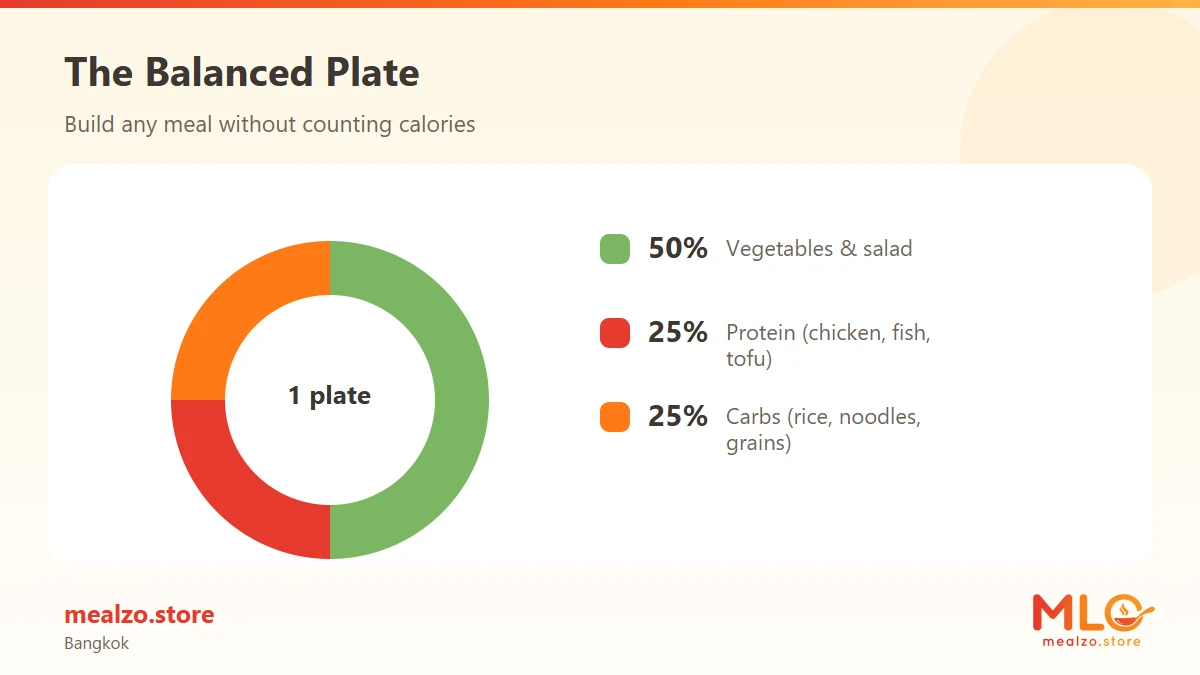
The goal is not a perfect plate. It is a pattern that gives you enough variety that no single seasoning habit dominates every meal.
Key takeaway: A balanced diet is broader than sodium. Vegetables, fruit and varied foods belong on the plate without pretending that any one ingredient treats the effects of another.
13. How a planned kitchen changes the variables
Eating out and cooking at home are not the same experiment.
A restaurant cook has to make food that tastes good immediately. Street food has to work for the next customer too. Seasoning is designed for a finished dish that is ready to eat now.
A planned kitchen works differently.
When meals are cooked from fixed recipes, the same dish can be prepared in a consistent way rather than adjusted plate by plate to win over a walk-in customer. Sauces can be measured and used deliberately. Seasoning does not have to be rescued at the end with another squeeze of fish sauce.
This is one reason meal planning changes the sodium conversation. It does not automatically make meals low sodium. It gives you more visibility into the variables.
Mealzo Bangkok operates a kitchen in Bang Na, Bangkok, where meals are prepared and delivered across Bangkok. The plans combine Thai and international dishes in the same mixed cuisine plan, rather than offering separate cuisine selections.
There are 12 plans, including Balanced, Weight Loss, High Protein, Vegetarian, Vegan, Keto, Low-Carb, Gluten Free, Easy-to-Digest, Pescatarian, No Fish & Seafood, and Dairy & Egg Free. Daily calorie levels range from 1200 to 2500 kcal, with options for 3 or 5 meals per day and package lengths of 3, 7, 14 or 30 days.
That does not make the meals sodium-controlled. It simply means the cooking process is based on planned recipes rather than the improvisation of a restaurant table.
For someone who eats out frequently in Bangkok, having some meals prepared in a consistent kitchen can also make it easier to understand the overall pattern of what they are eating. Thai food and weight loss discusses the broader relationship between Thai eating habits and meal planning.
There is also a social reality. Eating out is part of life in Bangkok. A sensible food routine should not require avoiding restaurants forever. meal plans and eating out in Bangkok looks at how planned meals and social eating can coexist.
If you want to use a planned meal service as part of that routine, explore Mealzo Bangkok meal plans gives you the available plans and package options.
Mealzo Bangkok offers morning delivery from 06:00 to 09:00 and evening delivery from 17:00 to 20:00, with the customer choosing one delivery window. Payment is online through PromptPay via Thai QR, processed by a payment provider.
The practical advantage is not a health promise. It is predictability. There is no table condiment caddy unless you put one on your own table, and the food is prepared according to the planned recipe rather than being adjusted in front of you.
The service also allows customers to declare allergens from nine allergen groups. Dishes containing a declared allergen are not assigned to them. This describes the assignment mechanism, not a guarantee that a meal is allergen-free.
14. Who should stop reading articles and talk to a doctor
For most people, understanding where sodium comes from is a useful nutrition skill. But general food articles have limits.
Recommended sodium and salt intakes are established by health authorities at a population level. They are not personal prescriptions.
If you have high blood pressure, kidney disease or heart failure, are pregnant, or take medication that affects fluid or salt balance, follow the advice of your doctor or qualified healthcare professional rather than trying to create a personal sodium target from an article.
The same applies if you have been specifically told to change your salt or fluid intake.
For everyone else, the useful lesson is straightforward: do not assume that the absence of a salt shaker means a meal is low in sodium. In Thai food, salty ingredients are often integrated into the cooking.
You do not need to eliminate them to understand them.
Look at sauces. Notice broths. Separate dipping sauces when possible. Choose freshly cooked proteins more often when that fits the meal. Taste before adding fish sauce. Read labels when labels exist, and accept that restaurant food cannot provide the same precision.
Most importantly, judge the preparation rather than the dish name.
Thai food has its flavour for a reason. The point is not to strip it of seasoning. The point is to know where that seasoning comes from, so you can make better choices when you have the choice.
FAQ
Is sodium in Thai food mainly from table salt?
Often, no. Thai cooking commonly gets sodium from fish sauce, soy sauce, oyster sauce, seasoning sauces, shrimp paste, fermented soybean products, curry pastes, stock cubes and prepared dipping sauces. Table salt may be used, but it is only one possible source.
Is Thai food automatically high in sodium?
No. Thai food covers a huge range of preparations. A dish that is grilled or steamed and served with sauce separately gives you more control than a dish where salty sauces are mixed into the food or a broth. The exact sodium content of restaurant food is usually unknown unless the recipe and nutrition information are provided.
Does asking for less salt work in a Thai restaurant?
Sometimes, but it depends on how the dish is prepared. If the kitchen uses fish sauce, soy sauce or another seasoning instead of table salt, "less salt" may not communicate exactly what you mean. Short requests such as ไม่เค็มมาก, meaning not too salty, or ขอน้ำจิ้มแยก, meaning sauce on the side, may be more practical.
Why can soup be different from eating the solids?
The broth can contain much of the seasoning. Eating the vegetables, noodles, meat or seafood does not necessarily mean consuming all of the seasoned liquid. If you leave some broth behind, you are not consuming that remaining portion of the liquid.
Are sauces on the side really useful?
Yes, because they give you control. When sauce is mixed into the food, every bite contains the seasoning. When it is served separately, you decide how much reaches each bite. This does not solve sodium in marinades, curry pastes or sauces already cooked into a dish, but it is one of the simplest choices available when ordering.
Does Mealzo Bangkok offer low-sodium meals?
Mealzo Bangkok does not claim its meals are low sodium, low salt or sodium controlled. Meals are cooked to fixed recipes in one kitchen, which means the seasoning is consistent rather than being adjusted plate by plate for a restaurant customer. The service offers mixed Thai and international cuisine within its plans, with different meal plans, calorie levels, meal frequencies and package lengths.
Mealzo Bangkok is a kitchen and meal delivery service operating exclusively in Bangkok, Thailand. We are not affiliated with similarly named services outside Thailand.
Find a Meal Plan That Fits
Compare Mealzo plans or use the calculator to explore meal options for your needs.