Pescatarian Meal Plans: Balancing Fish, Plants and Protein

A pescatarian meal plan sits in a practical middle ground. Fish and seafood stay on the menu, while meat and poultry do not. Vegetables, grains, legumes, fruit, nuts, seeds, dairy and eggs can still play substantial roles, depending on the individual plan.
That flexibility matters in Bangkok. Eating pescatarian here does not have to mean living on plain grilled fish and salad. Steamed fish with lime, tom yum goong, squid stir-fried with herbs, vegetable curries, tofu dishes and rice-based meals can all fit the general pattern when their ingredients match the plan.
The harder part is not finding seafood. It is building meals that feel complete rather than treating fish as the only interesting ingredient. A good pescatarian routine needs enough variety across plants, protein sources, carbohydrates and fats to remain practical day after day.
It also has to work around normal life. Commutes, office lunches, late meetings and Bangkok traffic tend to expose any eating plan that requires too much daily improvisation.

1. What a pescatarian meal plan actually includes
The simplest definition is a diet built without meat or poultry but with fish and seafood available as protein choices. Beyond that, pescatarian eating can vary considerably.
One person might eat fish several times within a rotating menu and rely on tofu, beans and eggs in other meals. Another might prefer seafood more often. Some include dairy; some do not. The label describes the broad boundary, not one fixed menu.
Typical ingredients can include:
- Fish such as sea bass, mackerel or other locally available varieties
- Shrimp, squid and shellfish
- Tofu, tempeh, beans, lentils and other legumes
- Eggs and dairy where the plan allows them
- Rice, noodles, potatoes and whole grains
- Vegetables, mushrooms, herbs and fruit
- Nuts, seeds and plant-based fats
What it excludes is clearer: dishes based on chicken, pork, beef, duck or other meat do not belong in a pescatarian plan.
Key takeaway: A pescatarian meal plan is not a seafood-only diet; fish and seafood are part of a broader pattern built around plant foods and other suitable protein sources.
2. Pescatarian versus vegetarian, vegan and other nearby plans
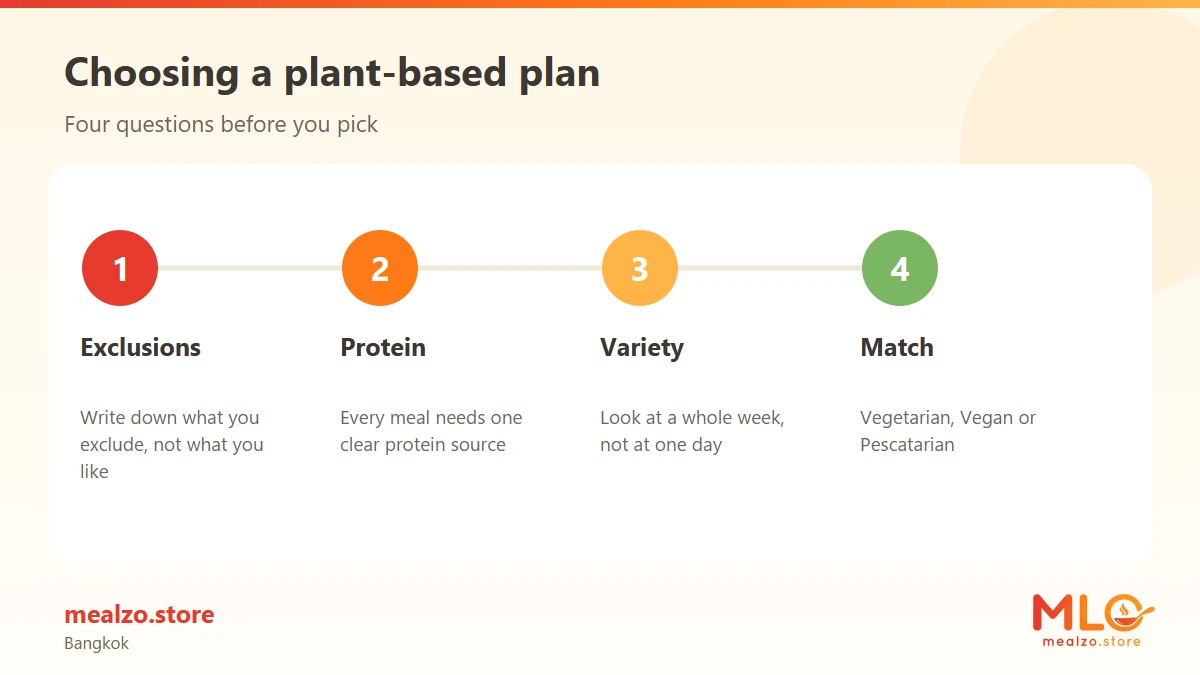
The labels can sound similar until you look at what actually appears on the plate. The main distinction is whether fish and seafood are included.
| Plan | Fish and seafood | Meat and poultry | Eggs and dairy | Plant foods |
|---|---|---|---|---|
| Pescatarian | Included | Excluded | May be included | Central to the plan |
| Vegetarian | Excluded | Excluded | Usually may be included | Central to the plan |
| Vegan | Excluded | Excluded | Excluded | Entire plan is plant-based |
| No Fish & Seafood | Excluded | Depends on the plan | May be included | Included |
| Balanced | May be included | May be included | May be included | Included |
Someone choosing between these approaches should think less about labels and more about foods they genuinely want to eat repeatedly. Our guide to choosing between vegetarian, vegan and pescatarian plans looks at those boundaries in more detail.
Pescatarian can be particularly convenient for people who already enjoy Thai seafood dishes but want to remove meat and poultry without shifting to a completely plant-based menu.
3. Fish should be one protein source, not the whole strategy
It is easy to design a pescatarian menu by simply replacing every piece of chicken with fish. That technically follows the definition, but it misses much of the useful variety available within the plan.
A more interesting rotation might move between steamed fish, tofu, eggs, legumes, shrimp and combinations of plant ingredients. This changes texture as well as flavour. It also stops lunch and dinner from becoming variations of the same seafood-and-rice plate.
Consider the difference between these meals:
- Pla neung manao with rice and vegetables
- Tofu stir-fried with basil and vegetables
- Lentil or bean-based curry with rice
- Egg-based meal with vegetables and a grain
- Tom yum goong served with rice and vegetable sides
- Squid with chilli, herbs and vegetables
The point is not that every pescatarian needs to eat each of these foods. It is that the plan becomes more flexible when several protein categories are available.
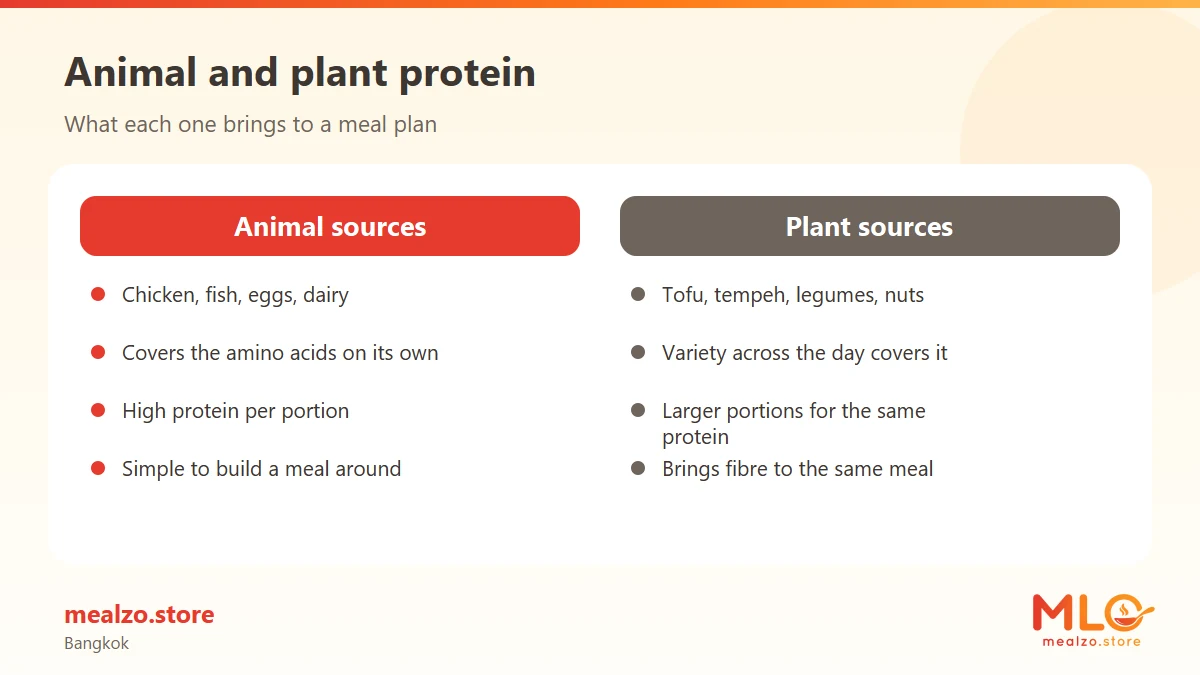
People considering a meat-free plan without seafood may find the protein ideas in our practical guide to vegetarian protein and meal variety useful as well.
4. Building a complete pescatarian plate
A meal generally feels more substantial when its components have distinct jobs. A bowl containing only noodles and a few shrimp may technically fit the plan but can feel very different from a meal built with a clear protein component, vegetables and an appropriate carbohydrate portion.
One useful way to think about meal construction is:
| Component | Pescatarian examples | Role in the meal |
|---|---|---|
| Main protein | Fish, shrimp, squid, tofu, eggs, legumes | Gives the meal its main protein component |
| Vegetables | Morning glory, cabbage, broccoli, mushrooms, pumpkin, greens | Adds volume, texture and variety |
| Carbohydrate | Jasmine rice, brown rice, noodles, potatoes, grains | Provides the main carbohydrate portion |
| Flavour base | Lime, chilli, garlic, ginger, lemongrass, herbs | Creates contrast and keeps meals distinct |
| Additional fats | Nuts, seeds, cooking oils, suitable sauces | Contributes richness and texture |
This framework works with Thai food because the cuisine already uses strong contrasts: sour with chilli, herbs with seafood, crisp vegetables beside softer rice, and aromatic broths around noodles or fish.
Key takeaway: Variety is easier when meals rotate both the protein source and the cooking style rather than changing only the sauce.
5. Bangkok makes pescatarian eating easier in some ways and harder in others
Bangkok offers an enormous range of fish and seafood dishes. Pla pao, steamed fish with lime, tom yum goong, seafood suki, squid stir-fries and fish-based rice dishes are ordinary parts of the food landscape rather than niche alternatives.
The complication is that the name of a dish does not always tell you everything inside it. A vegetable stir-fry may use a sauce or stock that does not fit a person's chosen eating pattern. A noodle soup may appear seafood-based while containing other ingredients in the broth. Shared dishes can make those boundaries even less obvious.
That does not mean restaurant eating is impractical. It means people who care about a particular dietary boundary usually have to pay attention to the complete dish rather than only the visible protein.
For busy days, that repeated checking can become tiring. The same problem affects vegetarian and plant-focused eating, which is why consistency is often more about planning than motivation. The practical approach to plant-based eating on busy Bangkok days covers that issue from a broader perspective.
6. Why plant variety still matters
The word "pescatarian" naturally draws attention to the fish. Yet much of the character of the diet comes from everything surrounding it.
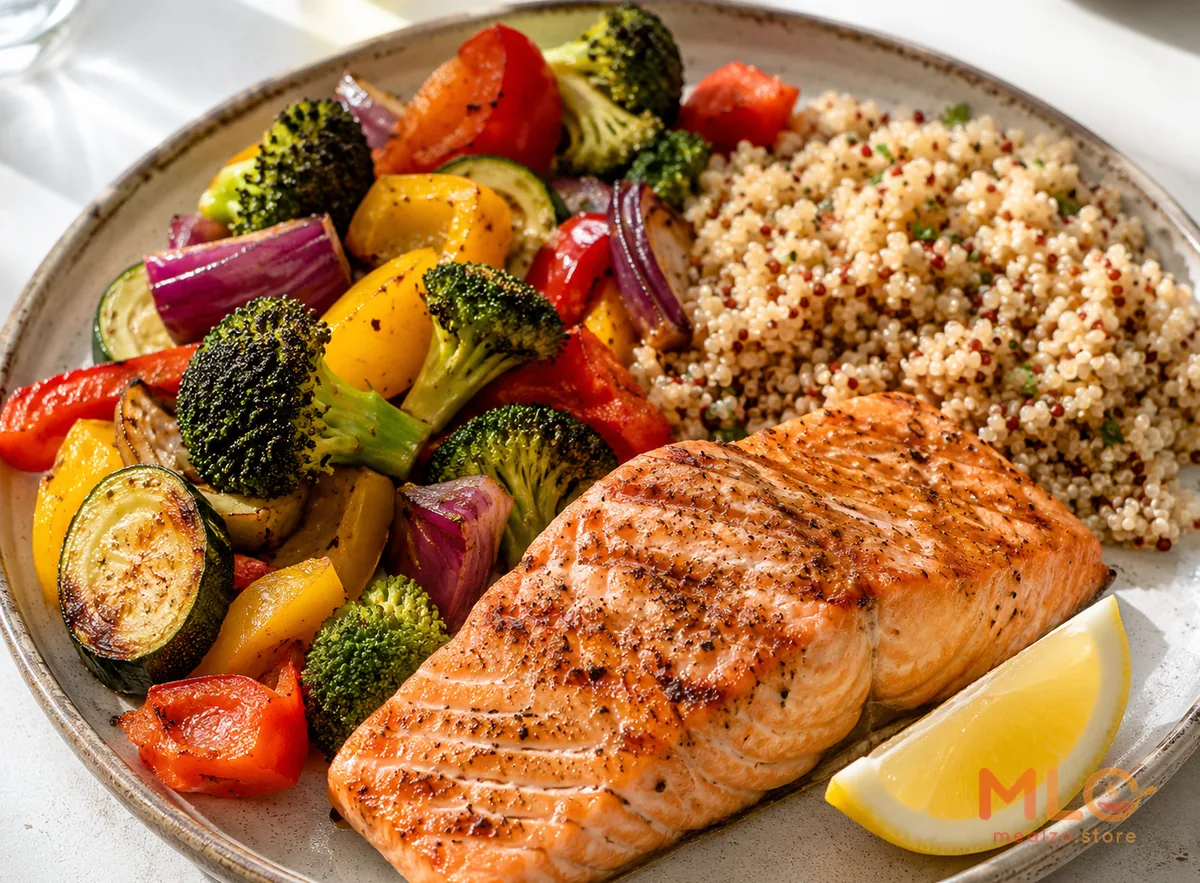
A week of rice, one vegetable and grilled fish is pescatarian. It is also repetitive. Change the vegetables, legumes, grains, herbs and cooking methods, and the same dietary pattern can produce meals that feel unrelated to one another.
For example, fish can appear in a light lime-and-chilli preparation one day, while the next meal relies on tofu with mushrooms and basil. Another day might use shrimp with vegetables, followed later by a bean-based meal without seafood at all.
This is useful from a menu-design perspective because variety does not require inventing unusual foods. Ordinary ingredients can be recombined in different ways.
A practical rotation might change:
- The main protein
- The vegetable mix
- Rice, noodles or another carbohydrate
- Dry stir-fry versus soup or curry
- Mild, sour, spicy or herb-led flavour profiles
- Thai-style meals versus simpler international combinations
7. Portions and calorie levels are separate from the diet label
"Pescatarian" tells you which categories of food belong in the plan. It does not tell you how much food a particular person needs.
Two people can both follow a pescatarian meal plan while choosing very different portions. Their schedules, body size, activity and individual goals may not be the same.
Mealzo therefore treats the dietary plan and calorie level as separate choices. The available daily calorie levels are 1200, 1500, 1800, 2000, 2200 and 2500 kcal. Customers can also choose either 3 or 5 meals per day.
The app includes a calorie calculator based on the Mifflin-St Jeor formula. It provides an estimate rather than medical advice. Someone can use that estimate as one piece of information when deciding which available level makes sense for their routine.
Key takeaway: Choosing pescatarian answers the question "which foods belong in my plan"; choosing a calorie level answers a different question about the amount of food provided.
8. Three meals versus five meals
Meal frequency is another practical choice rather than a defining feature of pescatarian eating.
Three meals may suit someone whose day naturally revolves around breakfast, lunch and dinner. Five meals can suit a routine where food is spread across more eating occasions. Neither format changes the underlying pescatarian rules.
The more useful question is what your normal day looks like. If meetings regularly occupy the afternoon, a meal pattern that assumes you will stop and eat at particular times may be inconvenient. If you dislike frequent eating, choosing more meals merely because the option exists makes little sense.
Mealzo packages can be configured for 3 or 5 meals per day, with package lengths of 3, 7, 14 or 30 days. The menu for each package is assembled automatically according to the selected plan, calorie level and meal count.
That separates several decisions that are often confused with one another: dietary pattern, portion level, meal frequency and package duration.
9. Allergens require a separate conversation
Pescatarian does not mean suitable for every person who eats fish or seafood, and it certainly does not mean allergen-free.
Mealzo customers declare allergens from nine allergen groups, including fish and shellfish. The assignment system does not allocate dishes containing a declared allergen to that customer.
That is a filtering mechanism, not a guarantee that meals are free from traces or cross-contact. Anyone dealing with a severe allergy needs to treat that distinction seriously rather than assuming the name of a meal plan answers the allergy question.
There is also an obvious alternative for someone who simply does not want fish or seafood in their plan. The guide to building meals without fish or seafood explains that approach separately.
10. Making pescatarian eating work on busy Bangkok days
A food plan usually fails operationally before it fails philosophically. The ingredients may make sense, but shopping, cooking, packing and deciding what to eat every few hours can become the real burden.
Bangkok adds its own logistics. A short distance can consume a significant part of an evening, and arriving home late changes how attractive cooking from scratch feels. Office districts also offer abundant food, but abundance is not the same as having a suitable meal ready when you need it.
Reducing decisions can therefore be valuable. Instead of repeatedly asking what to order, where to find it and whether it fits the plan, a predefined meal structure turns those questions into earlier choices.
With Mealzo, customers choose the plan, calorie level, 3 or 5 meals and package length. Delivery is available across Bangkok in either the 06:00-09:00 morning window or the 17:00-20:00 evening window. The kitchen is in Bang Na.
For people who want that kind of structured routine, the available Mealzo meal plan options in Bangkok provide the commercial starting point.
11. How to decide whether pescatarian is the right plan for you
The best reason to choose pescatarian is straightforward: you like eating fish and seafood, you are comfortable excluding meat and poultry, and you want plant foods to remain an important part of your meals.
It may be less suitable if seafood is something you only tolerate occasionally. A dietary label is not useful simply because it sounds balanced or flexible. It needs to match foods you actually enjoy.
Before choosing, ask yourself a few practical questions:
- Would I be happy eating fish, seafood, tofu, legumes, eggs or other suitable proteins in rotation?
- Do I genuinely want to stop eating meat and poultry?
- Do I prefer three larger eating occasions or five smaller ones?
- Which available calorie level fits the structure I am looking for?
- Would a 3-, 7-, 14- or 30-day package fit my current schedule?
- Do I have allergens that need to be declared separately from my plan choice?
The answers do not need to make pescatarian eating sound perfect. They only need to show whether the pattern fits your actual life.
Key takeaway: The most practical meal plan is usually the one whose food boundaries and daily structure you can live with without constantly renegotiating them.
FAQ
Can pescatarians eat shrimp and squid?
Yes. A pescatarian eating pattern can include fish and other seafood, so shrimp, squid and shellfish can fall within the plan. Individual preferences and declared allergens are separate issues.
Does a pescatarian meal plan include eggs and dairy?
It can. Pescatarian generally describes the exclusion of meat and poultry while allowing fish and seafood. Eggs and dairy may also be included unless the specific plan or individual preference excludes them.
Is every meal in a pescatarian plan based on fish?
No. Tofu, legumes, eggs and other suitable foods can provide variety alongside fish and seafood. A menu does not need seafood at every eating occasion to remain pescatarian.
Can I choose different calorie levels with Mealzo's Pescatarian plan?
Yes. Mealzo offers 1200, 1500, 1800, 2000, 2200 and 2500 kcal daily levels. The plan selection and calorie level are separate choices, and the menu is assembled automatically based on the selected configuration.
What if I have a fish or shellfish allergy?
Mealzo asks customers to declare allergens from nine allergen groups, including fish and shellfish. Dishes containing a declared allergen are not assigned to that customer. This filtering process should not be interpreted as a guarantee against traces or cross-contact.
How long can I order a pescatarian package for?
Mealzo offers packages of 3, 7, 14 or 30 days. Customers can choose 3 or 5 meals per day, and delivery across Bangkok is available during 06:00-09:00 or 17:00-20:00.
Find a Meal Plan That Fits
Compare Mealzo plans or use the calculator to explore meal options for your needs.