Plant-Based Eating in Bangkok: How to Stay Consistent on Busy Days

Plant-based eating in Bangkok is rarely difficult because there is nothing suitable to eat. The harder problem is keeping your routine intact when work expands into the part of the day that was supposed to contain lunch, grocery shopping or dinner.
A normal week may include jay food near the office, fruit from a street stall, tofu dishes at home and a planned lunch. Then Thursday arrives with three meetings, someone else orders food for the team, and you realise at 20:30 that the fridge contains half a lime and some chilli paste.
Consistency is therefore less about learning another list of plant foods and more about removing predictable points of failure. You already know roughly how you want to eat. The useful question is what happens when the convenient option and the intended option stop being the same thing.
Bangkok gives you plenty of possibilities, but possibilities still require decisions. A workable routine needs a few decisions made in advance and enough flexibility to survive the days when the plan changes.

1. Identify What Actually Breaks Your Plant-Based Routine
People often describe an inconsistent week as a motivation problem. In practice, the breakdown is usually much more ordinary.
You leave home without breakfast because you woke up late. Lunch is ordered for the whole office and the plant-based option is unclear. A meeting runs until 19:00. You planned to shop after work but no longer want to walk through a supermarket carrying a laptop bag. By the time you are hungry enough to make a decision, speed matters more than preference.
Those are logistics problems.
A useful first step is to notice your recurring failure points rather than designing an ideal menu. For one person, breakfast is effortless but office lunches cause trouble. For another, weekdays work perfectly until dinner. Someone working from a condo may eat consistently when the refrigerator is stocked but drift immediately after missing one grocery run.
| Typical failure point | What tends to hold up better |
|---|---|
| Morning starts late | A breakfast that requires almost no preparation |
| Office orders lunch as a group | One known plant-based fallback nearby or ready to order |
| Meetings run through dinner | Food already available before the meeting starts |
| Grocery shopping gets postponed | A small reserve of shelf-stable basics |
| Fridge is empty after a long day | A prepared meal rather than another decision |
| Social plans change suddenly | Flexible plant-based choices instead of a rigid daily menu |
Key takeaway: Build your routine around the days when time disappears, not around the days when everything goes according to plan.
2. Separate Plant-Based Eating From Perfect Eating
Consistency becomes fragile when every meal has to satisfy too many rules at once.
You may want food that is plant-based, freshly cooked, minimally processed, high in protein, inexpensive, available immediately and exactly what you feel like eating. Bangkok can provide all of those things at different times. Expecting every rushed Tuesday lunch to provide all of them simultaneously makes the routine unnecessarily brittle.
It helps to distinguish between your core rule and your preferences around it.
Your core rule might simply be that meals are plant-based. Around that, you can have preferences about vegetables, protein sources, portion size, preparation or how often you eat restaurant food. When the day becomes chaotic, protect the core first.
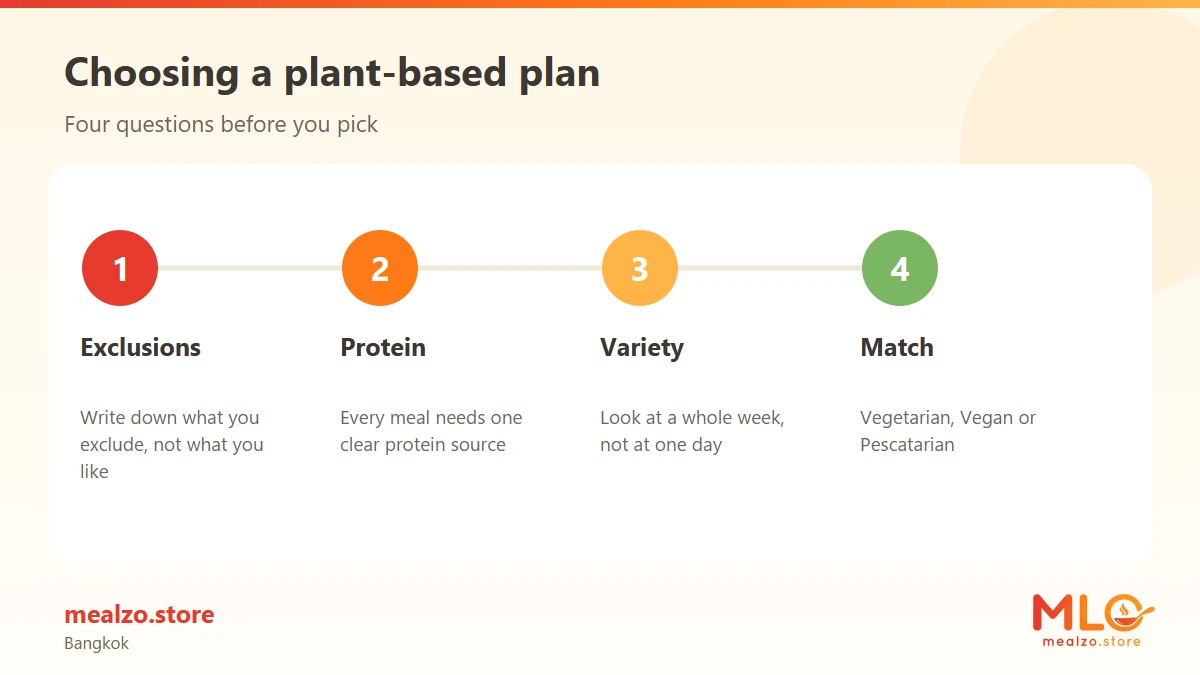
This is also where terminology matters. Vegetarian, vegan and pescatarian patterns overlap but are not interchangeable. If you are still deciding exactly where your boundaries sit, the guide to vegetarian, vegan and pescatarian meal plans gives the distinctions more space than they need here.
3. Have a Bangkok Street-Food Strategy Before You Need It
Bangkok street food can make plant-based eating easier, but only if you know what you are ordering.
Jay food is an obvious starting point. During the Vegetarian Festival it becomes highly visible, but jay restaurants and stalls exist outside that period too. The yellow-and-red เจ signs can be useful when you want food prepared according to jay conventions rather than trying to negotiate several ingredient changes with a busy vendor.
Outside dedicated jay places, ordering becomes more variable. A dish that looks vegetable-based may still include egg, fish sauce, oyster sauce, meat stock or another animal-derived ingredient. Rather than assuming from appearance, ask what is actually in it.
It is useful to know several meals near the places where you repeatedly spend time:
- one option near your office;
- one around your condo;
- one near a transit point you use often;
- one late-day fallback for evenings when plans collapse.
You do not need twenty saved restaurants. Three or four reliable choices reduce the number of decisions you have to make while already hungry.
For people who want a broader framework for everyday food choices rather than strict labels, practical clean-eating principles for Bangkok can help separate useful habits from unnecessary food rules.
4. Stop Treating Office Lunch as a Surprise
Office lunch is one of the most predictable unpredictable events in Bangkok.
You may not know what your colleagues will order, but you probably know that shared ordering happens. That means it can be planned for.
If someone else normally chooses the restaurant, check the menu before the order is final rather than after the food arrives. If the group tends to rotate through the same five restaurants, identify what you can eat at each one. When there is genuinely no workable option, having a backup prevents lunch from turning into snacks followed by an oversized dinner.
Build a small office reserve
A desk drawer is not a kitchen, but a modest food reserve can bridge the gap between a failed lunch order and your next proper meal.
Depending on your preferences, that might include:
- nuts or seeds;
- shelf-stable soy drinks;
- crackers or whole-grain snacks;
- fruit that keeps reasonably well;
- simple foods that can be combined with something purchased nearby.
The purpose is not to manufacture an exciting desk lunch. It is to avoid reaching mid-afternoon having eaten almost nothing because the office order did not work for you.
For a wider approach to structuring food around working hours, commuting and changing schedules, see the Bangkok meal-planning guide for busy professionals.
5. Keep Protein Visible Instead of Hoping It Appears
A plant-based meal can be substantial or surprisingly light. The difference often comes down to whether the meal has an obvious centre.
Rice with vegetables can be a perfectly normal part of a meal, but if you repeatedly finish lunch and start searching for snacks an hour later, look at how the meal is constructed. Tofu, tempeh, legumes, soy foods, nuts and seeds can make the protein component easier to identify instead of leaving it to chance.
Vegetarians have additional possibilities depending on what they include, while vegan planning needs to work entirely within plant sources. The vegetarian meal planning for protein and variety covers the vegetarian version in more detail, while the vegan planning for protein, iron and B12 deals specifically with vegan food planning.
You do not need to calculate every ingredient every day. A simpler question works surprisingly well: what is the protein source in this meal?
If the answer is obvious, the meal is easier to evaluate. If you cannot identify one, you know what is missing without turning lunch into a spreadsheet exercise.
Key takeaway: On busy days, make the main protein source obvious enough that you do not have to reconstruct the meal mentally.
6. Design a Routine for the Empty-Fridge Evening
The empty-fridge evening is one of the most common places where good intentions disappear.
You planned to shop on Tuesday. Tuesday became a late meeting. Wednesday morning started early. By Wednesday evening, cooking requires both ingredients and energy, and you have neither.
The solution is not necessarily more discipline. It is redundancy.
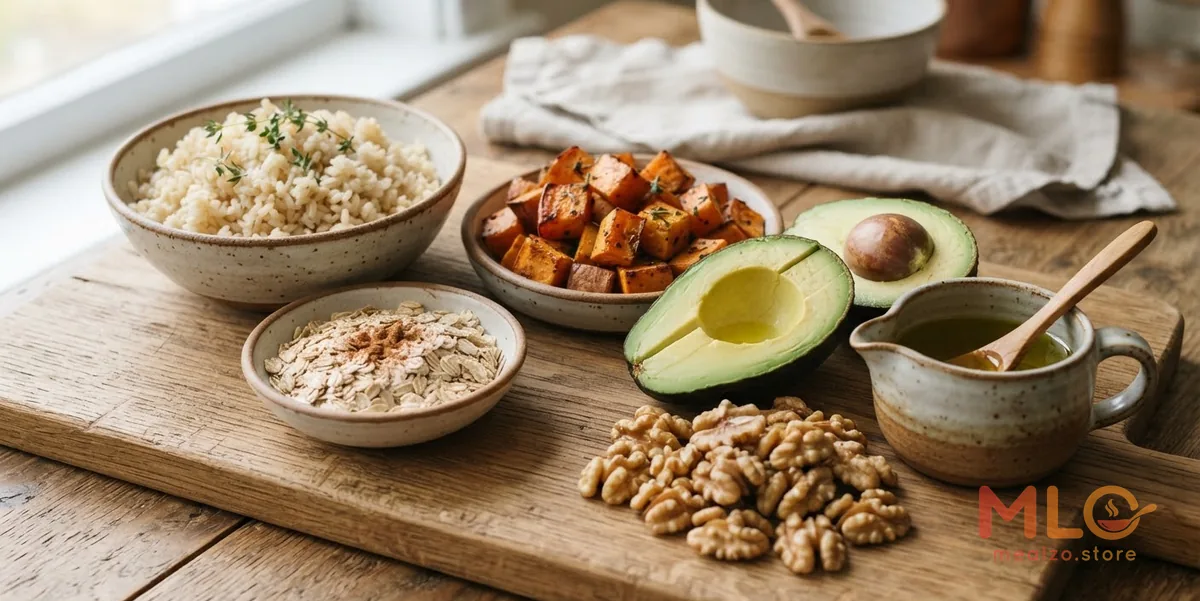
Keep a few meals or components that survive a missed shopping trip. If you cook, that might mean frozen vegetables, rice, noodles, tofu that has not yet expired, canned legumes or a simple sauce. If you prefer prepared food, schedule it before the fridge becomes empty rather than after.
| Situation at 19:30 | Fragile response | More durable response |
|---|---|---|
| No fresh vegetables | Abandon the meal plan | Use frozen or shelf-stable ingredients |
| No cooked rice | Order whatever is fastest | Use noodles, bread or another available base |
| Too tired to cook | Start a complicated recipe | Assemble a simple meal |
| Meeting ended late | Decide dinner while extremely hungry | Have dinner chosen earlier |
| Grocery trip missed | Assume tomorrow will be easier | Use a backup and reschedule shopping |
A fallback meal is not a failure. It is part of the system.
7. Reduce Decisions Before Late Meetings
Late meetings create a specific problem: hunger and decision-making arrive at the same time.
If you know at 15:00 that you will probably finish work after 20:00, decide what you are eating at 15:00.
That might mean ordering dinner early, eating before the meeting, taking food with you or confirming that something suitable is already at home. The exact solution matters less than moving the decision away from the moment when your patience is lowest.
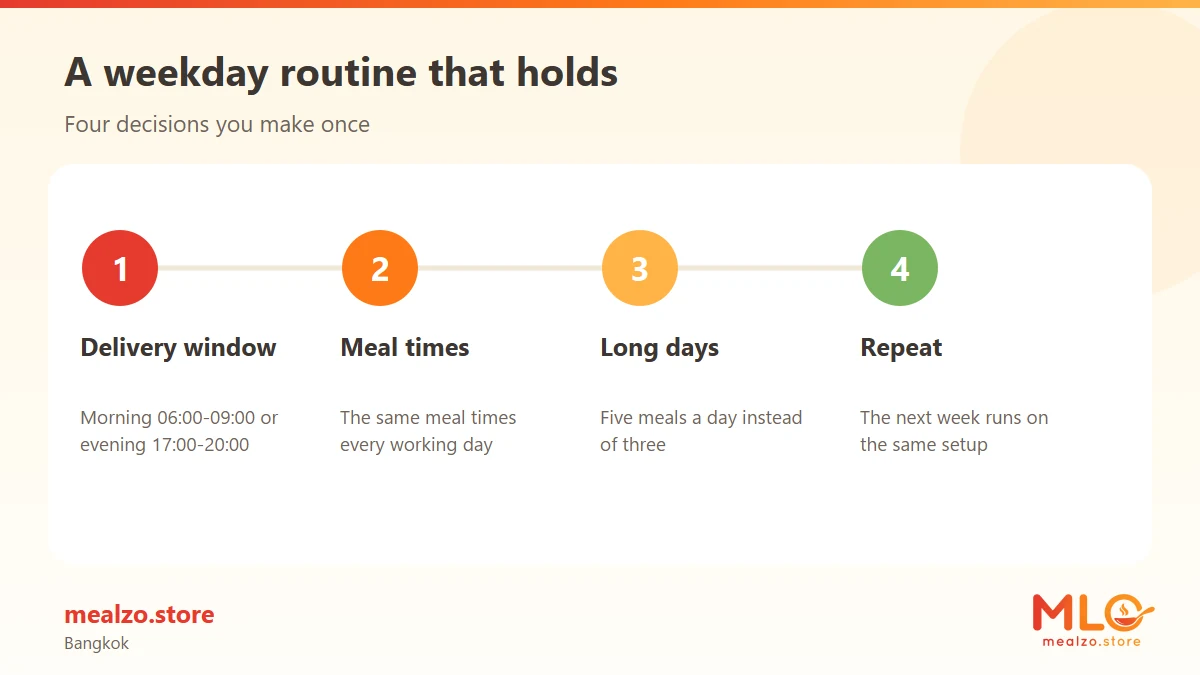
A simple weekday structure can look like this:
- morning: know what breakfast is before you open your laptop;
- midday: have one default office-lunch strategy;
- afternoon: check whether dinner is already solved;
- evening: use the planned dinner or fallback without renegotiating the whole day.
This may sound unremarkable. That is precisely why it works as a routine. Consistency is mostly built from boring decisions that do not need to be made twice.
8. Use Meal Delivery as Infrastructure, Not Motivation
Prepared meal delivery can be useful when your main obstacle is time rather than interest.
Mealzo offers Vegetarian and Vegan plans among its 12 meal plans, alongside Balanced, Weight Loss, High Protein, Keto, Low-Carb, Gluten Free, Easy-to-Digest, Pescatarian, No Fish & Seafood, and Dairy & Egg Free. Customers select a plan, daily calorie level, and either 3 or 5 meals per day; the menu for the package is then assembled automatically from those choices.
Available calorie levels are 1200, 1500, 1800, 2000, 2200 and 2500 kcal per day. The app also includes a calorie calculator using the Mifflin-St Jeor formula, which provides an estimate rather than medical advice.
Packages are available for 3, 7, 14 or 30 days. Delivery is across Bangkok, with morning delivery from 06:00-09:00 or evening delivery from 17:00-20:00. The kitchen is in Bang Na.
If the useful part for you is simply having fewer weekday food decisions, you can review the available Mealzo meal plans and choose based on the structure you actually need.
Key takeaway: Prepared meals are most useful for consistency when they replace a recurring logistics problem rather than another source of food decisions.
9. Plan for Mixed Social Weeks, Not Isolated Meals
A plant-based routine does not exist separately from birthdays, client dinners, office events and friends who choose restaurants without checking menus first.
Trying to control every meal in advance usually creates unnecessary friction. It is more practical to control the parts of the week you genuinely control.
If you know Friday dinner will be uncertain, keep breakfast and lunch straightforward. If Saturday is built around eating out, make sure Sunday does not depend on doing a large grocery shop when you are tired. When coworkers choose lunch, solve breakfast and dinner yourself.
The aim is not to compensate for one meal with another. It is to recognise where decision-making authority changes during the week.
Use weekly anchors
A few recurring anchors create stability even when individual meals vary.
For example:
- a predictable weekday breakfast;
- two or three reliable lunch locations;
- groceries purchased on a defined day;
- prepared food for the busiest workdays;
- a basic dinner that can be assembled from reserve ingredients.
You can change everything around those anchors without rebuilding your routine from scratch.
10. Review the System After a Bad Week
A bad week gives you useful information.
Instead of asking why you lacked discipline, look at where the sequence broke. Did you miss one grocery trip and then spend four days improvising? Did office lunches provide fewer plant-based options than expected? Did you repeatedly leave dinner until after late meetings? Were your planned meals too complicated for your actual schedule?
Then change one piece of infrastructure.
Maybe you need a second grocery window. Maybe Wednesday dinner should always be prepared rather than cooked. Maybe the office needs a backup food stash. Maybe you need to save three jay restaurants instead of relying on whichever stall happens to be nearby.
The goal is not to make every week identical. It is to make disruption less expensive.
Key takeaway: When a routine breaks, fix the repeated point of friction instead of designing an entirely new routine.
FAQ
Is plant-based eating in Bangkok difficult during a busy workweek?
It does not have to be, but convenience varies by location and schedule. Bangkok has jay restaurants, street vendors, supermarkets, restaurants and delivery options, yet a busy week can still create gaps. The most reliable approach is having several known options before work becomes hectic.
Is jay food always the same as vegan food?
Jay food follows a particular Thai-Chinese dietary tradition and generally excludes animal products as well as certain pungent vegetables. Vegan food is defined differently. If you follow specific rules, especially outside a dedicated jay restaurant, ask about ingredients rather than relying only on the appearance of the dish.
What should I do when colleagues order lunch from somewhere with poor plant-based options?
Check the restaurant menu early, identify anything workable and keep a fallback available. If this happens repeatedly, save alternatives near the office rather than solving the same problem from zero each time.
Do I need to count calories to stay consistent?
No. Calorie tracking is separate from the basic problem of maintaining a plant-based routine. Some people choose to estimate energy needs or follow defined portions, while others focus mainly on meal structure and regularity. Mealzo's app includes a Mifflin-St Jeor calculator for estimating calorie needs, but that estimate is not medical advice.
How should allergens be handled with a meal-delivery plan?
Mealzo allows customers to declare allergens from nine allergen groups. Dishes containing a declared allergen are then not assigned to that customer. This describes the assignment mechanism only and should not be interpreted as a guarantee that a meal is allergen-free.
What matters most after I fall out of the routine for several days?
Restart with the next practical meal and examine what caused the disruption. If the same situation keeps appearing, late meetings, empty fridge, unsuitable office lunches or missed shopping, change that part of the routine so the next difficult week requires fewer decisions.
Find a Meal Plan That Fits
Compare Mealzo plans or use the calculator to explore meal options for your needs.