Thai Curries in Bangkok: Green Curry, Massaman and Jungle Curry on a Balanced Day
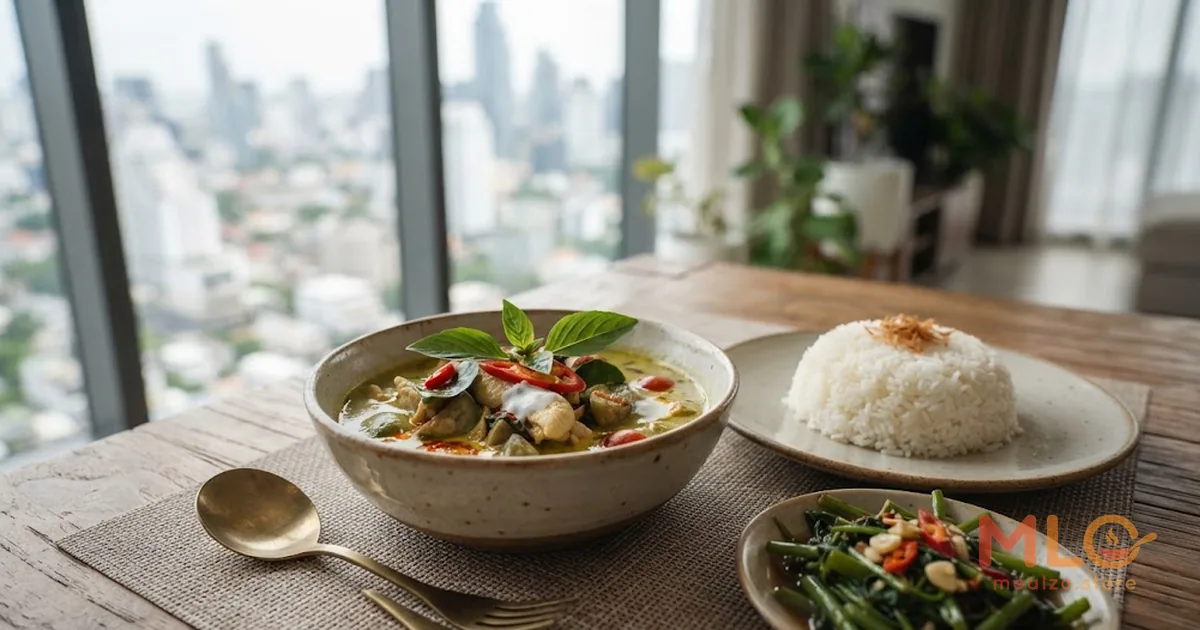
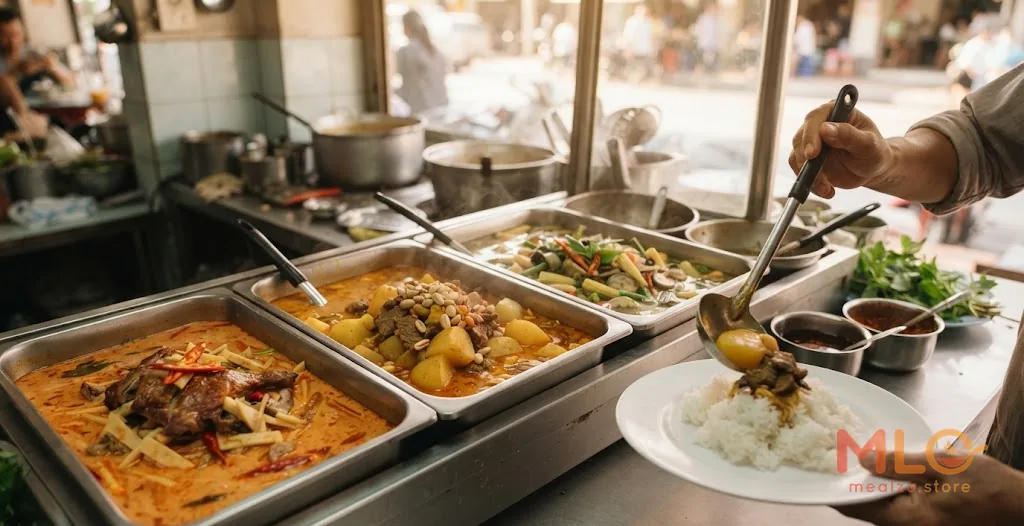
Curry is part of ordinary eating in Bangkok. At a curry-and-rice shop, trays of green curry, red curry, panang, massaman, jungle curry and vegetable dishes make it possible to assemble lunch in a few minutes. The same dishes appear in food courts, restaurants and delivery menus across the city.
Trying to eat in a balanced way does not mean avoiding kaeng. It helps more to understand what is actually in the curry, what accompanies it and how the whole plate fits together. A coconut-milk curry eaten over a large mound of rice is a different meal from a clear jungle curry with vegetables and a protein-rich side, even though both are simply called curry.
The useful question is therefore not whether Thai curry is "good" or "bad". It is how rich the curry is, how much sauce and rice end up on the plate, whether there is enough protein and vegetables, and what else you are eating that day.
For anyone searching for healthy Thai curry Bangkok options, that distinction matters. There is no single type of Thai curry that automatically fits the description. The practical approach is to know what you are ordering and adjust the rest of the meal around it.
1. Why curry over rice is an everyday Bangkok meal
Khao gaeng, literally curry with rice, is built for everyday eating. You start with rice and choose from prepared dishes displayed in trays. Depending on the shop and time of day, those trays may contain coconut curries, clear curries, stir-fried vegetables, eggs, meat dishes and other sides.
That flexibility is useful because the curry does not have to carry the entire meal. You can choose one curry, or combine it with something that changes the balance of the plate.
The part people often overlook is the rice. Visually, attention goes to the colourful curry, but rice commonly occupies much of the plate by volume. Sauce spreads through it, making it easy to eat more rice without thinking much about it.
That is also part of how Thai food works. A salty, spicy curry is intended to be eaten with rice rather than treated like a bowl of soup. Rice softens the intensity of chilli, curry paste, fish sauce and other strongly flavoured ingredients.
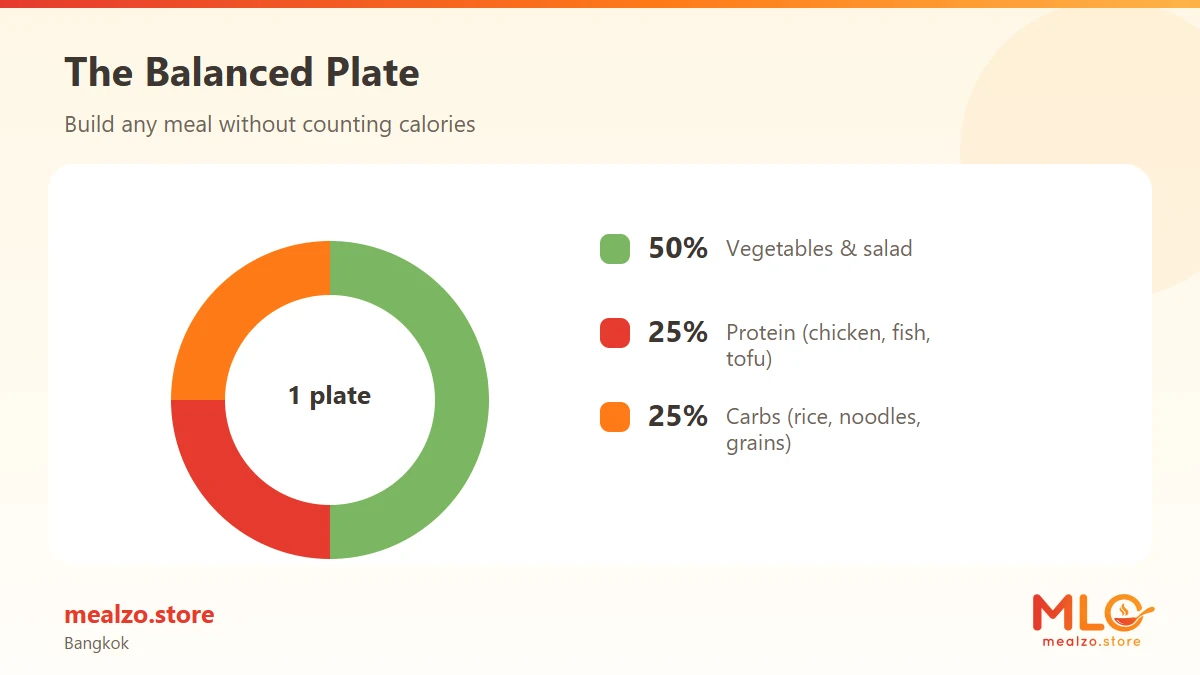
So the goal is not to strip the meal down until it no longer resembles Thai food. It is to pay attention to the relationship between rice, sauce, protein and vegetables.
Key takeaway: Think about curry and rice as one meal, not as a curry serving with an irrelevant side of rice.
2. Coconut-milk curries and clear curries are different meals
Thai curries in Bangkok can be roughly divided into two useful groups for everyday decision-making.
Green curry, red curry, panang, massaman and many yellow curries use coconut milk. Coconut milk contributes fat and gives these dishes their characteristic richness and texture. That does not make coconut milk something to fear, nor does it make it a special health food. It simply means that a generous portion of coconut curry sauce makes a richer meal than a similar amount of clear broth.
Jungle curry and sour curry are different. They are generally water-based rather than built around coconut milk. They can feel much lighter in the mouth, but "lighter" does not mean mild. Jungle curry in particular can be intensely hot, while both styles can contain substantial salty and strongly seasoned components.
Here is a practical way to read some common Bangkok curries:
| Curry | Typical base | What shapes its richness | One practical adjustment |
|---|---|---|---|
| Green curry | Coconut milk | Coconut milk and curry sauce | Take enough sauce to flavour the rice without soaking the whole plate |
| Red curry | Coconut milk | Coconut milk and curry paste | Pair it with a vegetable-heavy side |
| Panang | Coconut milk | Thick coconut sauce and sweetness | Use a smaller amount of sauce over the rice |
| Massaman | Coconut milk | Coconut milk, palm sugar, potatoes and peanuts | Remember that potatoes and rice are both part of the meal |
| Yellow curry | Coconut milk | Coconut milk and the ingredients used in the particular curry | Add vegetables or a protein side if the curry itself contains little |
| Jungle curry | Clear | Strong seasoning rather than coconut richness | Use rice to moderate the heat and choose a useful protein source |
| Sour curry | Clear | Sour, salty and spicy seasoning | Pair it with rice and assess what protein the curry actually contains |
The distinction is especially useful when ordering several dishes to share. If one dish is a rich coconut curry, the rest of the table does not need to follow the same pattern.
3. Green curry and red curry: look beyond the colour
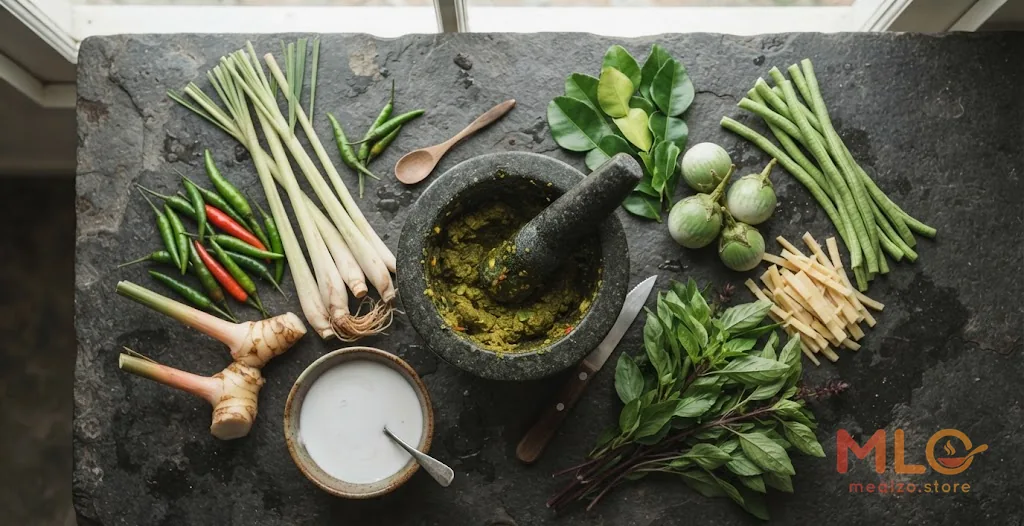
Kaeng khiao wan, or green curry, is one of the most familiar Thai curries. It commonly combines coconut milk and green curry paste with ingredients such as chicken, Thai eggplant, bamboo shoots and basil. The exact contents vary from one kitchen to another.
Red curry, or kaeng phet, follows a similar broad structure but uses red curry paste. Depending on the dish, it may contain meat, prawns, fish balls, vegetables or other ingredients.
For a balanced meal, the useful questions are straightforward:
- Is there a meaningful protein component, or mainly sauce with a few pieces of meat?
- Are vegetables present in useful amounts?
- How much sauce is being spooned over the rice?
- Is there a vegetable dish available as the second choice?
- How large is the rice portion relative to everything else?
At a khao gaeng counter, you can often answer those questions just by looking at the trays. A green curry containing mostly sauce and a few pieces of chicken will contribute differently to the meal from one containing visible vegetables and more substantial pieces of protein.
Oil can also collect toward the surface of prepared curry. You do not have to avoid the curry because of that. If you want a less rich plate, simply avoid deliberately spooning a large amount of the oily top layer over the rice.
For more detail on where cooking fat appears in everyday Bangkok food, this guide to fried food and cooking oil in Bangkok looks at the issue beyond curry.
4. Massaman, panang and yellow curry: richness and sweetness
Massaman deserves separate attention because it combines several elements in one dish. It is a coconut-milk curry, it can include palm sugar, and it commonly contains potatoes and peanuts. Meat may be substantial, but the potatoes also change how you should think about the rest of the plate.
If you eat massaman containing plenty of potato over a large serving of rice, you are combining two significant carbohydrate components. There is nothing inherently wrong with eating them together. It is simply worth noticing instead of treating the potato as if it were a vegetable side that has no bearing on the rest of the meal.
Panang is usually thick and concentrated. Its coconut base and sweetness can make a relatively modest spoonful flavour a lot of rice. Rather than drowning the plate in sauce, let the strength of the curry do some of the work.
Yellow curry varies considerably. The useful approach is therefore not to assume that every yellow curry has the same composition. Look at what is actually in the serving: sauce, meat or tofu, vegetables and any starchy ingredients.
Key takeaway: With rich curries, controlling the amount of sauce can change the meal without requiring you to replace the curry itself.
5. Jungle curry and sour curry: no coconut does not mean no trade-offs
Kaeng pa, or jungle curry, is usually made without coconut milk. It is often packed with herbs and vegetables and can include ingredients such as bamboo shoots, long beans and Thai eggplant. It is also known for serious chilli heat.
That makes jungle curry useful when you want a vegetable-heavy curry without the richness of coconut milk. But it should not be reduced to a simplistic "light curry" label. Curry paste, fish sauce and other seasonings can still make it salty, and the heat can be much stronger than in many coconut curries.
Kaeng som, or sour curry, is another water-based style. Its sour, spicy broth is very different from the creamy texture of green curry or massaman. Depending on how it is prepared, it may contain vegetables and a protein source, but the composition varies.
The point is not that clear curries are automatically preferable. They simply shift the trade-offs. You lose much of the coconut richness, but you may still have an intensely salty and spicy dish.
Anyone with high blood pressure, heart or kidney issues, diabetes or another medical condition should follow their own doctor's guidance on salt, fat and carbohydrates.
6. Salt, curry paste and why rice matters
Thai curry gets flavour from concentrated ingredients. Curry paste itself brings a great deal of flavour, and fish sauce and shrimp paste may add further saltiness. The finished curry can therefore taste deliberately strong when eaten by itself.
Rice is part of the answer. A spoonful of curry spread through rice tastes different from the same curry eaten alone. This is one reason trying to make a curry meal "better" simply by removing almost all the rice can backfire from a practical eating perspective. The curry may suddenly seem extremely salty or hot, encouraging you to reach for something else.
A more useful strategy is to decide how much rice you want before covering it in sauce. Add curry gradually. You can always add another spoonful, but once the rice is saturated with sauce, the portion becomes difficult to judge.
If rice itself is the part of the meal you struggle to assess, the Bangkok guide to jasmine, sticky and brown rice goes into that subject in more detail.
There is also no requirement to finish every drop of curry sauce. If you have eaten the meat, tofu and vegetables and there is a pool of coconut sauce left, leaving some behind is a perfectly ordinary adjustment.
7. Rice, khanom jeen and roti are the other half of the curry meal
Rice is the standard companion, but it is not the only one. Thai curries can also be eaten with khanom jeen, the soft fermented rice noodles commonly served with curry, while massaman and other curries may be eaten with roti.
Changing the accompaniment does not make the curry disappear nutritionally. It changes the form of the meal.
Khanom jeen can be deceptively easy to keep adding because the noodles are served in small bundles. Roti brings its own richness, particularly compared with plain rice. Neither needs to be treated as forbidden. The useful habit is simply to count the accompaniment as part of the meal rather than focusing only on the curry bowl.
This same principle applies to other Bangkok noodle meals. our practical guide to Thai noodles in Bangkok covers boat noodles, pad see ew and khao soi using the same whole-meal approach.
When choosing the base for a curry meal:
- Start with the amount of rice, noodles or roti that makes sense for the meal rather than adding it automatically.
- Consider whether the curry already contains potatoes or another substantial starchy ingredient.
- Add enough curry sauce for flavour instead of automatically emptying all the sauce onto the base.
- Leave room for vegetables and protein rather than building the entire plate around rice and sauce.
8. Protein can be abundant, or almost an afterthought
A curry name tells you surprisingly little about how much protein will actually reach your plate. Chicken, pork, beef, prawns, fish balls and tofu all appear in Bangkok curries, but the amount depends on the particular preparation and serving.
A large ladle of sauce may contain only a few pieces of chicken. Another curry may have much more meat or tofu. That difference matters if the curry is supposed to be the main protein source in the meal.
At a curry-and-rice shop, look into the tray rather than relying on the label. If the curry seems sauce-heavy, consider a second item that contributes more protein. An egg can be a simple addition where available. A separate meat, fish or tofu dish can serve the same purpose, depending on what you eat.
This becomes particularly useful when sharing delivery. One rich curry can provide the flavour centre of the meal while other dishes provide vegetables and protein.
There is no need to turn every Thai meal into a formula. The point is simply to notice when "chicken curry" is mostly curry sauce with very little chicken.
9. Vegetables can change the structure of the plate
Thai curries can contain vegetables, but their presence varies considerably. Green curry may include Thai eggplant, bamboo shoots and basil. Jungle curry is often particularly vegetable-heavy, with ingredients such as long beans, bamboo shoots and eggplant.
A few pieces of eggplant floating in coconut sauce, however, are not the same as having a substantial vegetable component in the meal.
This is where the khao gaeng format becomes useful. Instead of choosing two rich curries, you can choose one curry because you genuinely want it and use the second selection to bring vegetables into the meal.
For example:
| Rich choice | Lighter or vegetable-focused pairing | Why the pairing is useful |
|---|---|---|
| Green curry | Vegetable-heavy clear curry | Keeps the green curry while adding more vegetables |
| Panang | Stir-fried or prepared vegetable dish | Adds a contrasting component instead of more thick curry sauce |
| Massaman | Vegetable side without another rich coconut sauce | Balances a curry already containing coconut milk, potato and peanuts |
| Red curry | Jungle curry with vegetables | Combines a coconut curry with a clear, vegetable-heavy option |
| Yellow curry | Vegetable dish plus an appropriate protein side if needed | Lets you adjust according to what the yellow curry actually contains |
The exact dishes available change from counter to counter. Use the table as a decision pattern, not a fixed menu.
Key takeaway: At a curry-and-rice shop, one curry you really want plus one vegetable-heavy choice is often more useful than trying to identify a supposedly perfect curry.
10. Spice level changes how you eat the meal
Massaman is often relatively mild, while jungle curry can be extremely hot. Green and red curries sit somewhere in a broad middle range, but actual heat depends on the kitchen.
Coconut milk softens the perception of chilli because its richness changes how the curry feels in the mouth. A clear curry does not have that same cushion, so jungle curry can feel particularly direct and intense.
If you are ordering a dish made to order, you can ask for less heat. With prepared curries at a khao gaeng shop, however, the chilli level is largely already determined. In that case, choosing a different curry may be more realistic than expecting the prepared tray to be changed.
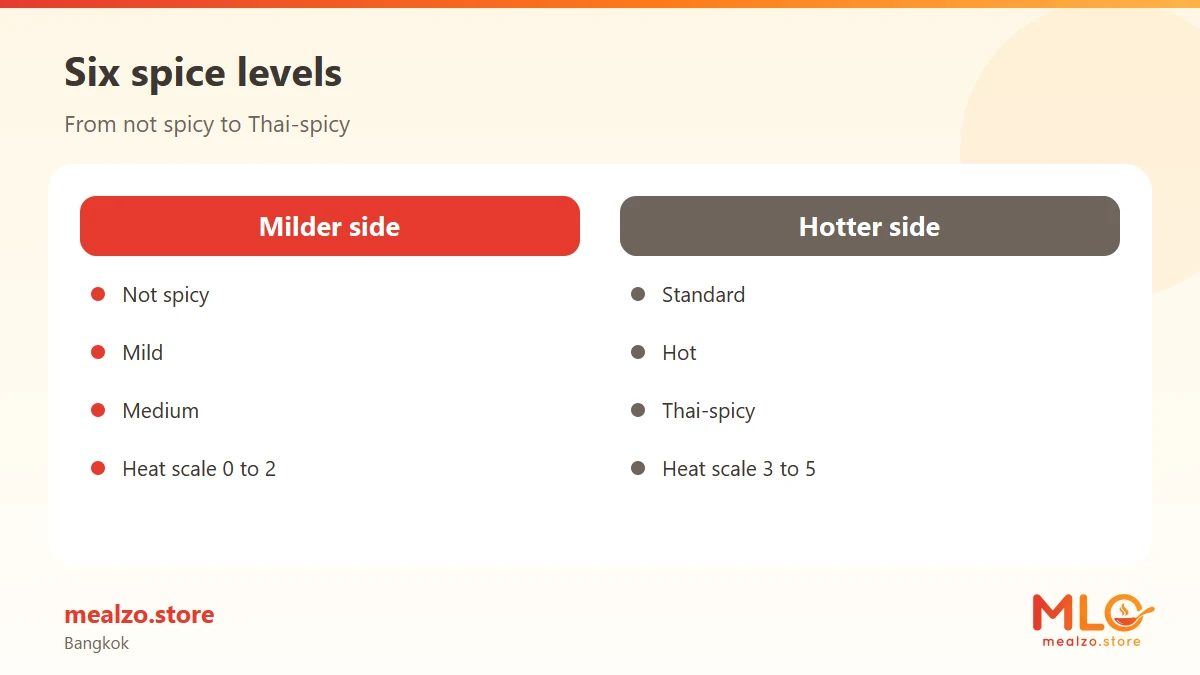
Rice can help moderate a strongly seasoned curry, which is another reason to consider the whole plate rather than treating rice as an enemy. What does not work particularly well is choosing a curry far beyond your comfortable spice level and then compensating with large amounts of rich sides or sauce.
If chilli itself is the concern, this guide to spicy food in Bangkok and chilli heat explains the practical side in more detail.
11. A practical curry-and-rice shop strategy
A busy Bangkok food court or khao gaeng counter is not the place for complicated calculations. You need a method that works while looking at a row of trays.
Start by choosing the curry you actually want. If that is massaman, panang or green curry, there is no reason to replace it with something you do not enjoy simply because it is water-based.
Then build around it.
A straightforward sequence is:
- Choose one main curry rather than automatically combining several rich sauces.
- Look at how much meat, fish, prawns or tofu is actually present.
- Add a vegetable-heavy item when the main curry contains few vegetables.
- Decide on the rice before covering it with curry.
- Spoon enough sauce to flavour the rice, without automatically drowning it.
- If oil has separated on top of the curry, take less of that layer if you prefer a less rich plate.
- If choosing two curries, consider combining a coconut curry with a clear or vegetable-heavy option.
This approach also leaves room for appetite. Someone who has eaten very little earlier in the day may want a different meal from someone having curry after several substantial meals. Balance is easier to understand across a day than by trying to make every plate identical.
12. Delivery, leftovers and how Mealzo Bangkok fits around curry days
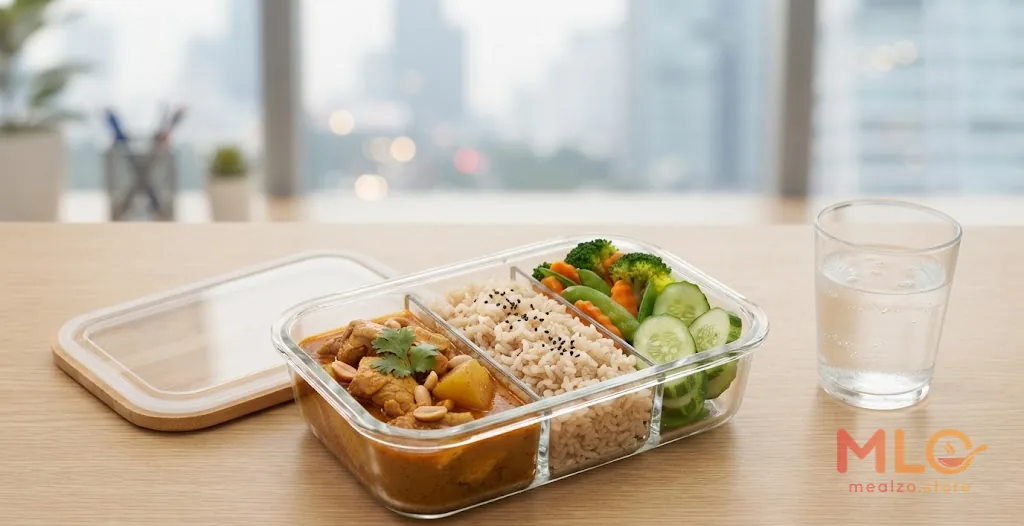
Curries are well suited to delivery because the sauce protects many of the ingredients from drying out. They also reheat well, which makes leftovers practical.
A rich curry does not necessarily have to be one person's entire meal. When ordering several dishes, sharing one coconut curry can let everyone enjoy it alongside vegetables, rice and protein from other dishes.
For leftovers, cool and store food safely rather than leaving curry sitting out in Bangkok's heat. Reheat stored curry thoroughly before eating it. If you are unsure whether food has been stored safely, do not rely on smell or appearance as proof that it is safe.
Meal planning can make curry days easier because you do not need to force every meal to have the same composition. Mealzo Bangkok prepares meals in advance as part of a planned day, so when one meal is richer, the other meals can carry more vegetables and protein.
Mealzo Bangkok's kitchen is in Bang Na, Bangkok. Meals are cooked fresh daily and delivered across Bangkok. Customers select either the morning delivery window from 06:00-09:00 or the evening window from 17:00-20:00.
There are 12 meal plans: Balanced, Weight Loss, High Protein, Vegetarian, Vegan, Keto, Low-Carb, Gluten Free, Easy-to-Digest, Pescatarian, No Fish & Seafood, and Dairy & Egg Free. Every plan uses one mixed cuisine combining Thai and international dishes. There are 6 daily calorie levels from 1200 to 2500 kcal, with 3 or 5 meals per day and package lengths of 3, 7, 14 or 30 days.
Customers can declare from 9 allergen groups. Dishes containing an allergen declared by the customer are not assigned to that customer. This describes the assignment mechanism and should not be interpreted as a guarantee of an allergen-free meal.
The website and mobile app are available in 8 languages: Thai, English, Polish, German, French, Russian, Simplified Chinese and Burmese. The app also includes a calorie calculator using the Mifflin-St Jeor formula. Its result is an estimate, not medical advice.
If you want meals planned in advance around your day, you can see Mealzo Bangkok meal plans.
Key takeaway: A curry meal does not need to be "fixed" in isolation. What matters is how its rice, sauce, protein and vegetables fit with the rest of the day's food.
FAQ
Can I eat Thai curry regularly and still keep my meals balanced?
Yes. The useful question is not whether curry itself is "healthy" or "unhealthy", but what the whole meal contains. A coconut-milk curry is richer than a clear curry, while the amount of rice, protein, vegetables and additional dishes also changes the balance of the meal. If you choose a rich curry, you can pair it with a vegetable-heavy dish and avoid covering all of the rice with extra sauce.
Which Thai curries are lighter than coconut-milk curries?
Jungle curry and sour curry are usually water-based rather than coconut-milk based, so they do not have the same coconut richness as green, red, panang, massaman or yellow curry. That does not automatically make them a better choice for everyone. They can still be salty, strongly seasoned and, particularly in the case of jungle curry, very spicy.
Is rice the main problem when eating curry in Bangkok?
Rice is not something that automatically needs to be removed from a curry meal. At Bangkok curry-and-rice shops, it is a major part of the plate and helps balance concentrated, salty and spicy curry. What matters practically is the relationship between the rice, curry sauce, protein and vegetables. If the rice portion dominates the meal and is soaked in a rich sauce, the meal is quite different from a plate where rice accompanies a moderate amount of curry, vegetables and a clear source of protein.
What should I choose at a curry-and-rice shop if I want a more balanced plate?
Look at the whole selection before ordering. A practical combination is a richer coconut-milk curry alongside a vegetable-heavy or less rich dish rather than choosing several rich, sauce-heavy items together. Check whether the curry contains a meaningful amount of chicken, pork, beef, prawns, tofu or another protein source. You can also take less of the oily layer from the top of a curry and avoid drowning the rice in sauce.
How can Mealzo Bangkok fit around days when I eat Thai curry?
Mealzo Bangkok meals are prepared and balanced in advance, which can make it easier to plan the rest of a day when another meal is a rich Thai curry. The other meals can carry more vegetables and protein rather than trying to make every individual meal identical. Mealzo Bangkok offers mixed Thai and international cuisine within its plans, with different plan types, daily energy levels, meal frequencies and package lengths. Anyone with high blood pressure, heart or kidney issues, diabetes or another medical condition should follow their own doctor's guidance on salt, fat and carbohydrates.
Mealzo Bangkok is a kitchen and meal delivery service operating exclusively in Bangkok, Thailand. We are not affiliated with similarly named services outside Thailand.
Find a Meal Plan That Fits
Compare Mealzo plans or use the calculator to explore meal options for your needs.