Your First 30 Days Eating in Bangkok: A Practical Guide for New Arrivals
Moving to Bangkok changes the way you eat almost immediately. The heat affects appetite, convenience stores are everywhere, street food can be cheaper than cooking, and a condo kitchen may be much less useful than the kitchen you left behind.
For someone searching for an expat food Bangkok first month routine, the real challenge is not finding food. Bangkok has too much of it. The challenge is building a way of eating that works when you are tired, still learning the city, unsure what is on a menu, and tempted by another cold sweet drink.
The first month is also when small habits become normal. A quick convenience-store breakfast becomes routine. Lunch gets pushed late. Dinner becomes delivery because you cannot face cooking. Then, usually somewhere around the third week, you realise you have never actually established a baseline.
Mealzo Bangkok can be one way of creating that baseline, but it is not the only answer and it is not automatically the cheapest one. A meal plan trades some flexibility and extra cost for structure and fewer daily food decisions.
1. What actually changes when you move to Bangkok
The biggest adjustment is not Thai food itself. It is the environment around food.
Bangkok makes eating easy at almost any hour. Food stalls, markets, supermarkets, convenience stores and restaurants create a constant supply of inexpensive choices. That sounds ideal, and in many ways it is. But abundance can make consistency surprisingly difficult.
Back home, you may have had a familiar breakfast, packed lunch and planned dinner. In Bangkok, your routine can disappear within days. You might leave home without eating because it is already hot, buy coffee and something sweet later, have noodles for lunch, then decide what to do about dinner at 9 pm.
None of those meals is necessarily a problem by itself. The issue is repetition without a plan.
The first month is therefore less about finding the perfect Thai diet and more about creating a food routine that survives ordinary Bangkok life.
Key takeaway: Your first month is easier when you build a repeatable eating routine before trying to optimise every individual meal.
There is another adjustment: Thai food does not have to mean extremely spicy food. You can eat locally while choosing dishes and preparation styles that fit your tolerance. You also do not have to abandon familiar international food. A practical routine can include both.
That matters because Mealzo Bangkok plans use one mixed cuisine, with Thai and international dishes together in the same plan. There is no separate Thai-only versus international-only plan.
2. The condo kitchen problem
A Bangkok condo kitchen can look perfectly adequate when you first move in. Then you try to use it.
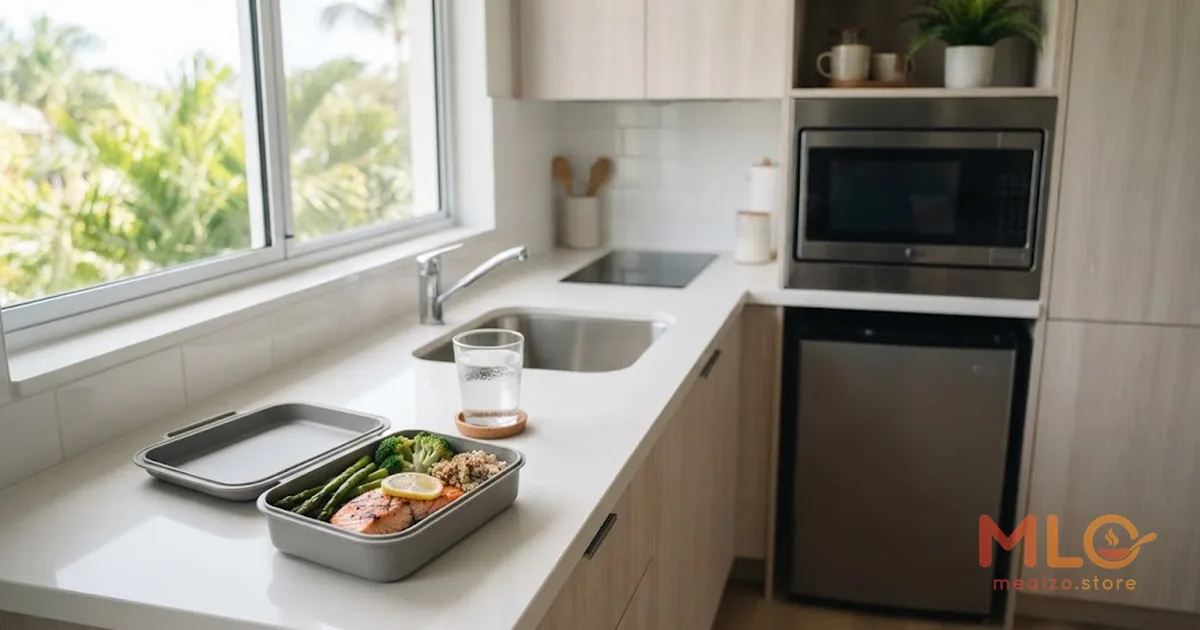
Many apartments have an induction hob, microwave and small refrigerator. Some have little or no useful oven capacity. Ventilation can also be limited. Frying or cooking strongly aromatic food may be impractical when there is nowhere for heat and smoke to go.
That does not mean you cannot cook. It means you should be realistic about what you will actually cook after work.
Simple meals can work well:
- Eggs, toast, fruit and yoghurt for breakfast.
- Rice with quickly cooked vegetables and protein.
- Microwaveable grains with prepared ingredients.
- Salads, sandwiches and cold meals requiring little equipment.
- Simple soups or stir-fries when ventilation allows.
The problem comes when your intended cooking routine requires several pans, lengthy preparation and ingredients that need to be used immediately. After a long day in Bangkok heat, the gap between "I can cook this" and "I will actually cook this" becomes significant.
This is one reason a structured meal plan can appeal to new arrivals. It removes preparation from the daily decision. It does not make the food free, and it does not replace every reason to cook or eat outside. It simply changes the amount of work required on an ordinary weekday.
For a more detailed comparison, see meal subscription versus home cooking in Bangkok.
3. Heat, appetite and hydration
Bangkok's heat changes eating behaviour.
Some newcomers discover that they are less interested in a heavy breakfast. Others find themselves grazing because regular meals feel uncomfortable. Appetite can also become confused with thirst, especially when you spend time outdoors or move between hot streets and strongly air-conditioned buildings.
Then there is the cold-drink problem.
Sweet iced coffee, milk tea, soft drinks and other chilled beverages can become part of the daily routine very quickly. One drink does not define your diet. Having several every day can quietly add a meaningful amount of energy without making you feel as though you have eaten more.
Water should therefore become a routine rather than something you remember only when you are thirsty. When sweating heavily, especially during long periods outdoors, electrolytes can also matter. The exact requirement depends on activity, heat exposure and the individual, so there is no universal amount that applies to everyone.
Food timing can help too. A smaller breakfast may suit you better than forcing yourself through a large meal at 7 am. A more substantial meal may work better later when you have cooled down.
The goal is not to fight Bangkok's climate. It is to build a routine that acknowledges it.
Key takeaway: In Bangkok, a practical food routine includes drinks and hydration habits rather than treating food as the only part of nutrition.
A meal plan can help with regular meals, but it does not remove the need to drink enough water. It also does not mean you should ignore your body's signals simply because a meal has been scheduled.
4. Spice: start with “mai phet”
Thai food can be very spicy, but the useful phrase for a newcomer is simple: mai phet, meaning not spicy.
It is a sensible starting point if you are still learning your tolerance.
Thai heat is not a single scale. The same dish can taste completely different depending on preparation, the cook and your own tolerance. Ordering something "medium spicy" when you have little experience can be an unpleasant surprise.
Start mild and increase gradually if you enjoy it.
Building tolerance is mostly about repeated exposure. You may find that chilli becomes easier after eating it regularly, but there is no prize for forcing yourself through food that you do not enjoy.
You should also learn to separate "Thai food" from "very spicy Thai food". Curries, soups, rice dishes, grilled meats, stir-fries and salads can have very different levels of heat.
If your goal is to manage portions or calories, spice is only one part of the picture. Sauces, oils, sugar, rice portions and snacks can matter too. practical Thai food and portion guidance covers those issues in more detail.
5. Learn the Bangkok meal rhythm
A rigid breakfast-lunch-dinner structure is not the only way to eat in Bangkok.
Thai eating patterns can spread food across the day. Breakfast might be rice-based, savoury or something bought quickly on the way to work. Small meals and snacks can appear between the main meals.
For a newcomer, this flexibility is useful but can also become chaotic.
A good first step is to decide what your basic weekday rhythm will be. It might look something like:
- Breakfast at home or near work.
- A planned lunch rather than waiting until extreme hunger.
- An afternoon snack when needed.
- Dinner at a predictable time.
- Flexible meals outside that routine on selected days.
The point is not to make every day identical. It is to establish enough structure that you are not making five food decisions while already hungry.
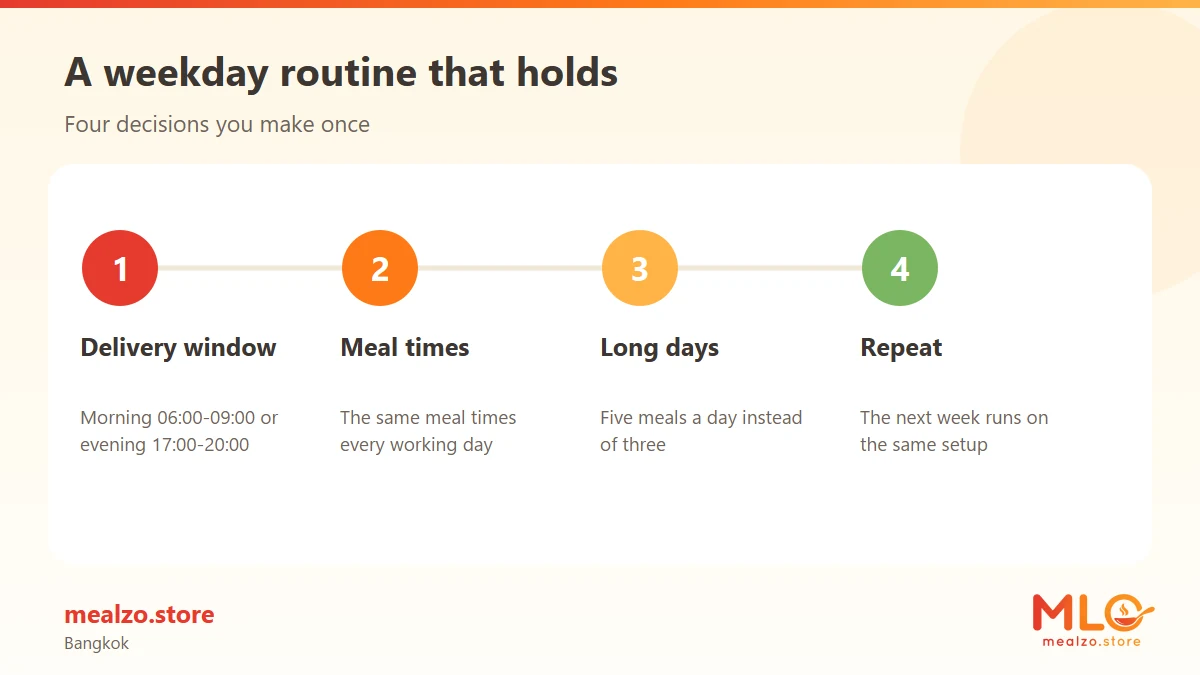
This is where a meal plan can be useful. Mealzo Bangkok offers plans with either 3 or 5 meals per day, allowing the structure to fit different routines. There are also six daily calorie levels from 1200 to 2500 kcal.
The calorie calculator in the app uses the Mifflin-St Jeor formula to estimate requirements. It is an estimate, not medical advice, and should not be treated as a diagnosis or a guarantee of what your body needs.
6. The convenience-store default
Convenience stores are one of Bangkok's great practical resources. They are useful when you need food immediately, have no kitchen access or are travelling across the city.
The problem begins when "easy" becomes your entire food system.
A typical convenience-store routine can gradually become coffee, sweet drink, packaged breakfast, quick lunch and packaged dinner. It saves time, but it may leave you with less control over overall meal composition and portions.
There is also a psychological effect. When food is available within minutes, there is little reason to plan ahead. That makes it easy to postpone decisions until you are already hungry.
Over a month, the issue is not necessarily that convenience food is bad. It is that relying on whatever is easiest can make your eating pattern inconsistent.
A structured plan creates the opposite pattern. Food is decided before hunger arrives.
| Factor | Convenience-food routine | Structured meal plan |
|---|---|---|
| Cost | Can be inexpensive day to day | Usually costs more than relying on inexpensive street food |
| Effort | Very low preparation | Very low daily preparation |
| Choice | Extremely flexible | More structured |
| Planning | Mostly reactive | Planned in advance |
| Nutrition | Depends heavily on individual choices | Meals are structured as part of the selected plan |
| Routine | Easy to become inconsistent | Easier to maintain a fixed meal pattern |
This is the honest trade-off. A meal plan is not a magic way to spend less money on food. If your priority is absolute minimum daily food spending, inexpensive local food can cost less.
If your priority is reducing daily decisions and having a predictable structure, the calculation is different.
Key takeaway: A meal plan generally makes more sense when the problem is consistency and decision fatigue, not when your only goal is spending as little as possible.
7. Shopping: markets, supermarkets and the imported-goods trap
Bangkok gives you several different ways to buy food.
Wet markets are useful for fresh local ingredients and can be inexpensive, although they may require more familiarity with Thai food and cooking. Supermarkets offer a more predictable shopping environment and make it easier to find packaged ingredients, familiar staples and imported products.
Imported food is where a new arrival can quickly damage a food budget.
If you try to recreate your previous country's entire grocery basket, the bill can rise quickly. Imported cheese, cereal, sauces, snacks, specialty ingredients and familiar packaged foods can cost substantially more than their local equivalents.
That does not mean you have to abandon everything familiar. It means you should decide which imported foods genuinely matter to you.
A useful first-month strategy is to build meals around ingredients that are easy to find locally, then add selected imported products rather than making the imported basket your default.
The same principle applies to eating out. Bangkok has endless international options, but eating the food you already know at every meal can become an expensive habit.
8. The first month, week by week
The first month usually changes in stages.
During the first week, everything feels new. You are exploring, ordering food, looking at menus and learning where the nearest supermarket is.
Week two often brings convenience. You discover the places that are easy and start repeating them.
By week three, the novelty has faded. This is when the lack of routine becomes more visible. You may realise you have been eating at inconsistent times, drinking more sweet beverages than expected or relying heavily on food ordered at short notice.
Week four is where a sustainable system starts to matter.
| Week | Typical problem | Practical fix |
|---|---|---|
| Week 1 | Too many new choices | Establish simple breakfast and lunch defaults |
| Week 2 | Convenience becomes routine | Keep basic food available at home |
| Week 3 | No clear baseline | Review meal timing, drinks and recurring snacks |
| Week 4 | Habits start becoming normal | Keep what works and remove unnecessary decisions |
There is no requirement to make the entire first month perfect. In fact, trying to control everything immediately can make the process harder.
Choose a few things that are easy to repeat.
For example, you might decide that weekday breakfasts will always be simple, lunches will follow a predictable pattern, and restaurant meals will be the flexible part of the week.
That creates a baseline without turning food into a full-time project.
9. Where a meal plan fits
A meal plan is most useful when your problem is not access to food but access to a reliable routine.
Mealzo Bangkok operates from a kitchen in Bang Na, with meals prepared there and delivered across Bangkok. Plans include 12 options:
- Balanced
- Weight Loss
- High Protein
- Vegetarian
- Vegan
- Keto
- Low-Carb
- Gluten Free
- Easy-to-Digest
- Pescatarian
- No Fish & Seafood
- Dairy & Egg Free
All plans use the same mixed-cuisine concept, combining Thai and international dishes.
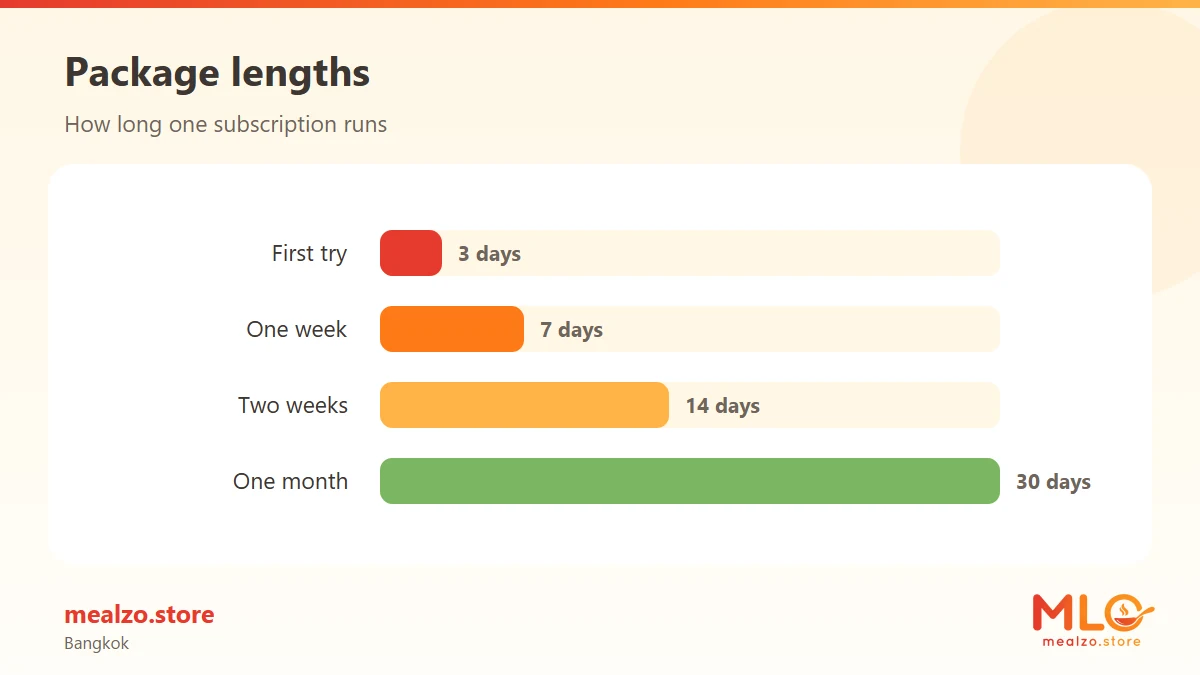
You can choose from six daily calorie levels between 1200 and 2500 kcal, with either 3 or 5 meals per day. Package lengths are 3, 7, 14 or 30 days.
how to choose between 3, 7, 14 and 30 days
There is also an allergen mechanism worth understanding. Customers declare allergens from nine allergen groups, and dishes containing a declared allergen are not assigned to them. That describes the assignment mechanism; it should not be interpreted as a guarantee that a meal is allergen-free.
For a new arrival, the attraction is straightforward: you do not have to decide what to eat from scratch every day.
The downside is equally straightforward. You are committing to a structured service and paying more than you might spend eating inexpensive street food every day.
That makes a meal plan particularly useful for someone who values predictability, but less compelling for someone who enjoys deciding every meal spontaneously.
10. Morning or evening: choosing a delivery routine
Mealzo Bangkok has two delivery windows: 06:00-09:00 and 17:00-20:00. You choose one.
The morning window works well if you can receive the meals before leaving for work, or if your building has a reliable handover arrangement.
The evening window can make more sense if you spend the day away from home and prefer receiving the next food supply after work.
The important point is that the delivery model is planned around meal-plan routes rather than treating every meal as an independent restaurant order. A fixed routine works because the delivery day is organised in advance.
| Delivery window | Best suited to | Main consideration |
|---|---|---|
| 06:00-09:00 | People who start the day at home or have reliable reception | Someone or an agreed location must receive the box |
| 17:00-20:00 | People who work during the day or prefer evening handover | You need a practical evening reception arrangement |
The morning window solves a particular problem for people who want their day's meals available before work. But it creates a responsibility: somebody, somewhere, needs to receive them.
That is the price of not deciding what to eat every day.
11. Your first-month delivery setup
Delivery instructions matter more in Bangkok than many newcomers expect.
Soi addresses can be confusing, buildings may have similar names, and a courier may reach the correct road without having a clear way to identify the exact entrance.
Before your first delivery, write instructions that another person could follow without knowing the neighbourhood.
Include:
- Condo or building name exactly as it appears at the entrance.
- Tower or building number where relevant.
- Soi number and street name.
- Lobby or entrance to use.
- Floor or unit details if appropriate.
- Reception desk instructions.
- A clear drop-off point if reception accepts deliveries.
- A useful landmark if the entrance is difficult to identify.
Condo reception desks deserve special attention. Some buildings will not allow couriers beyond reception. Others may have a designated delivery area. Do not assume a courier can walk directly to your door.
For offices, the same principle applies. Tell reception what the delivery is, where it should be left and who is responsible for collecting it.
condo and office delivery checklist
Storage matters too. If the meal box is chilled, do not treat a warm lobby as a refrigerator. A realistic approach is to arrange prompt collection and move the food into suitable refrigeration as soon as practical. If your office has no fridge, decide in advance where the meals will be stored rather than discovering the problem after delivery.
12. Language, ordering and making the first month easier
Language is another small source of friction when you first arrive.
You do not need to speak fluent Thai to build a workable food routine, but knowing a few basic ordering phrases helps. "Mai phet" is one of the most useful. Reading menus also becomes easier with repetition.
For Mealzo Bangkok, the website and mobile app are available in eight languages: Thai, English, Polish, German, French, Russian, Simplified Chinese and Burmese.
The Android app is available on Google Play: urlMealzo Bangkok Android apphttps://play.google.com/store/apps/details?id=store.mealzo.customer
Prices are shown in Thai baht. Payment is exclusively online through PromptPay via Thai QR, processed by a payment provider. The courier does not collect cash.
For questions, the public contact email is contact@mealzo.store.
You can also read what Mealzo Bangkok is and how meal delivery works before deciding whether the model fits your routine.
The most useful way to approach the first month is not to ask, "What is the perfect Bangkok diet?" Ask instead, "What can I repeat without making my life harder?"
That might mean cooking simple meals in your condo. It might mean eating local food most days. It might mean shopping at a market and using a supermarket for everything else. Or it might mean using a meal plan for part of the month while keeping restaurant meals flexible.
The right answer depends on your schedule, budget, kitchen, appetite and how much choice you actually want.
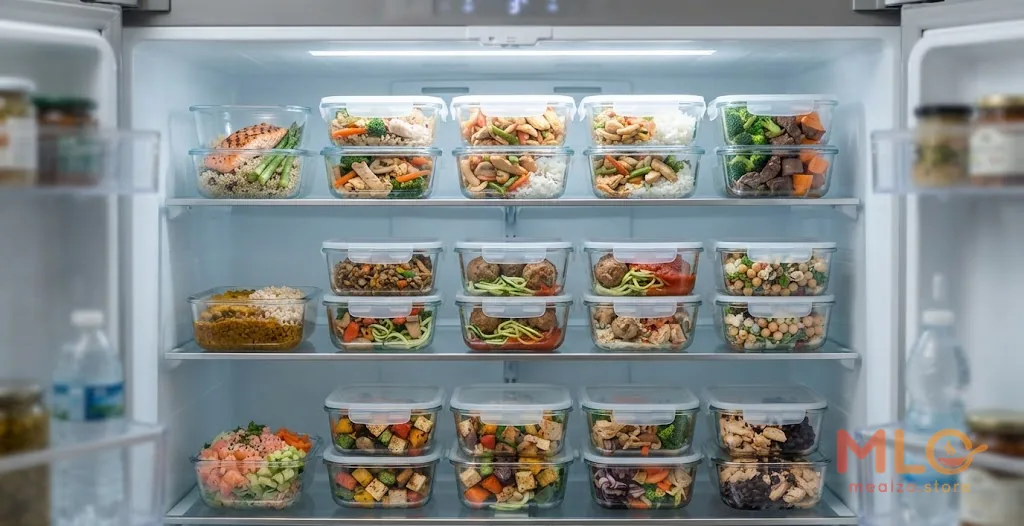
13. When a meal plan does not solve the problem
A meal plan cannot fix every food-related problem.
If you enjoy spontaneous street-food dinners every evening, a fixed plan may feel restrictive. If you travel frequently outside Bangkok, regular delivery may not fit your routine. If your building has no reliable place to receive chilled food, you need to solve the handover issue first.
It also should not be treated as medical treatment. Calorie figures are planning tools, not medical prescriptions. If you have a medical condition, specific dietary requirements or clinical nutrition needs, professional advice may be more appropriate.
The same applies to allergies. Declaring allergens allows the meal assignment mechanism to exclude dishes containing declared allergens, but that should never be interpreted as a guarantee of an allergen-free meal.
A meal plan is simply one logistical tool.
Its value is highest when the recurring problem is the daily decision itself.
14. The simple baseline to keep after day 30
After a month in Bangkok, you should know more about your own routine.
You will know whether you actually eat breakfast. You will know whether heat reduces your appetite. You will probably have discovered which foods are easy to find near your home and work. You will also have a better idea of how often convenience food becomes the default.
Keep the parts that work.
A practical baseline might include:
- A reliable breakfast option.
- A predictable weekday lunch.
- Water as the default drink.
- A small number of easy meals for days when cooking is unrealistic.
- A realistic grocery budget that distinguishes local and imported products.
- A plan for busy evenings.
- A sensible approach to Thai spice.
- A defined place to receive and store food.
If your first month has shown that you repeatedly fail at planning meals, a structured service may be worth considering. If you enjoy shopping, cooking and eating spontaneously, it may not.
The point is not to eat exactly the same way every day. It is to stop every meal from becoming a decision made at the last possible moment.
If a structured routine fits your first month, you can view the available meal plans and decide whether one suits your schedule and budget.
FAQ
Is Bangkok food expensive for someone who has just moved here?
It can be inexpensive if you eat mostly local food, particularly from everyday Thai restaurants and markets. Costs rise when you rely heavily on imported groceries, international restaurants or frequent convenience purchases. Your food budget depends heavily on which of these habits becomes your default.
Is cooking in a Bangkok condo practical?
It can be, but the kitchen may limit what is realistic. Many condos have an induction hob, microwave and small refrigerator, while oven space and ventilation can be limited. Simple meals are usually easier to maintain than elaborate cooking routines.
How spicy should I order Thai food as a newcomer?
Start with "mai phet" if you are uncertain about your tolerance. You can gradually increase the level of chilli as you become more comfortable. There is no reason to force yourself to eat food that is painfully spicy.
Does Mealzo Bangkok offer only Thai food?
No. Every plan uses one mixed cuisine, combining Thai and international dishes. There is no separate choice between Thai-only and international-only cuisine.
What delivery options does Mealzo Bangkok have?
There are two delivery windows: 06:00-09:00 in the morning and 17:00-20:00 in the evening. The customer chooses one. The practical requirement is having someone or an agreed location available to receive the delivery.
Is a meal plan cheaper than eating street food?
Not necessarily. A meal plan can cost more than inexpensive street food. Its main benefit is structure: meals are planned in advance, reducing the daily effort of deciding what to eat. If minimum food spending is your only priority, local food may be cheaper.
Mealzo Bangkok is a kitchen and meal delivery service operating exclusively in Bangkok, Thailand. We are not affiliated with similarly named services outside Thailand.
Know someone who'd like Mealzo?
If you know someone in Bangkok who might enjoy Mealzo Bangkok, you can share it with them through our referral programme.